

PODS by PEI
PODS by PEI is a podcast initiative of Policy Entrepreneurs Inc., a policy research center based in Kathmandu, that examines the state of Nepali politics, economy, and development and seeks to inform and enrich Nepal’s policy discourse. Every month, PODS by PEI brings to you thoughtful and in-depth discussions that will take you deep into the most pertinent issues in Nepal.

Set Into Motion: A Revived Youth Civil Society in Post-Gen Z Nepal
8 September 2025 marked a defining rupture in Nepal's recent political history—a youth-led flash mobilization that challenged not only the state but also the very grammar of political participation. After suddenly finding themselves at the center of a political rupture—one that opened up unprecedented space to represent a broader public mandate—Nepali youth were thrust into roles they had litt...
After the Verdict: How Might the Rastriya Swatantra Party Govern?
The 2026 "March 5th Verdict" has reset the Nepali political landscape. With the traditional establishment pushed aside, the Rastriya Swatantra Party (RSP) now holds a near two-thirds majority. But the real question is no longer about the win—it's about the work. In this episode, Nirjan Rai (Principal Advisor, PEI) and Saumitra Neupane (Executive Director, PEI) sit down with writer an...
Beyond the Ballot Box: Alok Bohara on Nepal’s Gen Z Movement and Why Institutions Matter
In this episode of PODS by PEI, Professor Alok Bohara joins PEI's Nirjan Rai and Saumitra Neupane to look past the March 5th polling numbers and examine the systemic decay of Nepal’s democratic guardrails. We dive deep into why Nepal’s institutions have collapsed three times since 1990 and how the current Gen Z movement is acting as a decentralized catalyst for institutional reform. From the &...
Sagar Prasai on Small States in the New World Disorder
Is the "Liberal World Order" officially over? 🌏 In the season premiere of PODS by PEI , we dive deep into the seismic shifts of global geopolitics. As the "America First" doctrine evolves into what some call the "Donroe Doctrine," small states like Nepal find themselves navigating a "New World Disorder" where traditional safety nets are being dismantled. Ou...
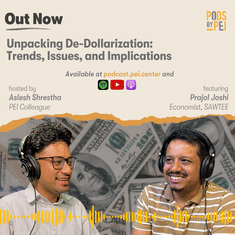
Prajol Joshi on Unpacking De-Dollarization: Trends, Issues, and Implications
In this episode, Aslesh and Prajol discuss is the dominance of the U.S. dollar and the emerging trend of de-dollarization. Prajwal traces the dollar’s rise to the 1944 Bretton Woods Agreement and its enduring role in global trade, finance, and reserves. They discuss why countries are now seeking alternatives, mainly to reduce vulnerability to U.S. sanctions—and note signs of gradual change such as...

Dr Buddha Basnyat on Poor Man’s Disease: The Persistent Challenge of Tuberculosis in Nepal
In this episode, Ben and Buddha discuss infectious diseases in Nepal, focusing on tuberculosis (TB). They highlight Nepal's epidemiological shift from to non-communicable diseases, while noting that TB continues to disproportionately affect poor and vulnerable populations, framing it as a “poor man’s disease” shaped by poverty. Despite effective, low-cost preventative therapies and lessons fro...
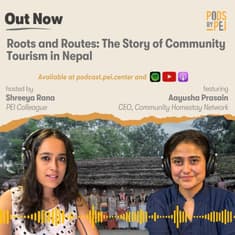
Aayusha Prasain on Roots and Routes: The Story of Community Tourism in Nepal
In this episode, Shreeya and Aayusha explore how community-led tourism is reshaping Nepal's travel landscape, from its roots in Sirubari village to a growing national network. Aayusha shares how homestays empower women, preserve culture, and create sustainable livelihoods. They discuss the operational model, economic impact, and challenges of scaling, offering insight into how authentic, local...
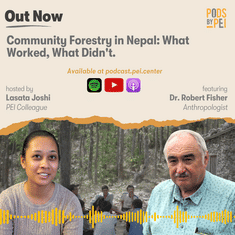
Robert Fisher on Community Forestry in Nepal: What Worked, What Didn't
In this episode, Lasata and Robert discuss Nepal's globally praised community forestry model. Unpacking its evolution from early experiments with user groups to the 1991 political revolution and 1993 legislation, they discuss how local communities learn to govern forests and explore transferability as global interests in the model rise. They also investigate tensions around inclusion, power, and d...
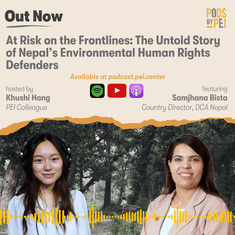
Samjhana Bista on At Risk on the Frontlines: The Untold Story of Nepal’s Environmental Human Rights Defenders
In this episode, Khushi and Samjhana spotlight the often-unseen struggles and strengths of Environmental Human Rights Defenders (EHRDs): community activists at the forefront of resisting environmental harm and advocating for human rights. They unpack the multifaceted challenges EHRDs face, from threats by powerful actors to the weight of social barriers. They explore gaps in national policy, the c...

Project Sambaad Bhaag Dui: New World Disorder: Trading Realities in an Uncertain and Mercurial Period
In this sambaad, Madhu Raman Acharya , Shiv Raj Bhatt , Kshitiz Daha l, and host Dikshya Singh explore Nepal’s evolving trade landscape—its participation in multilateral, regional, and bilateral frameworks, and why the country has yet to fully leverage these arrangements. Despite benefits like duty-free market access through its LDC status, Nepal faces challenges in integrating into regional value...