
#Ep.102
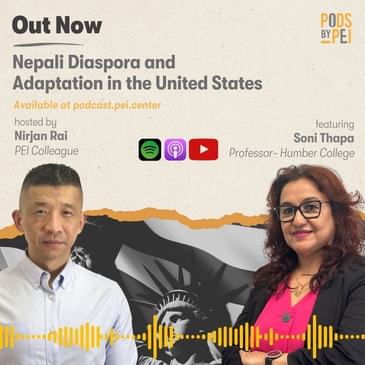
Soni Thapa, a professor at Humber College in Toronto, holds a PhD in Sociology and an MA in Women's Studies. Her research focuses on gender equality, violence against women, race, ethnicity, and immigration. She recently published "The Nepalese Diaspora and Adaptation in the United States" in the Journal of Genealogy (2024). Soni is the executive director of a non-profit empowering rural women in Nepal and president of the Nepali Women's Global Network, USA.
Nirjan and Soni explore the history and current status of the Nepali diaspora in the U.S. They detail migration trends and community categories, examining cultural, structural, marital, identificational, and receptional adaptation. They highlight key findings from Soni’s study and discuss future research recommendations for better understanding and tapping into the potential of the Nepali diaspora.
If you liked the episode, hear more from us through our free newsletter services, PEI Substack: Of Policies and Politics, and click here to support us on Patreon!!
[00:00:00] Namaste and welcome to PODS by PEI, a policy discussion series brought to you by Policy Entrepreneurs Inc. My name is Khushi Hang and in today's episode, PEI's Nirjan Rai is in conversation with Professor Soni Thapa on the Nepali Diaspora and Adaptation in the United States.
[00:00:29] Soni Thapa is a professor at Humber College in Toronto and holds a PhD in Sociology and an MA in Women's Studies. Her research focuses on gender equality, violence against women, race, ethnicity and immigration. She recently published the Nepalese Diaspora and Adaptation in the United States in the
[00:00:47] Journal of Genealogy 2024. Soni is the executive director of a non-profit empowering rural women in Nepal and also the president of the Nepali Women's Global Network USA. Nirjan and Soni explore the history and current status of the Nepali diaspora in the U.S.
[00:01:04] They detail migration trends and community categories examining cultural, structural, marital, identifiable and receptional adaptation. They highlight key findings from Soni's study and discuss future research directions and recommendations for effectively tapping into the potential of the Nepali diaspora. We hope you enjoy the conversation. Hello, this is Nirjan Rai.
[00:01:30] Hello, this is Soni Thapa. Welcome to PODS by PEI, Soni. Shall we dive right into our conversation? Sure. So, we are here today to discuss the Nepali diaspora in the United States based on your recent publication, The Nepalese Diaspora and their Adaptation in the United States.
[00:01:49] Let's begin our conversation with a bit of a background. So can you tell us how you ended up with this particular topic for your study? Well, thank you for the questions. So as a researcher finding a topic that truly captivates you and identifying a gap
[00:02:03] in the existing literature can be a daunting task. However, in my case, the choice was clear. I wanted to do a study on the Nepalese diaspora, a topic that I felt a personal connection and was deeply passionate about.
[00:02:19] So when it was time to choose a topic for my PhD, I noticed a significant gap in the existing literature. Many studies were focused on well-established immigrant communities, which left a void in our understanding of the unique challenges and opportunities faced by newer immigrants groups like the Nepalese.
[00:02:40] In addition, during my grad schools, I observed the rapid growth of the Nepali community in the U.S. marked by influx of Nepali international students and a green car lottery holders. At the time I was in Dallas, so I saw a massive growth of Nepalese.
[00:03:00] So these observations, a couple with my academic course on race, ethnicity and immigrations, lead me to a question. How do Nepalese adapt to American society? So my decision to study the Nepali diaspora was influenced not only by the
[00:03:16] community's significant growth, but also by a profound sense of duty as a social researcher. So I felt strong obligations to address the gap in the existing literature and to delve into the experience of Nepalese diaspora, a subject that I believe had been overlooked by other scholars.
[00:03:37] So before I delve further into this study, I would like to express my deep gratitude to my PhD dissertation advisor, Dr. Philipp Yang. His unwavering guidance and support were instrumental in making this study of our Nepalese diaspora possible.
[00:03:56] So more than a decade later, we collaborated to publish my original study, which shows that more research is needed to fill in the existing literature in the Nepalese diaspora community. I think that is how we end up having this conversation as well. That's great to hear, Soni.
[00:04:11] So let's dive into your paper. And since this is, as you noted, it is an academic undertaking, I think there are a few foundational elements that we should address. So first, let's talk about the theoretical framework. Here, you start by rejecting the classical assimilation theory.
[00:04:31] Can you briefly explain this theory and your rationale for rejecting it? And while you're at it, you could perhaps also discuss the other theories you considered and explain why you ultimately decided to go with. So over the past few decades, scholars have proposed several theoretical
[00:04:47] frameworks to explain the immigrants' adjustment in American society. The best known framework is the classical assimilation theory, developed by the Chicago School of Sociology in the 1930s. And according to Robert A. Park, in the classical assimilation theory, the race relation cycles undergoes four stages, contact, competition,
[00:05:11] accommodations and assimilation. Beyond Park's well-known race relation cycle, Milton Gordon's, seven stages of assimilation theory describes a more detailed process. The first stage is cultural or behavioural assimilation, which we also call culture relations, where immigrants adjust to the dominant culture by adopting its values and behaviour, often relinquishing
[00:05:38] their own religious belief and observance. So the second stage, structural assimilation, allows immigrants to enter the social network and institutions of the host society at the primary group labour. Third, marital assimilation, which we also call amalgamations.
[00:05:56] So Gordon was saying there will be a large scale of interracial marriage. Fourth, identification assimilation entails developing a sense of people who would base exclusively on the host society. How would you like to identify? The fifth attitude, reception assimilation, consists of the
[00:06:14] absence of prejudice and sixth, behavioural reception assimilation encompasses the absence of discrimination. So seventh is the civic assimilation, where immigrants typically participate in the new country's political and civic life, like becoming more aware about the politics of that particular country, right, including voting, joining community organisation
[00:06:35] and engaging in public affairs. So all of these Gordon's assimilation theory is like immigrants going to assimilate into the host society. So we are talking about these things pre-1965, like who came to the United States,
[00:06:50] why it is possible for them to assimilate is mostly the Europeans and all. It's easy for them to assimilate, particularly for the second generations because biologically they are white. For us, it's difficult because our biological composition,
[00:07:04] we are always brown, we're going to be brown for I don't know how many generations. So in addition to these stages, he also discussed two other theories. One is melting pot and other is cultural pluralism. Let's talk about what is melting pot theory.
[00:07:20] So the melting pot theory says that immigrants group distinct identities and culture blend with the dominant culture. All of those stages that we talked about comes under this umbrella as well. So we become just like the dominant culture. So ultimately forming a unified cultural identity that is Americanization.
[00:07:40] In contrast, cultural pluralism promotes the preservation of diverse cultures, belief and practices within the host society, arguing that immigrants partially assimilate into the dominant culture while maintaining aspect of their ethnic heritage. So the classic assimilation theories came under scrutiny
[00:07:59] with the arrival of the second wave of immigration to the United States after 1965, which primarily included Asian, Latin Americans and Caribbean blacks and any other racial minorities, non-European let's say. So this shift marked a departure from the predominantly European immigrants to more diverse non-European groups.
[00:08:21] The period from the World War I to the World War II also saw a decline in the jail of Americanization and assimilation. So challenging the classical theory, Richard and Alba proposed the new assimilation theory, addressing the experience of the post-1965.
[00:08:39] This theory suggests that assimilation is a multi-dimensional process that can occur across various aspects such as socioeconomic status, cultural practices and social interaction. So they argued that assimilation is a universal outcome that can occur at a different rates within existing ethnic groups operating on multiple levels.
[00:09:00] Another significant challenge to the classical assimilation theories, segmented assimilation theory proposed by Porter and Minjoo. They argued that second generation immigrants face challenges adapting to American culture resulting in segmented assimilation. This theory suggests that assimilation outcomes vary based on the segment of the society
[00:09:22] in which they wanted to assimilate. So in a sense, the assimilation theory has evolved significantly over time, especially with the influx of increasing diverse immigrant groups to the United States after 1965. This evolution demands a more thorough comprehensive analysis of the assimilation process. Although we reference for my study,
[00:09:48] Milton Goz's Five Stages of Assimilation, it is crucial to acknowledge that Nepalese experiences did not precisely conform to Gordon's depiction of complete assimilation. Instead, Nepalese adopted these five dimensions, a concept I will explore later in our discussion. Moreover, the theory of cultural pluralism, which Gordon later introduced,
[00:10:14] effectively encapsulates the adaptation process I witnessed within the Nepalese diaspora experiences. Okay, so what I get from you, from the theoretical part, is that in difference to classical assimilation theory where there is a linear path to assimilation and to the culture of the whole society,
[00:10:35] when we examine the data, that does not hold true, right? And in this line, you make an important distinction between adaptation and assimilation. Could you explain the difference between the two and why it was important for you to discuss adaptation rather than assimilation?
[00:10:51] Yeah, you raise a really good point that there is not a linear assimilation. That's what we see in our Nepali diaspora as well, right? So we have just discussed how the assimilation theory has transformed from 1930s until 1965 and 1965 to present. So the Landmark Immigration Reform Act
[00:11:11] abolished the national origin quota system that heavily favored the Northern and Western European immigrants. Instead, the act established a new system based on the family reunification and skilled labor, opening the doors to increase immigration from Asia, Latin America, Caribbean or Africa and other places.
[00:11:30] So assimilation in American society has always been under scrutiny. In the discourse of assimilation, while some proclaim that assimilation is dead, others argue that it remains very much alive in the United States. As we have seen, the old theory of assimilation has been criticized by several scholars.
[00:11:52] Hence, in this study on the Nepalese diaspora, I aim to examine both historical and contemporary debates and obstacles surrounding the immigrant assimilation. So in this study, I use the term adaptations to describe how foreign-born Nepalese immigrants adjust to their whole society.
[00:12:14] I prefer adaptation because it does not apply to one-way absorption into the dominant culture or suggests the cultural superiority of the whole society unlike the old assimilation theoretical framework. So adaptation has a different connotation as opposed to the old assimilation theory. So adaptations encompasses numerous dimensions
[00:12:39] and in this study, I examined cultural, structural, marital, identifiable and receptional adaptation among Nepali individuals in America. So contrary to the notion of complete assimilation proposed by the old assimilation theory where immigrants are expected to relinquish their culture identity to conform to the host country,
[00:13:02] the Nepalese do not undergo such a process of melting into the host culture. By focusing on adaptation rather than assimilation, my study seeks to provide a more detailed understanding of the Nepalese diaspora experience in the United States. As a relatively new immigrants group,
[00:13:21] the Nepalese in America provides a rare opportunity to set lights on whether and what extent new immigrants group differ from the older immigrants group in the scope of adaptation, multiculturalism and transnationalism. Those are some fascinating points and like you said, we'll dive into the specifics of these adaptations
[00:13:42] with regard to the Nepali diaspora in the US in a later session. One more question before we wrap up this segment. We all know that no discussion on an academic paper is complete without addressing the methodology and its limitations. So could you briefly explain how you went about
[00:13:57] doing your research and highlight any limitation that we should be aware of? The lack of research on the adaptation of Nepalese immigrants in the United States really necessitates a systematic empirical study. So I used primary and secondary data. The secondary data on the trend of Nepalese immigrations
[00:14:19] to the United States comes from the Office of Immigration statistics of the US citizen and immigration services now within the US Department of Homeland Security. Likewise, the Airbooks of Immigration statistics provided information on the number and types of Nepalese immigrants. And primary data collected through an online survey
[00:14:40] conducted in 2010, the survey targeted foreign-born Nepalese 18 years or older living in the US at the time, including both immigrants and non-immigrants with a relatively permanent address. The non-immigrants are the temporary workers with H1B visas, international students, and asylees. They are likely to become a permanent residence
[00:15:09] and undergo the adaptation process because they will be there more than four, five years. To collect my primary data, I took help from the 18 Nepalese organizations in the USA plus my personal network. After three rounds of detail and reminders, 768 valid questionnaire were completed and I used convenience sampling.
[00:15:31] And it's not possible to do random sampling when we don't have a sampling frame at all. So far, this is the largest data of Nepalese conducted in the US even after 10, 12 years. Let's look at the demographics. What kind of people did participate in my study?
[00:15:51] The average age of respondents upon entering the USA was 24 years. 59% of the respondents were male and 41% were female. 57% of respondents were the US citizens or permanent residents. On average, respondents had lived in the United States for approximately nine years. The average educational attainment
[00:16:16] was slightly above a bachelor's degree with about four years of education completed in the US. And also I wanted to clarify something like here in my publication, I only had descriptive statistics. I only look at how Nepalese adapt to American society. But if you look at my dissertation,
[00:16:33] those who are interested, you can also see what factors contribute, age, gender, level of education, all of those things are there. I also did regressions and all. But there are always limitations when you conduct a study. So while the study has significant achievements over existing scholarship,
[00:16:53] it is important to acknowledge the limitation that this particular study has. First is I have already said there's a non-random sampling and it's not possible to do random sampling as well. So there is exclusion of certain group of people because the study was conducted in English
[00:17:09] and it was conducted online. And the survey was conducted in 2010. So for some people, they might say it's outdated. But when we don't have a study, I don't consider it as outdated. And since many respondents belong to a Nepalese organization in the United States,
[00:17:25] the result may only reflect the experience of the Nepalese who are a part of that particular organization. Yeah, so despite the constraint, despite the limitations, this comprehensive survey presents a valuable opportunity to explore the adaptation of foreign-born first generation Nepalese in the U.S.,
[00:17:44] a topic that has not been addressed elsewhere for a decade. So with that out of the way, now let's get into painting a picture of what the Nepali diaspora in the U.S. actually looks like, right? So can you give us a quick overview
[00:17:57] of what the official data says? Maybe you can begin by telling us about when and how the migration started, the trend in numbers, and you mentioned some of the experiences, especially when compared to similar other migrant groups in the U.S. First, I will just briefly talk about
[00:18:15] some of the statistics and later lay out some categories also, like who came under what category. So first let me just briefly talk about a little bit of statistics and something, just like just painting a picture of the Nepali diaspora.
[00:18:31] So when compared to the Nepalese diaspora around the globe, the Nepalese diaspora in the U.S. ranks one of the largest and is growing. So since early U.S. immigration data grouped Nepal into the other Asia category before the 1950s, there is little definitive evidence
[00:18:51] of Nepalese immigrant in the U.S. before the 1950s. Nonetheless, until 1947, Nepalese could not come to the United States due to Nepal's restriction policy or diplomatic relationship between United States and Nepal. So interestingly, the recorded Nepalese immigration to the U.S. began in 1956 with only one Nepalese immigrant,
[00:19:17] and that's the record shows. From 1956 to 1967, fewer than 10 Nepalese came to the United States. So the number of Nepalese immigrants was less than 100 until 1987. From 1988 to 2001, the number of Nepalese immigrants began to increase surpassing 100 annually, but not reaching 1000. After the 2000 era, immigration from Nepal surged dramatically. Between 2000 and 2022,
[00:19:50] 167,000 Nepalese immigrants arrived in the U.S. So overall, from 1956 to 2022, we have 107,296 Lepnis have immigrated to the United States. That's the official data. We have more than that. So according to unofficial estimation, there are approximately 600,000 to 800,000 Nepalese live in the United States.
[00:20:21] Hi there, this is Kushy from Policy Entrepreneurs, Inc. We hope you're enjoying Pods by PEI. As you know, creating the show takes a lot of time and resources, and we rely on the support of our community to keep things going. If you've been enjoying the show
[00:20:36] and would like to help us out, we'd really appreciate it if you could become a patron on Patreon. Patreon is a platform that allows listeners like you to support creators like us with a small monthly donation. Your support will go a long way
[00:20:49] in helping us to continue creating high quality content for you. So if you're interested in supporting our show and becoming a part of our community, head on over to Patreon and become a patron today. You can find us at patreon.com slash pods by PEI.
[00:21:04] Every little bit helps, and we can't thank you enough for your support. Now let's get back to the episode. So if you were to dig a little deeper, I guess the way to do it, as you mentioned earlier, would be to categorize depending on
[00:21:22] how they immigrated to the U.S., right? So you have, like I said, the DV program, the refugees and the asylees. Can you give us an insight into each of these types or categories of Nepali diaspora in the U.S.? Maybe give some statistics
[00:21:36] and also some of their defining characters. Okay, so from the initial influx of professional in the 50s to the later waves prompted by geopolitical upheavals in the 2000, Nepalese immigrants have navigated diverse pathways to come to the USA. So I'm going to talk about the different categories
[00:21:55] based on that. The first one is the diversity visa program. So the diversity visa program introduced in the 1990s aims to diversify the immigrant population by allowing individuals from countries with historically low immigration rates in the United States to obtain a permanent residence.
[00:22:17] And within that category, Nepal definitely falls in. Since 2000, Nepalese immigration to the United States has experienced significant growth, primarily attributed to this DV visa. So Nepalese DV immigrants shows from 104 in 2000 to 2,894 in 2022. So notably between 2013 and 2018, over 3,000 Nepalese immigrants arrive annually by the DV program.
[00:22:44] Throughout the 21st century, 46,321 Nepalese immigrants enter the U.S. through the DV program. This constitutes approximately 28% of all Nepalese immigrants. So this DV initiative has played a pivotal role in bringing more diverse group of people in the United States. So, and it's eligible criteria is you have
[00:23:09] to have a high school diploma or two years of work experience. So the diversity visa has brought a diversity among our population as well. Initially we have mostly, we came for higher education and now we started seeing diversity in our community as well.
[00:23:24] Another category that we talked about is refugee and asylee. The federal refugee resettlement program that was introduced in 1980, it resettled about 300 million refugees in the United States. So within that category, we also fall in the number of Nepalese immigrants who obtain a permanent residency
[00:23:45] by adjusting their status as a refugees and asylees increased significantly after 2010. In particular, in the decades of the 2010s, 44,327 Nepalese refugees and asylees gained permanent residence. The spike in number is due to the political turmoil resulting from the mass government conflict that we had between 1996 to 2006.
[00:24:10] So the political instability drove many Nepalese to exist the country and seek refuge in the United States. So in 2010, we saw 3093 refugees and asylee getting permanent residency. Between 2011 and 2015, more than 5,000 refugees, asylees seekers received permanent residency each year. By 2022, we have 50,631 refugees and asylum seekers
[00:24:40] who had obtained a permanent residency in the United States. Yeah, here I was quite intrigued by the data because the number goes over 3000, right? Around 2010. Now in Nepal, we're already in the post-conflict era and busy drafting a new constitution and the number even peaks at around 6000, 2013.
[00:25:04] What explains this? Is it because of the processing time it takes or did you have an idea of this lag? So I think in my opinion, one of the reasons is it takes such a long time for asylee to get the permanent residence.
[00:25:21] So you can see the gaps and then you see how long they have waited. Yeah, okay. Well, we can carry on. So family unit response unification is another category. So since 2000, 46,393 Nepalese have been admitted through the family sponsor preference and immediate relatives of US citizens category.
[00:25:47] So another one is employment preferences. So we have 24,222 individuals gaining admission to the employment related channel. And these are the people who came as an employee and they got the permanent residence over here. So another one is international student. While international students are not classified
[00:26:09] as immigrant, they constitute a significant source of future immigration. Many Nepalese students pursuing higher education in the US transition to the immigration status, securing employment after graduation. And there is a significant number that have come so far in the United States is like 216,975 between 1995 to 2023.
[00:26:36] Nepal is the highest center of international student to the United States. So that also contributes to the- One of the highest, it would be not the highest, but one of the top 10, right? 11th. 11th, okay. Yeah, 11th, yeah. So that has been there for the longest time.
[00:26:55] And another category is temporary protected status, TPS we call it, right? So following the devastating earthquake in Nepal in 2015, the Department of Homeland Security granted TPS to 14,477 Nepali individuals. So allowing them to remain in the United States due to the ongoing situation in Nepal.
[00:27:17] And then they will perhaps take the pathways to getting residency and all. And another thing I wanted to talk about is like when we are talking about Nepali population in the US, I also don't wanna forget about the Nepalese migrant entering from the US border.
[00:27:37] One lesser known route involves Nepalese immigrants taking entry through the land route facilitated by human traffickers. They call it tollo bato. It involves a large amount of money extortion, a difficult and lengthy journey, and no guarantee that they will reach to the United States. Yeah, that's an interesting-
[00:27:56] These are all, they would all be undocumented, right? Do we have- Yeah, they are all documented. An estimate, a guesstimate of what numbers we're talking about. I don't have any numbers, but there are some deportations going on. So I don't have any numbers,
[00:28:11] but we will get the number one day. And their experiences in terms of adaptation to the US culture and everything. We've been completely different to rest of the groups that we're talking about. Different, yes, yes, yes. Okay, so let's shift into the specifics
[00:28:25] of your research on how the Nepali diaspora is adapting to the host culture of the US. And here, I think it makes sense to go through each of the five dimensions, right? Of the adaptation that you discussed. So do you wanna start with cultural adaptation?
[00:28:40] So I wanted to bring back Gordon and my framework, and I'll talk about where does it fit in, right? So Gordon's culture assimilation is the relinquence of the immigrants' traditional way of life, norms, belief, religions, all of those things, and they become American, right? We define cultural adaptation
[00:28:58] as adjustment to the host society culture. So to measure the cultural adaptation of the Nepalese in the United States, the survey asked the responder whether they celebrate Hindu festivals, whether they celebrate American holidays, how often they attend Hindu religious services, how often they attend Nepalese functions,
[00:29:16] what do they cook at home, what kind of language do they speak, and what language do they speak with their children? Because these all are indicators of cultural adaptation. So the finding shows that the significant portion of Nepalese immigrants participate in both Hindu festivals,
[00:29:35] 95%, and American holidays, which is 92%. So you see over here cultural adaptations, right? They are celebrating their own culture. At the same time, they are also participating in the host country's festivals and holidays. So Nepali remain the primary language spoken at home with the children.
[00:29:58] Respondent tend to attend Hindu services slightly more than several times a year, all of those things comes, and Nepali are cooking food at home two, three times a month. And in terms of language, most respondents use Nepali as the primary language at home with the children.
[00:30:20] So when considering cultural adaptation, this results reveals partial assimilation to American culture and partial retention of ethnic culture among the Nepalese in the US. Yeah, well, yeah, this one seemed quite obvious because it's the first generation, it's a fairly recent migration to the US.
[00:30:37] So that's, yeah, but interesting point that you raised. You want to move on to the next dimension, structural adaptation? So structural adaptation, according to Gordon, refers to gaining interest in the clique, clubs, and institutions of the host society at the primary level.
[00:30:53] However, I believe it should not be limited to the primary group labor and should be extended to the institutional label. Right? So I use the eight indicators to major structural adaptation. The survey asks the Nepalese respondent whether they hesitate to interact
[00:31:11] with members of other racial or social groups, who are their best friends, who they were mostly associated with, who they mostly work with in the workplace, that's also important, and what kind of neighborhood they live in. If they had a membership in Nepalese organization,
[00:31:29] say in a South Asian organization or in American organization. So what did the respondent say? Merely 8% of the respondent expressed hesitant in interacting with other racial group. It is not surprising that 72% of the respondent primarily socialize with other Nepalese. Regarding work interactions, respondent mostly collaborated with whites,
[00:31:51] I mean based on my data, 75%, followed by other Asians. Nepalese individuals predominantly reside in neighborhood where they interact with whites. So this particular group of people that have studied, 75% live in a white neighborhood and other in Asian, like 25% in other Asian or Hispanic neighborhood.
[00:32:12] Additionally, over half of the respondent were member of the Nepalese organizations. While only 14% were affiliated with American organizations or 13% were part of Asian organizations. This results indicate a high degree of ethnic retention but some partial assimilation in structural adaptation among the Nepalese in the US.
[00:32:34] Yeah, some of these things were quite, there was like two kinds of categories, like some were surprising answers and some were not. Category of not so surprising was Nepalese have, Nepalese has their closest friends and that most Nepalese socialize among themselves.
[00:32:50] What I was little surprised was two thirds of respondents reported living around and working with white colleagues. I may be relying on anecdotal evidence but that seemed almost reflective of the sample. If you were to do this, if you had a larger sample
[00:33:05] or if you were from a different sample, do you think this would be different? Definitely, this would be different. Like the way I have conducted my studies and also if you look at the education there, I have higher education. The survey was conducted online and in English,
[00:33:19] that could be a factor. And also my network is mostly the friends that I have who are at the university. So that could be a contributing factor. Otherwise you see Nepali these days, I see they are also building their own community.
[00:33:32] Like, you know, neighborhood, they have more Nepali and so dynamics have changed. So we have to do a study in a current era. It's completely different. Okay, thanks for the clarification. Let's move to the next dimension of marital adaptation. So Gordon says that marital assimilation
[00:33:50] is there will be a large scale intermarriage, right? So marital adaptation has three indicators that we asked. Is your spouse Nepali? Hypothetically, if you had a choice, who would you marry? And then have a category like Nepali or different other categories.
[00:34:08] So do you allow children to marry non-Nepalis? So approximately 89% of respondents were married to individuals of like own Nepali descendants. Like only 11% married to non-Nepalis, right? 79% expressed a preference for marrying a Nepali. And the interesting part is over half of the respondent,
[00:34:29] 55% agreed that they would permit their children to marry someone else outside of the Nepali community. So this finding, so there's a high degree of ethnic retention, right? So the first generation Nepali would like to marry their own ethnic group and all.
[00:34:46] But they are open if the children marry to non-Nepalis then. So yeah. What surprised me was that only half of the respondents directly stated that they would allow their children to marry a non-Nepali because, this is an interesting question because it talks about two different generations.
[00:35:03] Like, so one is a generation that grew up in Nepal and the next generation who will have completely grown up in the American culture, right? In the US. And how these two generations interact with and expect from each other. And I have kids of my own
[00:35:18] and I doubt I can have any influence on what the next generation says, right? So I found that interesting that only half said, oh yeah, I'll allow them to marry a non-Nepali. But I digress. Let's come back to your paper and the issue of identifications adaptation.
[00:35:34] So according to Gordon, identification assimilation involves the development of sense of people who are based exclusively on the whole society. It's like you wanted to identify as American, right? So I define identification adaptation as the development of identity which may include the retention of ethnic identity,
[00:35:54] the development identity based on the whole society or the development of the new identity. So my question is, how do you identify yourself? That is, what do you call yourself? Second question, how close do you feel to your own ethnic group? So the respondents not only identify themselves
[00:36:10] as Nepalese which is 72% but also very close and close to the ethnic group. 96%, about 96% said that they are very close to their ethnic group and 72% say they wanted to identify as Nepalese. This results paints a picture of ethnic retention in identification adaptation.
[00:36:31] Respondents here wanted to identify as Nepalese and felt very close to their own ethnic group. So you can see cultural pluralism happening here, retaining our own identity more so than assimilating into the host country's identity. Very interesting. And one of the things that's recurring
[00:36:50] at least to me when I'm reading this is the whole second generation, kids that grew up completely in America. And from what I've seen so far, I expect a huge spike in the Nepali-American category if you were to include them
[00:37:06] or if you were to do research on them, right? Would you have thoughts on that? Yeah, yeah. They might choose Nepali-Americans and maybe not because I also see that now that things have changed like for the last 10, 12 years, those kids who have grown
[00:37:20] and also see these youth are really connected with the Nepali root and all. It's like when they are growing up, they were a little hesitant, right? About their culture and all of this. Now they have grown up, I see they are okay with being American, being Nepali.
[00:37:36] I see them really participating in a conversation, attending conferences, really wanting to know about Nepal. So it's mixed. And would be better if we do the empirical study. Right, right, definitely. All right, so let's get to the final dimension, receptional adaptation. According to Gordon,
[00:37:54] receptional assimilation means the absence of prejudice. And behavior, receptional assimilation means the absence of discrimination. So I use a reception adaptations to measure whether or not the Nepalese in the US experience prejudice and discrimination. The survey asks, how well do you think the US government has treated you?
[00:38:14] Have you been discriminated against because of your ethnicity in the United States? Have you ever been excluded socially from your coworkers? Have you ever been discriminated against buying or renting house? So there are several categories. I don't want to get into the detail,
[00:38:28] but the findings is on average, respondents reported feeling treated well by the US government. They experienced ethnic discrimination between neighbor and sometimes. And additionally, respondents reported almost never feeling excluded from their coworker or nearly never experienced discrimination in housing. However, Nepalese individuals
[00:38:49] did encounter prejudice in the United States like I said earlier. They felt judged based on their appearances. They were perceived as less competent by individuals from other race between neighbor to sometimes. This result shows that Nepalese had mixed experience of prejudice and discrimination. Yeah.
[00:39:07] And to end this segment, I have one final question. So if you were to put all of these various dimensions of adaptations by the Nepali diaspora in the US together, what would you say would be your say two to three overarching takeaways for our listeners?
[00:39:25] The main takeaways from all these dimensions of adaptation are that it challenges the classical assimilation theory and the melting pot theory as it fails to fully encapsulate the adaptation trajectory of Nepalese immigrant in the United States. This study suggests that cultural imperialism best captures the adaptation experiences
[00:39:45] of Nepalese in the USA. First generation Nepalese immigrants express a strong identification with their Nepalese ethnicity and maintain close ties with their own ethnic group. Right? The finding also reveals that Nepalese individuals have partially assimilated into the American culture and still having a strong ties
[00:40:07] with their own ethnic culture, association, identities, and marital partners. I mean, I'm talking about the first generations. That is an excellent point. So moving forward, looking forward, what are some further questions you would like to explore or recommend future researchers to investigate about
[00:40:27] the Nepali diaspora in the US or elsewhere? Yeah, that's a good question. That I was also thinking not only in the US because Nepali diaspora has grown in Australia, in Canada where I live. So Canada, Australia, we have to do a research on that.
[00:40:46] So future study, like just looking at the dimension that I talk about, we can look at those kinds of dimensions. We can have a more on that. There are so many areas to look at. So we need a research in a Nepali diaspora wherever, right? Wherever we are.
[00:41:03] So the more reverse data that offers a conclusive generalizability of the findings is important. We have to avoid selection bias. We have to incorporate as many people as possible. So given the importance of diversity within the Nepalese community, future studies should be conduct in both English and Nepali
[00:41:26] and should not be limited only on online service. So that's why we see some kind of discrepancies over here based on our personal experiences and what you have seen. There is also an urgency to research Bhutanese Nepali refugees. Another important thing, and we've been talking about that,
[00:41:41] what about the second generation? Because we have a second generation, the children with us. So when we are talking about ourselves, what about them, right? This study is registered to the first generation immigrants. It is high time we survey the second generations. I have lived in North America
[00:41:58] for the last more than 22 years, and I have seen the second generation immigrant adjust to this whole country with their language fluency. We see like they don't have a problem like us because English is second language for the first generations. They have a language fluency.
[00:42:16] They have a better education. They have a better job because first generation, we really invest our own children. We wanted to have them better education, better universities and all of those things. But still they are a second generation immigrant children.
[00:42:30] So we have to really tap into their experience as well. How does this generation adapt to US life? How do their adaptation experience differ from their first generation parents, right? So last thing, to understand the lived experiences of the first and second generation Nepalese adding a qualitative analysis,
[00:42:51] either independently or in conjunction with a quantitative study is really, really important. Okay. So that's my take on. All right. Well, that's all from me for today. Is there anything else you'd like to convey to our listeners before we call this a wrap?
[00:43:07] Thank you for the opportunity to share my thoughts on the Nepalese diaspora in the US. I hope this conversation will inspire interest among future researchers, particularly graduate students. As a researcher, one can be constantly looking for a gap in existing literature and there is a significant void
[00:43:28] which we have also seen when in our discussion in his studies on the Nepalese diaspora that is waiting to be explored, whether you're in the US, Canada or Australia, please do research in your own community and see what is happening. Okay. Excellent.
[00:43:44] We've come to the end of our episode. Thank you, Soni for this very insightful conversation and also for accepting our invitation to be part of PODs by PEI. Thank you, Nirjan. And I'm very thankful to you for giving me this opportunity. Thanks for listening to PODs by PEI.
[00:44:03] I hope you enjoyed Nirjan's conversation with Soni on the Nepali diaspora and adaptation in the United States. Today's episode was produced by Nirjan Rai with support from me, Khushi Hang and Videsh Sabkota. The episode was recorded at PEI studio and was edited by Nirjan Rai and Videsh Sabkota.
[00:44:21] Our theme music is courtesy of Roj Shakyo from Zindabad. If you liked today's episode, please subscribe to our podcast. Also, please do us a favor by sharing us on social media and leaving a review on Spotify, Apple Podcasts, Google Podcasts or wherever you listen to the show.
[00:44:37] For PEI's video related content, please search for Policy Entrepreneurs on YouTube. To catch the latest from us on Nepal's policy and politics, please follow us on Twitter at tweet to PEI that's T-W-E-E-T followed by the number two and PEI and on Facebook at Policy Entrepreneurs, Inc.
[00:44:55] You can also visit pei.center to learn more about us. Thanks once again from me, Khushi. We'll see you soon in our next episode.