
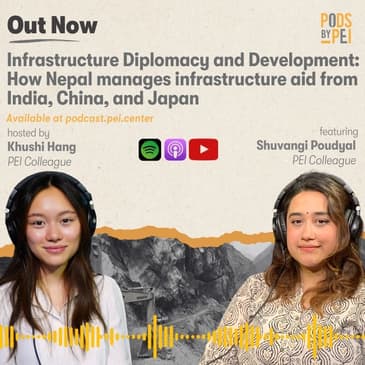
Ep#110 | Infrastructure Diplomacy and Development: How Nepal manages infrastructure aid from India, China, and Japan
In this episode, Shuvangi Poudyal explores infrastructure diplomacy and development: how Nepal manages infrastructure aid from India, China, and Japan . Shuvangi is a public policy researcher based in Kathmandu, with a focus on South Asia geo-economics, regional connectivity, and local governance. As the Program and Outreach Officer at PEI, she contributes to research projects like Infrastructure Diplomacy and RENT, while also coordinating programs and communicating findings through publications and an in-house host at PODS by PEI. She previously worked with Nepal-based think tanks CESIF and Governance Lab. She holds a Master’s in International Relations from the University of Warwick, UK.
Khushi and Shuvangi delve into PEI’s latest publication Of Infrastructure Diplomacy and Development, a comprehensive study that examines the aid dynamics between Nepal and its key partners—India, China, and Japan, and others. A key contributor to the study, Shuvangi provides insights into the geopolitical context shaping Nepal’s infrastructure landscape, the trends in aid and investment, and the public perceptions of different donors. We also explores the distinctions between DAC and non-DAC partners, their environmental and social impacts, and discuss recommendations for the Nepali government on navigating this complex terrain.
If you liked the episode, hear more from us through our free newsletter services, PEI Substack: Of Policies and Politics ( https://policyentre.substack.com/welcome ), and click here ( https://patreon.com/podsbypei ) to support us on Patreon!!
[00:00:13] [SPEAKER_00]: Namaste and welcome to PODS by PEI, a policy discussion series brought to you by Policy
[00:00:18] [SPEAKER_00]: Entrepreneurs Inc.
[00:00:20] [SPEAKER_00]: My name is Khushi and in today's episode I am in conversation with PEI's very own
[00:00:25] [SPEAKER_00]: Shuvangi Poudyal on Infrastructure Diplomacy and Development, how Nepal manages infrastructure
[00:00:31] [SPEAKER_00]: aid from India, China and Japan.
[00:00:35] [SPEAKER_00]: Shuvangi is a public policy researcher based in Kathmandu with a focus on South Asian
[00:00:39] [SPEAKER_00]: geoeconomics, regional connectivity and local governance.
[00:00:43] [SPEAKER_00]: As a programs and outreach officer at PEI, she contributes to research projects like
[00:00:48] [SPEAKER_00]: infrastructure diplomacy and rent, while also coordinating programs and communicating findings
[00:00:54] [SPEAKER_00]: through publications and as an in-house host at PODS by PEI.
[00:00:59] [SPEAKER_00]: Previously she worked with Nepal based think tanks such as SESIF and Governance Lab.
[00:01:04] [SPEAKER_00]: Shuvangi holds a master's degree in International Relations from the University of Warwick.
[00:01:10] [SPEAKER_00]: In this episode, we delve into PEI's latest publication, Off Infrastructure Diplomacy
[00:01:15] [SPEAKER_00]: and Development, a comprehensive study that examines the aid dynamics between Nepal
[00:01:20] [SPEAKER_00]: and its key partners including India, China and Japan and others.
[00:01:25] [SPEAKER_00]: A key contributor to the study, Shuvangi provides insights into the geopolitical
[00:01:30] [SPEAKER_00]: context shaping Nepal's infrastructure landscape, the trends in aid and investment
[00:01:35] [SPEAKER_00]: and the public perceptions of different donors.
[00:01:38] [SPEAKER_00]: We also explore the distinctions between DAC and non-DAC partners, their environmental
[00:01:43] [SPEAKER_00]: and social impacts and discuss recommendations for the Nepali government on navigating this
[00:01:49] [SPEAKER_00]: complex terrain.
[00:01:51] [SPEAKER_00]: Like listening to PODS?
[00:01:52] [SPEAKER_00]: We'd love to hear your thoughts and reviews on Spotify, Apple Podcasts, YouTube
[00:01:57] [SPEAKER_00]: or wherever you listen to the show.
[00:01:59] [SPEAKER_00]: For now, we hope you enjoy the conversation.
[00:02:44] [SPEAKER_00]: Great, so we are here to talk about PEI's latest publication, which is the paper on
[00:02:49] [SPEAKER_00]: Infrastructure Diplomacy.
[00:02:51] [SPEAKER_00]: Now this paper has been more than two years in the making and you and a team of PEI
[00:02:56] [SPEAKER_00]: researchers were a part of it.
[00:02:58] [SPEAKER_00]: Can you introduce the study to our audience and also tell us about the context surrounding
[00:03:03] [SPEAKER_00]: it?
[00:03:03] [SPEAKER_00]: How does a study, based on the study that you have done, help you understand
[00:03:04] [SPEAKER_00]: on Infrastructure Diplomacy come about?
[00:03:07] [SPEAKER_01]: Thank you for your question.
[00:03:09] [SPEAKER_01]: And first of all, I would like to mention and thank my colleagues and co-authors of
[00:03:13] [SPEAKER_01]: the report Nujan Rai on Raghacharya, Somatuniyopani and Srirana for their very
[00:03:18] [SPEAKER_01]: valuable contributions.
[00:03:21] [SPEAKER_01]: Coming into the report, this report examines Nepal's engagement with its major
[00:03:26] [SPEAKER_01]: bilateral donors, India, China and Japan, and some Western donors as well for
[00:03:31] [SPEAKER_01]: infrastructure development in Nepal.
[00:03:33] [SPEAKER_01]: It is positioned between discussions on China's ascendancy and its softball
[00:03:37] [SPEAKER_01]: strategies, and tries to offer a recipient country perspective.
[00:03:43] [SPEAKER_01]: Now Nepal has relied on bilateral and multilateral assistance to address this
[00:03:47] [SPEAKER_01]: report, analyzes each donor's infrastructure aid, highlighting logic
[00:03:51] [SPEAKER_01]: specifics, financing, conditionalities and implementation procedures.
[00:03:56] [SPEAKER_01]: It also tries to provide some observations tailored to each donor country and
[00:04:00] [SPEAKER_01]: relationship, as well as the Nepali perception of their aid, along with
[00:04:05] [SPEAKER_01]: cross-cutting observations on aid and diplomacy characteristics.
[00:04:08] [SPEAKER_01]: The report concludes with some reflections on Nepal's policy discourse
[00:04:12] [SPEAKER_01]: and recommendations for both donors and the Nepali government to maximize
[00:04:17] [SPEAKER_01]: infrastructure diplomacy and development objectives.
[00:04:20] [SPEAKER_01]: Now, the study on Nepal's infrastructure development and diplomacy is
[00:04:24] [SPEAKER_01]: situated within a broader historical and geopolitical context that is
[00:04:28] [SPEAKER_01]: crucial to understand.
[00:04:30] [SPEAKER_01]: For decades, the concept of foreign aid has served a dual purpose, not only to
[00:04:34] [SPEAKER_01]: promote development, but also to increase the political influence of
[00:04:37] [SPEAKER_01]: donor countries.
[00:04:39] [SPEAKER_01]: Now this dynamic has been particularly evident in Nepal's case, as the
[00:04:42] [SPEAKER_01]: country has relied heavily on aid from various bilateral and multilateral
[00:04:46] [SPEAKER_01]: sources to build critical infrastructure projects.
[00:04:49] [SPEAKER_01]: Starting from the 1950s, Nepal has leveraged its relationship with its
[00:04:53] [SPEAKER_01]: neighbors, particularly India and China, to be exact, to secure financing
[00:04:59] [SPEAKER_01]: for major infrastructure initiatives.
[00:05:01] [SPEAKER_01]: India, seeing Nepal's northern Himalayas as an integral part of its
[00:05:05] [SPEAKER_01]: border security, has consistently provided substantial aid as both a
[00:05:09] [SPEAKER_01]: diplomatic tool and as a means to establish political influence in the
[00:05:13] [SPEAKER_01]: region.
[00:05:14] [SPEAKER_01]: Meanwhile, Nepal is also engaged with China as a counterbalance to
[00:05:18] [SPEAKER_01]: India's overwhelming influence, what some Nepalese analysts believe is
[00:05:23] [SPEAKER_01]: India's overwhelming influence.
[00:05:25] [SPEAKER_01]: And using Chinese aid to construct key infrastructure like the road
[00:05:29] [SPEAKER_01]: connecting Kathmandu to the Tibetan border.
[00:05:32] [SPEAKER_01]: However, the landscape of infrastructure financing in Nepal has evolved
[00:05:36] [SPEAKER_01]: significantly over time.
[00:05:38] [SPEAKER_01]: By the 1990s, there was a notable decline in bilateral aid for
[00:05:41] [SPEAKER_01]: Nepal's infrastructure needs as Western donors had pivoted away from
[00:05:45] [SPEAKER_01]: supporting such projects.
[00:05:46] [SPEAKER_01]: This void was then filled by multilateral institutions like the
[00:05:49] [SPEAKER_01]: World Bank and Asian Development Bank.
[00:05:52] [SPEAKER_01]: More recently, there has been a resurgence of interest from bilateral
[00:05:55] [SPEAKER_01]: donors, particularly India and China in financing infrastructure in Nepal.
[00:05:59] [SPEAKER_01]: Now this renewed focus is also part of a larger global trend as China
[00:06:04] [SPEAKER_01]: leverages its rise as a global superpower to project influence through
[00:06:08] [SPEAKER_01]: this infrastructure diplomacy in Nepal and other parts of the world.
[00:06:12] [SPEAKER_01]: While traditional powers like the US and its allies work to
[00:06:14] [SPEAKER_01]: counterbalance India's expanding footprint.
[00:06:17] [SPEAKER_01]: For Nepal, navigating this new era of geopolitical competition has
[00:06:22] [SPEAKER_01]: presented with both opportunities and challenges as it would.
[00:06:27] [SPEAKER_01]: And the country, while the country continues to lead with principles
[00:06:32] [SPEAKER_01]: such as non-alignment and seeking to maintain a delicate balance
[00:06:36] [SPEAKER_01]: between the competing powers, it has become a bit complex because as
[00:06:42] [SPEAKER_01]: constructs of global alignment evolve, Nepal faces the imperative of
[00:06:48] [SPEAKER_01]: enhancing its understanding and updating its engagement strategies to
[00:06:52] [SPEAKER_01]: effectively capitalize on emerging opportunities and things that
[00:06:57] [SPEAKER_01]: serve its own interest.
[00:06:59] [SPEAKER_01]: So I'd say the significance of this study lies in its ability to
[00:07:03] [SPEAKER_01]: provide an objective recipient country perspective on how more
[00:07:06] [SPEAKER_01]: resourceful nations have leveraged aid and infrastructure diplomacy
[00:07:10] [SPEAKER_01]: to influence smaller countries of strategic importance like Nepal.
[00:07:14] [SPEAKER_01]: And by examining Nepal's engagement with its three largest infrastructure
[00:07:18] [SPEAKER_01]: donors, again, India, China and Japan, this offer this report also
[00:07:23] [SPEAKER_01]: offers valuable insights, I believe, for policymakers and researchers
[00:07:27] [SPEAKER_01]: to better understand the complex interplay of infrastructure,
[00:07:31] [SPEAKER_01]: diplomacy and development.
[00:07:33] [SPEAKER_00]: I think that was a really comprehensive background to this
[00:07:38] [SPEAKER_00]: conversation we're having and where this research is situated.
[00:07:43] [SPEAKER_00]: And so zooming into that, like you said, the report examines
[00:07:47] [SPEAKER_00]: India, China and Japan as major infrastructure partners of Nepal.
[00:07:51] [SPEAKER_00]: But it also looks into other partners.
[00:07:54] [SPEAKER_00]: Could you give us an overview of the aid landscape in Nepal?
[00:07:58] [SPEAKER_01]: Right. Like as you said, Nepal's aid landscape is a complex and
[00:08:02] [SPEAKER_01]: dynamic mix of traditional Western donors and emerging powers like
[00:08:07] [SPEAKER_01]: China and India, each with their own priorities and approaches.
[00:08:12] [SPEAKER_01]: Now, traditional Western donors that are primarily members of the
[00:08:15] [SPEAKER_01]: Development Assistance Committee, the DAC, prioritize development
[00:08:19] [SPEAKER_01]: objectives focusing on governance, human rights and climate change.
[00:08:22] [SPEAKER_01]: This is not just in Nepal, but this is the standard elsewhere as
[00:08:27] [SPEAKER_01]: well. And they typically provide a higher percentage of on-budget
[00:08:31] [SPEAKER_01]: aid, giving Nepal more control over fund allocation.
[00:08:34] [SPEAKER_01]: And their aid is often characterized by extensive planning,
[00:08:37] [SPEAKER_01]: negotiation and studies conducted by their agencies.
[00:08:41] [SPEAKER_01]: Grants are limited and they primarily provide highly concessional
[00:08:44] [SPEAKER_01]: loans to promote self-help and recipient country performance.
[00:08:48] [SPEAKER_01]: Japan, a prominent example, provides significant aid through
[00:08:51] [SPEAKER_01]: JICA, J-I-C-A, focusing on hydropower and transportations.
[00:08:57] [SPEAKER_01]: Major projects include Kulekhani hydropower plants, the Sindhuli-Bordibas
[00:09:01] [SPEAKER_01]: Highway and the Melemchi Water Supply Project.
[00:09:04] [SPEAKER_01]: Their aid is generally viewed positively in Nepal, with projects
[00:09:07] [SPEAKER_01]: seen as highly technical and delivered to high standards.
[00:09:11] [SPEAKER_01]: Emerging powers like India and China utilize aid more as a tool
[00:09:15] [SPEAKER_01]: for political influence, often prioritizing diplomatic goals over
[00:09:19] [SPEAKER_01]: development expertise.
[00:09:21] [SPEAKER_01]: They also provide a higher percentage of on-budget aid,
[00:09:24] [SPEAKER_01]: emphasizing South-South cooperation.
[00:09:27] [SPEAKER_01]: India focuses on transportation infrastructure with projects
[00:09:30] [SPEAKER_01]: like the 3-1 Highway and segments of the East-West Highway.
[00:09:34] [SPEAKER_01]: They have also been involved in hydropower projects.
[00:09:37] [SPEAKER_01]: Through these, they have faced challenges due to mistrust and
[00:09:40] [SPEAKER_01]: disagreements, which is a big part of the conversation in Nepal.
[00:09:45] [SPEAKER_01]: Recent focus has been on trade and connectivity infrastructure
[00:09:48] [SPEAKER_01]: projects to enhance regional integration and counter China's influence.
[00:09:53] [SPEAKER_01]: The recently approved MCC project also intends to connect Nepal with India.
[00:10:00] [SPEAKER_01]: China, on the other hand, provides significant funding for infrastructure
[00:10:04] [SPEAKER_01]: projects, including hydropower plants and railway projects.
[00:10:08] [SPEAKER_01]: While projects involve both Chinese and local labor, concerns exist
[00:10:12] [SPEAKER_01]: regarding the treatment and working conditions of Nepali workers.
[00:10:15] [SPEAKER_01]: This is something that has been raised time and again.
[00:10:18] [SPEAKER_01]: Now Nepal faces other challenges, multiple challenges when
[00:10:23] [SPEAKER_01]: navigating this aid landscape.
[00:10:25] [SPEAKER_01]: And there are concerns regarding transparency and accountability in
[00:10:29] [SPEAKER_01]: the use of aid, particularly with non-DAC donors that are typically non-Western donors.
[00:10:35] [SPEAKER_01]: There are also concerns about environmental and social impacts of some projects,
[00:10:38] [SPEAKER_01]: particularly those funded by Chinese companies.
[00:10:42] [SPEAKER_01]: But I'd say overall, the Nepali aid landscape is dynamic.
[00:10:48] [SPEAKER_01]: It is multifaceted.
[00:10:50] [SPEAKER_01]: It has a mix of traditional and emerging donors.
[00:10:54] [SPEAKER_01]: And like I said before, they all have their own priorities and approaches.
[00:10:57] [SPEAKER_01]: And coming back to the report, it emphasizes the need for Nepal to develop a clear strategy
[00:11:04] [SPEAKER_01]: for engaging with its various partners to maximize development benefits and navigate
[00:11:09] [SPEAKER_01]: the challenges of a changing geopolitical landscape rather than the other way around.
[00:11:14] [SPEAKER_00]: Point well noted Shivangi.
[00:11:16] [SPEAKER_00]: One of the other focuses of the study, one of the major focuses of the study is also
[00:11:24] [SPEAKER_00]: exploring the trends in the amount of aid Nepal has received.
[00:11:28] [SPEAKER_00]: Can you elaborate on these trends and also illustrate the key factors that are driving them?
[00:11:36] [SPEAKER_01]: Sure. I mean, like you said, we can understand that there is a shift that Nepal's
[00:11:42] [SPEAKER_01]: aid landscape is undergoing currently.
[00:11:44] [SPEAKER_01]: And we have identified three key trends in this report.
[00:11:48] [SPEAKER_01]: Firstly, I'd say there's a growing reliance on loans instead of grants with loans now
[00:11:54] [SPEAKER_01]: comprising 80 percent of total aid.
[00:11:57] [SPEAKER_01]: This shift creates concerns about debt burdens and potential conditionalities associated
[00:12:02] [SPEAKER_01]: with loans. Nepal's Gautam Buddha International Airport has been a topic of much
[00:12:09] [SPEAKER_01]: debate because of this.
[00:12:11] [SPEAKER_01]: And while loans can provide much needed funding for infrastructure projects, they
[00:12:16] [SPEAKER_01]: also come with the risk of increasing Nepal's debt burden, but potentially limiting its
[00:12:21] [SPEAKER_01]: future development options.
[00:12:22] [SPEAKER_01]: And for a country like Nepal, that can prove to be quite devastating.
[00:12:26] [SPEAKER_01]: And in case of Nepal, we can also see that loan agreements often include conditions
[00:12:31] [SPEAKER_01]: that may affect Nepal's policy choices and economic autonomy.
[00:12:35] [SPEAKER_01]: And that, again, is not a great signal.
[00:12:38] [SPEAKER_01]: Secondly, multilateral institutions like the World Bank and Asian Development Bank
[00:12:42] [SPEAKER_01]: play a significant role in infrastructure development.
[00:12:45] [SPEAKER_01]: They often collaborate with Western donors, the DAC donors.
[00:12:49] [SPEAKER_01]: These institutions bring expertise, financial resources and a focus on development
[00:12:55] [SPEAKER_01]: objectives, contributing to a more coordinated, a more sustainable approach to
[00:13:00] [SPEAKER_01]: infrastructure development in Nepal.
[00:13:02] [SPEAKER_01]: However, it is still important to make sure that these institutions are responsive
[00:13:07] [SPEAKER_01]: to Nepal's specific needs and priorities.
[00:13:10] [SPEAKER_01]: And we don't know if that's exactly what's at play currently.
[00:13:14] [SPEAKER_01]: Finally, the third trend is China and India are expected to dominate infrastructure
[00:13:21] [SPEAKER_01]: diplomacy in Nepal, with India aiming to regain influence in South Asia and China
[00:13:26] [SPEAKER_01]: cautiously engaging while considering the issue of Tibet, which remains sensitive.
[00:13:31] [SPEAKER_01]: This creates a geopolitical dynamic where Nepal must carefully navigate and tread in
[00:13:37] [SPEAKER_01]: its relationships with these powerful nations.
[00:13:40] [SPEAKER_01]: Again, there is a need for Nepal to balance its development needs with its
[00:13:43] [SPEAKER_01]: strategic interests, ensuring that its engagement with China and India does not
[00:13:47] [SPEAKER_01]: compromise its sovereignty or autonomy.
[00:13:50] [SPEAKER_01]: So I'd say this requires a careful diplomacy and a clear understanding of the
[00:13:54] [SPEAKER_01]: motivations and interests of each donor.
[00:13:58] [SPEAKER_00]: I think one of the merits of this paper is that there is a holistic
[00:14:01] [SPEAKER_00]: investigation of this topic, infrastructure diplomacy.
[00:14:05] [SPEAKER_00]: And this includes a very intriguing exploration of general perceptions towards
[00:14:10] [SPEAKER_00]: aid and its different sources.
[00:14:11] [SPEAKER_00]: What were some of the key insights the report uncovered regarding the
[00:14:16] [SPEAKER_00]: perception of Indian, Chinese and Japanese aid in Nepal?
[00:14:20] [SPEAKER_01]: Yeah, I mean, it is a complex situation.
[00:14:24] [SPEAKER_01]: And let's start with India.
[00:14:26] [SPEAKER_01]: India and Nepal have had a long intertwined history.
[00:14:29] [SPEAKER_01]: We can't emphasize this enough.
[00:14:31] [SPEAKER_01]: And India's influence is deeply embedded in Nepal's everyday life, from trade
[00:14:35] [SPEAKER_01]: to cultural exchanges. It's everywhere.
[00:14:37] [SPEAKER_01]: This close proximity has also created a sense of anxiety, however,
[00:14:41] [SPEAKER_01]: among Nepalese.
[00:14:43] [SPEAKER_01]: There's a deep-seated fear rooted in historical realities that India
[00:14:48] [SPEAKER_01]: interferes in Nepal's internal affairs.
[00:14:50] [SPEAKER_01]: This perception of interference, especially in sectors like hydropower, has
[00:14:55] [SPEAKER_01]: led to a lot of skepticism towards India's intentions.
[00:14:59] [SPEAKER_01]: The economic blockade of 2015 really brought this tension to the forefront,
[00:15:04] [SPEAKER_01]: I'd say. It had a devastating impact on Nepal's economy and solidified
[00:15:08] [SPEAKER_01]: perception of India as a controlling neighbor.
[00:15:12] [SPEAKER_01]: And this was right after Nepal was reeling from the earthquakes,
[00:15:16] [SPEAKER_01]: the 2015 earthquakes.
[00:15:18] [SPEAKER_01]: The way India, Indian aid is managed with the Ministry of
[00:15:21] [SPEAKER_01]: External Affairs of India overseeing everything, further reinforces
[00:15:25] [SPEAKER_01]: this perception.
[00:15:26] [SPEAKER_01]: MEA's involvement in every project driven by India's national security
[00:15:30] [SPEAKER_01]: and developmental priorities is seen by many in Nepal as yet another
[00:15:34] [SPEAKER_01]: layer of control rather than genuine support.
[00:15:37] [SPEAKER_01]: Initiatives like the HICDP are even seen as tools for Indian
[00:15:43] [SPEAKER_01]: influence, further fueling the belief that aid is used for political
[00:15:47] [SPEAKER_01]: leverage rather than sincere assistance.
[00:15:50] [SPEAKER_01]: It is a catch-22 situation of sorts because while India has made
[00:15:55] [SPEAKER_01]: significant contribution to Nepal's development, the perception of its
[00:15:58] [SPEAKER_01]: foreign policy characterized by interference and regional hegemony
[00:16:03] [SPEAKER_01]: overshadows these positive contributions.
[00:16:05] [SPEAKER_01]: Many in India express frustration over what they perceive as Nepalian
[00:16:10] [SPEAKER_01]: gratitude, but it is often overlooked.
[00:16:14] [SPEAKER_01]: The deeper undercurrents of mistrust and the need for transparency
[00:16:18] [SPEAKER_01]: and respect for Nepal's autonomy is often overlooked in these
[00:16:20] [SPEAKER_01]: conversations.
[00:16:22] [SPEAKER_01]: So this dissonance further, I guess, demonstrates the broader
[00:16:25] [SPEAKER_01]: challenges in India's neighborhood policy and its ability to build
[00:16:30] [SPEAKER_01]: trust and support with its neighbors.
[00:16:33] [SPEAKER_01]: Coming to China next.
[00:16:35] [SPEAKER_01]: I mean, I think Nepal's view of Chinese aid is very much tied to its
[00:16:38] [SPEAKER_01]: perception of China as a whole.
[00:16:41] [SPEAKER_01]: Nepal, Nepalese, a lot of Nepalese view China as a counterweight
[00:16:46] [SPEAKER_01]: to India, a strategy crucial for its survival.
[00:16:50] [SPEAKER_01]: They admire China's economic growth and hope to benefit from it.
[00:16:54] [SPEAKER_01]: Plus, with China being a close neighbor, they're eager to leverage
[00:16:56] [SPEAKER_01]: that power.
[00:16:57] [SPEAKER_01]: Some even see China's strategy as similar to the US.
[00:17:01] [SPEAKER_01]: Big both big players trying to influence the world.
[00:17:05] [SPEAKER_01]: All of this makes Nepal open to China's gestures of goodwill,
[00:17:09] [SPEAKER_01]: like infrastructure aid, and they want to keep good relationships,
[00:17:12] [SPEAKER_01]: good relationship with China.
[00:17:14] [SPEAKER_01]: But again, there are complexities to this.
[00:17:17] [SPEAKER_01]: Experts are aware of the sensitive issue of Tibet,
[00:17:20] [SPEAKER_01]: which is a big part of the China-Nepal relationship.
[00:17:23] [SPEAKER_01]: And China has managed to get Nepal to take a stronger stance
[00:17:26] [SPEAKER_01]: against those who support Tibet, which has raised concerns
[00:17:29] [SPEAKER_01]: about restrictions on demonstrations and monitoring of the Tibetan
[00:17:33] [SPEAKER_01]: community here in Nepal.
[00:17:35] [SPEAKER_01]: And with the US-China rivalry growing, Nepal's importance
[00:17:38] [SPEAKER_01]: to China's security is becoming more apparent.
[00:17:42] [SPEAKER_01]: On a local level, people are aware of Chinese projects,
[00:17:45] [SPEAKER_01]: but they don't fully understand how they're implemented.
[00:17:48] [SPEAKER_01]: While they generally see China as a friendly neighbor
[00:17:51] [SPEAKER_01]: and appreciate the professionalism of Chinese workers,
[00:17:54] [SPEAKER_01]: there's also frustration that local communities don't benefit enough.
[00:17:57] [SPEAKER_01]: They feel like political leaders are getting the most out of these projects
[00:18:00] [SPEAKER_01]: and that Chinese companies aren't engaging with the local communities.
[00:18:04] [SPEAKER_01]: Some analysts have also raised concerns about corruption in Chinese aid.
[00:18:09] [SPEAKER_01]: It's not unique to Nepal, but controversies around certain projects
[00:18:12] [SPEAKER_01]: have fueled this perception.
[00:18:14] [SPEAKER_01]: However, proving corruption is tough
[00:18:16] [SPEAKER_01]: and pre-existing biases can influence how people see these things.
[00:18:21] [SPEAKER_01]: And also, corruption is a big problem in Nepal itself,
[00:18:24] [SPEAKER_01]: which might encourage more corrupt interactions.
[00:18:26] [SPEAKER_01]: I mean, we shouldn't really be surprised about this.
[00:18:29] [SPEAKER_01]: But we shouldn't also ignore the corruption and we need solid evidence
[00:18:34] [SPEAKER_01]: before we make such strong claims.
[00:18:36] [SPEAKER_01]: Ultimately, I'd say there's a lot of interest in promoting
[00:18:39] [SPEAKER_01]: the idea of China's increasing involvement in Nepal.
[00:18:42] [SPEAKER_01]: It makes Nepal look like it's important on the world stage
[00:18:45] [SPEAKER_01]: and shows that China is a supportive ally.
[00:18:48] [SPEAKER_01]: For India, it highlights China's growing influence.
[00:18:51] [SPEAKER_01]: And for China, it's a chance to show itself as a global superpower.
[00:18:54] [SPEAKER_01]: But the real extent of China's interest in Nepal is up for debate.
[00:18:59] [SPEAKER_01]: With all this uncertainty, Nepal risks making foreign policy decisions
[00:19:03] [SPEAKER_01]: that might not actually benefit its people.
[00:19:08] [SPEAKER_01]: Lastly, Japan.
[00:19:09] [SPEAKER_01]: You know, the general perception of Japanese aid in Nepal
[00:19:13] [SPEAKER_01]: is actually quite positive.
[00:19:15] [SPEAKER_01]: People here really appreciate the high technical standards
[00:19:18] [SPEAKER_01]: and quality of Japanese products.
[00:19:19] [SPEAKER_01]: It's almost like the Japanese have a reputation for doing the right things,
[00:19:23] [SPEAKER_01]: which has even shaped how Nepali officials view them.
[00:19:27] [SPEAKER_01]: They feel less of a need to negotiate because they trust the Japanese to deliver.
[00:19:31] [SPEAKER_01]: A report even by the Japan's Ministry of Foreign Affairs
[00:19:34] [SPEAKER_01]: has highlighted this sentiment.
[00:19:36] [SPEAKER_01]: It said that Japan has built a relationship of trust with Nepal
[00:19:39] [SPEAKER_01]: through years of assistance without any historical baggage or hidden agendas.
[00:19:44] [SPEAKER_01]: Nepalese don't see Japan as trying to influence them politically through their aid.
[00:19:48] [SPEAKER_01]: Plus, the Japanese brand is known for its quality.
[00:19:51] [SPEAKER_01]: Take the Kathmandu walk the road, for example.
[00:19:54] [SPEAKER_01]: Even though it was a short stretch, it was built to such a high standard
[00:19:57] [SPEAKER_01]: with smooth traffic flow and it received tons of praise from both citizens
[00:20:02] [SPEAKER_01]: and officials. But there's a catch.
[00:20:05] [SPEAKER_01]: This emphasis on high quality comes with a high price tag.
[00:20:08] [SPEAKER_01]: And recently, Nepal asked Jaiika for help expanding a road stretch.
[00:20:13] [SPEAKER_01]: But Jaiika's solution involved building two tunnels,
[00:20:15] [SPEAKER_01]: which would have been extremely expensive.
[00:20:18] [SPEAKER_01]: The government just couldn't afford it.
[00:20:19] [SPEAKER_01]: And after some back and forth, Jaiika decided to pull out.
[00:20:22] [SPEAKER_01]: So Nepal ended up having to fund the project themselves.
[00:20:25] [SPEAKER_01]: It seems like sometimes the quality comes at a cost that Nepal can't always handle.
[00:20:30] [SPEAKER_00]: I think it's really interesting to see how historical events
[00:20:34] [SPEAKER_00]: and relationships shape these perceptions.
[00:20:37] [SPEAKER_00]: But at the same time, infrastructural diplomacy,
[00:20:41] [SPEAKER_00]: I think this is where we can see it in action,
[00:20:43] [SPEAKER_00]: how the general public is perceiving it,
[00:20:46] [SPEAKER_00]: which takes me to my follow up question,
[00:20:48] [SPEAKER_00]: which is why did this study regard it important to explore
[00:20:53] [SPEAKER_00]: this aspect of the issue?
[00:20:56] [SPEAKER_00]: Because like I hinted before,
[00:20:59] [SPEAKER_00]: general public perception isn't something that is covered
[00:21:02] [SPEAKER_00]: in a technical study like this.
[00:21:06] [SPEAKER_01]: Right. Well, let's think of it this way.
[00:21:09] [SPEAKER_01]: Imagine you're giving somebody a gift, but they don't like it.
[00:21:12] [SPEAKER_01]: They might even feel insulted by the gift.
[00:21:14] [SPEAKER_01]: That gift wouldn't be very useful, right?
[00:21:16] [SPEAKER_01]: So it's the same thing with aid.
[00:21:18] [SPEAKER_01]: If people don't see it as helpful or feel resentful about it,
[00:21:22] [SPEAKER_01]: it's not going to be very effective.
[00:21:25] [SPEAKER_01]: So studying the perception of aid is like
[00:21:29] [SPEAKER_01]: seeing if they actually like the gift that you're giving them.
[00:21:32] [SPEAKER_01]: It helps understand if the aid is actually meeting their needs
[00:21:36] [SPEAKER_01]: and if it is being used in a way that benefits them.
[00:21:39] [SPEAKER_01]: It also helps us figure out if there are any problems
[00:21:42] [SPEAKER_01]: with how the aid is being delivered,
[00:21:44] [SPEAKER_01]: like if it's not transparent or if it's not reaching the people
[00:21:47] [SPEAKER_01]: who need it the most.
[00:21:49] [SPEAKER_01]: If we know how people feel about aid,
[00:21:51] [SPEAKER_01]: we can make sure that it's actually helpful and build trust
[00:21:54] [SPEAKER_01]: between countries that are involved.
[00:21:56] [SPEAKER_01]: It becomes very important for foreign policy as well.
[00:21:59] [SPEAKER_01]: It's all about making sure that the aid is a positive thing
[00:22:01] [SPEAKER_01]: for everyone involved and not just a one sided transaction.
[00:22:06] [SPEAKER_00]: Moving forward, Shubhangi, in the report,
[00:22:08] [SPEAKER_00]: there's also special attention paid to the distinctions
[00:22:11] [SPEAKER_00]: between DAC and non-DAC partners of Nepal.
[00:22:14] [SPEAKER_00]: What were the main observations here?
[00:22:17] [SPEAKER_01]: Yeah, well, in Nepal, aid from DAC donors, partners,
[00:22:22] [SPEAKER_01]: primarily Western countries,
[00:22:24] [SPEAKER_01]: differs a bit from non-DAC donors like India and China.
[00:22:28] [SPEAKER_01]: While non-DAC donors use aid to exert political influence
[00:22:32] [SPEAKER_01]: like I mentioned before,
[00:22:34] [SPEAKER_01]: DAC donors focus on development objectives.
[00:22:37] [SPEAKER_01]: Indian aid is, like I said before,
[00:22:39] [SPEAKER_01]: managed by the Ministry of External Affairs,
[00:22:42] [SPEAKER_01]: potentially prioritizing diplomatic goals
[00:22:44] [SPEAKER_01]: over development expertise.
[00:22:46] [SPEAKER_01]: Chinese aid is managed by various agencies
[00:22:48] [SPEAKER_01]: with unclear coordination.
[00:22:51] [SPEAKER_01]: Non-DAC donors provide a higher percentage
[00:22:53] [SPEAKER_01]: of on budget aid to Nepal,
[00:22:55] [SPEAKER_01]: giving the country more control over fund allocation
[00:22:57] [SPEAKER_01]: like I also mentioned before.
[00:22:59] [SPEAKER_01]: But Western donors prioritize governance,
[00:23:01] [SPEAKER_01]: human rights and climate change
[00:23:03] [SPEAKER_01]: while China and India emphasize South and South cooperation.
[00:23:07] [SPEAKER_01]: Environmental and social standards in Nepal
[00:23:09] [SPEAKER_01]: is yet another complex issue
[00:23:11] [SPEAKER_01]: because Chinese companies often face criticism
[00:23:14] [SPEAKER_01]: for prioritizing rapid execution
[00:23:17] [SPEAKER_01]: over long-term sustainability and neglecting assessments.
[00:23:21] [SPEAKER_01]: There are concerns about limited engagement
[00:23:22] [SPEAKER_01]: with local communities or stakeholder management struggles
[00:23:26] [SPEAKER_01]: and a lack of consideration
[00:23:28] [SPEAKER_01]: for environmental and social requirements.
[00:23:31] [SPEAKER_01]: However, despite these allegations,
[00:23:32] [SPEAKER_01]: there is little evidence to be found
[00:23:34] [SPEAKER_01]: of their neglectful environmental practices
[00:23:36] [SPEAKER_01]: in Nepal at least,
[00:23:38] [SPEAKER_01]: even in comparison to the rest of the partners.
[00:23:41] [SPEAKER_01]: Donors like India and Japan
[00:23:42] [SPEAKER_01]: while relying on the Nepali government's executing agency
[00:23:45] [SPEAKER_01]: also face criticism regarding the quality of assessments
[00:23:48] [SPEAKER_01]: and delays in project development.
[00:23:52] [SPEAKER_01]: The future of aid in Nepal shows a shift towards loan
[00:23:56] [SPEAKER_01]: instead of grants, like I said.
[00:23:59] [SPEAKER_01]: And multilateral institutions like the World Bank
[00:24:02] [SPEAKER_01]: and Asian Development Bank
[00:24:03] [SPEAKER_01]: play a significant role in infrastructure development
[00:24:05] [SPEAKER_01]: while Western donors coordinate with them more closely
[00:24:09] [SPEAKER_01]: than Chinese and Indian donors.
[00:24:12] [SPEAKER_01]: Yeah, so it is again crucial for Nepal
[00:24:15] [SPEAKER_01]: to reevaluate its foreign policy principles,
[00:24:19] [SPEAKER_01]: engage in public policy discourse
[00:24:21] [SPEAKER_01]: and navigate these challenges and opportunities
[00:24:23] [SPEAKER_01]: presented by our changing geopolitical dynamic.
[00:24:27] [SPEAKER_00]: I think it's the perfect segue that you talk about
[00:24:29] [SPEAKER_00]: the future of aid in Nepal
[00:24:31] [SPEAKER_00]: because we've come to the end of the episode
[00:24:35] [SPEAKER_00]: and based on the study,
[00:24:37] [SPEAKER_00]: it's now time to talk about some of the key recommendations
[00:24:39] [SPEAKER_00]: that you have for the Nepali government.
[00:24:41] [SPEAKER_00]: And this is in terms of navigating the aid landscape,
[00:24:44] [SPEAKER_00]: exploring new avenues and negotiating
[00:24:47] [SPEAKER_00]: or implementing projects
[00:24:49] [SPEAKER_00]: while considering the geopolitical factors.
[00:24:51] [SPEAKER_01]: Wow, thank you for very clearly
[00:24:53] [SPEAKER_01]: laying out that question for me
[00:24:56] [SPEAKER_01]: because Nepal's journey towards sustainable development,
[00:25:00] [SPEAKER_01]: according to this report,
[00:25:02] [SPEAKER_01]: hinges on its ability to navigate the complex
[00:25:05] [SPEAKER_01]: and evolving landscape of foreign aid,
[00:25:07] [SPEAKER_01]: like I've been reiterating throughout this episode.
[00:25:10] [SPEAKER_01]: This report highlights the need for both
[00:25:12] [SPEAKER_01]: the Nepali government and donor countries
[00:25:14] [SPEAKER_01]: to adopt a more strategic
[00:25:15] [SPEAKER_01]: but more importantly collaborative approach.
[00:25:19] [SPEAKER_01]: For the Nepali government,
[00:25:20] [SPEAKER_01]: this means taking a proactive stance.
[00:25:22] [SPEAKER_01]: Firstly, it must cultivate a deeper understanding of aid,
[00:25:25] [SPEAKER_01]: recognizing its dynamic nature
[00:25:27] [SPEAKER_01]: and motivations of various donors.
[00:25:30] [SPEAKER_01]: This requires a comprehensive analysis
[00:25:31] [SPEAKER_01]: on the Nepal government side
[00:25:34] [SPEAKER_01]: of the changing aid paradigms,
[00:25:36] [SPEAKER_01]: a spectrum of opportunities presented
[00:25:38] [SPEAKER_01]: and the geopolitical factors
[00:25:40] [SPEAKER_01]: then shaping this landscape.
[00:25:42] [SPEAKER_01]: The government should leverage
[00:25:43] [SPEAKER_01]: its own research institutions.
[00:25:45] [SPEAKER_01]: Secondly, Nepal needs to capitalize
[00:25:47] [SPEAKER_01]: on new and emerging opportunities.
[00:25:49] [SPEAKER_01]: The increasing competition among donors
[00:25:52] [SPEAKER_01]: with initiatives like BRI, BIMSTEC, Global Gateway,
[00:25:55] [SPEAKER_01]: it provides us with a unique advantage.
[00:25:58] [SPEAKER_01]: The government must analyze the offerings of each donor,
[00:26:01] [SPEAKER_01]: identify those most relevant to its needs
[00:26:03] [SPEAKER_01]: and determine which option then aligns best
[00:26:06] [SPEAKER_01]: with Nepal's national goals.
[00:26:08] [SPEAKER_01]: This requires a thorough understanding
[00:26:10] [SPEAKER_01]: of the shift of aid landscape
[00:26:12] [SPEAKER_01]: and a strategic approach on Nepal's side
[00:26:14] [SPEAKER_01]: to maximizing its benefits from foreign aid.
[00:26:19] [SPEAKER_01]: Thirdly, Nepal must build capacity
[00:26:22] [SPEAKER_01]: to negotiate and implement projects effectively.
[00:26:25] [SPEAKER_01]: This seems to be something that we were very good
[00:26:28] [SPEAKER_01]: in the past but have since faltered from recently.
[00:26:33] [SPEAKER_01]: So this building of capacity
[00:26:35] [SPEAKER_01]: involves strengthening coordination among ministries,
[00:26:38] [SPEAKER_01]: particularly finance, foreign affairs
[00:26:40] [SPEAKER_01]: and relevant line of ministries
[00:26:42] [SPEAKER_01]: to devise a cohesive, well-rounded strategy
[00:26:45] [SPEAKER_01]: during aid negotiations.
[00:26:47] [SPEAKER_01]: Furthermore, Nepal needs to address
[00:26:49] [SPEAKER_01]: its weak absorptive capacity
[00:26:51] [SPEAKER_01]: by improving planning, procurement and project management
[00:26:55] [SPEAKER_01]: to ensure timely completion and project outcomes.
[00:26:58] [SPEAKER_01]: Finally, the Nepali government should prioritize
[00:27:00] [SPEAKER_01]: a clear and consistent foreign policy strategy.
[00:27:03] [SPEAKER_01]: I cannot stress that enough.
[00:27:05] [SPEAKER_01]: We need to find a foreign policy strategy
[00:27:07] [SPEAKER_01]: that genuinely balances Nepal's development needs
[00:27:10] [SPEAKER_01]: with its strategic interests.
[00:27:12] [SPEAKER_01]: We talk about this time and again
[00:27:14] [SPEAKER_01]: but somehow have not been able to find that sweet spot.
[00:27:17] [SPEAKER_01]: So I'd say this would include navigating
[00:27:20] [SPEAKER_01]: the geopolitical dynamics of its relationship
[00:27:22] [SPEAKER_01]: with China and India,
[00:27:24] [SPEAKER_01]: ensuring its engagement with these powerful neighbors
[00:27:26] [SPEAKER_01]: does not compromise on its sovereignty and autonomy.
[00:27:30] [SPEAKER_01]: And Nepal must also address concerns
[00:27:32] [SPEAKER_01]: about transparency and accountability,
[00:27:35] [SPEAKER_01]: strengthen environmental and social impact assessment
[00:27:37] [SPEAKER_01]: and promote meaningful engagement with local communities.
[00:27:40] [SPEAKER_01]: It should be a Nepalese undertaking.
[00:27:45] [SPEAKER_01]: We shouldn't expect that from our donors or our partners.
[00:27:50] [SPEAKER_01]: But on the other hand, for donor governments,
[00:27:52] [SPEAKER_01]: I'd say their approach must shift a bit
[00:27:57] [SPEAKER_01]: from steering to supporting Nepal's development.
[00:28:00] [SPEAKER_01]: It should be recognized by our partners
[00:28:03] [SPEAKER_01]: that Nepal's foreign policy reflects its historical context
[00:28:06] [SPEAKER_01]: and its desire to balance its relationships
[00:28:08] [SPEAKER_01]: with its immediate neighbors for foremost.
[00:28:11] [SPEAKER_01]: Instead of trying to influence Nepal
[00:28:12] [SPEAKER_01]: to choose sides in a geopolitical game,
[00:28:16] [SPEAKER_01]: donors should support Nepal
[00:28:17] [SPEAKER_01]: in maximizing the available opportunities from our partners.
[00:28:21] [SPEAKER_01]: This means offering choices and allowing Nepal
[00:28:23] [SPEAKER_01]: to pursue its own strategic autonomy.
[00:28:26] [SPEAKER_01]: Furthermore, I think donor government should invest
[00:28:28] [SPEAKER_01]: in strengthening Nepal's media and civil society.
[00:28:33] [SPEAKER_01]: These institutions play a crucial role
[00:28:35] [SPEAKER_01]: in fostering informed public discourse,
[00:28:37] [SPEAKER_01]: promoting transparency and accountability
[00:28:39] [SPEAKER_01]: and ensuring that aid projects are implemented effectively.
[00:28:43] [SPEAKER_01]: Look at us, that is exactly what we're trying to do
[00:28:45] [SPEAKER_01]: right now.
[00:28:46] [SPEAKER_01]: By supporting a strong media and civil society,
[00:28:49] [SPEAKER_01]: donor governments can contribute to a more robust
[00:28:52] [SPEAKER_01]: and accountable aid landscape in Nepal.
[00:28:54] [SPEAKER_01]: I truly believe that.
[00:28:56] [SPEAKER_01]: And by embracing these recommendations,
[00:28:59] [SPEAKER_01]: I believe both Nepali government
[00:29:00] [SPEAKER_01]: and donor partner countries can foster
[00:29:03] [SPEAKER_01]: a more collaborative and mutually beneficial relationship.
[00:29:06] [SPEAKER_01]: Again, with the goal of contributing to Nepal's
[00:29:09] [SPEAKER_01]: sustainable development and promoting a more stable
[00:29:12] [SPEAKER_01]: and prosperous region.
[00:29:13] [SPEAKER_01]: I'll stop there.
[00:29:15] [SPEAKER_00]: And that brings us to the end of this conversation
[00:29:18] [SPEAKER_00]: which was so jam packed with information.
[00:29:20] [SPEAKER_00]: Thank you so much, Shivangi.
[00:29:21] [SPEAKER_00]: You were articulate and so refined as always.
[00:29:24] [SPEAKER_00]: Thank you so much for being here with us.
[00:29:25] [SPEAKER_01]: Thank you for creating such a comfortable environment
[00:29:27] [SPEAKER_01]: for me, Kushy.
[00:29:28] [SPEAKER_01]: I really had fun.
[00:29:29] [SPEAKER_01]: Thank you.
[00:29:33] [SPEAKER_00]: Thanks for listening to Pods by PEI.
[00:29:35] [SPEAKER_00]: I hope you enjoyed my conversation with Shivangi
[00:29:37] [SPEAKER_00]: on infrastructure diplomacy and development.
[00:29:40] [SPEAKER_00]: How Nepal manages infrastructure aid
[00:29:42] [SPEAKER_00]: from China, India and Japan.
[00:29:45] [SPEAKER_00]: Today's episode was produced by Niranjana Rai
[00:29:47] [SPEAKER_00]: with support from Ridesh Sabkota,
[00:29:49] [SPEAKER_00]: Pibhuti Bhatta and me, Kushy Han.
[00:29:52] [SPEAKER_00]: The episode was recorded at PEI studio
[00:29:54] [SPEAKER_00]: and was edited by Ridesh Sabkota.
[00:29:57] [SPEAKER_00]: Our theme music is courtesy of Rohit Shakya
[00:30:00] [SPEAKER_00]: from Zindabad.
[00:30:01] [SPEAKER_00]: If you liked today's episode,
[00:30:03] [SPEAKER_00]: please subscribe to our podcast.
[00:30:04] [SPEAKER_00]: Also, please do us a favor by sharing us on social media
[00:30:08] [SPEAKER_00]: and leaving a review on Spotify, Apple podcasts,
[00:30:12] [SPEAKER_00]: Google podcasts or wherever you listen to the show.
[00:30:15] [SPEAKER_00]: For PEI's video related content,
[00:30:17] [SPEAKER_00]: please search for policy entrepreneurs on YouTube.
[00:30:21] [SPEAKER_00]: To catch the latest from us
[00:30:22] [SPEAKER_00]: on Nepal's policy and politics,
[00:30:24] [SPEAKER_00]: please follow us on Twitter at tweet2pei.
[00:30:27] [SPEAKER_00]: That's T-W-E-E-T followed by the number two, N-P-E-I.
[00:30:32] [SPEAKER_00]: And on Facebook at policy entrepreneurs, Inc.
[00:30:35] [SPEAKER_00]: You can also visit pei.center to learn more about us.
[00:30:39] [SPEAKER_00]: Thanks once again from me, Kushy.
[00:30:41] [SPEAKER_00]: We will see you soon in our next episode.