
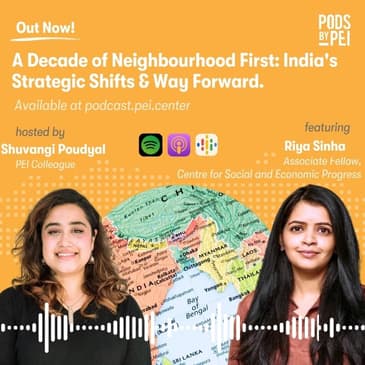
Riya Sinha on a Decade of Neighborhood First: India's Strategic Shifts & Way Forward | PODS by PEI
Riya Sinha on a Decade of Neighborhood First: India's Strategic Shifts & Way Forward | Riya Sinha is an Associate Fellow at the Centre for Social and Economic Progress (CSEP) in New Delhi, where she coordinates the Sambandh Regional Connectivity Initiative and co-manages the Sambandh Policy Dialogue. Her research focuses on regional economic connectivity in South Asia, covering trade, logistics, infrastructure, and border management. In 2022, she was a Visiting Fellow at the Stimson Center in Washington DC and a Fellow at the Asian Forum on Global Governance. Previously, Riya worked at the Bureau of Research on Industry and Economic Fundamentals (BRIEF), conducting research on regional trade, supply chains, and trade facilitation.
Shuvangi and Riya reflect on a decade of India's 'Neighbourhood First' policy since its inception in 2014. They discuss India's initial focus, strategic adjustments in response to China's Belt and Road Initiative, and regional expectations for enhanced connectivity and cooperation, including the potential revival of SAARC. Riya highlights new connectivity projects with the Middle East and Europe, economic cooperation with Nepal, especially in the energy sector, and collaborative initiatives with the U.S. She advocates for prioritizing funds and manpower for India's neighbors to achieve its 'Vishwa Guru' ambitions and emphasizes incorporating a feminist dimension into the policy.
If you liked the episode, hear more from us through our free newsletter services, PEI Substack: Of Policies and Politics, and click here to support us on Patreon!!
[00:00:00] Namaste and welcome to PODS by PEI, a policy discussion series brought to you by Policy
[00:00:18] Entrepreneurs Inc.
[00:00:19] I am Prakat Karki.
[00:00:21] In today's episode, PEI colleague Subhangi Pawdal is in conversation with Rhea Sinha
[00:00:27] on a decade of neighborhood-first India's strategic shift and way forward.
[00:00:32] Rhea Sinha is an associate fellow at the Center for Social and Economic Progress in
[00:00:37] New Delhi, where she coordinates the Sambandh Regional Connectivity Initiative and co-manages
[00:00:44] the Sambandh Policy Dialogue.
[00:00:46] Her research focuses on regional economic connectivity in South Asia covering trade,
[00:00:51] logistic, infrastructure and border management.
[00:00:54] In 2022, she was a visiting fellow at the Stimson Center in Washington DC and a fellow
[00:01:01] at the Asian Forum on Global Governance.
[00:01:04] Previously, Rhea Sinha worked at the Bureau of Research on Industry and Economic Fundamentals,
[00:01:10] conducting research on regional trade, supply chain and trade facilitation.
[00:01:15] Subhangi and Rhea reflect on a decade of India's neighborhood-first policy since its
[00:01:20] inception in 2014.
[00:01:22] They discuss India's initial focus, strategic adjustment in response to China Belt and
[00:01:28] Road Initiative and regional expectations for enhancing connectivity and cooperation,
[00:01:34] including the potential revival of shark.
[00:01:36] Rhea highlights the new connectivity projects with the Middle East and Europe, economic
[00:01:41] cooperation with Nepal, especially in the energy sector, and collaborative initiatives
[00:01:47] with the U.S.
[00:01:49] She advocates for prioritizing funds and manpower for India's neighbors to achieve
[00:01:54] It's Vishwa Guru ambition and emphasizes in incorporating a feminist dimension into
[00:02:00] the policy.
[00:02:01] We hope you enjoy the conversation.
[00:02:31] a woman in foreign policy and to be taken so seriously and have so much going on for
[00:02:36] you.
[00:02:37] It's really amazing that you agreed to come on.
[00:02:38] So thank you so much once again.
[00:02:39] With the pleasure of all mine, it's an honor to be on the podcast.
[00:02:43] Great.
[00:02:44] All right, so let's get right into it.
[00:02:46] Today we'll mostly be talking about India's neighborhood policy in a reflection because
[00:02:52] it's been a decade since India's neighborhood-first policy was first announced.
[00:02:56] And so to begin the episode, I'd like us to reflect on India's neighborhood policy
[00:03:00] a decade since its inception.
[00:03:02] So Prime Minister Modi highlighted the importance of strengthening relationships with
[00:03:07] the neighborhood, particularly with a focus on different forms of connectivity in the
[00:03:11] region when he first came into power in 2014.
[00:03:14] Can you share the insights on India's initial focus and approach under this policy
[00:03:19] in the early years? And what would you say have been some of the notable
[00:03:23] developments since?
[00:03:25] Thank you for that question, Shivangi.
[00:03:26] That should be the bread and butter of what I do in my research area.
[00:03:31] And I'm happy to share that the last decade has actually been very good for
[00:03:36] India's regional connected development across a range of sectors.
[00:03:40] And this is a result of prioritization of the neighborhood through the
[00:03:44] neighborhood-first and ACTIZ policies.
[00:03:47] There are several areas, several examples that I can give over here, for
[00:03:50] example, in infrastructure development.
[00:03:53] We now have many integrated checkposts along the land borders with our
[00:03:57] neighboring countries, including multimodal integrated checkposts with
[00:04:01] Bangladesh today.
[00:04:02] New railway links are being developed.
[00:04:04] Six out of seven railway links have been revived in Bangladesh.
[00:04:07] We have the first passenger railway with Nepal and new railway lines have
[00:04:11] been planned with Bhutan, you know, first of its kind in the region.
[00:04:15] There's been construction of petroleum pipelines with Nepal and Bangladesh,
[00:04:19] better air connectivity with our neighboring countries, inland water
[00:04:23] where roads have been operational and cargo movement through them has been
[00:04:27] increasing. India and Nepal also signed a power trade agreement earlier this
[00:04:31] year, wherein India will buy 10,000 megawatts of power from Nepal.
[00:04:35] And beyond this, you know, beyond this hard infrastructure development,
[00:04:39] there have been other developments such as increase in bilateral visits
[00:04:42] in the region. If we measure it in the last decade, Prime Minister
[00:04:46] Modi has made twice as many visits to the neighborhood compared to the
[00:04:50] previous 20 years.
[00:04:51] Also, even domestically in India at the central level and state level,
[00:04:57] there have been many changes.
[00:04:59] For example, the Assam government has launched its own active
[00:05:03] division. Bhutan has opened a consulate in Guwahati.
[00:05:07] So we also feel like decentralization of the neighborhood policy where
[00:05:12] states in India, the border states in India also play a major role.
[00:05:16] Then at a sub regional level, there have been efforts to work through
[00:05:19] the Bangladesh, Bhutan, India, Nepal sub region.
[00:05:23] Even though the motor vehicles agreement has been delayed, I think
[00:05:26] mobilization from sub region initiatives has been important.
[00:05:30] And lastly, I think important factors also include the private sector.
[00:05:35] The private sector has been offered, for example, a concessional finance
[00:05:38] team to invest in strategic infrastructure projects in the neighboring
[00:05:42] countries. And these are some of the examples of the developments
[00:05:46] that have taken place in the last decade, especially in terms of
[00:05:49] building. Many projects have been successful.
[00:05:52] Many are still lagging.
[00:05:54] It's not a 100% story yet.
[00:05:57] And therefore there is also now a potential for us to rethink after
[00:06:02] 10 years how we want to evolve our neighborhood connectivity and
[00:06:06] strategy and take a holistic view of all the factors needed to
[00:06:10] move the trend direction.
[00:06:12] Right. I mean, it's great that you talk about how India should look
[00:06:16] towards evolving the strategy, because my next question was, how would
[00:06:21] you say that India has adjusted its strategic approach and engagement
[00:06:25] in South Asia and the Indian Ocean region over the past few years
[00:06:30] to maybe counter China's growing influence, particularly through the
[00:06:33] Belt and Road Initiative?
[00:06:35] India has focused mostly on its strength in the neighboring
[00:06:39] countries. I mean, there's no doubt that China's engagement in India's
[00:06:44] neighborhood is one of the factors why India has also stepped up on
[00:06:48] delivering on its connectivity projects.
[00:06:51] I mean, except Bhutan, all of India's neighbors are signatory to the
[00:06:54] Belt and Road Initiative.
[00:06:56] But that said, China is not the only reason.
[00:07:00] There are political factors, there are economic factors to this
[00:07:03] approach as well, including India's own foreign policy ambitions in
[00:07:07] the neighborhood, the ambition of becoming a regional leader.
[00:07:10] That said, though, India cannot match China dollar for dollar in every
[00:07:14] infrastructure project that is going in the region.
[00:07:16] And therefore, India's strategy now has been to focus on
[00:07:20] strengths and on its own strengths and delivery of the
[00:07:23] connected projects.
[00:07:24] Development cooperation, for instance, has been one of India's
[00:07:28] strengths with the neighboring countries.
[00:07:30] In one of the papers that I co-authored with Dr.
[00:07:33] Konstantinos, we point out that India's immediate neighborhood
[00:07:37] accounts for maximum development cooperation that India gives out.
[00:07:42] And out of this, almost 86 percent is directed at infrastructure
[00:07:45] development projects in these countries.
[00:07:48] Additionally, among all of our lines of credit, for example,
[00:07:52] that India bilaterally extends to other countries, the
[00:07:54] highest has been extended to Bangladesh, which is today at
[00:07:58] $1.4 billion.
[00:08:00] Even during Sri Lanka's economic crisis, India extended an
[00:08:04] assistance of approximately $4 billion.
[00:08:06] But beyond this, India is also engaged in small development
[00:08:09] projects or the so-called high impact community development
[00:08:13] projects in the neighborhood.
[00:08:15] And these include building schools, houses, hospitals,
[00:08:18] providing ambulances, etc., which benefit the grassroot
[00:08:22] community.
[00:08:23] India also has an Indian technical and economic
[00:08:26] operation ITAC program, which has many officials from the
[00:08:30] neighboring countries.
[00:08:32] And as I previously mentioned, India has been delivering on a
[00:08:35] lot of these infrastructure projects, building land ports,
[00:08:38] petroleum pipelines.
[00:08:40] And this kind of delivery has become one of India's
[00:08:43] strengths because we've seen in the past, there were projects
[00:08:47] that would be delayed for 20 plus years and now we have
[00:08:49] seen delivery happen one after another.
[00:08:51] So that's a big change and the involvement of border states
[00:08:54] as I mentioned before.
[00:08:57] SART may have hit a roadblock, but India is also
[00:08:59] working through other regional institutions, Winstead, one of
[00:09:02] them BDIN, as I mentioned before.
[00:09:04] But another one of India's strategy, which I at least
[00:09:08] appreciate in my research is India is now open to engaging
[00:09:12] with external partners such as Japan, US, Australia, European
[00:09:16] Union for connectivity projects.
[00:09:18] This was a country which did not like the involvement of
[00:09:21] external players in its neighborhood.
[00:09:23] But today it's become a reality for us that we do
[00:09:26] need these external players, like-minded partners in the
[00:09:29] region to coordinate infrastructure projects with.
[00:09:34] And these are just some examples of how much India's
[00:09:37] approach has evolved in the neighborhood.
[00:09:39] It focuses on using bilateral regional external instruments
[00:09:44] to really deliver on the connectivity and development
[00:09:46] projects.
[00:09:47] I mean, that's a great overview.
[00:09:50] Now building on this, I would now like to ask a few
[00:09:53] questions with the curiosity of being India's neighbor.
[00:09:56] So like you mentioned, India is also a part of regional
[00:09:59] initiatives like BIMSTEC and BBI.
[00:10:02] And as the largest power in South Asia, India is
[00:10:05] undoubtedly has a lot of leverage with its neighbors.
[00:10:09] And the neighbors also look towards New Delhi to lead
[00:10:12] the regional growth and development and increasingly so.
[00:10:16] And while regional initiatives like BIMSTEC and BBI hold
[00:10:19] major significance for development aspirations of
[00:10:23] India's small state neighbors, would you disagree if
[00:10:26] I said India's neighbor expect more from India and not
[00:10:29] just in improving regional connectivity, but also to
[00:10:32] revive other areas of regional cooperation like SARC?
[00:10:36] I wouldn't disagree with you.
[00:10:37] I mean, absolutely.
[00:10:38] And why not?
[00:10:40] I would agree that expectations from India have
[00:10:43] increased from the neighboring countries and for good
[00:10:46] reasons.
[00:10:47] This has also pushed India to deliver on the
[00:10:49] lot of these problems.
[00:10:50] So I think it's a win-win situation for all.
[00:10:52] But India also needs to respond to these demands of
[00:10:55] the neighboring countries for two reasons specifically.
[00:10:58] One is economic growth in the neighboring countries.
[00:11:01] Before COVID, if we see many of our neighboring
[00:11:04] countries, South Asian neighborhood countries,
[00:11:06] we're showing a growth, economic growth of 6 to 8%.
[00:11:10] Two countries from the region, Bangladesh and Nepal,
[00:11:13] are set to graduate from the least developed
[00:11:15] country status in 2026.
[00:11:18] Today, Bangladesh is higher per capita GDP than
[00:11:22] India and it's been leading for the last four
[00:11:23] years.
[00:11:25] Bangladesh is today the fifth largest export
[00:11:28] destination for India.
[00:11:30] We're also negotiating a comprehensive economic
[00:11:33] partnership agreement.
[00:11:34] And there's also a major trade partner for
[00:11:36] other South Asian countries.
[00:11:37] So naturally there is a demand for more
[00:11:40] bilateral trade, more development projects, more
[00:11:43] infrastructural investments from these
[00:11:45] countries.
[00:11:46] But another reason is the increasing number of
[00:11:48] players in the region.
[00:11:49] Today we're in a scenario where India is not
[00:11:51] the only player in the South Asian region.
[00:11:53] There's China, there's Japan, there's United
[00:11:55] States, European Union.
[00:11:57] All are engaged in the region and different
[00:11:59] developmental areas.
[00:12:00] And therefore, India really needs to step up
[00:12:04] to the demands of the neighboring countries
[00:12:05] because if India doesn't fill that gap,
[00:12:07] somebody else will.
[00:12:09] And what kind of leverage does that leave
[00:12:11] India with?
[00:12:12] And India does have a lot of strengths with
[00:12:14] its own agencies, with its private sector
[00:12:16] that it can deliver on and respond to the
[00:12:19] demands of these neighboring countries.
[00:12:20] So I think like again, agree with you
[00:12:23] that the demands, I mean, I don't disagree
[00:12:25] that the demand should be there.
[00:12:26] In fact, there should be more demands.
[00:12:28] It's only a mark of a healthy development.
[00:12:31] Wonderful.
[00:12:31] Wonderful to hear that.
[00:12:33] I mean, apart from the neighborhood also,
[00:12:34] India seems to be championing its own
[00:12:36] connectivity project with the Middle East
[00:12:38] and Europe.
[00:12:39] Could you tell us more about that development
[00:12:41] and how it could probably maybe somehow
[00:12:43] also benefit the neighborhood?
[00:12:46] Yeah, with the Middle East and the
[00:12:48] neighborhood, there's been a lot of
[00:12:49] conversations on railway development,
[00:12:51] on port development.
[00:12:52] In fact, one of the important outcomes
[00:12:54] of the G20 summit was the signing of
[00:12:58] an MOU on the India-Middle East Europe
[00:13:02] Economic Corridor.
[00:13:03] And this corridor is aimed at facilitating
[00:13:06] multimodal trade between India and
[00:13:09] European countries, basically dealing
[00:13:10] with this and getting alternative routes
[00:13:13] to connect with one of its major markets.
[00:13:16] Now, this multimodal connectivity is
[00:13:18] expected to benefit all the associated
[00:13:20] countries in the region in the whole
[00:13:22] chain and for India also to show its
[00:13:24] expertise in railway development,
[00:13:27] in port development, UAE has expertise
[00:13:29] to develop complementarities in
[00:13:32] infrastructure development.
[00:13:33] But IMEC, when extended eastwards
[00:13:36] from India, also has a potential for
[00:13:38] connecting the economies of the Bay of
[00:13:40] Bengal region.
[00:13:41] And that's when this whole chain can have
[00:13:43] immense benefit, not just in the IMEC
[00:13:46] corridor, but also for India's
[00:13:48] neighborhood towards acting policy by
[00:13:50] extending it to the Bay of Bengal region.
[00:13:52] So I think there's both east-west
[00:13:54] approach, which is aimed at good
[00:13:56] connectivity, good development and
[00:13:58] economic growth.
[00:14:00] Now I'd like to zoom you in from
[00:14:01] the neighborhood a bit and explore
[00:14:02] India-Nepal bilaterally.
[00:14:05] And all that has evolved over
[00:14:08] the past decade.
[00:14:09] So has Nepal's hydropower capabilities.
[00:14:11] And we just spoke about, you just
[00:14:12] mentioned a while ago, energy
[00:14:14] cooperation between the two countries.
[00:14:16] So I know it comes with its own
[00:14:18] issues, but it has nonetheless
[00:14:20] captured the imagination of a
[00:14:21] section of Nepalese for sure.
[00:14:23] And so I'd like to talk about
[00:14:25] India's cooperation with Nepal now
[00:14:27] in terms of energy, as it is one
[00:14:29] of the most important areas of
[00:14:30] bilateral cooperation with clear
[00:14:33] benefits for Nepal in particular.
[00:14:35] While India too stands to benefit
[00:14:37] from Nepal's clean hydropower
[00:14:38] based energy, why is India, New
[00:14:40] Delhi insisted on treating Nepal's
[00:14:42] energy as a strategic product
[00:14:44] with seemingly security
[00:14:46] implications?
[00:14:47] Any connectivity initiative is
[00:14:49] also seen as a strategic product.
[00:14:51] It's not specific to Nepal's
[00:14:53] energy sector.
[00:14:54] Railway sector, for example,
[00:14:56] has also treated as strategic
[00:14:57] where we build broad gauge railways
[00:14:59] as compared to the standard
[00:15:00] gauge railways that every other
[00:15:01] country builds.
[00:15:03] So there is a strategic thought
[00:15:05] process that goes into any sort of
[00:15:06] connectivity initiative and this
[00:15:08] includes the hydropower sector,
[00:15:10] the energy sector.
[00:15:11] And today we are in a time
[00:15:13] where we cannot really bifurcate
[00:15:16] the economic from the security.
[00:15:19] There is ongoing border crisis
[00:15:21] because there's an ongoing border
[00:15:22] crisis with China.
[00:15:23] We know that India is competing
[00:15:25] with China on some of the
[00:15:27] projects in our neighboring
[00:15:28] countries.
[00:15:29] The increasing engagement is
[00:15:30] something that concerns India.
[00:15:32] So I mean, it's also
[00:15:35] a way to sort of
[00:15:36] have closer relations,
[00:15:38] have closer strategic relations
[00:15:40] with these countries.
[00:15:41] Like I said before, by delivering
[00:15:43] on some of these projects and
[00:15:44] if these and they will have
[00:15:46] strategic implications no matter
[00:15:47] what.
[00:15:49] It's just that countries have to
[00:15:50] find a way to work through it.
[00:15:52] Right.
[00:15:53] In another one of your recent
[00:15:54] analysis, you also advocated
[00:15:56] for greater US engagement
[00:15:58] on infrastructure development in
[00:15:59] South Asia and citing that
[00:16:01] US-India partnership
[00:16:03] and the Millennium Challenge
[00:16:05] Compact Project in Nepal are
[00:16:06] such examples where India seems
[00:16:08] to be closely coordinating with
[00:16:09] the United States at least.
[00:16:11] So are there similar
[00:16:13] and complementing development
[00:16:14] initiatives elsewhere in South
[00:16:16] Asia, where two powers of
[00:16:18] these two powers in particular
[00:16:19] have collaborated to support
[00:16:20] development aspirations of the
[00:16:22] recipient state?
[00:16:23] And do you believe that there
[00:16:24] is a need for India to seek
[00:16:26] and welcome more of such
[00:16:27] complementing initiatives in the
[00:16:29] region, especially if it can
[00:16:31] contribute to regional security
[00:16:32] and the recipient country's
[00:16:34] needs?
[00:16:35] No, absolutely.
[00:16:36] I mean, if it contributes to the
[00:16:37] development and security needs
[00:16:39] of the neighboring countries,
[00:16:40] then why not?
[00:16:41] And this is one of the
[00:16:42] change that we see under the
[00:16:43] Neighborhood First Policy that
[00:16:45] India is willing to engage
[00:16:46] with a not more external
[00:16:47] players.
[00:16:48] Japan is a fantastic example
[00:16:50] for this. For example, a lot
[00:16:52] of the projects that the
[00:16:53] Japanese government is
[00:16:55] investing in India's Northeast
[00:16:56] region, in Bangladesh, and
[00:16:58] actually complementing
[00:16:59] to invest own projects in the
[00:17:01] region, road development,
[00:17:02] road development, railway
[00:17:04] development, they all
[00:17:05] complement and build a
[00:17:07] whole network of corridors
[00:17:09] in the Northeast region for
[00:17:11] economic development, which
[00:17:12] also then onwards connects to
[00:17:13] Bhutan, also connects to
[00:17:15] Nepal. So these developments
[00:17:16] are taking place in
[00:17:18] coordination.
[00:17:19] We believe the countries
[00:17:20] cannot be involved in every
[00:17:21] project together.
[00:17:22] There are different standards,
[00:17:23] country-specific standards and
[00:17:25] norms to consider.
[00:17:26] So I mean, it might be a
[00:17:28] difficult scenario to think of
[00:17:29] India, Japan, for example,
[00:17:31] doing a project together
[00:17:33] because of these different
[00:17:34] standards, but we can always
[00:17:35] coordinate on the different
[00:17:36] projects and which is
[00:17:37] happening right now.
[00:17:39] US beyond the MCC,
[00:17:40] India is developing the
[00:17:42] West container terminal in
[00:17:43] Colombo Port, for example.
[00:17:45] US is also offered an
[00:17:47] amount of more than
[00:17:48] $400 million for the
[00:17:50] development of the West
[00:17:51] container terminal.
[00:17:52] So these are complementary
[00:17:53] to Indian initiatives
[00:17:56] in the region that are
[00:17:57] only going to strengthen
[00:17:58] Indian initiatives in the
[00:17:59] region while also
[00:18:00] contributing to the
[00:18:01] development of the host
[00:18:03] country.
[00:18:04] And such initiatives should
[00:18:06] be welcomed.
[00:18:07] Not everything is to
[00:18:08] counterbalance China in
[00:18:09] the region or done with
[00:18:10] that vision.
[00:18:11] That's actually
[00:18:11] counterproductive.
[00:18:12] The only vision is to
[00:18:14] counterbalance China in
[00:18:15] the region.
[00:18:16] Sure, that can be one of
[00:18:17] the objectives, but
[00:18:19] that's not the only
[00:18:20] objective.
[00:18:21] Right.
[00:18:23] Building on that, I
[00:18:25] wanted to get your
[00:18:25] perspective on the
[00:18:26] budgetary allocation for
[00:18:28] India's neighborhood
[00:18:29] initiatives.
[00:18:29] I mean, I believe it is
[00:18:30] a crucial indicator of
[00:18:33] the priority and
[00:18:34] commitment India places
[00:18:36] on its neighborhood
[00:18:36] first foreign policy.
[00:18:38] And while I was doing
[00:18:39] my research for this
[00:18:40] episode, I came across
[00:18:42] yet another article
[00:18:43] you co-authored for
[00:18:44] the Hindustan Times
[00:18:45] called India's
[00:18:46] Vishwa Guru ambitions
[00:18:48] need to be backed by
[00:18:49] resources, manpower.
[00:18:51] I believe that was the
[00:18:52] title.
[00:18:53] You argue that India
[00:18:55] needs to prioritize
[00:18:55] funds for its
[00:18:56] neighbors and that for
[00:18:57] India to achieve its
[00:18:58] ambition of becoming
[00:18:59] a leading power or
[00:19:01] a Vishwa Guru in
[00:19:02] PM Narendra Modi's
[00:19:03] terms.
[00:19:04] Can you elaborate
[00:19:05] more on that?
[00:19:07] First of all, thank you
[00:19:07] for reading the article
[00:19:08] that I co-authored with
[00:19:10] Dr.
[00:19:10] Konstantinos Evia.
[00:19:12] What we argue in
[00:19:14] what we argued in
[00:19:14] that article is that
[00:19:15] while India has
[00:19:16] ambitions to become
[00:19:17] a regional leader,
[00:19:19] a Vishwa Guru,
[00:19:20] or a Vishwa Bandhu,
[00:19:21] the government will
[00:19:22] have to invest heavily
[00:19:24] in upgrading
[00:19:25] the Ministry of
[00:19:25] External Affairs,
[00:19:26] human and financial
[00:19:27] resources.
[00:19:29] If you look at the
[00:19:30] last few years,
[00:19:31] India's public share
[00:19:32] has been increasing
[00:19:33] only markedly by
[00:19:34] 3 to 4 percents.
[00:19:35] Our diplomats are
[00:19:36] increasingly over-
[00:19:37] stretched.
[00:19:38] We have just about
[00:19:39] 1000 diplomats,
[00:19:40] which is the same
[00:19:41] size as Portugal,
[00:19:42] New Zealand and
[00:19:43] just smaller than
[00:19:44] Singapore.
[00:19:45] Therefore, there is
[00:19:46] a need to expand
[00:19:47] the both generalist
[00:19:48] and expert cardinal
[00:19:49] to deal with
[00:19:50] a complex range of
[00:19:51] policy domain from
[00:19:52] emerging tech,
[00:19:53] critical minerals,
[00:19:54] energy security.
[00:19:55] These are the areas
[00:19:56] where India
[00:19:57] has security issues
[00:19:58] in today's standard.
[00:19:59] And the MEA needs
[00:20:00] to keep up with that.
[00:20:01] And the neighbourhood
[00:20:02] will need to be
[00:20:03] prioritized in all of this
[00:20:04] because India is
[00:20:05] expanding its projects
[00:20:06] in the region.
[00:20:07] It will have to
[00:20:08] increase its financial
[00:20:09] allocation to the
[00:20:10] neighbourhood.
[00:20:11] But that, it needs
[00:20:12] a well-capacitated
[00:20:13] MEA, a huge network
[00:20:14] of diplomats
[00:20:15] to deliver on
[00:20:16] India's commitments.
[00:20:17] Right.
[00:20:18] This has been great
[00:20:19] so far and
[00:20:20] we are very happy
[00:20:21] that we have
[00:20:22] reached this point
[00:20:23] and that we have
[00:20:24] reached this point
[00:20:25] and that we have
[00:20:26] been great so far
[00:20:27] and we have come,
[00:20:28] I can't believe
[00:20:29] I mean time has
[00:20:30] literally flown by
[00:20:31] but we have come
[00:20:32] towards the end of
[00:20:33] the podcast.
[00:20:34] And the last question
[00:20:35] is one that is
[00:20:36] a bit close to my heart
[00:20:37] as well.
[00:20:38] Through your work
[00:20:39] you have often
[00:20:40] emphasized that the
[00:20:41] inclusion of a
[00:20:42] feminist dimension
[00:20:43] in India's
[00:20:44] neighbourhood first policy
[00:20:45] highlighting the need
[00:20:46] to centralize the
[00:20:47] role of women
[00:20:48] in order to better
[00:20:49] achieve regional interests.
[00:20:50] This is a topic
[00:20:51] that energizes me
[00:20:52] personally so I am
[00:20:53] curious to know.
[00:20:54] How can the India's
[00:20:55] policy be
[00:20:56] innovatively shaped
[00:20:57] to centralize the
[00:20:58] role of women
[00:20:59] and adopt a
[00:21:00] feminist and gender
[00:21:01] sensitive approach
[00:21:02] in line with its
[00:21:03] foreign policy
[00:21:04] tradition of
[00:21:05] democratic realism
[00:21:06] and what concrete
[00:21:07] policy measures
[00:21:08] can India undertake
[00:21:09] to promote
[00:21:10] political diversity,
[00:21:11] social inclusiveness,
[00:21:12] regional stability,
[00:21:13] development and
[00:21:14] security.
[00:21:15] While emphasizing
[00:21:16] the importance of
[00:21:17] women's participation
[00:21:18] and empowerment
[00:21:19] in the region.
[00:21:20] Thank you and I am
[00:21:21] glad to hear
[00:21:22] that you feel
[00:21:23] so strongly about
[00:21:24] this as well.
[00:21:25] I mean in my
[00:21:26] career I have been
[00:21:27] in rooms where
[00:21:28] I was the only
[00:21:29] woman talking
[00:21:30] about these issues
[00:21:31] on infrastructure,
[00:21:32] on trade,
[00:21:33] on logistics.
[00:21:34] So you know
[00:21:35] this is something
[00:21:36] that is always
[00:21:37] very close to my heart
[00:21:38] too.
[00:21:39] To get back
[00:21:40] to your question
[00:21:41] I think I will answer
[00:21:42] both your questions
[00:21:43] together.
[00:21:44] See South Asia
[00:21:45] with its history
[00:21:46] of war, border
[00:21:47] conflicts is a
[00:21:48] difficult place
[00:21:49] for India to
[00:21:50] practice its
[00:21:51] feminist foreign policy.
[00:21:52] But then
[00:21:53] there is
[00:21:54] scope for rethinking
[00:21:55] and adoption
[00:21:56] of policy measures
[00:21:57] that ensure
[00:21:58] participation
[00:21:59] of women
[00:22:00] and other
[00:22:01] marginalized
[00:22:02] groups in the
[00:22:03] exercise of
[00:22:04] foreign policy.
[00:22:05] And there are
[00:22:06] a few areas
[00:22:07] where India
[00:22:08] can focus on
[00:22:09] for doing this.
[00:22:10] One is through
[00:22:11] development cooperation
[00:22:12] particularly through
[00:22:13] these high impact
[00:22:14] community
[00:22:15] development projects.
[00:22:16] India could
[00:22:17] increase support
[00:22:18] to these
[00:22:19] proposals dedicated
[00:22:20] to gender equality,
[00:22:21] fair opportunities
[00:22:22] and when India
[00:22:23] does impact assessment
[00:22:24] of these projects
[00:22:25] as well
[00:22:26] it should also
[00:22:27] use a marker
[00:22:28] to identify
[00:22:29] how this has
[00:22:30] benefited women
[00:22:31] and other marginalized
[00:22:32] groups
[00:22:33] so that this can
[00:22:34] be adopted
[00:22:35] to future
[00:22:36] community development
[00:22:37] projects as well.
[00:22:38] Another area
[00:22:39] is cross border trade.
[00:22:40] Most of these
[00:22:41] especially in land
[00:22:42] border trade
[00:22:43] most of these
[00:22:44] land ports
[00:22:45] are located
[00:22:46] in difficult
[00:22:47] to access areas
[00:22:48] where there is
[00:22:49] no road
[00:22:50] or public transportation
[00:22:51] and there also
[00:22:52] the officials
[00:22:53] posted in these
[00:22:54] areas there is a lack
[00:22:55] of gender sensitization
[00:22:56] among border
[00:22:57] authorities.
[00:22:58] So these are the
[00:22:59] areas where
[00:23:00] India really
[00:23:01] needs to work on
[00:23:02] the land ports
[00:23:03] authority of India
[00:23:04] in fact is doing
[00:23:05] some work on this
[00:23:06] but more work
[00:23:07] needs to be done
[00:23:08] to make sure
[00:23:09] that there is
[00:23:10] equal opportunity
[00:23:11] to trade
[00:23:12] for every group
[00:23:13] and one of the
[00:23:14] suggestions how
[00:23:15] this can be done
[00:23:16] is through
[00:23:17] digitization
[00:23:18] of trade procedures.
[00:23:19] What happens
[00:23:20] is that
[00:23:21] for clearance
[00:23:22] one agency
[00:23:23] is seated close
[00:23:24] to the border
[00:23:25] the second agency
[00:23:26] might be
[00:23:27] seated 10 kilometers
[00:23:28] away.
[00:23:29] So and you
[00:23:30] need to physically
[00:23:31] go to all of
[00:23:32] these to clear
[00:23:33] your cardboard.
[00:23:34] By digitization
[00:23:35] a lot of these
[00:23:36] processes can
[00:23:37] be done online
[00:23:38] it can be
[00:23:39] easily accessible
[00:23:40] to women
[00:23:41] and therefore
[00:23:42] the conductive trade
[00:23:43] can remain
[00:23:44] very easy.
[00:23:45] Finally the last
[00:23:46] area where India
[00:23:47] can focus on
[00:23:48] is health cooperation
[00:23:49] and the irony
[00:23:50] in the region
[00:23:51] is said while
[00:23:52] women form
[00:23:53] a significant
[00:23:54] portion of
[00:23:55] the healthcare
[00:23:56] workers
[00:23:57] women and
[00:23:58] children are
[00:23:59] not
[00:24:00] they continue
[00:24:01] to face
[00:24:02] health disparities
[00:24:03] and are
[00:24:04] not prioritized
[00:24:05] in the
[00:24:06] policy space.
[00:24:07] Therefore there
[00:24:08] is a need
[00:24:09] to put together
[00:24:10] a gender
[00:24:11] sensitive
[00:24:12] health cooperation
[00:24:13] high on the
[00:24:14] agenda.
[00:24:15] India already
[00:24:16] engages in
[00:24:17] capacity building
[00:24:18] and
[00:24:19] I don't just mean
[00:24:20] women like
[00:24:21] I mean every
[00:24:22] group every
[00:24:23] marginalized
[00:24:24] into the
[00:24:25] training
[00:24:26] program.
[00:24:27] And India can
[00:24:28] do this it
[00:24:29] has been
[00:24:30] pushing for an
[00:24:31] increasingly
[00:24:32] progressive and
[00:24:33] feminist foreign
[00:24:34] policy at a
[00:24:35] global level
[00:24:36] and it's just
[00:24:37] time to
[00:24:38] replicate those
[00:24:39] in our
[00:24:40] neighborhood.
[00:24:41] Yeah I mean usually
[00:24:42] when you put
[00:24:43] foreign policy
[00:24:44] and feminist
[00:24:45] together people
[00:24:46] think it's
[00:24:47] a good
[00:24:48] thing to
[00:24:49] do.
[00:24:50] So I think
[00:24:51] that's
[00:24:52] a good
[00:24:53] thing to
[00:24:54] do.
[00:24:55] Thank you so
[00:24:56] much for
[00:24:57] detailing
[00:24:58] that.
[00:24:59] Yeah absolutely
[00:25:00] it has
[00:25:01] implications in
[00:25:02] every
[00:25:03] sector so
[00:25:04] this is something
[00:25:05] people
[00:25:06] need to
[00:25:07] think about
[00:25:08] and
[00:25:09] I thank you
[00:25:10] for giving
[00:25:11] such a
[00:25:12] wonderful
[00:25:13] explanation.
[00:25:14] This conversation
[00:25:15] has given
[00:25:16] a pleasure.
[00:25:17] Thank you so
[00:25:18] much Rhea and
[00:25:19] we'll be in
[00:25:20] touch.
[00:25:21] Thank you very
[00:25:22] much.
[00:25:23] Thanks for listening to
[00:25:25] Pods by
[00:25:26] P.I.
[00:25:27] I hope you enjoy
[00:25:28] Subangi's
[00:25:29] conversation with
[00:25:30] Rhea on a
[00:25:31] decade of
[00:25:32] neighborhood first
[00:25:33] India's
[00:25:34] strategic shift
[00:25:35] and way
[00:25:36] forward.
[00:25:37] Today's
[00:25:38] episode was
[00:25:39] produced by
[00:25:40] Nirjan Rai
[00:25:41] with support from
[00:25:42] Khushi Hang
[00:25:43] and Ridesh
[00:25:44] Sapkota.
[00:25:45] Our theme
[00:25:46] music is courtesy
[00:25:47] of Rohit
[00:25:48] from Zindabad.
[00:25:49] If you like
[00:25:50] today's episode
[00:25:51] please subscribe to
[00:25:52] our podcast.
[00:25:53] Also please
[00:25:54] do us a favor
[00:25:55] by sharing
[00:25:56] us on social
[00:25:57] media and leave
[00:25:58] a review
[00:25:59] on Spotify,
[00:26:00] Apple Podcasts,
[00:26:01] Google Podcasts
[00:26:02] or wherever
[00:26:03] you listen
[00:26:04] to the show.
[00:26:05] For P.I.'s
[00:26:06] video related
[00:26:07] content please
[00:26:08] search for
[00:26:09] policy entrepreneurs
[00:26:10] on YouTube.
[00:26:11] To catch
[00:26:12] the latest
[00:26:13] from us on
[00:26:14] YouTube
[00:26:15] please visit
[00:26:16] policyentrepreneurs.com
[00:26:17] to P.I.
[00:26:18] That's tweet
[00:26:19] followed by
[00:26:20] the number 2
[00:26:21] and P.I.
[00:26:22] And on
[00:26:23] Facebook at
[00:26:24] policy
[00:26:25] entrepreneurs
[00:26:26] Inc.
[00:26:27] You can also
[00:26:28] visit
[00:26:29] P.I.
[00:26:30] dot center
[00:26:31] to learn
[00:26:32] more about us.
[00:26:33] Thanks once
[00:26:34] again from me
[00:26:35] Prakatikarki.
[00:26:36] We will see you
[00:26:37] soon in our
[00:26:38] next
[00:26:39] episode.