
#Ep.107
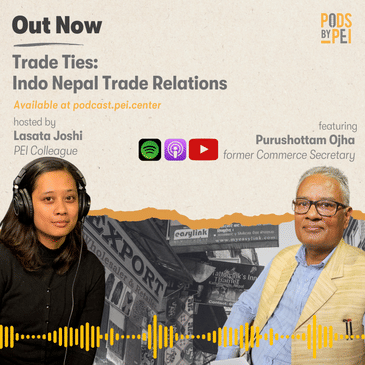
Purushottam Ojha is the former Commerce Secretary of Nepal and has extensive expertise in trade, transit, investment, private sector, and institutional development. Mr. Ojha has held key roles in public service since 1979 and has also served as a Trade Facilitation Consultant for The World Bank and Global Training Institute Development & Research, providing strategic advice on trade negotiations and capacity building.
Lasata and Purushottam’s discussion centers around the longstanding trade relationship between Nepal and India, guided by the 1950 Treaty of Peace and Friendship. Ojha shares his insights on how historical trade arrangements have shaped Nepal's economy and the ongoing challenges and opportunities in this bilateral relationship. From tariff regimes to non-tariff barriers, this episode offers a comprehensive look at Nepal-India trade dynamics and the future of this crucial partnership.
If you liked the episode, hear more from us through our free newsletter services, PEI Substack: Of Policies and Politics, and click here to support us on Patreon!!
[00:00:11] - [Speaker 0]
Namaste, and welcome to Pods by PI, a policy discussion series brought to you by Policy Entrepreneurs Inc. I am Anupam Adhikari. In today's episode, PI colleague Dasta Jyousi is in conversation with Purr Sotem Oza on trade ties, Indo Nepal trade relations. Pursotim Oza is the former Commerce Secretary of Nepal and has extensive expertise in trade, transit, investment, private sector, and institutional development. Mr.
[00:00:39] - [Speaker 0]
Oza has held key roles in public service since 1979, and has also served as a trade facilitation consultant for the World Bank and the Global Training Institute Development and Research, providing strategic advice on trade negotiation and capacity building. Lassita and Purushottam's discussion centers around the long standing trade relations between Nepal and India. Uza shares his insight on how historical trade arrangements have shaped Nepal's economy and ongoing challenges and opportunities in this bilateral relationship. From tariff regime to non tariff barriers, this episode offers a comprehensive look at Nepal India trade dynamics and future of this crucial partnership. We hope you enjoy the conversation.
[00:01:26] - [Speaker 1]
Namaste, this is Loshta Joshi.
[00:01:29] - [Speaker 2]
Namaste, this is Purushottam Oza.
[00:01:32] - [Speaker 1]
Mr. Osha, welcome to PODS by PEI.
[00:01:35] - [Speaker 2]
Thank you very much.
[00:01:36] - [Speaker 1]
It's a pleasure to have you here with us today. We'll be diving into the Indo Nepal bilateral trade relationship, a vital economic partnership that has profoundly shaped the geopolitical landscape of the region for generations. Given your experience as the former trade secretary, your insights and first hand experience will be invaluable in guiding our discussion. So without further ado, shall we begin?
[00:02:01] - [Speaker 2]
Okay. Yeah.
[00:02:03] - [Speaker 1]
Let's first start with the historical context of our bilateral trade relations with India. Could you walk us through how has the trade relation between Nepal and India evolved over the centuries? And what has been the core motivation and dynamics shaping this long standing economic, particularly trade partnership?
[00:02:23] - [Speaker 2]
Thank you, La Sota, for the question. Of course, Nepal and India enjoy very long standing trade relations from the very beginning. In the past, Nepal's trade was limited to India and Tibet Autonomous Region Of China. Due to this very porous border, the trade with India was happening quite at large scale as compared to our trade with China. It started from time immemorial.
[00:02:52] - [Speaker 2]
But in the recorded history documentation of the trade relations, it has been for the first time done in 1792 during the reign of King Rana Vahadu Saha. And that time the treaty was very primitive type. It has only couple of components, something like each country were supposed to impose 2.5% duties tariff on import from the other country. That was one part of that very agreement, Treaty of Commerce. And second, it was the protection of the traders.
[00:03:28] - [Speaker 2]
If the traders' goods were confiscated, or it has been hijacked, or it has been taken away by some wrong element, then the government was supposed to reign on it. That was one of the areas. And secondly, there was also provision of punishment to the customs officer. If any customs officer levied duties more than 2.5%. That was the unique type of arrangement made in that treaty in 1792.
[00:03:58] - [Speaker 2]
And after that, the next treaty in our recorded documentary, it was in 1923, during the time of Rana Prime Minister Sondra Sampshir. During that time, it was basically peace and peace treaty of peace and friendship, and along with that, there was provisions of transit for Nepal as a landlocked country. Actually, it was a follow-up of the transit provision that has been made in 1921, Barcelona Convention. Following that in 1923, British India government provided transit facilities to Nepal. It is in a written form.
[00:04:42] - [Speaker 2]
And the third that you have mentioned is the treaty that was concluded in 1950, 07/31/1950. There are two treaties. One of the treaty is the peace and friendship treaty, and second treaty on the same day was signed. It was called Treaty of Trade and Commerce. So, that treaty basically was based on the assumptions on the perception of customs union.
[00:05:08] - [Speaker 2]
I mean the customs duty to be led by India and Nepal had to be similar, and in export from Nepal to India, even Nepal government was supposed to levy the export taxes in order to level the price of the goods in India. So, that sort of thing was there and it was for a period of ten years. And after that we had treaty in 1960 which basically was a single treaty of trade and transit. And following five years period, in 1970 it was renewed. And for the first time, with the follow-up of the government of Nepal and the persecution of the government of Nepal, India signed three different treaty in 1978.
[00:05:52] - [Speaker 2]
One was the Treaty of Trade and second was the Treaty of Transit, and third was the Agreement of Cooperation to Control Unauthorized Trade. So, those three agreement were signed 1978. Even today, the treaty trade and transit arrangement between Nepal and India is based on those three treaties, and those treaties has been amended from time to time, and even today it is effective on that one.
[00:06:17] - [Speaker 1]
That's an excellent summary of the key points from the historical context. Based on the evolution you outlined of the bilateral treaties between Nepal and India, I would like to understand how the current Nepal India trade and transit agreements compare to the past iterations of these bilateral agreements. From your experience, have you observed any clear departure or continuities in the established Nepal India trade relationship compared to the past?
[00:06:48] - [Speaker 2]
Yeah, you are right. In the sense that there is continuous evolving of the trade arrangement between the two countries. If you compare the provisions of '19 there was a sea change in 1960. During that period in 1950, Nepal was supposed to levy the taxes, customs tariff, customs duty at par with Indian customs duty. So, there was no independent tariff applied by Nepal.
[00:07:17] - [Speaker 2]
That was one. And second establishment of Nepal Rastra Bank, it was sometime in nineteen fifty seven, fifty six, fifty seven. Before that, foreign currency earned by Nepal used to be deposited in Reserve Bank of India. The payment is to be received by the RBI, and also it is to be done by that very institution. So, a kind of monetary independence was not there, independent trade policy was not there.
[00:07:50] - [Speaker 2]
So, Nepal got out of that clauses in 1960, and during that time, Nepal Rash Bank was already established, and even the provisions that has been made for equalization of the tariff, it was abandoned in 1962. And the name of the treaty itself was changed from the Treaty of Trade and Commerce to Treaty of Trade and Transit. And if you see the Treaty of Trade in 1978, the rules of origin criteria for Nepal's product to enter into Indian market, it was quite stringent. It was stringent up to 1995. So, Nepal's exports were destined to Western countries like European countries and America.
[00:08:40] - [Speaker 2]
The export to India was very much minimal due to very stringent rules of origin criteria. So, that very criteria was changed in 1996. The revision don't allow market access for the Nepalese product in India under the basis of the rules of origin defined by the government of Nepal itself. So, that was a sea change in the provision of the Treaty of Trade, but that very arrangement could not last very long. It lasted only for six years, and in 2002 we were subjected to renegotiate the treaty and then rules of origin criteria was imposed, then there were certain products that has been put under the tariff rate quota or what we call the quantitative restriction.
[00:09:29] - [Speaker 2]
So, what we see today is that the tariff is not such a problem between Nepal and India, because the tariff, all of the product from Nepal to India, it gets duty free tariff preferences. But the problem here is about non tariff barriers like quarantine, food test requirement, tariff rate quota, rules of origin, you know, arrangements, non tariff barriers have been created, and that is also playing a role in non realization of the trade potential, export potential of Nepal, that is there. So, previously it was tariff as well as non tariff, but now tariff barriers have been lowered, but the non tariff barriers have been raised. So, that's why Nepal could not make good progress in export of the goods to India as well as in other countries.
[00:10:25] - [Speaker 1]
Your explanation helps paint a clear picture of how the provisions around custom duties, monetary policy, and rules of origin have shifted significantly over the decades, impacting Nepal's economic autonomy and export opportunities. I would like us to focus now on rules of origin. First of all, what is rules of origin? And given the complex evolving nature of rules origin between Nepal and India, how has it impacted Nepal's economic development?
[00:10:59] - [Speaker 2]
Yes, when we have this preferential trade agreement with India, it started during 1970s. There are two provisions. One is the agricultural primary product that gets duty free access in both countries on a reciprocal basis. Nepalese goods as well as the Indian goods categorized under 14 different headings. Now in 16 different headings, it gives duty free access to each other's countries.
[00:11:27] - [Speaker 2]
Another sector is about these manufactured articles, India provides duty free access to Nepal. So, first I would like to clarify about the rules of origin criteria. Any preferential trade regime, the preferences is given to the product that has been originated in the country, in the participating country or participating party or contracting party. In order to confirm the status of origination, certain rules are defined. Say, for example, under Nepal India Treaty of Trade, it is the rule, the current rule is 30% value addition, four digit changes in the customs tariff rating, and there are certain operations even after completing these processes, there are certain operational procedure that cannot be confirmed with the origin.
[00:12:23] - [Speaker 2]
Like if some product if they have the value addition 30% or the changes in the custom styrene rating, If it is simply due to slicing, cutting, freezing, this type of operations, making dust or something like that, grinding, that doesn't confirm the original status. So there are certain rules. The current arrangement is that there is need of having 30% value addition, changes in the customs tariff, hitting at four digit level, and sooner they have gone through on insufficient working. That is there. In 1978, the material content provision was there.
[00:13:02] - [Speaker 2]
That means any product that qualifies to get duty free access into Indian market, it has to have 90% material content of either Nepal or Indian origin. That was impossible for Nepal to manufacture product with 90% Nepalese material content. That is why the provision mentioned could not be realized in action. So later on, it was decreased from 90% to decreased 50%, then it came to it came down to 50% as well in 1991 when the treaty was renewed. But even then, Nepalese goods could not meet this criteria.
[00:13:43] - [Speaker 2]
In 1996 during the Gujarat prime ministership, what we call the Gujarat doctrine, it was non reciprocal provisions accorded by government of India, particularly to its neighbors. So under that scheme, the treaty was revised in a way that any product that has been that says that it is manufactured in Nepal, ended by the authority designated by the government of Nepal, in that case that product will get duty freezes in India. So after that we had a lot of industries coming in Nepal, but those industries rather than really generating employment in the country, the industries came to getting benefits from duty differences between Nepal and India. That sort of industries emerged in Nepal, like vegetable fat, acrylic yarn, zinc oxide, and even Kodak film manufacturing industry. So, there are certain industry that were really not adding value, rather they are getting benefits out of the arbitrage, directly arbitrage between the two country.
[00:14:54] - [Speaker 2]
So that's why the concern was raised from the Indian side and we had a marathon negotiation during nineteen ninety eight-two thousand and one quite extensive negotiations were held, and after that we had to agree on rules of origin criteria, and the rules of origin criteria that are set in 02/2001, it still prevails today. So, several prologue from Nepal qualifies under that very rules of origin criteria. It is the non tariff barriers that are creating hassles in export. So that is the situation as of today.
[00:15:33] - [Speaker 1]
Indeed, the non tariff barriers are creating concerns with the trade dynamics between the two countries. But let's dwell a little into tariff structures differences between Nepal and India first before addressing the impact of non tariff barriers. Are there any significant differences in tariff structures between the two countries? And are these key concerns in our trade dynamics? What are your thoughts on the main issues arising from these disparities and how they influence the economic activities between Nepal and India?
[00:16:09] - [Speaker 2]
I think that there should not be much differences in the tariff in practical terms. Because if there is a difference in the tariff structure, then all kind of illicit trade or the informal trade happens because there is people want to take advantage of the duty arbitrage. Say for example, one of the major product that has been exported to India over the last couple of years or over the last decade or so is sunflower oil, palm oil, soybean oil. These three oils are exported in a large quantity. And if you see the trade figure of last over the last three, four years, out of the in three years back, total export of Nepal was worth 200,000,000,000 rupees.
[00:16:59] - [Speaker 2]
Out of that 96,000,000,000 rupees worth of export was only due to these three items. But this product, the raw materials we get it from outside. Although it qualifies under the rules of origin criteria, because they bring it raw or crude oil, and then they process it and send it to the destination market. On that process, the rules of origin criteria is made, but the real value addition or the employment generation out of the export, it is questionable. It was due to the duty differences because those products, if it is imported by India directly from third country, it will attract 3540% duty.
[00:17:45] - [Speaker 2]
But if it is imported through Nepal, then it is zero deputy. That means there is a duty difference and there is quite big profit for the exporter from here. That is why this type of export or this type of trade has to be curtailed, and the real trade has to happen based on the raw materials and the value added product from Nepal. That is very much important. So, what do we see that besides there are a lot of environmental happening between the two countries.
[00:18:19] - [Speaker 2]
It is due to the price differences and even customs tariff. If we impose a high customs tariff on the imported goods, then in that case due to this open and porous border, people are motivated to export or to import informally. And in one study, it has been said that the volume of informal trade is almost half of the formal trade as well. Although there is no systematic study done on this, and some of those economists and researchers, they have done some guesstimate. According to the guesstimate, the volume is quite high.
[00:18:55] - [Speaker 2]
The volume of informal trade is almost half of the formal trade. So, what I see that getting that higher tariff and creating more barrier in trade, it encourages people to trade informally.
[00:19:10] - [Speaker 1]
Earlier, you mentioned how open border is unique arrangement in Nepal's relationship with India, And the informal border trade is a less discussed issue. So earlier you mentioned how open border is unique arrangement in Nepal's relationship with India and informal cross border trade is a less discussed issue. However, with the huge scale of informal trade, which likely is providing a crucial livelihood opportunities for border communities, especially the economically marginalized. Do you think Nepal and India can find an amicable way to address challenges of smuggling and illicit trade without jeopardizing livelihood of border population?
[00:20:02] - [Speaker 2]
I think there are a few things that we can do to curb down the informal trade. I cannot say that it can be eliminated because due to this porous border and frequent movement of the people without any passport or visa and even the open border everywhere, almost 18,000 kilometer in east, west, and south. One of the measures to curb down is the tariff harmonization. So there should not be much differences in tariff. If in one country, if there is a high tariff, in another country, there is no tariff, then it will have the incentive for the traders, rock traders to take the route of informal trade.
[00:20:49] - [Speaker 2]
That is there. And second is the pricing policy. The prices of the goods should not be much different differences between the two countries. So we have the glaring example of petroleum product. Whenever the petroleum product in Rakhshul and Birgand, the price if it is deferred by $5.06, or 7 rupees per liter, then the people find it easier to transport the goods illegally from one point to another across the border.
[00:21:23] - [Speaker 2]
They will make living out of that. So that sort of thing is there. Even you see, say for example, even agricultural productive, the cost of the agricultural crop is higher in Nepal, and you see if it is cheaper in India, then people have the incentive to transport it illegally. So the pricing mechanism and how the price can be equalized, near to equalize, don't say they're completely equalized, but the price difference should be in a way that it doesn't support informal trade or illicit trade or smuggling. And thirdly, is about regulating border enforcement.
[00:22:05] - [Speaker 2]
Although it is a very long and porous border, but the both the countries and the law enforcement agency can work together, can cooperate to each other to control the unauthorized trade. So active intervention of the law enforcement agency that can also be checked. But the complete elimination is not possible.
[00:22:31] - [Speaker 1]
So far, we have discussed the key strategies Nepal and India can explore to address the challenges of large scale informal cross border trade. Now, let's talk about non tariff barriers. According to you, what are the major categories of non tariff barriers that currently hinder formal trade between Nepal and India?
[00:22:50] - [Speaker 2]
Of course, one of the great export of Nepalese goods is the USPS related barriers, sanitary and vital sanitary. One is the quarantine, animal health, plant health, and food test. These are the major hurdles. Just to explain it, you see, if even there are some irony in this. Say for example from Khoasi province, export ginger, tea, coffee, even broom.
[00:23:22] - [Speaker 2]
Whenever there is, say for example, in case of ginger, what we have observed that if there is bumper harvest in India, like in Sikkim and Northeast India and Himansal, then the barriers is raised on their side. So they want Nepalese ginger to the required parameters or required test parameters. And the same thing applies to the Nepalese tea as well. We have seen from the past. If there is under production in Indian states, then in that case, they take all the goods without any problems.
[00:24:05] - [Speaker 2]
So these are the things that we have faced we are facing as of today.
[00:24:10] - [Speaker 1]
And what can Nepal and India do to enhance cooperation and address the non tariff barriers hindering trade between the two countries?
[00:24:18] - [Speaker 2]
In order to address this issue, we need to enhance cooperation and test and certification. First, we need development of Nepal standards and the Indian standards are there. One of the areas is to harmonize those standards or Nepal adopt the ISO standards. What you call this ISO certification 17025, but there are ISO standards. We have to follow that so that Nepal standard is accepted.
[00:24:48] - [Speaker 2]
And second, is about the test and certification facilities. So thus test and certification facilities would also be at the international standard so that those certified product is accepted by other importing countries. And third, is about concluding Yamar Mutual Recognition Agreement. And also non tariff barrier is related with the tariff rate quota or the quota restrictions. The product under Nepal India trade of trade is under the quota.
[00:25:23] - [Speaker 2]
So, is non relevant today because if you see the export volume of these four products, that is vegetable fat, agarilica, zinc oxide, and copper product, their export is much less than the allocated quota. So, there is no meaning to maintain this quota restrictions. And there are other barriers like non automatic licensing. Say for example, if someone from India wants to import vegetables or some agricultural product for example, first of all, have to get the license from their authorities, from their SPH authorities, The quota, with quota. So, this sort of things, this is not free trade in that sense.
[00:26:09] - [Speaker 2]
And in some cases, there are local taxes as well that is also hampering the export of memory goods. So, what I see that although some mentions in the bilateral treaty of trade about dealing with the non tariff barrier, but the exercise is not sufficient. The consideration is not sufficient. And both the government now needs to sit together and really analyze the problem. What are the real problems and how it can be resolved?
[00:26:42] - [Speaker 2]
So at least at the bilateral level, if we could resolve this issue, I think that will have great potential of increasing export to neighboring countries.
[00:26:52] - [Speaker 1]
Indeed, both governments need to proactively analyze the problems and find solutions through close collaboration. Now moving forward with the next question, while going through Nepal India trade treaty, I came across unconditional most favored nation. Can you explain this provision and whether Nepal actually benefits from it?
[00:27:12] - [Speaker 2]
Yeah. Actually, there is one provision in article three of the treaty of trade that mentioned, if any contracting party, that means either India or Nepal, if it provides more preferences to any countries in terms of the customs tariff or quantitative restriction, the concessions or the facilities will be automatically available to the other country. That is the provision of EMF and that you have mentioned. So that is one of the issues that needs to be reflected on the review and revision of the agreement. Due to this provision in the treaty, it has become difficult for Nepal to conclude to negotiate and conclude the agreement with other countries like Bangladesh or Thailand or whatever is there.
[00:28:05] - [Speaker 2]
Because if say for example we have Bangladesh and we have trade interest with Bangladesh as a neighboring country, But we can't have that concessions provided to each other because if we provided some concession to Bangladesh, then it is automatically applicable to India according to the provision of the agreement. So in that case, really, the Bangladeshi exporter will not benefit, and the benefit will go to the Indian exporters. So what we see that this type of arrangement that has been made in back in 1978, it has been continued till now, and it needs to be reviewed by both the government because it might not be a problem for India because it provides duty free access to all of the Nepal's products. So there is no question about that. But Nepal will not be able to sustain that, because providing duty free access to all Indian products will be difficult for Nepal to be around.
[00:29:04] - [Speaker 1]
In order from Nepal's perspective, what key provisions in Nepal India trade treaty should be reviewed and renegotiated to address the challenges faced by Nepal? And what potential solution could the two governments explore to enhance the trade relationship in a more balanced and mutually beneficial manner?
[00:29:27] - [Speaker 2]
What I see that there are certain provisions that needs to be looked on during the process of review and revision of the agreement. I understand that government of Nepal is doing homework to that. One of the area that we have to look at, as you have indicated, the MFN provision is contained in article three needs to be revisited. Second, it is about the tariff free import of the Indian agricultural product. India provides quite they have the capacity to provide subsidy to the agriculture sector, very high subsidy in comparison to Nepal.
[00:30:14] - [Speaker 2]
Although their level of subsidy is lower than the European countries or America or developed countries, but in comparison to Nepal's capacity, they have much higher capacity to provide subsidy. And those subsidized agricultural product in India, they are getting easy market in Nepal. There are other reasons as well, but one of the reasons behind the fallback of the Nepalese agriculture is the cheap import from India, from neighboring countries. It is formally and informally, we get a lot of Indian products in Nepal. So across the border, if you see our Tarai and across the border in Bihar and UP, the cost of production of the crops is quite different.
[00:31:03] - [Speaker 2]
There is no similarity. So, in that context, another area that we have to look at is about imposing customs tariff on agricultural products in order to protect the neighbor's agriculture. So, that is also one of the area that we need to look at in the revision of the treaty. And third, what I see that trade dispute. There are several because we have India is the largest trade partner for us.
[00:31:32] - [Speaker 2]
Around two third of the trade takes place with India, and one third of the trade takes place with the rest of the world. So given the volume of the trade transaction, there are several disputes, but the mechanism to address the dispute is also not very much effective. So we have to make an effective mechanism whenever the dispute arises. It has to be the fast track methods of resolving the dispute.
[00:31:58] - [Speaker 1]
Beyond just focusing on trade in goods, what are other sectors or areas of cooperation that Nepal should prioritize in economic negotiation and partnership with India?
[00:32:11] - [Speaker 2]
There are several other areas such as hydropower, maybe tourism, that we can have cooperation between the two countries. So that also could be made a part of the trade negotiation. And another is the investment. Of course, investment, we need more investment from outside for indirect investment to develop industrial core in the country, to increase production, to develop more technology. And a few years back, India were the largest investor in Nepal.
[00:32:48] - [Speaker 2]
Now it is taken over by China. But still, the total volume of FTI coming into Nepal each year, if you see the figure published by the UNCAT old investment report, Nepal is on the lowest among South Asian countries, living aside Afghanistan and Bhutan, we are on the lowest ebb. So we have to create an environment where the investment comes, foreign direct investment comes and the investment it helps to create job, it helps to run the industry to establish industry. All these things has to be looked in totality rather than just looking only the trade from one single perspective. We have to have the trading services.
[00:33:32] - [Speaker 2]
We have to have the investment as well as the cooperation for development of the potential product in Nepal.
[00:33:40] - [Speaker 1]
From our conversation so far, I guess that Nepal and India trade relationship is clearly a mixed bag of fraud with challenges, but is also critical for both countries. Now, let me bring into another factor into this trade relationship, which is Nepal's graduation in the LDC list in 2026. Do you see Nepal's LDC graduation impacting our trade relationship with India? And at the same time, do you see opportunities for Nepal to potentially renegotiate or devise Nepal India trade treaty to better safeguard its position post LDC graduation?
[00:34:19] - [Speaker 2]
Yes. After LDC graduation, reference is given to these developed countries by the international organizations or the other countries, it may affect. Say for example, European Union, they have everything but arms initiatives in favor of the least developed country. So that will go away. But while talking with India, our bilateral agreement is not between the least developed and developing countries, rather it is between the two neighboring countries.
[00:34:53] - [Speaker 2]
So, in that sense, the provisions that have been laid in the bilateral treaty, it will not be affected even after the LDC graduation. But we have to remain alert in the sense that whenever we are going to negotiate or renegotiate the treaty of trade, Indian side means exert pressure that now we have already become developing countries. There is India is also a developing country, so we are yet part. So why should we give you more preferences? So we should do it in a very reciprocal basis.
[00:35:30] - [Speaker 2]
So that sort of proposal may come up, that kind of pressure may build up. So I think government of Nepal should be aware about it, and they have to be prepared. The discussions are going on about giving some transitional period for the least developed country graduating LDCs to fully go into the developing studies so maybe we can ask similar things with India as well in that case. But what you see that fundamentally our agreement, treaty with India is not on the status of LDC rather it is on the status of neighboring countries. So I think after LDC graduation, there will not be much difference for Nepal in its trade with India.
[00:36:16] - [Speaker 2]
And one of the benefits for for Nepal is that two third of the trade is with India, and that trade will affect after early graduation. And even if you take the case of export, last year, almost 68 almost 70% of the trade was export was to India. So the export will not much be affected. Only 30 of our export will be affected. So I think that is good side of the story.
[00:36:46] - [Speaker 1]
Given the evolving global trade landscape and the need for Nepal to adapt its trade agreements with neighbor to modern practices, what key reforms should Nepal prioritize in renegotiating its bilateral trade and transit treaties with India?
[00:37:03] - [Speaker 2]
Of course, now the trade, see, the international trade regime is it is dynamic. It is changing over the years. And if you see the situations two decade ago and one decade ago, and now it is quite different. Now the international trade is also under the WTO. Some of the big countries, they are just taking a broad approach.
[00:37:33] - [Speaker 2]
In introvert export. Sorry. We have to the least developed countries and developing countries, they have to take a more forward approach because some of the developed countries and big countries, since they are rolling back from the open trade regime. So we have to be very much careful for that. And since the WTO related negotiations, they are quite time consuming and delayed in the process, it is better for the countries to open up trade within their dual steps with the neighboring countries, either sub regional or the regional level.
[00:38:10] - [Speaker 2]
So, for that purpose, what I think that we have a big market in South Asia and as well as China itself is a big market. So, we need to engage more with the neighboring countries. China, India, Bangladesh, these are quite big market for Nepal. We have to have more favorable trade agreement and the current arrangement on the trade and the current arrangement in the transit, it has to be reviewed and revised to suit the modern approaches and modern practices. For example, digitization of the trade processes, it is taking shape, and it has also helped in reducing the cost of transactions.
[00:38:58] - [Speaker 2]
So we have to go further. Still, our trade agreements and the transit agreements, they are based on the traditional processes. So we have to transform from that very traditional process to digitization. Automation should be there, and that should be better coordination among border agencies. And we need to move into paperless environment.
[00:39:20] - [Speaker 2]
So we talk about artificial intelligence, big data, and all these things. The Internet based or the IT enabling environment, we have to work on that very environment. So in Nepal, we have implemented national single window that links all the participating stakeholders in one platform, single window platform. So we have to have the cross border single window as well that will reduce the time and the process and it will also help to get rid from the unnecessary process, redundant processes. And in order to implement this, we have to have the review and revisions of the bilateral treaty of trade and bilateral treaty of transit as well according to modern practice, to fit it into the modern practices.
[00:40:12] - [Speaker 1]
Given your additional perspective on the need to focus more on sub regional cooperation in South Asia, should we go beyond bilateral and focus on the regional block as well for the trade purposes?
[00:40:25] - [Speaker 2]
Very what I see that that is a quite nice idea. We start from bilateral, and we go for subregional and the regional. But, unfortunately, in South Asia, the SARC process is installed since over the last ten years. And the Bemischek is also not moving very well. It is also in a moving at a very snail pace.
[00:40:46] - [Speaker 2]
And the emerging concept is about subregional cooperation, South Asian subregional economic cooperation. And these four countries, what we call as BBIN. Bangladesh, Bhutan, India, and Nepal, they have signed the motor vehicle agreement, but it it still has to be made effective. If the cooperation at the subregional level could be developed, if it could be built up, then it can work as a building block for the regional cooperation. So we start with bilateral, then go on subregional and then regional.
[00:41:24] - [Speaker 2]
So I think that is the best option that we can have today rather than going through multilateral process.
[00:41:31] - [Speaker 1]
We have covered a lot of ground on Nepal India trade but as we wrap up could you share what do you see as some of the most important step the Nepali government should take in the near future to improve trade?
[00:41:45] - [Speaker 2]
It is I have mentioned most of the things. I think I am covered most of the things over here. We have to build up our products productive capacity. That is very much important. In order to participate effectively in the international trade, it may be bilateral regional or multilateral trade.
[00:42:04] - [Speaker 2]
We have to build our capacity to produce. Without production, it may be goods production or it may be services production. And for that to happen, we have to have the investment environment. For that, there are other factors like the policy, trade policy, investment policy, and governance, and all these things, policy stability. These are very quite important things in order to attract more investment either from outside or from within the country.
[00:42:37] - [Speaker 2]
Until and unless we have the investment, we cannot generate production. And we have to remember that production makes a country great but not the consumption. Consumption cannot make a country great. So our current trend is more in consumption. We get more remittance from the migrant workers from the migrant outside, and it it is increasing consumption within the country, but without any production.
[00:43:08] - [Speaker 2]
So that's why we have to reverse this process. We have to increase production. Increment production means that will give solace to the consumer, and it also help at the same time, helps to build up our export capacity. So more focus would be on production rather than in consumption.
[00:43:27] - [Speaker 1]
Thank you, Mr. Oja, for this insightful discussion on the steps Nepal need to take to build its productive capacity and strengthen economic cooperation with India. Thank you, Mr. Oja, for this insightful discussion on the steps Nepal needs to take in order to build its productive capacity and to strengthen economic cooperation with India. I appreciate you taking the time to share your valuable perspective on this important topic.
[00:43:55] - [Speaker 2]
Thank you very much.
[00:43:58] - [Speaker 0]
Thanks for listening to Pause by PEI. I hope you enjoyed Plastas conversation with Purushwatam on trade ties, Idunipal, trade traditions. Today's episode was produced by Kushi Hang with support from Nirjan Rai, Pride Sapkota, Bhivuti Bottom and me Anubham Adhikari. The episode was recorded at BI Studio and was edited by Pride Sapkota and Lustachosi. Our theme music is courtesy of Rohit Sakya from Jindabad.
[00:44:26] - [Speaker 0]
If you like today's episode, please subscribe to our podcast. Also, please do us a favor by sharing us on social media and leave a review on Spotify, Apple Podcast, or wherever wherever you listen to our show. For PI's video related content, please search for policy entrepreneurs on YouTube. To catch the latest from us on Nepal's policy and politics, follow us on Twitter at tweet two p I that's tweet followed by number two and p I and on Facebook at policy entrepreneurs inc you can also visit pie.center to learn more about us thanks once again from me Anupoma we'll see you soon on our next episode.