
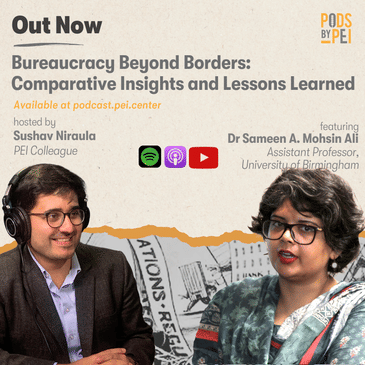
Ep#108
Dr. Sameen A. Mohsin Ali is an Assistant Professor of International Development at the University of Birmingham. Her research focuses on the impact of bureaucratic politics on state capacity and service delivery. She is particularly interested in the dynamics of bureaucratic reform, the implementation and impact of donor programs, and the intersection of party politics, citizens’ interests, and bureaucratic incentives. Exploring cases from Pakistan and Nepal, Sushav and Sameen delve into the dynamic relationships between politicians and bureaucrats. In doing so, they imagine bureaucracy in a decentralized context, discuss ways of navigating bureaucratic embeddedness, corruption, and efficiency, and explore how to plan bureaucratic reforms. The conversation offers a nuanced perspective on the complexities of governance and the critical forces that shape public administration in developing countries.
Like listening to PODS?
We’d love to hear your thoughts and reviews on Spotify, Apple Podcasts, YouTube, or wherever you listen to the show! You can also follow us on Twitter at Tweet2PEI, and on Facebook and Instagram at policyentrepreneursinc for updates on the latest episodes and share to help us reach more enthusiasts. If you liked the episode, hear more from us through our free newsletter services, PEI Substack: Of Policies and Politics, and click here to support us on Patreon!!
[00:00:11] - [Speaker 0]
Namaste and welcome to Pods by PEI, a policy discussion series brought to you by Policy Entrepreneurs Inc. My name is Kushihang, and in today's episode, PEI colleague, Sushov Nirola, is in conversation with doctor Samin Ali on bureaucracy beyond borders, comparative insights and lessons learned. Doctor Samin Ali is an assistant professor of international development at the University of Birmingham. Her research delves into bureaucratic politics in Pakistan. She also codirects the women in public service in Pakistan oral history archive and has published extensively on political stability, service delivery, and public health.
[00:00:51] - [Speaker 0]
Susha Van Samin explore cases from Pakistan to delve into the dynamic relationships between politicians and bureaucrats to imagine bureaucracy in a decentralized context and discuss ways of navigating bureaucratic embeddedness, corruption, and efficiency. The conversation offers a nuanced perspective on the complexities of governance and the critical forces that shape public administration in developing countries. Like listening to Pods? We'd love to hear your thoughts and reviews on Spotify, Apple Podcasts, YouTube, or wherever you listen to the show. You can also follow us on Twitter at tweet two p e I and on Facebook and Instagram at Policy Entrepreneurs Inc for updates on the latest episodes and share to help us reach more enthusiasts.
[00:01:39] - [Speaker 0]
For now, we hope you enjoy the conversation.
[00:01:46] - [Speaker 1]
Hi, everyone. I'm Sussalb, and today we have with us doctor Samin from University of Birmingham. Samin's research focuses on the impact of bureaucratic politics on state capacity and service delivery. Welcome, Samin, to this podcast where we discuss all things policies and politics. So let's jump right into it.
[00:02:06] - [Speaker 1]
Usually, bureaucrats, politicians, and civil society, three key influential institution who save a country's development or democratic trajectory. But when it comes to mainstream social science literature, it feels as if politicians or civil society, they have studied quite extensively, but bureaucracy doesn't get that much of an attention. And even when they are studied, bureaucracy doesn't get a very positive representation. They are often portrayed as status quo is orthodox. Right?
[00:02:41] - [Speaker 1]
Why do you think that's the case? And, also, what made you study this understeam within social science or development study?
[00:02:50] - [Speaker 2]
First of all, thank you so much for having me. I'm I'm so pleased to be here. It's so nice to connect to other people in South Asia, especially from, you know, places like Nepal, which are so underrepresented in research on South Asia. So interestingly, I got into bureaucracies through studying political parties, so I didn't come to bureaucracies first. I think the primary reason for that is that politicians are a far more public figure.
[00:03:17] - [Speaker 2]
Bureaucrats tend to be sort of behind the scenes. You don't know their names, usually, or you shouldn't know their names, ideally, but, you know, politicians are just sort of interacting with citizens on a day to day basis and are, you know, there's a there's a relationship between the politician and the and the voter. In my own experience, I was actually a research assistant on a project on Pakistan's political parties, and one of my mentors and I, we traveled all over Pakistan speaking to political party members, political party leaders, and we would ask them about, you know, what's it like being in government when you're a minister or when you're elected, what's it like to actually deliver services and, you know, make sure that your constituents are happy and so on. And, you know, they would respond and they would say, oh, it's very difficult and there's no money or there's no this or this goes wrong or whatever. And then we, you know, we were asking these questions to a lot of people, and eventually this one politician got kind of upset with us and he got a bit frustrated and he said, why are you asking me these questions?
[00:04:15] - [Speaker 2]
You should be asking the bureaucrats because they're the real power in terms of service delivery and and I was I had been thinking about doing a PhD for some time and I had been in a should I do it on something about politics and political parties? Because we were doing the research anyway, and my mentor worked on political parties. When I heard that comment, I was like, hang on a second. I could do something on the bureaucracy because Pakistan's bureaucracy has been written about. Charles Kennedy wrote a book on it, that was in the nineteen eighties.
[00:04:42] - [Speaker 2]
And there's been some work by Ilhan Niaz on the colonial bureaucracy and how it status quo even to this day, but there wasn't a lot about how bureaucrats and politicians interact with each other. And so that's how I got interested in bureaucracies.
[00:04:56] - [Speaker 1]
Interesting. That bit about politics in saying bureaucrats have power, I think recently, we had an interesting bit when our former prime minister, he was facing a lot of criticism on why there was certain controversial changes in a certain bill. And, ultimately, the prime minister said, you know, we did everything right. Maybe the typist might have changed it. Right?
[00:05:20] - [Speaker 1]
So just locating that amount of power to a bureaucrat, but also in a much junior position, that just felt interesting. So these are bits we also keep hearing in Nepal. Especially, we have this contradictory sort of narrative. On one hand, politicians, they portray bureaucrat as overly powerful that everything has to go through them. And at the other hand, we also have this competing narrative of bureaucrats being subservient to politicians.
[00:05:50] - [Speaker 1]
So at times, it feels difficult to wrap around. Are they super powerful, or are they basically subservient to politicians? Right? So those bits seem interesting in Nepali context as well. And when I was following bureaucracy related work, it seems as if the first point of inquiry of all this literature or all these research is to engage with this Weberian idea of bureaucracy that it being impersonal, politically neutral, standardized, and rule based institution.
[00:06:22] - [Speaker 1]
How practical or relevant do you see this theorization, especially in the context of developing country?
[00:06:29] - [Speaker 2]
I think there's there's two things that are important here. One is that, of course, Weber was writing about European systems. Right? So that was his context. He he didn't have any experience of anywhere else in the world, so he could only write about the state development experience in the Western context.
[00:06:44] - [Speaker 2]
Undoubtedly, his writing is focused on a system that is premised on Western frameworks and Western modes of sort of governing societies. That's not to say that he's, you know, useless. He's got some really interesting things to say, And I think that one of the things that happens is that, of course, because it's an older work in the scholarly literature, a lot of people are are not reading Weber in the original text. Right? So even I have not read the entirety of his work in the original text.
[00:07:11] - [Speaker 2]
I've read some bits of it here and there, which I thought were relevant. But if you read more of his work, you realize that he's saying all of this about neutrality and separation from society and all that, but he's also saying that it's kind of hard to do that stuff, right? So he's also acknowledging that I'm saying all of this about an ideal Weberian type, but it's really hard to achieve this. The second thing is that there's been a lot of critique of Weberian approaches to bureaucracy, right? And it's not that people are saying that Weber was wrong.
[00:07:41] - [Speaker 2]
They're not saying that. They're saying that the way that Weber has been understood is wrong. So people have taken this ideal vision that they take out of Weber's work and just run with it. Right? But actually, the problem there is that Weber himself put, like, sort of caveats on his thinking and people ignore that part completely.
[00:07:57] - [Speaker 2]
So a lot of the thinking on bureaucracies that comes out of international development stakeholders, World Bank, and so on is informed by precisely these ideas of neutral bureaucracies. When, you know, as we all know, when we live in societies, bureaucracies cannot be neutral because they are staffed by the people emerging from societies themselves. So you have a lot of work increasingly on things like embeddedness, that bureaucrats are embedded in societal systems and state systems, and you it's very difficult to separate them from that. You have the work of people like Yuan Ang in China who's talking about how we have to move beyond Western frameworks of thinking about bureaucracies and develop our own frameworks in countries in the global South, whether it's China or Pakistan or India or Nepal, or anywhere else. And and for me that was really important because a lot of my work was looking at how bureaucrats exercise their own agency.
[00:08:48] - [Speaker 2]
So it's not just that politicians are telling them what to do, and that's a lot of the literature on the Western world which is talking about things like delegation, which was like, a politician is indicating that this is the next step that the bureaucrat should take or the policy that they should implement. But for me, what was happening was something that was far more contested and far more negotiated because the bureaucrat had a role to play, and they weren't this neutral actor who was like, yes. Of course. I'll do whatever you tell me to do. And I think that that's where the complexity of bureaucracy lies and the more respect we pay to it, the more interesting it gets when you study service delivery, service capacity, state capacity policy, things like that.
[00:09:25] - [Speaker 1]
Right? When I I feel Weybl might have just tried presenting somewhat of an ideal type, not as in how things should be. But then I think if we try to read too much on it, I think that's where the problem lies. And one of the areas that I find this coming wherein, you know, you Weber's idea of rule following bureaucracy comes along is when they take this Weberian idea and try to interpret relationship between politicians and bureaucrats portraying one subservient to the other, you know, the principle as in theory wherein the politicians lay the broader framework. I mean, they lay the idea, whereas bureaucrat, they just have to implement that.
[00:10:08] - [Speaker 1]
But then I see your work as well questioning that portrayal of bureaucrats as just. You give a lot of agency and discretion to bureaucrat in your work as well. Right? So based on the examples you have followed, what sort of relationship do you see, or what sort of dynamic is there between politicians and bureaucrats? And what are the factors that influence these dynamic?
[00:10:38] - [Speaker 1]
You know?
[00:10:38] - [Speaker 2]
So it's a big question, and I I'm gonna try and and answer it concisely. I think there's a few different things. Right? I mean, for me, one of the most important things that came out of my work was that a lot of relationships or the key relationships between politicians and bureaucrats are formed through working together. Right?
[00:10:54] - [Speaker 2]
So they will have worked in some role together as in a department or, you know, as a minister and a bureaucrat or or as a prime minister or chief minister and a bureaucrat, and that will set up a relationship where they trust each other, where there's a level of loyalty and there's a level of, you know, sort of we see eye to eye about how we work. Right? So there's yeah. And we all experience this in our own workplaces where sometimes you have bosses or colleagues who you just get along with, you know, that they understand the way you want to work, and and so you get along easily because of that. So those are very, you know, so a very straightforward work kind of relationships where you see things.
[00:11:29] - [Speaker 2]
There are also, of course, because it's South Asia, lot of linkages that are based on things like biradri, family, kinship ties, ethnicity ties, caste in India and other elsewhere, caste becomes very, very important. It's not that it's not important in Pakistan, but it's less so. And I think those are things that you would when I started my fieldwork, I assumed that they would be very, very important, that people would talk about it, that, you know, we are we are from the same ethnic group or we are from the same region or the same village or something like that. And actually, didn't, which I found very surprising because I had thought that people would say, Oh, he's from my village. Didn't say that at all.
[00:12:05] - [Speaker 2]
Instead, they said things like, I worked with this person in this department a few years ago. So there was this thing about, you know, we're very professional and we want you to know that we're very professional, so all of our relationships are based on work or training. Training is a big one, so bureaucrats and especially elite bureaucrats because they have a lot of training as a cohort, a lot of cohort building comes at that level. And for elite bureaucrats, whether it's the Pakistan administrative service or the Indian administrative service, those are very, very important relationships that run for the course of their careers. So for instance, I was sitting in a bureaucrat's office, and he, in the middle of my interview, remembered that he had to make a phone call.
[00:12:42] - [Speaker 2]
So he picks up the phone and he calls someone and he says, I can see that you're looking for someone to fill this post. I can recommend so and so who was my batch colleague, and she's great and she's an amazing person, she's done this, she's done that, And the guy at the other end is like, yeah. Okay. Whatever. You know?
[00:12:59] - [Speaker 2]
And then whether he took his advice or not, I don't know. But, you know, these kinds of recommendations based on I trained with this person or I work with this person is is really, really important. Elite bureaucrats also tend to live in the same housing communities. You know, their kids go to the same schools, they play in the same streets, they share meals, things like that are really important. Once you step away from the elite bureaucracy, it becomes a little bit more complex and much less cohesive.
[00:13:24] - [Speaker 2]
Because they don't receive the same kind of training, they don't receive the same kind of cohort building, they're not recruited in the same way, so the relationships between bureaucrats and with politicians becomes become very, very different. Right? They don't have the same kind of access to ministers, for example. They might work in their offices in some cases, so personal assistants are very important. Typists, as you mentioned, are very important.
[00:13:45] - [Speaker 2]
Stenographers, clerks, all of those people are very important because they control paper. And if you read Matthew Hull's work on Pakistan's bureaucracy, it's about how paper becomes so important in writing and noting things become so important in bureaucracies like Pakistan's. But once you start going down the ladder with the bureaucracy, the the relationships become different. And the reason for that is that these are people who do not have access to elite bureaucrats or elite politicians. And there, becomes a bit more antagonistic, and it can be quite you know, they can be quite unhappy with politicians.
[00:14:16] - [Speaker 2]
They can be very unhappy with senior bureaucrats and say, look. I've been sitting in this post for, like, twenty years, and I haven't been promoted, or I haven't had a pay raise, or or whatever their issues might be. And so it it depends where you locate the bureaucrat in terms of the relationship. It also depends on who the politician is. If the politician is a party leader or really senior in the party, their relationship with bureaucrats is completely different than someone who is very junior in the party or who is in opposition at that time.
[00:14:42] - [Speaker 2]
There, it's much more adversarial because they're like, the bureaucrats don't listen to us, they will not do the things we want them to do, we can't fulfill our constituents' demands because the bureaucrat is just doing whatever they want. But if you're politically powerful, then you and the bureaucrat are friends. So you know? And and you help each other out because you know that that's what's going to get you ahead. And it also obviously depends on, you know, political systems and larger issues like that.
[00:15:08] - [Speaker 1]
Interesting. Yeah. You mentioned something about having worked earlier. There's something that I found starting Nepali bureaucracy as well. A lot of times, we think about ethnic gender dimensions, which rings true.
[00:15:21] - [Speaker 1]
But lot of times, it seems as if the relationships are built based on the fact that certain bureaucrats can get work done. They're efficient at that, and they maintain those sort of linkage. We pass their tenure. You know? So and then they'll be like, there's someone who can get work done and is has good ties with my parties or something.
[00:15:43] - [Speaker 1]
So that ability to get work done efficiency also gets factored in when it comes to parties and relations. That's something I found interesting when talking to bureaucrats over here in Nepal as well. So there's that. And the second system that you mentioned regarding the system in itself. Right?
[00:16:00] - [Speaker 1]
So there's something that I keep observing in Nepal. We I mean, we are quite unstable. Right? So every year, we have new prime minister, and there are a lot of changes in in government. Right?
[00:16:13] - [Speaker 1]
And the bureaucrats, they are there. So they have a degree of stability. And that also gives them somewhat of a power also because the political establishment, they are quite unstable. So I see that happening where in Nepali bureaucrats have this this power just given their permanency. And then you look at other systems, let's say India, right, wherein one or two forces have been in power constantly.
[00:16:41] - [Speaker 1]
Let's say, BJP has been in power for ten years or so. And therein, bureaucrats might find it a bit difficult to not pay or follow the political representatives' line because, otherwise, there would be consequences. So those sort of factor also gets played. That's something I can see following India's and Nepal's cases. When it comes to Pakistan, I mean, the country that you closely study, what sort of discretion bureaucrats have when engaging with politicians?
[00:17:12] - [Speaker 1]
Do they have to obey, follow them, or or there's a much larger space of them exercising their agency like here in Nepal?
[00:17:20] - [Speaker 2]
It it depends, and it it's it's partly dependent on what the regime dynamic is like. Spicer is a hybrid regime, and at different points in time, you might have an elected government, but that elected government's power is, you know, very variable because it could there could be extra constitutional interference, and you might have someone intervening in in the political system, And bureaucrats know that as well. Right? And bureaucrats are very, very aware of this. So when I would speak to people and I would ask them, they'd be like, know, we we know what's happening, you know, politically.
[00:17:49] - [Speaker 2]
We keep an eye on these things, and we keep a check on, you know, who's important and who's not important and how that is changing over time. So so they keep that in mind, establishing these relationships. While there is an elected government in power, it makes total sense to side with that elected government. Right? But bureaucrats always know which politicians are important in a political party and which ones are not.
[00:18:11] - [Speaker 2]
So, if you have a constituency politician who is, you know, a minister or a very senior member of the party or he's very good friends with the party leader, of course, the bureaucracy also knows this, and so they will make sure that this person is always happy and gets exactly what they want because they know that if they need their help, you know, they'll be able to get it because they're senior enough to influence these decisions. But if you're, like, you know, not very important, you're new to the party, you're you're a new politician, you've never done this before, then you're in trouble because the bureaucrats also know this, and they can take you for a ride, and they do take you for a ride. Because, for example, you can go to them and say, look. My constituents aren't receiving any irrigation water. Can you fix it?
[00:18:52] - [Speaker 2]
And then I go, eventually, it will get fixed, And nothing will get done and the guy will go again and again and again. This is someone told me this story about their constituency because they were a junior politician. They they could not get the bureaucrat to listen to them because they were simply not important enough. So, you know, it's a judgment that bureaucrats are making every step of the way. I think what's interesting about the Nepali case as well is because you have lots of political parties that tend to factionalize all the time, so the bureaucrat also doesn't know which way to go, and and so you're trying to judge day to day, you know, is this person gonna form a new party and suddenly become really important, and should I side with them, or should I side with someone else?
[00:19:27] - [Speaker 2]
So that is a level of discretion that bureaucrats have. And in Pakistan's system, it's the same because you have to think, okay. Is the regime dynamic going to shift because, like, the military or the judiciary are going to interfere? Whose side will they interfere on? Are they going to help this party or that party?
[00:19:42] - [Speaker 2]
But having said that, bureaucrats also are like, when you speak to them, they will say that, you know, we're not we're not party political. You know? They'll Yeah. Tell you that we're not committed to this party or that party. Sometimes that's true, and sometimes it's not true.
[00:19:56] - [Speaker 2]
But there is this thing of which I heard a lot when I did my field work was that, oh, other people should get a chance in politics. So they felt, you know, everyone should get a shot at power and see what they can achieve, and there was a lot of support at that time for Imran Khan's PTI Mhmm. Because he hadn't power at that point. The other thing I found really interesting is that, especially amongst elite bureaucrats who work closely with politicians, there was a lot of respect for what politicians do. So in the sense of, like, you know, that they have a difficult job.
[00:20:25] - [Speaker 2]
They have a lot of constituents who are turning up at their house every morning and demanding things from them, and it's a stressful job. And this idea that if we can, you know, sort of help with that, then, you know, they'll help us as well. You know, everyone will be happy at the end of the day. Bureaucrats, like everybody else, are are are very nuanced actors, and and they're very aware politically of what is happening around them even if they don't have distinct political affiliations. Many do.
[00:20:50] - [Speaker 2]
Some even have political aspirations. Some want to retire and contest elections, and some don't, and sometimes they win. I mean, it's rare, but it does happen. So each of them has their own sort of little interest in political systems in a way. And there are, of course, those who are very professional and who go do their job and go home.
[00:21:08] - [Speaker 2]
And, you know, they see any political involvement as interference, as pressure, and they will typically accept it because there's nothing they can do about it, but they're not happy about it.
[00:21:20] - [Speaker 1]
In Nepal's case, I find it interesting. I'm not sure if the same follows in Pakistan. It's that we have party affiliated trade unions of bureaucrats. So you have one, NC leading trade union with bureaucrats who have soft spot for Nepali Congress. You have another trade union of bureaucrats who are closer to other parties.
[00:21:42] - [Speaker 1]
So they are divided on parties, and this happens especially with junior bureaucrats. So up to a certain rank, you can be member of these trade unions. But after you skip, after you are higher up in the rank, you're not allowed to be part of these party affiliated bureaucrats trade unions. So that's something I find interesting. And even senior, like, elite bureaucrats, they do have parties and, you know, relations with different political leaders, but then they are also highly strategic in a sense.
[00:22:15] - [Speaker 1]
They also maintain connection with other parties as well because they know things are constantly changing. So they might have some friends with whom they studied who might be from other party or a family member who would be from different parties. So they would try to balance things out because they know things are pretty unstable. And when a different party comes to power, they just don't want to be left too far behind.
[00:22:40] - [Speaker 2]
I mean, it's interesting to mention trade unions. Like, it's it's not the same in Pakistan, which is a really interesting point because in Pakistan, you do have unions at the junior level of the bureaucracy, but they're very specific to different roles. So for instance, lady health workers will have their own, you know, sort of union activity. It was interesting, and you bring this up, I rarely get to talk about this, but when one of the one of the cases I looked at was irrigation, and in the irrigation department, because they're engineers, right, typically, they did not want to unionize because they thought that going out on the streets and protesting Yeah. As, you know, a lot of union activity involves was beneath them because they were well educated.
[00:23:18] - [Speaker 2]
They had these professional degrees. And so protesting and unionizing in that way was for people without those kinds of issues. So there was a very interesting class dynamic there, which, you know, I I didn't get a chance to explore very fully. But, eventually, in the a few years after my field work, things got so bad that they had to unionize, and they had to protest. Right?
[00:23:36] - [Speaker 2]
So they were struggling already, and and things got worse and worse and worse till they realized they had no option but to unionize. But at the senior levels, of course, there's no need, right, to unionize because they're so powerful, they're so well connected, you don't need to be unionized. But they're not in Pakistan, the unions are not politically affiliated. And I think, you know, I mean, this I'm not a neighbor's scholar, but one of the reasons might be that the politics of the country is so dynamic and ever changing that it makes no sense to ally with political parties because parties keep getting exiled. So, you know, recently, it was the PMLN, Farsharif and Shabasharif's party, which was in exile, and, you know, then makes a return, and now Imran Khan is in jail.
[00:24:13] - [Speaker 2]
You know, it's like, you can't tie yourself to a political party in Pakistan because it would then bring serious repercussions if they're in in trouble. But but it's a really interesting difference with Nepal, and, you know, I mean, it would be so interesting to explore further, in contrast.
[00:24:26] - [Speaker 1]
Right. Yeah. I mean, we've been trying to ban party affiliated trade unions and have just a single one, but there seem to be a lot of resistance. And something that, I observed was especially young bureaucrat, though junior but ambitious and who see, themselves going far ahead, they would not like to be associated with a particular union because they don't want to be seen two parties. And so they would do have soft corner, soft space for a certain party.
[00:24:56] - [Speaker 1]
They would just try to be flexible with their connection. But for junior bureaucrats who feel they have optimized their capacity when it comes to their rank, they are much more into it, they try to use that political connection for their gain or even fight if they see some injustice going on. So that's something that I see in Nepal. Speaking of politicians and bureaucrats' relationship, I found the network of effectiveness, the idea that you propose in one of your writing quite counterintuitive and interesting. Traditionally, when we talk about network between politicians and bureaucrat, we assume that it distorts accountability and it results in bad performance.
[00:25:42] - [Speaker 1]
But you mentioned how at times it can even encourage efficiency. Am I getting that right?
[00:25:48] - [Speaker 2]
Yeah. There's some work on patronage or politicization producing good ends, like competence or service delivery or or completion of projects, things like that. But you're right that that the bulk of the literature on this topic talks about things like corruption. Right? So it says, oh, it's it's bad.
[00:26:02] - [Speaker 2]
It's wrong. It's, like, you know, capturing the state, elite capture, those kinds of terms. But there is some work that pushes back against this, so, for example, Mary Lee Grindle, writing on Latin America, talks about she actually uses the phrase adapting patronage to competence, so using patronage in ways that are not necessarily corrupt. They can be corrupt, maybe they are, but one of their outcomes is also improving bureaucratic performance. Right?
[00:26:27] - [Speaker 2]
So, for instance, you need to build a road, and so you appoint someone that you know to do the job well. Use patronage to make the appointment, but eventually the road gets made, and it get gets made faster. And the reason that this was important an important argument for me is that I saw that when I was doing my field work, the government was handpicking specific bureaucrats to lead on specific projects. So for instance, they wanted to complete a public transit system. They appointed this guy, told him we need this done in six months.
[00:26:57] - [Speaker 2]
We know that is insane because it's a big project and you're digging up half the city, but it needs to be done in six months. And the guy did it in six months. Right? And then they rewarded him for it. Right?
[00:27:07] - [Speaker 2]
So there were a few of these players who were appointed to do these difficult tasks. There was one guy who was told, we are pointing you to the services department in the province, and we need you to cut the wage bill. Right? Which is a very difficult thing to do because if you have any, you know, trade unions or or bureaucrats who don't want their wage bill cut off, is everybody, then you're going to get a lot of backlash. But but he succeeded.
[00:27:30] - [Speaker 2]
So, you know, these tough committed bureaucrats that see eye to eye with the way that the politician thinks about the world. Now, the issue with that is that these are bureaucrats who, in order to achieve these performance ends, will cut a lot of corners. Right? So and that's what they're expected to do. They are expected to be harsh.
[00:27:48] - [Speaker 2]
They're expected to take over a department and make everyone else do the things that they need them to do, even if the other bureaucrats want to do something else or the politicians aren't happy with them or whatever it is, right? So you need them to be pushing a certain agenda even when it goes against everything else. And so you have to protect them because of that. So you have to protect them from politicians, have to protect them from criticism, and you have to make sure that they then have a good job at the end of it. You know, once they've achieved whatever it is you want to achieve, you then give them a good next posting.
[00:28:19] - [Speaker 2]
The other thing that I found was very interesting is that these kinds of appointments and, you know, looking at patronage in terms of improving bureaucratic performance was also particularly used where you had donor involvement. So where you have international donors who are saying that we are investing this much money in this project, we want to see results. That's where you want these kinds of people to be appointed because you want to have what are often very dysfunctional bureaucratic systems operating towards a target that a donor has set for you. So in my case, I was looking at school education where there was a lot of investment by the UK government and other governments as well into improving, for example, transparency and things like that in teacher recruitment. Because all of that investment had been made, different and all were like, okay.
[00:29:04] - [Speaker 2]
What's happening? What is the design of your new reform? What are you gonna do? How are you gonna do it? What are the systems that are gonna be in place?
[00:29:10] - [Speaker 2]
And so you appointed really, you know, appropriate bureaucrats for that task who knew the education system, who knew how to work with donors. It's a different thing about how the reform was actually implemented. Right? So in my experience, the all of this signaling was happening that, look. We're doing an amazing job, and, you know, we've got this properly trained bureaucrat to lead on this, but the actual implementation was hugely problematic and and, you know, very variable.
[00:29:33] - [Speaker 2]
So you're signaling to the donor even if you're not actually getting very far on the reform, but it looks to the donor like you're doing a great job. Right? Because you've got this ideal person at the top. So patronage for competence became like this thing that that was very useful to governments and to bureaucrats. But in the paper that you mentioned, networks of effectiveness, one of the things that I'm doing is contributing to a larger literature on pockets of effectiveness.
[00:29:56] - [Speaker 2]
Right? So a lot of people have argued that places like Ghana and places in other parts of the African Continent and elsewhere, politicians will create these pockets of effectiveness where they will collect the best trained, the most efficient bureaucrats in a particular department. They think that department is very important. And usually that department is something like the national finance department, typically, because you want them to deal with donors, want them to bring in money, that kind of thing. Now my argument is that, yes, that's true.
[00:30:23] - [Speaker 2]
They do that. But those are not pockets of effectiveness in at least the Pakistani context. The reason for that is that they never develop into a pocket because they're just networks. And once the network is broken, then all of that efficiency is also scattered. So they're not pockets, they're not sustainable, they're not long term, they're sometimes six months long, sometimes they're three months long, sometimes they're a year long.
[00:30:46] - [Speaker 2]
They're not sustainable and they're never developing into pockets because it's just that network which is doing the work. So for me, that was the big sort of difference from the pockets of effectiveness literature, which seemed to assume that collecting these bureaucrats meant that the department would become stronger. And for me, that was not true. I I did not see that happening. I didn't see the department approving its efficiency.
[00:31:08] - [Speaker 1]
Interesting. There's something that I find in Nepal as well. We have a commission land commission, and I had the opportunity to closely follow its work. It's a commission formed by executive order where the chair would be appointed by the prime minister. You know?
[00:31:24] - [Speaker 1]
They'll particularly appoint a party cadet also. So in the first few years when the prime minister was from the same party that the chair was, the commission was doing a lot of work. The home minister was also from the same party, so there was much work done by the commission. But then suddenly, when different coalition partner came in, the PSO, the efficiency was drastically reduced. And, ultimately, after a few months when the opposition party came in, they completely scrapped the commission.
[00:31:54] - [Speaker 1]
Now they're trying to set up this commission once again with their own party members. So, they have peaks, but as you said, it can be sustained sustained for for a long run. So that's something that we see as well. Related, I had a query, like, how or what sort of condition leads Petronase appointments being more efficient and when you think it's more extractive? Even if it's short run effectiveness, what are the conditions that you feel patronage leads to efficiency and is less extractive?
[00:32:28] - [Speaker 1]
Are there certain conditions? Because I have some theory based on Nepali cases, but I'm not sure how strongly it holds.
[00:32:33] - [Speaker 2]
I think there there's a few things that it depends on. The first is what is the relationship between the parties involved. Right? So are the politician and the bureaucrat equally committed to the relationship, and do they each gaining something from it? Because if the politician is making the appointment of the bureaucrat, the bureaucrat is like, you know, I could probably get the same post on my own.
[00:32:52] - [Speaker 2]
I don't really need this politician to help me. Then it's a very different kind of relationship than if we we both need each other, and so there's an exchange relationship that's happening there. I think it also depends on what each party is trying to achieve. So is the bureaucrat looking to work closely with this politician in the long term? And so the patronage relationship is one that is planned for the long term, reciprocity for the long term.
[00:33:14] - [Speaker 2]
Those kinds of dynamics become really important because then you're willing to sort of go out of your way to achieve the things that the person wants. Right? For instance, the example I gave of the public transit system, it was a difficult target, but the bureaucrat knew that if he achieved it, then he was kind of set for life. He really has been to some degree. I mean, he's had a little stint in jail, unfortunately, but that was for other reasons.
[00:33:36] - [Speaker 2]
But he's benefited a lot from it. Right? So he got really good postings. He's now a minister. So, you know, there's rewards to be had.
[00:33:43] - [Speaker 2]
And so I think those are the considerations that come in as to you know, it it I I think it's about the strength of the patronage relationship, which is really important. Right? Whether it is used for performance targets or electoral gain or something else, I think that comes second. It's the nature of the relationship which is most important. Right?
[00:34:02] - [Speaker 2]
Because that will help you achieve almost anything. Because you might start by saying, I'm forming this patronage relationship because I want to improve bureaucratic performance. But maybe one month in, you're like, oh, well, okay, maybe I might also win some votes from it. Right? So the outcomes become more blurry as you go along, but it's that relationship and the strength of the relationship which I think is most important.
[00:34:23] - [Speaker 2]
And in a lot of cases, what strengthens that relationship is time. So how long have you worked together? And in some cases that I was looking at, people had worked together in the nineteen nineties, then had a little break where because, you know, parties got exiled and things like that, there was martial law, and then came back to work together again ten, fifteen years later. So, you know, there's you it's it's over time, and you don't give up on those relationships. You keep maintaining them, and then you, you know, keep fostering them so that they work for you when you need them.
[00:34:52] - [Speaker 2]
And sometimes you need them for bureaucratic performance, and sometimes you need them for something else, but the relationship is still the same.
[00:34:59] - [Speaker 1]
Interesting. Similar here as well. I would assume, like, politicians and bureaucrats who are more ambitious, they have long run plans. Those local mayors who see themselves running for big tickets in the future, I would say that even though they would offer parties an appointment of a bureaucrat, they'd want to do good work so that they can run on that platform. But on the other cases, if I see local level mayors who are not so ambitious or they feel they have optimized where career wise they can go, so they would feel, you know, this is the best that they can get, and they might be more extractive also.
[00:35:37] - [Speaker 1]
I think that's something that I see or can hypothesize based on Nepali cases.
[00:35:43] - [Speaker 2]
But it's interesting you say that because in Pakistan, local government doesn't exist in the same way. So the elected mayor's thing is not a pathway to politics because there are no consistently elected mayors. So it's it's a it's an interesting difference because in India and in in Nepal, you have local governments that function and are elected and stuff like that. In Pakistan, they are consistently disrupted. So we haven't had consistent local governance since, you know, ever, really.
[00:36:09] - [Speaker 1]
Interesting. And in Nepal's case, like, our local level has more rights than India's. So our provinces are quite weak, but local level mayors, they're quite powerful. So there's also that dynamic, being played out. So now let's just jump into the case of decentralization and bureaucracy because I feel we can learn much from Pakistan's case.
[00:36:30] - [Speaker 1]
This is somewhat of a hot topic in Nepal these days. Nepal committed to federalism in 02/2015, and since then, this issue of administering and managing bureaucrats, you know, in the federalized set setup has been ever lingering. The federal government wants to maintain its control when it comes to appointing bureaucrats at the provincial and local level. While the sub national government, they are trying to resist that sort of center's high handedness. But it feels like they'll have to give in to center.
[00:37:00] - [Speaker 1]
I was curious, like, being a federal country itself, Pakistan, the country that you study so closely, has there been somewhat of similar tensions between federal and subnational government? And if so, how has that played out?
[00:37:14] - [Speaker 2]
So Pakistan has a very difficult history with federalism. The Pakistan federation federation, and and there's a lot of work by Catherine Adonie on this and Filip Obone, which looks at the fact that, first of all, Pakistan has very few provinces, only four provinces, as compared to, for example, India, which has many more. And also, the way power is distributed in Pakistan's federation is that Punjab, which is the most populous and the most developed province, it has the most power. Right? Because it it sends the most seats to the national assembly, gets it has the greatest population, therefore, it has gets the most state grants and money, things like that.
[00:37:46] - [Speaker 2]
So so the the federation itself is is very, very unbalanced in that manner, and and there's a lot of discontent over that because it means that, in terms of representation, in terms of funds, the other units get much less money. This there was an attempt to change this and and to to some degree to fix it in 2010 with what was known as the eighteenth amendment to the 1973 constitution of Pakistan, and this was very, important because it was a party consensus, which is rare in Pakistan for all the parties to agree that this is something that we're gonna do. And and one of the reasons for it was to try and keep the military out of power and and, you know, sort of not interrupt the government, but also to introduce local government, and that was a huge demand by the smaller political parties in in the in the smaller provinces in Pakistan that you must allow local governments so that these smaller parties have a chance to actually make a difference in their particular provinces. Right? But despite that, what is happening really is that despite Pakistan being a federation power is concentrated at the provincial and central levels.
[00:38:47] - [Speaker 2]
So local government has not flourished, has not developed, and there's a number of reasons for this. The first is that traditionally and historically, military governments introduce local governments. So when military rule was declared, one of the first things that martial law administrators would do is exile the political parties and then introduce a local government system to try and change the makeup of the political class and to break the political parties. Right? So there is a sort of historical distrust of local government and why it is being introduced because the parties feel like it's a means of trying to break their hold on the provinces.
[00:39:20] - [Speaker 2]
Right? So they're unwilling to commit to local government development. It's also I mean, the very nature of local government decentralization, the whole point is that you like you said about the mayors, that you introduce a new political class. Right? So they rise from local government up to the provincial and then the national.
[00:39:36] - [Speaker 2]
That's not how Pakistan works and nobody wants it to work that way. Right? So the elites don't want that to happen, so there's a resistance to introducing that kind of empowered local government. Now when it comes to the bureaucracy, the bureaucracy is also not invested in decentralizing. Right?
[00:39:49] - [Speaker 2]
So one of my papers looked at an attempt to decentralize the control of irrigation water. So this was a World Bank program introduced in a lot of countries where they wanted the farmer to have control over their area's irrigation water, right, a farmers' committee. And the bureaucracy was not happy because they were I'm talking about the the bureaucracy at the at the local level. Because they were like, but this is the one thing we have power over, right? This is how we exercise power, this is why our role is important, that we control irrigation water.
[00:40:18] - [Speaker 2]
If you take that away from us, then we are what are we left with? Nothing. We were not paid well. There are no good job prospects. This was the only thing we had going for us.
[00:40:27] - [Speaker 2]
So if you take that away, then it empowers the farmer, and we don't want that. So the resistance to decentralization is coming from both the politician and the bureaucrat. So one of the things that happened in 2010 was that because the eighteenth amendment wanted the federation to decentralize power to the provinces and eventually to local government, a lot of the ministries at the federal level were dissolved. Right? So they got rid of them and they established them at the provincial level, and money was also reallocated.
[00:40:54] - [Speaker 2]
So they changed the way that money was being distributed. Unfortunately, that hasn't really translated into very much because the provinces don't have the capacity to do that kind of work because the bureaucracy in the provinces doesn't receive the same level of training, and they haven't changed that. So the elite bureaucrats are still working at the national level, to some extent at the provincial level, but not enough to actually take over all of these functions that were decentralized to them. And and so a lot of times, what happens is that even if the provinces have the funds, they're not utilizing them because they they can't they don't have the capacity to do it. And and there was a lot of resistance also to this decentralization.
[00:41:31] - [Speaker 2]
So once you speak to people who are involved in this process, the bureaucracy and even actually donors, World Bank and so on, they were very resistant to the decentralization of ministries from the national to the provincial level because they felt that it would harm their projects, would harm service delivery, would harm the progress of work because they could control it better at the federal level than they could at the provincial level. So, Pakistan's yeah. I mean, it's got this really, really complicated situation with decentralization, and and whenever we have tried to introduce local government in the last, you know, ten, twenty years, it has always been captured by the ruling party and by the bureaucrats that they trust. So they've set up they've designed the system in such a way that local government is being run by bureaucrats rather than being run by elected members. Right?
[00:42:18] - [Speaker 2]
So for instance, the law will say, yes, there will be an election, but the province can overrule the election and disrupt the local government. Or there will be a bureaucrat who will be in charge of all the funds. Now, that's not local government, right? So so Pakistan has this really strange relationship with decentralization, and actually, I think it's a very, very important distinction between what happens democratically speaking or in terms of democratic principles embedding themselves into society when you compare this situation with, for example, India or even Nepal. Right?
[00:42:48] - [Speaker 2]
So because there's no local government consistently in Pakistan, I think the relationship that people have with the state is very different than the type of relationship that people in India might have or Nepal might have. Right? Because there's no local point of access that you can use to make a difference. And so your only engagement with the state is either through bureaucrats or through politicians who are typically provincial politicians. So it it really changes the way that you think about state society dynamics.
[00:43:14] - [Speaker 1]
The question about capacity that you mentioned, that's also something that I see in Nepal. The federal government would say that if we give provinces or local level the power to appoint their own bureaucrat, then first is they don't have the capacity. Second is there'd be a lot of corruption because federal government can maintain a level of check with federal bureaucrats, which the local and provincial governments can. And when I speak to federal level bureaucrats working at the local level, I also you know, I'm sympathetic to them of the cases they say. They say cases wherein the mayor or the ward chair, they'd be conducting themselves in what can be called as corrupt ways, and they feel like they are helpless.
[00:44:01] - [Speaker 1]
They are made to transfer every now and often. Right? So there's that question of corruption that comes in as well, but then there is also this question of giving local governments their power, decentralizing, the question of efficiency through or, you know, the local demands are met through their own bureaucrats. So how do we balance those two? Is there a sure certain way to address that concern regarding corruption, but also consider things having more locally led?
[00:44:30] - [Speaker 2]
I don't I I I don't have any very good answers, but, I mean, I think the problem is discretion. Right? Be because discretion is regarded as a as a bad thing. So it's regarded as bad that bureaucrats at the local level have this much discretion, have this much autonomy. But actually, a lot of research shows that if you do give them some autonomy, you don't have to give them all the autonomy, but some autonomy, they actually perform better.
[00:44:52] - [Speaker 2]
So, yes, there will be some corruption, but there will also be greater performance. Right? And Anja has written about this in the Chinese context, where if you allow bureaucrats some level of autonomy at the local level to charge fees and and, you know, raise a little bit of money for themselves and and for their own units, they perform better on the national targets that the government is setting them. There's also the work of Dan Honig. He's got a recent book out which talks about mission driven bureaucrats.
[00:45:16] - [Speaker 2]
Right? So this idea that if you are managing bureaucrats to encourage them to fulfill a mission and enabling them to fulfill that mission, right? So education or health or whatever, the idea being that people are not joining these necessarily because they just want a job. They're doing it because they believe in whatever it is that they're doing, right? Or at least believe in public service in some way.
[00:45:37] - [Speaker 2]
And if you empower them, if you manage them in a way that empowers them, you might get more results than if you just manage for what he calls compliance, right? So if you're just like, oh, you haven't met this target, haven't met this target, then the reaction from the bureaucrat is always like, Well, I'm not going to do anything now. In work that I did with a great student of mine, we found that a lot of teachers, for example, when they experience that kind of compliance management, they experience so much stress, so much anxiety that they're not able to do their jobs properly. So, you know, that level of power that is exerted on them by this kind of management style is really detrimental to actually doing the job they're supposed to do. So I think the point is not that you should accept corruption.
[00:46:20] - [Speaker 2]
That's not it. The point is that there are ways and means of empowering bureaucrats that allow them to do their job without constantly checking on them, while also making sure that they are achieving whatever targets you're setting them. So, yes, sometimes it means accepting a level of local discretion that you might want to get rid of, but discretion is not always a bad thing. Sometimes it's a very good thing because it allows people to adapt to local needs, which is what local government is about. Right?
[00:46:49] - [Speaker 2]
So if you're giving them that space, then you might get better results. Now, all of that requires a lot of buy in from a lot of different people. Right? So you need to have trust in the system that you have set up, and you need to actually let it run for some time. Right?
[00:47:02] - [Speaker 2]
There's going to be problems. There's going to be issues that you will need to fix. It will take time, and you need to embed it. And at the same time, you need to trust the citizens. Right?
[00:47:11] - [Speaker 2]
So I think a lot of, like especially for Pakistan, I see this government talks a lot about public interest. But what is the public interest? They're not actually interested in finding that out. And in fact, they have no trust in the in the people's ability to figure that public interest out. Right?
[00:47:25] - [Speaker 2]
So the idea is that the this paternalistic style of of government and the state is what permeates our understanding of state and society relations because you don't trust the citizen to know what is best for them. Right? So if you do local government properly and you let it run, then you trust that the citizen knows that this person is doing the wrong thing or the right thing. Right? So you let them make those decisions.
[00:47:47] - [Speaker 2]
And what's really interesting in work that comes out of India, for example, and there's lots of it, Praer Nassingh, Gabrielle Crook Swisner, Tarek Tachil, Adam Aarbak, they all talk about how local actors, brokers, constituents, citizens in different villages of different ethnicities, sometimes the same ethnicity, are working together to influence the state and improve public services. Right? And that happens when you have consistent local government over a long period of time, which actually allows people access to procrastin pollutants who can make a difference. So I think that it's about consistency, you know, as the first step. You have to let the system run and and work itself out as it goes along, and you have to have that faith that it will.
[00:48:30] - [Speaker 1]
Right. Exactly. As you said, like, discretion combined with certain checks from citizen or civil society at at the ground level, I think that might be a good combination to let things happen. Yeah. Absolutely.
[00:48:43] - [Speaker 1]
Now we are at the tail end of our episode. I really appreciate all your insights and your time. I have two, like, queries pertaining to bureaucratic traits that is here in Nepal and also a question on reform, how to go on about bureaucratic reform. I'll just get into it. The first that I see in Nepal is about this certain insularity that bureaucracy functions in Nepal, particularly at the elite level, particularly with the federal bureaucrat, I see this hesitancy to engage with nonstate actors.
[00:49:17] - [Speaker 1]
I also think given that there's no incentive for them, engaging or not, engaging with nonstate actors won't affect their transfers or their promotion, or they also feel that it doesn't support them in any direct way in conducting their work. We can contrast this with street level bureaucrats who might need actors to get their work done. Right? And alongside this, I also see a certain degree of or a certain sense of nationalism wherein bureaucrats see themselves as more nationalist as this protector of a nation's interest, and they refrain from engaging with NGOs, which they view as following donors' agenda. And contradictory, there would be close engagement with donors at the top level.
[00:50:08] - [Speaker 1]
But when it comes to rhetoric, is that bit of skepticism that I see. Have you seen these sort of dynamics in other countries that you have studied, Dhanav? Yeah.
[00:50:17] - [Speaker 2]
Yeah. Yes. There is sort of a skepticism of local civil society organizations or not wanting to work with them, not wanting to listen to them. And I think, like, for me, the the straightforward explanation for this is that colonial systems in this part of the world have their roots in colonial systems. They're emerging out of the British style of governance that was imposed on South Asia.
[00:50:45] - [Speaker 2]
And the bureaucracy is still following the same practices, same methods, even some of the same training manuals, that the British put in place. And and because of that, they have a certain attitude towards people, towards societies that is structured by a colonial way of thinking. So in South Asia, we call them babus. We you know, you have all of these terms with them which refer to their paternalism and the fact that we see them as not being from amongst us, but as somehow being imposed on us and controlling us, right? And the bureaucracy sees itself the same way.
[00:51:17] - [Speaker 2]
Some of them are very critical, I'm not saying that all of them are like that, but a lot of them think of their role as as paternal, as saviors of people who don't know any better. So I think that that is a huge part of this thing of distrusting local civil society organizations because they think that they know best, that no one can tell them anything that they don't already know. So even when I've engaged with them as an academic in Pakistan, I work with government departments, and it's always this thing of, well, you you're here because, you know, the donor said that we have to work with you or whatever, but, you know, we we don't really take you very seriously, and and we're certainly not going to listen to you because, you know, we not only is it that we know best, but it's also that if you suggest things and this goes to your maybe second question on reform, you will want to change things in such a way that will affect our power. And that is the problem. Right?
[00:52:13] - [Speaker 2]
Now, I I'm not a fan of donor led reform at all. Like, I I I don't agree with most of it because I think it's very top down It doesn't take bureaucrats seriously. It doesn't involve them in the negotiation process. But no matter what reform is introduced, if the bureaucrat is feeling that their power is going to be threatened, they will not take it seriously. Right?
[00:52:31] - [Speaker 2]
And and that goes whether the reform comes from the World Bank or it comes from an NGO on the ground or or or whatever it is. Right? So the bureaucrats are just like everybody else looking to ensure their careers, looking to ensure their power. And I think the thing to remember also is that these are all of our countries, you know, Sri Lanka, Nepal, Pakistan, all struggling financially in one way or the other. Right?
[00:52:57] - [Speaker 2]
So economies that are in difficult position. And so you have in Pakistan, you have a massive population that is at the age of 30 or under. There are no jobs. And because there are no jobs, the public sector is the one secure job that you can get where you have an easy ride. Right?
[00:53:14] - [Speaker 2]
And you have a pension at the end of the day. And there's a level of job security that you would not have in the private sector. So that that in itself means that if you've made it to the bureaucracy, and especially if you've made it to the elite bureaucracy, you're you're you're set for life, right, and so that gives you that high of, you know, I've made it, you know, I've done the best that I could and I've achieved something. And so that combination of power and that combination of, you know, sort of a colonial mindset that bureaucrats tend to have in South Asia, I think, is the reason that they don't want to engage with society. And I think it's also I mean, you we started this conversation with Weber, and I think that a lot of the training that these bureaucrats get is still based on the Weberian model, that you are supposed to be separate from society, that you are above society because you are better than them, because you're more neutral, you're more intelligent, you're more this, you're more that.
[00:54:06] - [Speaker 2]
They're not. I don't think they are, but but, you know, they've kind of internalized it to a huge extent. And it's really interesting when you speak especially to women bureaucrats, they are they are bureaucrats, but they are slightly different bureaucrats because they are not involved in the same social circles and the same networking as the men are. And so, you know, there's different degrees within the bureaucracy and you can see how women, for instance, experience these things very differently. They also see themselves as government servants, as public servants, and as being different from all the other women that they know who don't work in the public sector.
[00:54:41] - [Speaker 2]
But they're not they also know that they're not the same as the men. Right? So there's these degrees of power and gradations of power and how who interacts with who and who speaks to who and who takes advice from who, which is which is really interesting within every bureaucracy, I think.
[00:54:55] - [Speaker 1]
Absolutely. I think I found the bit where you said how they are cautious of any changes because that would question their power. That that seems very relevant. And in Nepal's case as well, it's like, one, you have to give an exam to enter into bureaucracy. For promotion, I mean, your work is in review.
[00:55:17] - [Speaker 1]
I mean, everyone gets full marks or so, so there's no review as such. It's just that you have to pass a certain number of years or you have to, again, clear some exam. Right? So there's no incentive to perform or engage with other actors or so. That also seems to be driving their inaction or uninterestness.
[00:55:38] - [Speaker 1]
I mean, they don't prefer to engage as such. Some do, and we are grateful for that. And related to this is the question about reforming bureaucracy. Right? Speaking of Nepali experience, we had our constitution in 02/2015.
[00:55:53] - [Speaker 1]
And since then, it's been good nine, ten years. We've been trying to reform our bureaucracy through new civil service act, but it's been five, six years. The draft was prepared, but then there's some disagreement, and it doesn't get out. Right now, also, you know, parliamentary committees are reviewing it. And one of the criticisms or one of I mean, my my question is and and it's also quite sad is whenever these sort of bills are table, the focus is a non substantive bit regarding how to imagine bureaucracy in this new federalized context.
[00:56:29] - [Speaker 1]
The focus is on pathways to promotion, how would an undersecretary be joint secretary, in how many years, what are the ways for transfers, and they would be infighting between bureaucrats as such. The entire civil society politicians, bureaucracy would be engaged in this technical aspect of salary promotion transfers. So my question to you is, if a country wants to change its bureaucracy, how should they plan about it? Right? Is there any issue or certain way of making it more palatable to all the actors involved?
[00:57:03] - [Speaker 1]
Because it seems like it's an issue that no one wants to talk about it.
[00:57:07] - [Speaker 2]
Yeah. I think it's it's it's really difficult. Right? Because the the the fact of the fact of the matter is that if you bring about these changes which are actually necessary, then you change the reality so much that the people who are introducing the changes will lose power. Right?
[00:57:22] - [Speaker 2]
So that that's the the fundamental issue, obviously. In Pakistan, you know, we've had a much longer history of trying to reform the bureaucracy and failing. So lots of committees have been formed and made recommendations. Some of them, you know, minor, like you're saying that, you know, promotion should be like this or like that. Some of them quite significant in that you should change the structure of the elite bureaucracy and you should change the way that they are trained and recruited and so on and so forth.
[00:57:47] - [Speaker 2]
The most recent process started in 2018 and ran till about 2021, and it achieved some things, minor things, you know, where where they agreed on on the small stuff, but the really big changes have never been introduced. One of the problems with Pakistan's processes and and possibly with Nepal's is that who is involved in these conversations, right? So a lot of the conversation around civil service reform in Pakistan has been dominated by the same people to the extent that the committees are headed by the same person again and again. Now, it's not to say that he's not a very experienced person, of course he is, he's done this many times, he knows exactly what he's talking about, but it also means that the voices in the room are from a very specific kind of group, right? And they're often people who are very sympathetic to elite bureaucrats.
[00:58:34] - [Speaker 2]
So there's not there's no representation from provincial bureaucrats, there's no representation from the street level bureaucracy, but the elite bureaucracy is overrepresented. Right? So, obviously, any changes that do result have to do with making sure that they get what they want, right? And anything that threatens their power is never implemented and never even really seriously considered. But I think one of the things that's happening, which is quite interesting in Pakistan right now, is an increasing realization that the bureaucracy is not fit for purpose.
[00:59:02] - [Speaker 2]
Even the elite bureaucracy, which is the best trained, it's not very good training, but nonetheless, the best trained of the lot is not fit for purpose. And the reason I bring that up is that very recently, two or three months ago, the federal government, the Prime Minister's office, said that we will hire consultants to help us develop investment programs and funding programs because the federal bureaucracy does not have the skill to do it. And so when they go into meetings with Saudi Arabia or The UAE or whoever, we are embarrassed because our bureaucrats do not know what they're doing. And the quality is so different in terms of what's coming from The Middle East and what's coming from us. And so they've authorized the hiring of consultants.
[00:59:41] - [Speaker 2]
Now I'm not a fan of hiring consultants, but to me it's really interesting that even the prime minister's office, and traditionally, the prime minister right now is someone who's been very sympathetic to the bureaucracy. So someone like that is saying that they have no idea what they're doing. So I think there's increasingly the realization that something has gone very, very wrong with the bureaucracy and and some something needs to change. Now when know, introducing consultants is like bypassing the because you're not fixing it. Right?
[01:00:10] - [Speaker 2]
So but but, I mean, I I I do wonder if it will lead to a little bit of soul searching, maybe even on the part of the bureaucracy itself that, you know, this is this is bad. We're basically being bypassed completely, so what power we had over these processes is being taken over by private consultants, which, you know, is is a is a research research, so it's incredibly dangerous way of doing things. So I I think there is everybody realizes that things are bad in terms of civil rights reform, even, like, by some establishment division. If they give statements as, this is a disaster. We know it's a disaster, and we're trying to manage that disaster, but we we need change, but we can't make it happen.
[01:00:47] - [Speaker 2]
Right? So, I mean, a lot of people have talked about things like political will, and political will is a really difficult term to argue around because, of course, like, people should be willing to change. Right? You have to have that. But it's also very difficult to achieve.
[01:01:02] - [Speaker 2]
How do you convince bureaucrats that you need to change the ways in which power is distributed? Right? That's essentially what we're trying to do. And I think the only way to do it, to be honest with you, is to begin from the from the bottom up rather than beginning from the top down. So if you have federal and central committees that are trying to tell everyone else what they should do, I don't think it's gonna work.
[01:01:22] - [Speaker 2]
I think you have to start from the bottom and start with things like local government and changing the way that people engage with the state and then move upward. And especially in countries where in theory, you should have, you know, federal systems, decentralized government, decentralized powers. So every time you try doing it from the top, it doesn't work. And every time you try doing it with external partners, it doesn't work. So when the World Bank comes and says, decentralize this or decentralize that, it doesn't work.
[01:01:48] - [Speaker 2]
Because it can't work, because it's an external party that's coming and telling you what to do. You And can always say, Oh, this person doesn't understand this, or they don't understand this reality. So it has to be developed by engaging with local partners. You mentioned NGOs and civil society organizations. I think they have such a huge part to play in critiquing how the state works at the local level.
[01:02:07] - [Speaker 2]
And and the more they do it, it's not that the state will respond, but I think there's you know, you have to keep doing it persistently for it to make even a small level of difference.
[01:02:15] - [Speaker 1]
Start from the bottom and start yourself. I think those two, the means or take away. In Nepal's case also, a friend was mentioning it the other day how when it comes to certain technical aspect, no one at the ministry is trained to do it, and they call in this former bureaucrats or even consultant and do stuff done. So there has to be a certain amount of thinking on how we train our public officers as well. This is it from my side.
[01:02:43] - [Speaker 1]
It was great listening to you, learning from your research and your experience in in understanding bureaucracy from Pakistan. It was nice to share cases from Nepal as well and see things that we have in common and things that we differ slightly. So it was great having you, Samit.
[01:03:01] - [Speaker 2]
Absolutely. Thank you so much. It's been such an excellent conversation, and, you know, I hope we can, you know, do more in terms of comparing countries across South Asia. I think it's such an important you know, something that we can learn from and we don't do enough of because, you know, we're very tied to sort of Western linking with Western ideas and Western concepts and Western partnerships. But I think these are really important conversations we should have more of for sure.
[01:03:24] - [Speaker 2]
And thank you very much for inviting me.
[01:03:26] - [Speaker 1]
It it has been a pleasure. Thank you very much.
[01:03:31] - [Speaker 0]
By PEI. I hope you enjoyed Sushov's conversation with Samin on bureaucracy beyond borders, competitive insights and lessons learned. Today's episode was produced by Nerjin Rai with support from Vitesh Saphuta, Vibhuti Bhattar, and me, Kushi Han. The episode was recorded at PEI Studio and was edited by Ritesh Saphota. Our theme music is courtesy of Rohit Shakya from Zindabad.
[01:03:56] - [Speaker 0]
If you like today's episode, please subscribe to our podcast. Also, please do us a favor by sharing us on social media and leaving a review on Spotify, Apple Podcasts, YouTube, or wherever you listen to the show. For PEI's video related content, please search for policy entrepreneurs on YouTube. To catch the latest from us on Nepal's policy and politics, please follow us on Twitter at tweets to PEI. That's t w e e t, followed by the number two and PEI, and on Facebook at policy entrepreneurs inc.
[01:04:29] - [Speaker 0]
You can also visit pei.center to learn more about us. Thanks once again from me, Kushi Han. We will see you soon in our next episode.