
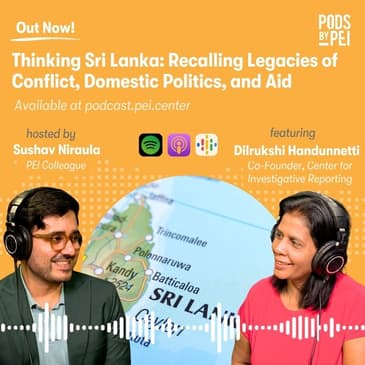
Ep#090
Dilrukshi is an international award-winning investigative journalist and a lawyer from Sri Lanka. She has worked extensively across South Asia as an on-ground reporter and trainer. As an investigative journalist, she has broken stories on grand corruption and crime, conflict and communities, and dedicated significant time to reporting on women, children, health, and the environment. A recipient of many prestigious journalism fellowships, she won the coveted Wash Media Award in 2014. She was also the Sri Lankan Journalist of the Year in 2012.
Sushav and Dilrukshi discuss Sri Lanka's complex socio-political history, including its violent ethnic conflict and colonial legacy, exploring the role of various events in shaping its identity. Drawing simultaneously from her work and her lived experience of the war, Dilrukshi illustrates the political roots of the conflict, reflecting on the civil war's impact and the quest for ethnic minority rights, including the rise of groups like the LTTE. They also examine international influences, notably from India, China, and the West, on Sri Lanka's political landscape and review its governance challenges, human rights issues, and economic reforms. The dialogue concludes with reflections on Sri Lanka's civic space, civil society, press freedom, and the broader South Asian context of handling dissent and nurturing democratic spaces.
If you liked the episode, hear more from us through our free newsletter services, PEI Substack: Of Policies and Politics, and click here to support us on Patreon!!
[00:00:00] [SPEAKER_00]: Namaste and welcome to PODS by PEI, a policy discussion series brought to you by Policy
[00:00:18] [SPEAKER_00]: Entrepreneurs Inc.
[00:00:19] [SPEAKER_00]: I am Ridesh Apkota.
[00:00:21] [SPEAKER_00]: In today's episode, PEI colleague Susabh Nirawala is in conversation with Sri Lankan investigative
[00:00:26] [SPEAKER_00]: journalist Dil Rukshi Hanboniti on thinking Sri Lanka, recalling legacies of conflict, domestic
[00:00:32] [SPEAKER_00]: politics and aid.
[00:00:34] [SPEAKER_00]: Dil Rukshi is an international award-winning investigative journalist and a lawyer from
[00:00:38] [SPEAKER_00]: Sri Lanka.
[00:00:39] [SPEAKER_00]: She has worked extensively across South Asia as an on-ground reporter and trainer.
[00:00:44] [SPEAKER_00]: As an investigative journalist, she has broken stories on grand corruption and crime,
[00:00:49] [SPEAKER_00]: conflict and communities and dedicated significant time to reporting on women, children, health
[00:00:55] [SPEAKER_00]: and the environment.
[00:00:56] [SPEAKER_00]: As a recipient of many prestigious journalism fellowships, she won the coveted WAS Media Award
[00:01:02] [SPEAKER_00]: in 2014.
[00:01:03] [SPEAKER_00]: She was also the Sri Lankan journalist of the year in 2012.
[00:01:07] [SPEAKER_00]: Susabh and Dil Rukshi discuss Sri Lanka's complex socio-political history including
[00:01:12] [SPEAKER_00]: its violent ethnic conflict and colonial legacy, exploring the rules of various events
[00:01:17] [SPEAKER_00]: in shaping its identity.
[00:01:19] [SPEAKER_00]: Drawing simultaneously from her work and her lived experience of the war, Dil Rukshi
[00:01:23] [SPEAKER_00]: illustrates the political roots of the conflict, reflecting on civil war's impact and quest
[00:01:28] [SPEAKER_00]: for ethnic minority rights, including the rise of groups like the LTTE.
[00:01:32] [SPEAKER_00]: They also examine international influence notably from India, China and the West on
[00:01:38] [SPEAKER_00]: Sri Lanka's political landscape and review its governance challenges, human rights issues
[00:01:43] [SPEAKER_00]: and economic reforms.
[00:01:45] [SPEAKER_00]: The dialogue concludes on the reflections on Sri Lanka's civic space, civil society,
[00:01:50] [SPEAKER_00]: press freedom and the broader South Asian context of handling dissent and nurturing democratic
[00:01:55] [SPEAKER_00]: spaces.
[00:01:56] [SPEAKER_00]: We hope you enjoy the conversation.
[00:02:20] [SPEAKER_04]: The idea amongst others, Dil Rukshi was principally here for that but I couldn't resist the opportunity
[00:02:27] [SPEAKER_04]: of her presence to discuss about Sri Lanka.
[00:02:30] [SPEAKER_04]: Sri Lanka and Nepal share a lot in common issues like ethnic politics, conversation around
[00:02:36] [SPEAKER_04]: post-war or post-conflict reconciliation, managing relationship between India and China,
[00:02:43] [SPEAKER_04]: conversations around donors and development, common questions regarding accountability
[00:02:48] [SPEAKER_04]: and corruptions with our respective governments.
[00:02:51] [SPEAKER_04]: These are questions that we share.
[00:02:53] [SPEAKER_04]: I understand that we cannot cover all these conversations in one setting.
[00:02:58] [SPEAKER_04]: We'll focus around the issue of ethnic conflict in Sri Lanka but alongside doing that, we'll
[00:03:05] [SPEAKER_04]: also touch on other common aspects that we, Nepal and Sri Lanka share.
[00:03:12] [SPEAKER_04]: So let's get right at it.
[00:03:14] [SPEAKER_04]: Throughout Nepali listeners especially, can you share a bit of history about Sri Lanka?
[00:03:20] [SPEAKER_04]: By that I mean when does the period of modern nation state of Sri Lanka as we know today
[00:03:25] [SPEAKER_04]: begin from, is it 1948 when Sri Lanka became independent from the Britishers or are there
[00:03:32] [SPEAKER_04]: other crucial points?
[00:03:34] [SPEAKER_02]: Well, Sri Lanka is one of the oldest democracies in South Asia but the modern
[00:03:41] [SPEAKER_02]: nation state as you mentioned dates back to 1948 and we were colonized by the British
[00:03:50] [SPEAKER_02]: and following Indian independence.
[00:03:53] [SPEAKER_02]: A few months later Sri Lanka was also declared independent and of Indian, different to Indian
[00:03:59] [SPEAKER_02]: independence struggle, Sri Lanka was very different.
[00:04:03] [SPEAKER_02]: Sri Lankan independence struggle was an intellectual one.
[00:04:07] [SPEAKER_02]: That was about bargaining with the British and using India to leverage and there was
[00:04:14] [SPEAKER_02]: no bloodletting in Sri Lanka but I think we were beneficiaries of the Indian struggle
[00:04:21] [SPEAKER_02]: and so the modern state was born in 1948.
[00:04:26] [SPEAKER_04]: Before 1948, were you guys divided into small kingdoms or were you?
[00:04:31] [SPEAKER_02]: Yes, we had Ruhu No, Pehiti and Maya and provincial kings ruled.
[00:04:36] [SPEAKER_02]: So lots being said about power devolution and I think Sri Lanka knew power devolution when
[00:04:43] [SPEAKER_02]: you had provincial kings but at times it has been unified by different kings, the entirety
[00:04:48] [SPEAKER_02]: of Sri Lanka but 1948 of course was a watershed moment and it created the modern salon
[00:04:57] [SPEAKER_02]: and then we became Sri Lanka.
[00:05:00] [SPEAKER_04]: Getting along this conversation of identity and conflict, I wanted to understand what
[00:05:05] [SPEAKER_04]: were the major factors that led to the civil war in 1983?
[00:05:10] [SPEAKER_04]: How did that deal up?
[00:05:12] [SPEAKER_04]: As we know, Sri Lanka civil war went on from 1983 to 2009 and claimed more than 80,000
[00:05:19] [SPEAKER_04]: lives so I just wanted to understand what was the starting point of all that conflict
[00:05:25] [SPEAKER_04]: what led to it.
[00:05:27] [SPEAKER_02]: Okay, so that also has some history and I think besides the territorial question,
[00:05:33] [SPEAKER_02]: the language do has been a huge one.
[00:05:36] [SPEAKER_02]: The Singhala language policy which was driven by SWRD Bandar Nairnaika who was a plural man,
[00:05:43] [SPEAKER_02]: a democrat but I think the politics of the day went against him and in a weak moment
[00:05:50] [SPEAKER_02]: this policy was introduced and then with that single stroke of division when your language
[00:05:58] [SPEAKER_02]: becomes the second best and gets reduced.
[00:06:01] [SPEAKER_02]: I think the language played a huge part and then we had the Republican constitution in 1972
[00:06:11] [SPEAKER_02]: and the Tamils also felt that they were losing out a lot through that and all of that collectively,
[00:06:18] [SPEAKER_02]: so it's now one single moment, one single incident.
[00:06:21] [SPEAKER_02]: Then in 1976 we saw the proliferation of political groups, dissenters,
[00:06:31] [SPEAKER_02]: you can call them resistance groups and they got armed.
[00:06:35] [SPEAKER_02]: The TOLF, Tamil United Liberation Fund was the first and then there was a crop of other
[00:06:43] [SPEAKER_02]: resistance groups and they got armed and they got trained in South India so that you know it's never
[00:06:50] [SPEAKER_02]: really been- South India.
[00:06:51] [SPEAKER_02]: Yes, of course the camps are in South India and then you have this whole tension within
[00:06:56] [SPEAKER_02]: your country and there is a real connection to your neighboring country because there is
[00:07:03] [SPEAKER_02]: this support for identity and it drives a certain political interest and even a wedge
[00:07:09] [SPEAKER_02]: between the two large ethnic groups in the country so then we come to 83.
[00:07:15] [SPEAKER_02]: So you have resistance groups and you may call them rebel, you know whatever,
[00:07:20] [SPEAKER_02]: resistance, insurgents, all kinds of terminologies used around them and then there is this military
[00:07:27] [SPEAKER_02]: engagements.
[00:07:29] [SPEAKER_02]: In 1983 the LTD Liberation Tigers of Tamil Ilam killed 13 soldiers and then the state,
[00:07:38] [SPEAKER_02]: the Colombo Singhala State made sure that there was a program of obviously and then there
[00:07:43] [SPEAKER_02]: was violence that targeted Tamils.
[00:07:46] [SPEAKER_02]: I remember this, I was a kid and I remember that and it was so senseless.
[00:07:50] [SPEAKER_02]: I never understood but I still remember the buildings burning and in my mind there is still
[00:07:56] [SPEAKER_02]: this car turn upwards and it's like consumed in flames.
[00:08:01] [SPEAKER_02]: That whole senselessness of it all and the fear of people, something's really changed
[00:08:08] [SPEAKER_02]: that day, that month, 83 July and I don't think we have ever really rebuked our relationship.
[00:08:19] [SPEAKER_04]: The language policy, Singhala only language policy I think it was recognized as the
[00:08:23] [SPEAKER_04]: official language while not giving the similar status to Tamil language right?
[00:08:28] [SPEAKER_02]: And another issue was also the state was also colonizing, this is how the Tamils would
[00:08:34] [SPEAKER_02]: colonizing the saying hello governments called it settlement and development projects like the
[00:08:40] [SPEAKER_02]: Gallaway project in the North Central province.
[00:08:43] [SPEAKER_02]: So you have people, the Singhala is being settled in what the Tamils felt were originally
[00:08:49] [SPEAKER_02]: the lands that they occupied.
[00:08:51] [SPEAKER_04]: I see now I want to take this conversation and focus on how a particular Tamil militant
[00:08:58] [SPEAKER_04]: organization resisted.
[00:09:00] [SPEAKER_04]: So you have 1983, several worst starts from my reading I see there were a lot of
[00:09:08] [SPEAKER_04]: militant organizations but then LTTE, Liberation Tigers of Tamil Ilam they gain
[00:09:16] [SPEAKER_04]: upper hand and slowly they become the militant organization.
[00:09:21] [SPEAKER_04]: They started out as a relatively small guerrilla force but they went on to resemble this modern
[00:09:26] [SPEAKER_04]: forces with having their own military wing including Navy and airborne units.
[00:09:32] [SPEAKER_04]: So from a small guerrilla force to being an organization that resembles a modern armed force
[00:09:38] [SPEAKER_04]: how did they go on about being that force?
[00:09:42] [SPEAKER_04]: Because I see the geography of Sri Lanka it seems pretty secluded right and with
[00:09:48] [SPEAKER_04]: a majority in state with their power on face pillow it seems that it could have easily
[00:09:55] [SPEAKER_04]: gained control but that didn't happen it went on for quite a period.
[00:10:00] [SPEAKER_04]: The war started at 1983 and ended at 2009 right so a lot of it was because of the strength of
[00:10:07] [SPEAKER_04]: LTTE. So the question to you is what was the basis of that strength through which they could
[00:10:12] [SPEAKER_04]: develop so advanced and challenged Sri Lankan state?
[00:10:16] [SPEAKER_02]: So the LTTE wanted to be recognized as the sole representative of the Tamil people
[00:10:22] [SPEAKER_02]: and this was resisted by certain other groups.
[00:10:25] [SPEAKER_04]: Tamil groups.
[00:10:25] [SPEAKER_02]: Yes you have all these multiple groups and everybody wants to have a piece of that pie
[00:10:31] [SPEAKER_02]: but the LTTE grew in strength and in influence. I think any liberation organization they call
[00:10:40] [SPEAKER_02]: themselves a liberation front right and we may call it by any other name and I used to cover
[00:10:47] [SPEAKER_02]: I was a journalist and I was actually going to the north and reporting and was also privy to
[00:10:53] [SPEAKER_02]: the dialogues peace dialogues between the government and the liberation attackers
[00:10:58] [SPEAKER_02]: of Tamil leader so I have some insights no movement can take such strong root in any place
[00:11:05] [SPEAKER_02]: if there's no civil support. So I think the issue of identity the issue of deprivation of
[00:11:12] [SPEAKER_02]: political grievances of living through violence as citizens civilians all of that and being treated
[00:11:19] [SPEAKER_02]: as second-class citizens or being denied are things that contribute to civil unrest and unhappiness
[00:11:27] [SPEAKER_02]: and the LTTE came to symbolize those aspirations of the Tamil people we may not like to hear this
[00:11:34] [SPEAKER_02]: but they definitely gave expression to the people's requirements and of course it was a violent
[00:11:40] [SPEAKER_02]: group and Tamils were also at the receiving end you couldn't resist the LTTE they ruled they had
[00:11:48] [SPEAKER_02]: tax systems and I used to get taxed so every time I crossed from this end so that we had this area
[00:11:54] [SPEAKER_02]: called the border and their defined border so you cross that the speed limit in the rest of
[00:11:59] [SPEAKER_02]: Sri Lanka was different and driving at 60 was upper limit all that so I get fined if my van
[00:12:06] [SPEAKER_02]: goes at 60 and for me to see a real other state within one country now it's interesting but it was
[00:12:16] [SPEAKER_02]: mind-blowing at that time yeah everything changes from the topography geographically what it looks
[00:12:22] [SPEAKER_02]: like from the palms to the clothes to how people live everything changed secondly I think besides the
[00:12:30] [SPEAKER_02]: fact that they had acceptance whether it was by force or by real you know organic support
[00:12:36] [SPEAKER_02]: they had public support we cannot deny this and then there was this growing diaspora influence
[00:12:44] [SPEAKER_02]: we have driven people out of our country Tamils mostly and some of them ended up in South India
[00:12:49] [SPEAKER_02]: as refugees when the when the war broke out in 1980 three people were taking boats to go to India
[00:12:57] [SPEAKER_02]: and seeking refuge so Sri Lanka has not given protection to all Sri Lankans
[00:13:02] [SPEAKER_02]: and then others who could who had the leverage of money and education went to western countries
[00:13:08] [SPEAKER_02]: and then they funded then they supported and they believed in a cause and so I think the diaspora
[00:13:15] [SPEAKER_02]: played a huge role in supporting the LTT so you're talking about the money the financial
[00:13:20] [SPEAKER_02]: capacity the military capacity let's not also forget our beautiful neighbor they definitely
[00:13:27] [SPEAKER_02]: had a role to play and it's very well documented and something history has been unkind I think my
[00:13:32] [SPEAKER_02]: personal take to Rajiv Gandhi who was trying to correct something that happened during Mrs. Gandhi's
[00:13:39] [SPEAKER_02]: time and it was possibly too late for him to enter but he did try India played a critical role in
[00:13:48] [SPEAKER_02]: arming and training the LTT and other groups so you knew how to use the weapons and you
[00:13:55] [SPEAKER_04]: also had your supply route and you said this was mostly during the period of Indira Gandhi
[00:14:01] [SPEAKER_02]: well the beginnings the training and all that since then when you have the diaspora growing
[00:14:06] [SPEAKER_02]: and becoming a fluent the money flows you know how militant groups function yeah then you have
[00:14:14] [SPEAKER_02]: all kinds of other things about trade and narcotics and arms and all of that LTT was
[00:14:23] [SPEAKER_04]: you know I did spin a lot of points so what I want to get back now is you said LTT received
[00:14:29] [SPEAKER_04]: support from India but then I also read how LTT attacked India at one point so why was that
[00:14:37] [SPEAKER_02]: okay I think there's a small nuance thing yeah the dynamic between when you say support it was
[00:14:43] [SPEAKER_02]: largely the training and the easy passage for armaments but very quickly India changed India
[00:14:51] [SPEAKER_02]: had to change that is also because Tamil Nadu is part of India and it's like you know we are we are
[00:14:56] [SPEAKER_02]: separated by 16 kilometers the proximity you know we are closer to Tamil Nadu than Tamil Nadu to Delhi
[00:15:04] [SPEAKER_02]: yeah so when in your backyard there is this growing power of militancy I think the Indian
[00:15:12] [SPEAKER_02]: security state had very good reason to be concerned about the one that they were feeding
[00:15:18] [SPEAKER_02]: in a way having said that so once it was done again I think it's also an extension of the divide and rule
[00:15:25] [SPEAKER_02]: India divides and rules I'm not going to mince my words on this one it does all big powers do
[00:15:32] [SPEAKER_02]: even small countries try we if we can we also try to get the wedge between something right and
[00:15:36] [SPEAKER_02]: get the advantage so it's it's international politics but when you do that you have domestic
[00:15:44] [SPEAKER_02]: concerns and to be fair to India I think managing Tamil Nadu a large Indian state which has its own
[00:15:51] [SPEAKER_02]: identity itself can be very problematic India is many countries in within one country and in that
[00:15:58] [SPEAKER_02]: all these identities and languages and aspirations of people it's very difficult to manage the
[00:16:04] [SPEAKER_02]: terminals are originally from Sri Lankan Tamils are deeply connected culturally and linguistically
[00:16:10] [SPEAKER_02]: to Tamil Nadu so you would want to be very cautious about that growing identity and intimacy
[00:16:18] [SPEAKER_02]: that's one and finally when Colombo wanted to have this discussion and bring the LTT to the
[00:16:27] [SPEAKER_02]: table India played a huge role the moment India played that role of bringing these two groups
[00:16:33] [SPEAKER_02]: together there was resistance and the LTT felt that India was changing this was no longer the pro LTT
[00:16:42] [SPEAKER_02]: or LTT supportive India and when I say supportive I say I want to qualify this word it's politically
[00:16:49] [SPEAKER_02]: aspirationally supportive because training phases ended by that time and then you want to think
[00:16:57] [SPEAKER_02]: that the LTT not only resisted could not probably understand and I met a lot of
[00:17:04] [SPEAKER_02]: Tamil leaders except for Velu Pillai Prabhakaran I've interviewed almost all those leaders and so
[00:17:11] [SPEAKER_02]: when you really unpack the history during peacetime where during the peacetalks and ceasefire
[00:17:18] [SPEAKER_02]: I had access to these people and to understand how they were unpacking politics and looking at
[00:17:24] [SPEAKER_02]: those historical times when all these things happened with the Indolanka Accord which was signed
[00:17:30] [SPEAKER_02]: between Rajiv Gandhi and the then Sri Lankan president J R Javodana well let's say Sri Lanka didn't like
[00:17:37] [SPEAKER_02]: it Colombo didn't like it they didn't like it people felt we were forced to run and that India
[00:17:42] [SPEAKER_02]: was twisting their arm and the Tamils they liked it they didn't do this is the interesting
[00:17:46] [SPEAKER_02]: thing you did not please any group right you're making both groups feel very unhappy about it
[00:17:52] [SPEAKER_02]: and I think you know he when you live through that moment and much later only you have that
[00:17:58] [SPEAKER_02]: peace of mind to unpack incidents and look at it with some new ones even Rajiv Gandhi I think had
[00:18:05] [SPEAKER_02]: a tough time trying to you know find some middle ground and after the peace accord so you have
[00:18:11] [SPEAKER_02]: conditions and the LTT is strongly resisted and I think Colombo did not have much opportunity to
[00:18:17] [SPEAKER_02]: resist but I think J R Javodana was very smart at that moment he also doesn't get credit for some
[00:18:24] [SPEAKER_02]: things you know we are all very good at criticizing leaders but when he was the president at the
[00:18:31] [SPEAKER_02]: time the first degree president of Sri Lanka so we also had then the IPK Indian peacekeeping forces
[00:18:38] [SPEAKER_02]: 3000 boots on the ground this really put the Tamils off India because now you have Indian
[00:18:46] [SPEAKER_02]: troops Hindi speaking not Tamil speaking Hindi speaking any other language right of India
[00:18:52] [SPEAKER_02]: but not necessarily Tamil speaking this is what people used to tell me people who are now old and
[00:18:58] [SPEAKER_02]: remember the time I would say like they were not talking our language so there was a disconnect
[00:19:04] [SPEAKER_02]: and I think after the IPK and how IPK went after the LTT because that was part of the accord
[00:19:11] [SPEAKER_02]: to bring control to crush the LTT IPK played a huge role there is a monument for the IPK in
[00:19:18] [SPEAKER_02]: Sri Lanka so we do remember them Sri Lanka does remember them and I think Tamils don't want to
[00:19:24] [SPEAKER_02]: remember them so things have changed there is no one single thread right to anything history
[00:19:31] [SPEAKER_02]: is all about these changing threads and even based on ones based and our own understanding
[00:19:38] [SPEAKER_02]: changes so when India changed the severe assistance to that India from mostly the Tamils but singhalese
[00:19:48] [SPEAKER_02]: had God a very contentious relationship with India they do not trust India largely
[00:19:56] [SPEAKER_02]: they think there is always vested interest and even yesterday I was saying that there is a lot
[00:20:01] [SPEAKER_02]: of historical baggage and one bit of that baggage an important piece is the fact that
[00:20:08] [SPEAKER_02]: the the arming and the support training of dissenting groups interesting I think a lot of
[00:20:17] [SPEAKER_04]: these things like fall out when we look at binary so someone who doesn't follow Sri Lankan politics
[00:20:24] [SPEAKER_04]: it's like singhala and Tamils fighting India has Tamil populace and so they must be closer
[00:20:30] [SPEAKER_04]: Tamils you know but then you have conflict between these groups as well so I think it's
[00:20:35] [SPEAKER_02]: interesting to follow that as well talking about ethnic politics so Tamil Nadu's ethnic
[00:20:41] [SPEAKER_02]: politics would be so close to what we have in the northern part of Sri Lanka so how can you
[00:20:46] [SPEAKER_02]: not show support to the Tamils of Sri Lanka even when you know you wouldn't want to be one
[00:20:52] [SPEAKER_02]: state it's such a pipe dream and Delhi has to appease Tamil Nadu too right yep and now moving
[00:21:00] [SPEAKER_04]: on to understand Tamil as a group better normally from the outside there is a tendency to see
[00:21:08] [SPEAKER_04]: Tamils as a monolithic category but based on my cursory reading there are different subgroups
[00:21:14] [SPEAKER_04]: with different identity within that monolithic category I just wanted to ask and understand
[00:21:20] [SPEAKER_04]: what sort of prominent different subgroups have been there historically have these subgroups had
[00:21:26] [SPEAKER_04]: similar way of engaging with this Sri Lankan state or have they been different so the subgroup
[00:21:31] [SPEAKER_02]: questions within Tamils yes so you have people who are brought from India for the longest
[00:21:39] [SPEAKER_02]: period of time they were called Indian laborers can you imagine the language used it was so
[00:21:45] [SPEAKER_02]: condescending and these people were brought from parts of India and then from large it
[00:21:51] [SPEAKER_02]: on and south India and then they worked in the plantations T growing British got these
[00:21:59] [SPEAKER_02]: people to work and what happens Sri Lanka doesn't give them citizenship and then there
[00:22:04] [SPEAKER_02]: is this cinema Shastri packed to give them citizenship and in the 60s around 300,000
[00:22:12] [SPEAKER_02]: people Tamils of Indian origin as they were called were given citizenship and another over
[00:22:20] [SPEAKER_02]: 500,000 people were returned so they were repatriated and the question today is live
[00:22:27] [SPEAKER_02]: there is a call for fully fledged political rights of this community so that's a second
[00:22:33] [SPEAKER_02]: community while during so these are the two main groups one who have been there historically
[00:22:39] [SPEAKER_04]: and one who are predecessors brought in to work in the plantations so two main subgroups of Tamils
[00:22:49] [SPEAKER_02]: the second group has not been violent there's never been any uprising they have been less
[00:22:55] [SPEAKER_02]: than citizens never really fully treated Sri Lanka's unspoken people and really the margin
[00:23:04] [SPEAKER_04]: and within these group how did they engage with the state was it logically speaking some
[00:23:10] [SPEAKER_04]: opted parliamentary politics and some opted arms was that sort of dynamics there or
[00:23:17] [SPEAKER_04]: there were a single force going through militant route to demand their rights
[00:23:23] [SPEAKER_02]: so salon workers congress CWC became a huge political force and this was created
[00:23:32] [SPEAKER_02]: so this is about Tamils who were brought central parts of Sri Lanka I see yes they became
[00:23:37] [SPEAKER_02]: the king makers later on yeah in the 80s and early 90s they were the king makers they got a lot of
[00:23:44] [SPEAKER_02]: power a lot of clout and in the central parts you know you have sizable representation you
[00:23:50] [SPEAKER_02]: represent the working class plantation workers with huge numbers so you have a lot of
[00:23:55] [SPEAKER_02]: representation and they leveraged on that and they were deciding as to who would gain parliamentary
[00:24:02] [SPEAKER_02]: majority so to that extent they were very clever but at the same time some of them were rich of
[00:24:08] [SPEAKER_02]: course you know this is how politics work but they are the most unservice people of Sri Lanka
[00:24:16] [SPEAKER_02]: and you have these good indicators about Sri Lanka right our health our education
[00:24:22] [SPEAKER_02]: our sanitation all that's good but not if you look at the plantations that's that untold story
[00:24:27] [SPEAKER_02]: so even the politicians did not service them but they used them for votes so they assimilated and
[00:24:33] [SPEAKER_02]: worked with the single majority governments extremely well securing powerful portfolios
[00:24:40] [SPEAKER_02]: and having control over aspects of economy like plantations minister of plantations that's a big
[00:24:47] [SPEAKER_02]: thing for a country that produces tea the finest tea is in the world so that engagement was different
[00:24:54] [SPEAKER_02]: these two groups never really identified with each other and I think towards the end when
[00:25:00] [SPEAKER_02]: peacetalks happened the LTT did make an attempt with that sole representative of the Tamil people
[00:25:07] [SPEAKER_02]: thing to extend but there are many reasons as to why the northern Tamil would not want to
[00:25:14] [SPEAKER_02]: be the representative of the central province Tamil of Indian origin I say interesting we have
[00:25:22] [SPEAKER_04]: somewhat of similar equation here in as in ethnic minority parties the Madae's based parties
[00:25:30] [SPEAKER_04]: they are also in position of king makers it's a question of what they do that with that power
[00:25:38] [SPEAKER_04]: but they are in that position so now moving on to the question of post-war reconciliation what has
[00:25:46] [SPEAKER_04]: that been like while following the news I could see issues of devolution and transitional justice
[00:25:52] [SPEAKER_04]: pop up in Sri Lanka in Nepal's case as well as part of post conflict restructuring we
[00:25:58] [SPEAKER_04]: transition into federal governance additionally we are also in the process of tabling the
[00:26:03] [SPEAKER_04]: truth and reconcile the bill in the parliament I'll buy it a bit too late
[00:26:09] [SPEAKER_02]: okay see the original call of the Tamil people also included federalism a federal state
[00:26:16] [SPEAKER_02]: so the 13th amendment which was the brainchild of you know it is a spin-off of this piece of code
[00:26:25] [SPEAKER_02]: so you want to develop power and I think that's a very important watershed moment in
[00:26:30] [SPEAKER_02]: politics Sri Lanka has as we discussed had these provincial kingdoms but then we became unified
[00:26:37] [SPEAKER_02]: and we only could see one single country and I think it's all right to see Sri Lanka as one
[00:26:43] [SPEAKER_02]: single country but at the same time there is a real need to share power with all the people in
[00:26:50] [SPEAKER_02]: this country not just Tamil there are Muslims there are burgers we have driven the burgers
[00:26:55] [SPEAKER_02]: out of this country as well yeah with the language policy we also made made it impossible for them to
[00:27:01] [SPEAKER_02]: group so what did you mention burgers we called them Sri Lankan burgers but they are people of
[00:27:06] [SPEAKER_02]: dutch and Portuguese origin largely dutch and they have contributed to Sri Lanka's architecture
[00:27:11] [SPEAKER_02]: and arts in a big way but we have been dispossessing people for the longest possible time in a
[00:27:18] [SPEAKER_04]: quite a shameful story is there an attempt towards post-war reconciliation right now no
[00:27:24] [SPEAKER_02]: this was like you know post independence but in post war push 2009 yeah so the attempt was
[00:27:33] [SPEAKER_02]: to after the 13th amendment one of the biggest grievances was that the 13th amendment was never
[00:27:38] [SPEAKER_02]: truly implemented by the single state we have never really even when we set up the
[00:27:43] [SPEAKER_02]: northern council the chief minister who you know I speak to him sorry for our listener
[00:27:49] [SPEAKER_04]: the third in amendment talked about the revolution of power it was in 1987 yeah so and then you have
[00:27:56] [SPEAKER_02]: these nine provinces and then you have a chief minister and you have a provincial council for
[00:28:01] [SPEAKER_02]: each of the states so technically the the requirement comes from the north right so it's
[00:28:07] [SPEAKER_02]: very critically important to show your commitment by setting it up so yes it was done so there is
[00:28:14] [SPEAKER_02]: a northern provincial council varda rajaparumar was the first chief minister we talk about northern
[00:28:22] [SPEAKER_02]: province we talk a lot a very interesting very very interesting historical figure he is
[00:28:28] [SPEAKER_02]: he kept on coming to kalambo to you know make sure that this becomes a functional reality
[00:28:37] [SPEAKER_02]: and yeah he has told this to me in a number of interviews and eventually he's remembered for
[00:28:43] [SPEAKER_02]: declaring separate state and you know raising the flag and saying that this is a separate
[00:28:49] [SPEAKER_02]: state why we kalambo drove him to that desperate level of so we have never been true to the idea
[00:28:56] [SPEAKER_02]: of sharing power now you have provincial councils and a lot of people don't feel it's an important
[00:29:03] [SPEAKER_02]: political you know body because they don't really truly serve the people and they're seen as
[00:29:09] [SPEAKER_02]: wide elephants it's important to see that the one thing our unit of devolution is the problem
[00:29:16] [SPEAKER_02]: and then we never really feed it we never really make it take root and function so all these
[00:29:22] [SPEAKER_02]: aspirational things that have been lost in the annals of time contribute to our unhappiness
[00:29:29] [SPEAKER_02]: collective unhappiness and then we have the war and obviously our engagement in terms of
[00:29:37] [SPEAKER_02]: the Sri Lankan state with the LTT in talks is you know it's rooted in suspicion everybody thinks
[00:29:44] [SPEAKER_02]: that you know you're really not going to make a good bargain you just out there to you know crush
[00:29:49] [SPEAKER_02]: the other so all that distrust and then you have the end of the war was create victors and
[00:29:57] [SPEAKER_02]: vanquished and for this proud Tamil race I think it was really you know you lose your
[00:30:04] [SPEAKER_02]: opportunity your bargaining clout without the LTT you lose your bargaining clout so and then you talk
[00:30:12] [SPEAKER_02]: about transitional justice at the time my Rajapaksha's government was hell bent on bringing the war to an
[00:30:22] [SPEAKER_02]: end and people were tired there was war fatigue I'm sure the war fatigue is common to the south
[00:30:28] [SPEAKER_02]: and the north perhaps more to the north we didn't hear them too much so in that sense I think most
[00:30:35] [SPEAKER_02]: people felt at some point this had to come to an end but it was a very violent end which according
[00:30:42] [SPEAKER_02]: to the UN estimated over 60,000 people's lives being lost and many many thousand missing
[00:30:49] [SPEAKER_02]: so in that you try to introduce these mechanisms but why the mechanisms are something that
[00:30:57] [SPEAKER_02]: some of the single reason some of the Tamils may have wanted and all the international order
[00:31:03] [SPEAKER_02]: so there was a lot of you know international pressure to move to the second level unfortunately
[00:31:09] [SPEAKER_02]: for Mahindra Rajapaksha there was no real honest commitment to make sure that we transition
[00:31:16] [SPEAKER_02]: from the war phase to a post-war and transformative phase where we actually start working with the
[00:31:24] [SPEAKER_02]: Tamil people when they are trust become one country which is what you wanted so I don't think there was
[00:31:30] [SPEAKER_02]: political commitment even at that stage so these were like you know mechanisms that didn't he was
[00:31:37] [SPEAKER_02]: not even considering all of that he could have we always say that he could have been the
[00:31:41] [SPEAKER_02]: Nelson Mandela Sri Lanka it's just that he ended up being Robert Mugabe this is something that a lot
[00:31:46] [SPEAKER_02]: of people say but it was much later these mechanisms came when president Maitri Palasiri Sena and the
[00:31:53] [SPEAKER_02]: current president promised at that time Prime Minister Rani Lekramasinha he believed in that
[00:31:59] [SPEAKER_02]: and they they wanted these mechanisms so it wasn't as if the Rajapaksha's were you know
[00:32:04] [SPEAKER_02]: interested in pushing peace they were only interested in ending the war I see a bit of small
[00:32:12] [SPEAKER_04]: follow-up with the devolution and provinces in Nepal we have provinces but then there's still
[00:32:19] [SPEAKER_04]: a question of devolving power things are centralized is it the same in Sri Lanka as well like you
[00:32:26] [SPEAKER_04]: already are divided into provinces the question is you know them having power to govern themselves
[00:32:32] [SPEAKER_04]: is it that you still have to work around the first bit about the center government is that
[00:32:36] [SPEAKER_02]: Congress is still up but that's a settled one well it's the mapping of it is done
[00:32:42] [SPEAKER_02]: the power sharing is not done you have power technically you have power you don't have police
[00:32:48] [SPEAKER_02]: power you don't have power over lands because this whole territorial thing is a huge issue for
[00:32:53] [SPEAKER_02]: Sri Lanka but you're still working around the central government and so you have the
[00:32:59] [SPEAKER_02]: central government and always the provincial councils have to work with the central government
[00:33:04] [SPEAKER_02]: for other provinces it's not an issue but I think it's a huge come down for those who wanted a separate
[00:33:10] [SPEAKER_02]: state and wanted autonomy that word autonomy doesn't even figure anymore I see it's somewhat
[00:33:17] [SPEAKER_04]: similar I think we have technically divided into provinces but the powers that is aren't there
[00:33:24] [SPEAKER_04]: we fail to operationalize it through regulations rules and though our constitution imagines some
[00:33:30] [SPEAKER_04]: mode of power sharing structure but when it comes to drafting those regulations and acts you know
[00:33:37] [SPEAKER_02]: so you have a schedule of powers like we have a schedule this is what is devolved
[00:33:41] [SPEAKER_04]: yes but it's very blurry you have overlapping mandates and then for that to operationalize
[00:33:46] [SPEAKER_04]: you need regulations and and they're in the center government comes in and puts it all on
[00:33:51] [SPEAKER_04]: under their control so that has been one of the pivotal thing regarding our federalism story
[00:33:57] [SPEAKER_04]: yeah we have power division but that hasn't been operationalized yeah so center
[00:34:05] [SPEAKER_04]: you know has majority of it and the provinces are just helpless and now moving on to a bit
[00:34:12] [SPEAKER_04]: of a tangential question but I think it's something we can learn from Sri Lanka's experience
[00:34:18] [SPEAKER_04]: in Nepal due to the current instability brought in by coalition politics there has been a growing
[00:34:25] [SPEAKER_04]: call for an executive presidency Sri Lanka on the other hand has shifted from the
[00:34:30] [SPEAKER_04]: Westminster system to a more of a French like system of the executive presidency
[00:34:37] [SPEAKER_04]: how has that experience with executive presidency been like in Sri Lanka
[00:34:42] [SPEAKER_04]: on what aspect do you think it has helped and where do you think it can be a disadvantage
[00:34:48] [SPEAKER_04]: please feel free to highlight both development and human rights related aspect visa v executive
[00:34:54] [SPEAKER_02]: presidency one of the most contentious topics in Sri lankan politics would be the executive
[00:35:00] [SPEAKER_02]: presidency so you're right it's very de gallist our constitution right so we have a very
[00:35:07] [SPEAKER_02]: de gallist executive president who has lots of power lots of power concentrated on one single
[00:35:14] [SPEAKER_02]: individual so it is like the dance of the prima donna right you dance around we of course have
[00:35:22] [SPEAKER_02]: a parliamentary system we have an executive president we have a cabinet of ministers so
[00:35:29] [SPEAKER_02]: that's how the government functions the president is also the head of the cabinet
[00:35:34] [SPEAKER_02]: and that's important and the president also retains to at least two key this tradition
[00:35:42] [SPEAKER_02]: there this is not written but then they all have retained defense and finance yeah so control
[00:35:51] [SPEAKER_02]: over a lot of things and also the executive president is also the head of armed forces
[00:35:58] [SPEAKER_02]: right so whenever you want you can mobilize the military since jaya javadhan's ascendancy
[00:36:05] [SPEAKER_02]: and he created this position he's a very interesting lawyer so everyone else who followed him promised
[00:36:13] [SPEAKER_02]: to abolish it but we still have an executive president so those who get to that position
[00:36:20] [SPEAKER_02]: understand it's a lot of power command re-in-chief of the armed forces you know and then control
[00:36:26] [SPEAKER_02]: over your public finance through the finance portfolio and of defense which i can understand
[00:36:35] [SPEAKER_02]: so that's a lot of power and also the right to appoint people this has got diluted later
[00:36:42] [SPEAKER_02]: with the 19th amendment which was once again destroyed by the rajapaksha because we amended
[00:36:47] [SPEAKER_02]: that to 19th amendment created a space for independent public commissions like the police
[00:36:54] [SPEAKER_02]: all of that has been undone much later so it is a very powerful position where one person
[00:37:02] [SPEAKER_02]: is capable of making a lot of decisions on behalf of the people so people understand it's too much
[00:37:08] [SPEAKER_02]: power in the hands of one man except in one instance we haven't had a woman they all have
[00:37:14] [SPEAKER_02]: excesses as a result we have spoken about the political manifest the various parties
[00:37:20] [SPEAKER_02]: have in their manifestos promise to abolish it's one of the most popular slogans we will
[00:37:25] [SPEAKER_02]: abolish executive presidency and we never do it and i think those who get to that point enjoy the
[00:37:33] [SPEAKER_02]: power this is an election year in Sri Lanka but i don't see this even becoming a promise
[00:37:40] [SPEAKER_04]: interesting we here in Nepal are frustrated with our west minister system where you need
[00:37:46] [SPEAKER_04]: coal is in to run the government you or Sri Lanka on the other end it seems that
[00:37:52] [SPEAKER_04]: you guys are frustrated with executive presidency where president has a lot of power right so
[00:37:57] [SPEAKER_02]: well the president is able to come to parliament but he's not part of parliament so he sits a level
[00:38:04] [SPEAKER_02]: above and therefore the parliamentary politics where you need a majority what happens is if
[00:38:11] [SPEAKER_02]: a presidential election this is practically if you go for a presidential election and one person
[00:38:15] [SPEAKER_02]: gets elected he's a vote for the vote for psychological right people vote for the president
[00:38:21] [SPEAKER_02]: people yeah vote for the president and and then president can represent a party he is or she is
[00:38:28] [SPEAKER_02]: representing a political party so that party wins and then the candidate becomes president
[00:38:33] [SPEAKER_02]: and then invariably that person's party gets the parliamentary majority if not you cobble
[00:38:40] [SPEAKER_02]: a coalition but we haven't seen very shaky coalitions power attracts power and quickly the
[00:38:48] [SPEAKER_02]: smaller parties come as i told you the king makers they have got diluted but there are the king makers
[00:38:52] [SPEAKER_02]: so they slowly convert themselves into these groups and somehow they cobble you know if you
[00:38:59] [SPEAKER_02]: don't have the majority in the house you create functional majorities it's not as if we have
[00:39:06] [SPEAKER_02]: not seen it collapse but we have not been so shaky like there was a time in india like you'd see
[00:39:13] [SPEAKER_02]: the government collapse like you know pack of cards every three months where we have it here
[00:39:18] [SPEAKER_04]: now we don't have it we haven't seen too much of that no and just logically speaking the position
[00:39:25] [SPEAKER_04]: of executive presidency i guess it also invites a lot of populistic politics because
[00:39:32] [SPEAKER_04]: people vote for you directly so you're there to charm them and you know it attracts big personality
[00:39:38] [SPEAKER_04]: who might not necessarily be democratic is that so how has that experience been like
[00:39:45] [SPEAKER_02]: okay that's a very interesting question because we are actually talking about the individual
[00:39:49] [SPEAKER_02]: i see yeah individual uh there is individual style each president will have his or her way
[00:39:56] [SPEAKER_02]: so we have seen one female president chandrakakumar tsonga everyone else been a man
[00:40:00] [SPEAKER_02]: and their styles have been different uh rana singhapremadas was different to jr javodana
[00:40:05] [SPEAKER_02]: and now ranil vikram Singh who is also the nevi of jr javodana is very different
[00:40:11] [SPEAKER_02]: and my tripala sirisena was also different so they were very different their priorities could
[00:40:16] [SPEAKER_02]: also be somewhat different focus areas the issue is that so much of power in the hands of one can
[00:40:25] [SPEAKER_02]: create very kleptocratic authoritarian rulers you were talking about 1983 and violence javodana
[00:40:33] [SPEAKER_02]: is blamed for unleashing violence on the tamils under his watch he let it happen and this is
[00:40:43] [SPEAKER_02]: recorded history that the government allowed three days of violence to continue before they
[00:40:48] [SPEAKER_02]: stepped in and that's fact so you can actually use it to crush somebody crush a group
[00:40:54] [SPEAKER_02]: a post descent think we have a very good taste of it it's quite bitter in our mouths i see something
[00:41:02] [SPEAKER_04]: to learn for us then yeah now we move on to questions regarding international organizations and
[00:41:09] [SPEAKER_04]: i think there been a big player in Sri Lanka and Nepal likewise here i just wanted to understand
[00:41:15] [SPEAKER_04]: what sort of roles international organizations be it un e u and others have played historically
[00:41:23] [SPEAKER_04]: in resolving minority grievances and how effective have there been i recently read how the president
[00:41:30] [SPEAKER_04]: is pushing for ethnographic reconciliation partly resulting from pressures from these international
[00:41:36] [SPEAKER_04]: organizations who die economic assistance and trade related assistance with human right issues
[00:41:43] [SPEAKER_04]: in Nepal's case personally what i've observed is somewhat of a cyclical pattern in the early
[00:41:51] [SPEAKER_04]: years of Maoist war when the minority voices were not mainstream international organizations
[00:41:56] [SPEAKER_04]: were relatively quiet here about minority rights related issues the focus was more on service
[00:42:03] [SPEAKER_04]: delivery focusing on health or education but then when there was a strong movement here in
[00:42:08] [SPEAKER_04]: Nepal internally and subsequently when Nepal went through a period of state restructuring
[00:42:14] [SPEAKER_04]: international organizations were very active in raising issues regarding minority rights
[00:42:22] [SPEAKER_04]: and at this current point when the conversation regarding state restructuring at least on paper
[00:42:28] [SPEAKER_04]: appears to be a settled issues and traditional forces have regained power international
[00:42:35] [SPEAKER_04]: organizations haven't been very active on minority rights related issues they have
[00:42:39] [SPEAKER_04]: again started focusing more on issues of service delivery or promoting growth right so
[00:42:46] [SPEAKER_04]: is this cyclical pattern somewhat similar to what you have experienced in Sri Lanka or is it
[00:42:54] [SPEAKER_02]: somewhat different can i ask you a counter question do you think in our countries power shifts
[00:43:03] [SPEAKER_02]: are so organic or is there a measure of external pressure and influence if not pressure
[00:43:11] [SPEAKER_04]: there is some influence it's something i've been thinking about i don't know if it domestic actors
[00:43:18] [SPEAKER_04]: influence international politics or international politics influence domestic actor i see a lot of
[00:43:24] [SPEAKER_04]: things happening one way and i also have a lot of other examples of things having other ways so
[00:43:29] [SPEAKER_04]: it just like everyone you know they play their cards sometimes one forces can make the other
[00:43:34] [SPEAKER_04]: move sometime other forces can make other forces move right now what i've seen is our government
[00:43:41] [SPEAKER_04]: it's filled by traditional forces and they have a stronger bargaining power when engaging with
[00:43:47] [SPEAKER_04]: international organizations that that can be good bad i'm not going to comment on it so right
[00:43:52] [SPEAKER_04]: now they are able to somewhat direct where we need assistance and previously when we were in the
[00:43:58] [SPEAKER_04]: phase of state restructuring that wasn't the case because our internal politics was itself fluid
[00:44:05] [SPEAKER_04]: and at that point international partners they could influence domestic politics so i see
[00:44:13] [SPEAKER_04]: it being somewhat of a cyclical pattern at one point someone can get up a hand at others
[00:44:19] [SPEAKER_04]: that's my reading based on napalipolitics i'd love to hear yours i think when you're a small state
[00:44:26] [SPEAKER_02]: there are different dynamics yeah and not to play the victim card but to understand that how do we
[00:44:32] [SPEAKER_02]: leverage the little power the soft power that we may have plus various ways in which to bargain
[00:44:40] [SPEAKER_02]: with the big powers they're so important at all times so president javadana was
[00:44:47] [SPEAKER_02]: was not making india happy yeah he was making india extremely unhappy so this is understood
[00:44:53] [SPEAKER_02]: so he was president when in the 80s actually yeah so the the ipkf came to shrillanka and the
[00:44:59] [SPEAKER_02]: piece accord was signed uh when he was in power he was the first executive president i just wanted
[00:45:04] [SPEAKER_02]: to make an example so you know to these power blocks power blocks do have a lot to do in
[00:45:11] [SPEAKER_02]: propping up the person and also you're talking about the international agencies and about
[00:45:18] [SPEAKER_02]: addressing grievances so when shrillanka went into this phase of engaging with the liberation
[00:45:24] [SPEAKER_02]: tigers of tamale alum the the talks were facilitated by the novigiles and i always
[00:45:32] [SPEAKER_02]: think there's no free lunch yeah very elusive and so novi that alone became very suspicious
[00:45:40] [SPEAKER_02]: for some people because you know the conspiracy theories that people love to hear think about
[00:45:45] [SPEAKER_02]: and western influence all these things are there this is international power play you know what
[00:45:51] [SPEAKER_02]: it's always there it's our reality and when you're a small state it's really more prevalent
[00:45:55] [SPEAKER_02]: and we feared it having said that it's up to us to navigate those not so great you know waters
[00:46:02] [SPEAKER_02]: as best as we can so peace talks had this whole novige in context and you're right
[00:46:07] [SPEAKER_02]: the western aid was always linked to a number of things like the gsp plus the preferential concessions
[00:46:15] [SPEAKER_02]: by the u is linked to human rights so i know they say that we would not support you if your human
[00:46:21] [SPEAKER_02]: rights record is really bad and then of course the us aid that's the other big player every
[00:46:27] [SPEAKER_02]: country and and their agencies would have a certain position and i don't see any problem with
[00:46:32] [SPEAKER_02]: that as long as you understand and the positions are clear but today the trajectory is different
[00:46:39] [SPEAKER_02]: after the economic collapse the focus and support is now on taxation and growth and recovery
[00:46:47] [SPEAKER_02]: and shrillanka is in that phase with the imf bailout so it's changed but do they also apply
[00:46:54] [SPEAKER_02]: the condition of human rights well well not that traditional set of human rights now this
[00:47:00] [SPEAKER_02]: is about service delivery cutting on corruption so we had a very interesting diagnostic tool the
[00:47:07] [SPEAKER_02]: first time shrillanka became a case study for the imf and it does say that you know even the
[00:47:13] [SPEAKER_02]: benefits given to the poor is not rightfully given and this and the fact that there's a lot of
[00:47:19] [SPEAKER_04]: political beneficiaries which is true and the emergence of china has it sort of
[00:47:26] [SPEAKER_04]: altered the equation that you guys had with traditional donors because china usually doesn't
[00:47:32] [SPEAKER_04]: factor to human rights related commitments when giving aid so has that changed the equation
[00:47:40] [SPEAKER_04]: with western donors also shrillanka's relationship how much do shrillanka leaders use china or
[00:47:48] [SPEAKER_02]: you know as they say play china card many cards um it's an interesting question but a very common one
[00:47:58] [SPEAKER_02]: it's easy to understand that the Indo-Pacific the neighborhood first and then bri all having their
[00:48:07] [SPEAKER_02]: own line to push the game is for shrillanka to play well and to manage all these three now the
[00:48:16] [SPEAKER_02]: united states has been a long-standing friend of shrillanka if you may call it a friend president
[00:48:23] [SPEAKER_02]: javadana was very west leaning yeah he he looked to the west for development support and this did
[00:48:33] [SPEAKER_02]: not make india happy so our our friction with india has a huge history and and president javadana
[00:48:40] [SPEAKER_02]: did not make the neighbor happy shrillanka was the first to first country in south asia to have
[00:48:47] [SPEAKER_02]: an open economy and then so we started working with the european nations and there was european aid
[00:48:53] [SPEAKER_02]: and he had a very good relationship with uh japan so he had a lot of japanese aid so that's how
[00:48:59] [SPEAKER_02]: the developer the donor dependent economy was created and then about china so you're
[00:49:06] [SPEAKER_02]: right they don't ask questions for a country that has been historically working with the european
[00:49:12] [SPEAKER_02]: western donors and also with the united states then you have a situation where in 2005 when president
[00:49:23] [SPEAKER_02]: mahindra raja pakshar becomes the president he wants to grow he wants shrillanka to grow
[00:49:28] [SPEAKER_02]: and the war to end i think to be fair there were two trusts to his government the conceptualizing
[00:49:35] [SPEAKER_02]: of his regime he lost himself and the government lost its way later on for sure and uh were contributing
[00:49:43] [SPEAKER_02]: to this huge economic collapse because they did not know what they were doing but one was to end
[00:49:49] [SPEAKER_02]: the war the other one was to have a quick development trajectory and this infrastructure development
[00:49:55] [SPEAKER_02]: is brie's main thing right so we were working with china suddenly and all those uncomfortable
[00:50:03] [SPEAKER_02]: questions about human rights which the raja pakshar has had a plenty to deal with they are because of
[00:50:07] [SPEAKER_02]: the war so why do you work with these these countries and make you uncomfortable when there is
[00:50:13] [SPEAKER_02]: a country that doesn't ask you questions and give you a high interest loans to even service your
[00:50:18] [SPEAKER_02]: vanity projects we know what has happened the final outcome of this china's presence has made
[00:50:27] [SPEAKER_02]: india and the united states obviously worry so we have a situation at a point i remember president
[00:50:34] [SPEAKER_02]: raja pakshar in an interview said that we play china against india and india against china
[00:50:40] [SPEAKER_02]: yeah he didn't play india against china too well i would say yeah he was almost anti-india
[00:50:47] [SPEAKER_02]: and and india did not uh necessarily feel that the raja pakshars were very india friendly
[00:50:55] [SPEAKER_02]: and so when you're reliant on one single country and all your development work is linked to
[00:51:02] [SPEAKER_02]: chinese support obviously other countries do worry everybody wants a presence everybody wants this
[00:51:09] [SPEAKER_02]: take so from united states to india to china everybody is there and in competition my problem
[00:51:15] [SPEAKER_02]: is not about them wanting to compete the trillanka becoming their battleground if you're smart
[00:51:21] [SPEAKER_02]: you will play it well and get the us china and india all to support and pursue your agenda which is
[00:51:31] [SPEAKER_02]: what trillanka leaders should have done if they did that 2022 wouldn't have happened yeah absolutely
[00:51:39] [SPEAKER_04]: i think it's all about using what you have leverage it just that at times they use that to
[00:51:45] [SPEAKER_04]: gain like domestic credibility and win votes very popular very popular at that time yeah here also
[00:51:52] [SPEAKER_04]: anti-india sentiments they use politicians they use it to gather votes rather than it being something
[00:51:59] [SPEAKER_04]: strategic so now i just wanted to focus a bit on india you said some bit previously
[00:52:06] [SPEAKER_04]: just capturing india's position on trillanka's ethnic politics so historically they have been
[00:52:14] [SPEAKER_04]: heavily involved starting from creating an atmosphere for the 13th amendment that devolved power in 1987
[00:52:24] [SPEAKER_04]: the question is have they maintained similar sort of engagement at present as well or how has their
[00:52:29] [SPEAKER_04]: engagement changed so it's just similar dynamic playing out with india right now i think nothing
[00:52:37] [SPEAKER_02]: stays the same i see if you thought china was your friend in the financial crisis time we realized
[00:52:44] [SPEAKER_02]: when the whole thing collapsed china wasn't your friend we couldn't negotiate those loans
[00:52:50] [SPEAKER_02]: we couldn't delay those payments it was like shailok come to your house and saying like
[00:52:55] [SPEAKER_02]: we are demanding our pound of flesh and you got a deliver but if that is their policy
[00:53:02] [SPEAKER_02]: i wouldn't fault china i would say that the shailankan leaders should have known who you're
[00:53:07] [SPEAKER_02]: engaging with and on what terms likewise india's relationship has evolved and it's never static
[00:53:17] [SPEAKER_02]: india can never be static right it's it's the closest neighbor and there are good moments and
[00:53:22] [SPEAKER_02]: bad moments very you know friction and unhappiness as someone who watches india closely and south
[00:53:29] [SPEAKER_02]: asia in general i think indian foreign policy has evolved especially in the neighborhood first
[00:53:38] [SPEAKER_02]: so india is a believer and then its foreign policy is technically multipolar there is no
[00:53:46] [SPEAKER_02]: unipolarity possible because that's the chinese position right or the united states position
[00:53:53] [SPEAKER_02]: so in that when you work with the neighbors and i know india has a very contentious
[00:53:58] [SPEAKER_02]: relationship with napal the neighborhood first policy can be can sound nice but not necessarily
[00:54:08] [SPEAKER_02]: translate into real good action having said that i would also come up with an exemption
[00:54:14] [SPEAKER_02]: when the financial collapse happened and i know it is of strategic interest to quickly get your
[00:54:19] [SPEAKER_02]: you know food into shailanka you know and then start moving but at the same time that is also
[00:54:24] [SPEAKER_02]: neighbor and so with regard to the mobilization of humanitarian assistance supplies of food and medicine
[00:54:33] [SPEAKER_02]: and also the four billion dollars that they contributed for shailanka to stay afloat
[00:54:41] [SPEAKER_02]: cannot be written off either you know if we were a desperate country at that moment so india
[00:54:48] [SPEAKER_02]: played a pivotal role and sometimes i think because of the historical legacy and our contentious
[00:54:55] [SPEAKER_02]: relationship that some of these moments are lost some of the better moments are also lost
[00:55:01] [SPEAKER_02]: but then it is also so what happens shailanka is vulnerable our economic vulnerability creates
[00:55:08] [SPEAKER_02]: a place for india to come in and assist but it's an extension of their foreign policy
[00:55:15] [SPEAKER_02]: and it's also an opportunity to get a better foothold and then to bargain for you know management of
[00:55:20] [SPEAKER_02]: certain resources of the country so i would say the relationship at this given moment is slightly
[00:55:28] [SPEAKER_02]: better than what it used to be to be fair i think indian foreign policy has evolved
[00:55:37] [SPEAKER_02]: and even in that how it deals with napal is not how it deals with pakistan how it deals with
[00:55:44] [SPEAKER_02]: shailanka would be different to how it deals with the motives the problem is that big player in the
[00:55:49] [SPEAKER_02]: neighborhood thing is always there and as small states we always feel that it is there interesting
[00:55:57] [SPEAKER_04]: just retraining what you said you mentioned india was a better friend financially in 2022 than
[00:56:05] [SPEAKER_04]: china was and i also heard indian foreign minister suggesting indian to you know visit
[00:56:11] [SPEAKER_04]: shailanka right so that clip got viral we have indian currency in shailanka we never had now i know
[00:56:18] [SPEAKER_02]: it's used in this country but it's not largely in circulation but you can see i was surprised so
[00:56:24] [SPEAKER_02]: this whole mobilization it's a very interesting thing how it's not just the tourist that's
[00:56:30] [SPEAKER_02]: slowly much of india becoming more present and visible this is how it happens and regarding
[00:56:37] [SPEAKER_04]: 30th amendment do you think india has a strategic interest to see it implemented or because i've seen
[00:56:45] [SPEAKER_04]: you know recent news where you know indian counterparts they were nudging the shailankun
[00:56:52] [SPEAKER_04]: government to you know go through the 13th amendment and devolve power so is it running
[00:56:59] [SPEAKER_04]: a su or is it something you know that just comes out sometimes three years after this it will be
[00:57:06] [SPEAKER_02]: the 40th anniversary of the amendment what do we have to show for it and to bring the ltt to the table
[00:57:16] [SPEAKER_02]: many things had to be done and also to have negotiated peace to get to a point of a truce
[00:57:24] [SPEAKER_02]: to you know we've seen years of escalation and of violence but 13th amendment honestly implemented
[00:57:32] [SPEAKER_02]: could have at least sent out a signal that kalamba was honestly genuinely concerned about sharing power
[00:57:41] [SPEAKER_02]: and was willing to commit we haven't really shown it so clearly as something that india supported
[00:57:49] [SPEAKER_02]: conceptualized and to bring these two factions parties to the table it's important for them to see
[00:57:57] [SPEAKER_02]: 13th amendment implemented fully and to see power devolution as a reality and to see negotiated
[00:58:05] [SPEAKER_02]: peace peace that is not about the victor and the vanquished and i think more than to india
[00:58:13] [SPEAKER_02]: to shrillankans it should matter because they are finally shrillankans ltt is not a foreign army
[00:58:20] [SPEAKER_02]: yeah i did these people shrillankans so it is in our interest to share power
[00:58:26] [SPEAKER_04]: and now to the final question as someone who is heavily engaged in regional platforms i wanted to
[00:58:33] [SPEAKER_04]: understand your take if asked to compare on civic space in different southeastern countries
[00:58:40] [SPEAKER_04]: you can perhaps highlight things more constructively if you want it it just that i do not want to
[00:58:47] [SPEAKER_04]: miss out the opportunity to hear from someone with so much reason experience in this field as you do
[00:58:54] [SPEAKER_02]: in south asia people are losing their voice collectively and i think there are things that
[00:59:00] [SPEAKER_02]: napal should celebrate that you have retained a sense of space and opportunity well and above
[00:59:07] [SPEAKER_02]: other countries and for that you're alone you're a case study of inclusion and of also
[00:59:13] [SPEAKER_02]: tolerance that descent is not something that somebody needs to go and kill you for
[00:59:19] [SPEAKER_02]: and that's huge because in the rest of south asia it isn't so i see shrinking space for civil
[00:59:28] [SPEAKER_02]: society and for journalists in a country that we used to celebrate for its democratic norms
[00:59:34] [SPEAKER_02]: and that's our neighboring india and it makes practitioners very apprehensive and think
[00:59:40] [SPEAKER_02]: of any other country another country that we don't know too much about like butan
[00:59:46] [SPEAKER_02]: and we all know there are napalese-speaking refugees in nepal you know in your country
[00:59:54] [SPEAKER_02]: so where is your tolerance and acceptance of people and if you then move to afghanistan
[01:00:00] [SPEAKER_02]: it's a complete collapse your critical voices are no longer within your country have driven them
[01:00:05] [SPEAKER_02]: out so i think we are very same case in point i think a lot of people are leaving you know finding
[01:00:15] [SPEAKER_02]: it very difficult to freely express themselves what are we seeing are we having the kind of states
[01:00:23] [SPEAKER_02]: who are unable to deal with descent you're not talking about militant groups here we are talking
[01:00:30] [SPEAKER_02]: about people working at ground level people who have a certain belief system and who would want to
[01:00:37] [SPEAKER_02]: protect the democratic space to have those voices right and i think south asia has a problem of
[01:00:45] [SPEAKER_02]: tolerance and of accepting descent to be part of democracy what is democracy if you do not
[01:00:52] [SPEAKER_04]: allow another voice regarding nepal's case i mean yesterday too i kept hearing you know
[01:00:59] [SPEAKER_04]: nepal as an example for having a vibrant civic space we do have that i feel that we can say anything
[01:01:07] [SPEAKER_04]: you know criticize any leaders and i don't see having that bigger repercussion but then i wonder
[01:01:14] [SPEAKER_04]: do we believe on freedom of expression having a healthy civic space value wise or it is just
[01:01:20] [SPEAKER_04]: the case that we have many small factions there's no dominant you know ruler that's why
[01:01:26] [SPEAKER_04]: you know you're enjoying this space right so that's a question for us to think about as well
[01:01:32] [SPEAKER_04]: and with this note i would like to end the podcast it was great having you here to hear
[01:01:39] [SPEAKER_04]: your experiences as working journalists in Sri Lanka as well as your experience of
[01:01:44] [SPEAKER_04]: engaging in this sort of regional platform and giving more of that southeast invoice that
[01:01:49] [SPEAKER_04]: all name so thank you for your time and hopefully we'll get to have many such discussions in
[01:01:54] [SPEAKER_02]: the future as well thank you so much for having me and i think south asia needs to understand that
[01:02:01] [SPEAKER_02]: we have our different voices and our collective voices and unlike other regions we are not collective
[01:02:09] [SPEAKER_02]: and it's something that south asia should really seriously think about so it's great
[01:02:13] [SPEAKER_02]: that you're talking to people from the region and making these experiences shareable
[01:02:21] [SPEAKER_02]: with others thank you yeah pleasure was ours thank you so much
[01:02:28] [SPEAKER_00]: thanks for listening to pods by pei i hope you enjoyed susab's conversation with dil rukshi
[01:02:32] [SPEAKER_00]: on thinking Sri Lanka recalling legacies of conflict domestic politics and aid today's episode
[01:02:38] [SPEAKER_00]: was produced by nirjan rai with support from kusihang and me ridhe subkota the episode was
[01:02:43] [SPEAKER_00]: recorded pei studio and was edited by me ridhe subkota our theme music is courtesy of royd
[01:02:50] [SPEAKER_00]: sake from jindabad if you like today's episode please subscribe to our podcast also please do
[01:02:56] [SPEAKER_00]: us a favor by sharing us on social media and leave a review on spotify apple podcast google
[01:03:01] [SPEAKER_00]: podcast or wherever you listen to the show for pei's video related content please search for
[01:03:07] [SPEAKER_00]: policy entrepreneurs on youtube to catch the latest from us our nepal's policy and politics
[01:03:13] [SPEAKER_00]: please follow us on twitter at tweet to pei that's tweet followed by the number two and pei
[01:03:18] [SPEAKER_00]: and facebook at policy entrepreneur you can also visit pei.center to learn more about us thanks
[01:03:25] [SPEAKER_00]: once again from me ridhe's we'll see you soon in our next episode