
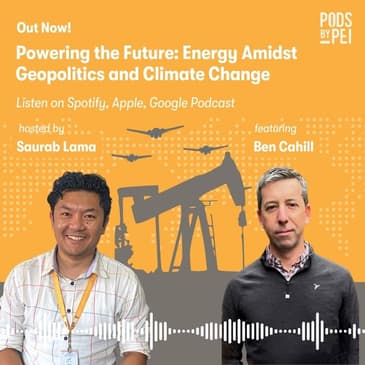
#Ep.042
The global energy landscape is changing due to factors such as the Russia-Ukraine War, the rise of renewable technology, and the impending climate crisis. Oil and gas have historically been the primary sources of energy, but the impending climate crisis has highlighted the need for humanity to shed its reliance on fossil-intensive fuels. Furthermore, the Russia-Ukraine conflict has shown the need for diversification of energy sources and supply routes. There's also a greater focus on renewable energy sources to address environmental issues. While oil and gas remain important, the transition to greener energy sources will have significant implications for the industry and the global energy market.
It is within this backdrop we find PEI colleague Saurab Lama in conversation with Ben Cahill to discuss the global energy landscape within the context of the Russia-Ukraine War and the impending climate crisis. They further discuss the future of the global energy sector, in the aftermath of the ongoing conflict, conversations around climate change, and turbulent geopolitics.
Ben is a senior fellow in the Energy Security and Climate Change Program at the Center for Strategic and International Studies (CSIS). He also leads a research initiative on methane emissions and analyzes how national oil companies respond to the energy transition. He has an MA in International Affairs and Economics from the Johns Hopkins School of Advanced International Studies.
Click here to support us on Patreon!!
[00:00:13] - [Speaker 0]
Namaste and welcome to Pods by PEI, a policy discussion series brought to you by Policy Entrepreneurs Inc. My name is Kushi Hung and in today's episode we have PEI colleague Saurabhlama's conversation with Ben Cahill on powering the future energy amidst geopolitics and climate change. Ben Cahill is a senior fellow in the energy security and climate change program at the Center for Strategic and International Studies. He also leads a research initiative on methane emissions and analyzes how national oil companies are responding to the energy transition. He has an MA in international affairs and economics from the John Hopkins School of Advanced International Studies.
[00:00:52] - [Speaker 0]
The two discuss the global energy landscape within the context of the Russia Ukraine war and the impending climate crisis. They further discussed the future of the global energy sector in the aftermath of the ongoing conflict, conversations around climate change and turbulent geopolitics. We hope you enjoy the conversation.
[00:01:14] - [Speaker 1]
So warm welcome back to all our listeners to another brand new episode of Pause by PI. Namaste. This is Sohr Blama.
[00:01:21] - [Speaker 2]
Namaste. This is Ben Cahill.
[00:01:23] - [Speaker 1]
Welcome to Pods by PI, Ben. How are you doing today?
[00:01:26] - [Speaker 2]
Doing great. Thank you very much for having me.
[00:01:28] - [Speaker 1]
And it is our pleasure to have you here on the show. So shall we get on with our conversation then? Sounds good. Let me first start by acknowledging that the energy sector is quite vast. The possibilities for discussion, limitless.
[00:01:43] - [Speaker 1]
That is why for our conversation today, I want to limit our conversation mostly to fossil fuel, in particular, oil and gas. I'm doing this because for many of our listeners in Nepal, the discussion around oil and gas does not feature significantly as you are also aware that our primary source of electricity or energy is hydroelectricity. But despite this, we import oil and gas by the billions. Here, the concern in Nepal is mostly around hydropower and the price of electricity that we can sell to the Indian market. But as the recent Russia Ukraine conflict has made clear, what happens in the oil and gas sector has far reaching global ramifications.
[00:02:21] - [Speaker 1]
But before we get into the details, let's begin with you describing to our audience the overall status of the global energy sector. Perhaps you could also highlight some of the major trends in the sector.
[00:02:32] - [Speaker 2]
Sure. Thanks, Adam. It's really a pleasure to be here today. So it's been an interesting eighteen months. You know, we are in the midst of a huge transition of the global energy system, a long term shift from fossil fuels towards renewable energy And the momentum behind that is building all the time.
[00:02:49] - [Speaker 2]
But at the same time in the last eighteen months or even longer, we've had extremely high gas and electricity prices in Europe that started even before the Russia Ukraine war broke out when Russia launched its illegal invasion of Ukraine in February. But it's really accelerated in the last year. So I think what's happening is that we are trying to balance this long term transition away from fossil fuels and all the momentum that we're seeing. That's clearly going to continue. But the Russia Ukraine war has really reminded us of the significance of energy security.
[00:03:21] - [Speaker 2]
I think we forgot about energy security for a number of years. We got used to low prices. We didn't really have big disruptions to the global energy system. And all of a sudden we had a really sharp shock to the system. And so what it's brought home to me is that it is really hard to pull off this long term transition and avoid the bumps and the shocks that are inevitable along the way.
[00:03:41] - [Speaker 2]
And some of the geopolitical complications that are happening. You know, this Russia Ukraine war has really meant a fundamental break between Russia and Europe. I mean, is the world's largest oil exporter, if you include crude oil and petroleum products, and it's now been shut off from its premium export market. That's a big change. So all these things are happening simultaneously.
[00:03:59] - [Speaker 2]
The cliche that you hear often now is that the energy transition is not going to be smooth and easy. I don't think anyone ever expected it to be smooth and easy, but this is really just highlighted how tough the challenge is.
[00:04:10] - [Speaker 1]
So moving more specifically to oil and gas, which today comprises the world's primary energy source, what are the key issues that you consider to be the most crucial within this sector?
[00:04:21] - [Speaker 2]
Yeah. And I I think we are in a moment where the oil and gas industry's long term trajectory is in doubt. Everyone knows that the transition is happening and it's picking up pace. The threats to long term oil demand are clear and we see people adopting electric vehicles. We see transportation systems and mobility systems changing around the world, whether you're talking about South Asia or Europe or The United States.
[00:04:45] - [Speaker 2]
And yet we're going to need fossil fuels for some time to come, for decades to come. I think a big challenge is can the industry get enough investment to avoid supply shortages? You know, we've had basically seven years of lower investment in the oil and gas industry and this was really a result of the shale boom that happened in The United States and a big oversupply. The industry produced a lot of oil and gas, especially in The United States, we saw incredible growth for years. But from an investor standpoint, it was a failure.
[00:05:15] - [Speaker 2]
We had a decade of extremely poor financial returns. And so it's been hard for this industry to access capital and to lock up enough investment to ensure continued oil and gas production. And I think a big challenge for the industry is how can it shift to a world that's obviously changing, where investors are more climate conscious, it's harder for oil and gas companies to access capital and still ensure that we have all the supplies that we need over the next decade and beyond as we navigate this transition. I think that's a really existential challenge for the industry. And of course, lot of oil and gas companies are changing their own business too.
[00:05:50] - [Speaker 2]
They're starting to invest in renewables, like offshore wind. They're interested in carbon capture and storage. They're interested in some of these new technology, like air capture, which are really a big part of the transition. So they're trying to change their game and at the same time adapt to really rapidly changing demands from investors and society.
[00:06:06] - [Speaker 1]
How big does geopolitics also feature within the electricity sector?
[00:06:10] - [Speaker 2]
I mean, geopolitics are inevitable with energy. It's just too important to national economies to be left to free markets and to private actors. When you think about either importers or exporters, you know, energy is such a huge essential part of national economies that it's inherently tied up with politics. I think what we've seen with the Russia Ukraine war is that Russia really weaponized its natural gas supplies to Europe. I mean, there was clearly a political calculation that Vladimir Putin made that Europe really needed Russian gas and that it had a lot of leverage over Europe.
[00:06:42] - [Speaker 2]
In fact, I think what we found is that that was not true. That was actually a miscalculation. Europe has adapted a lot better than people thought it would. But clearly there are big geopolitical changes afoot. I mean, I think what's happened in the last year and a half really raises big questions about Russia's future relationship with China, for example, with India, with some of these other markets that have started to absorb more Russian exports as it's shifted away from And I think also because we've had high energy prices, it's really highlighted some of the gaps and the tensions that exist between the richer countries of the world and developing countries.
[00:07:17] - [Speaker 2]
You know, everyone talks about the energy crisis in Europe and high prices. Well, in reality, a lot of the countries that bore the brunt of this are in South Asia and Southeast Asia with extremely elevated gas prices. You know, you had economies like Bangladesh, Sri Lanka, Pakistan that really had trouble paying for energy costs and you had blackouts and outages. In many ways, they suffered much worse than the Europeans ever did. So I think as the transition occurs, there are a lot of second and third order impacts in different countries and we can't lose sight of that.
[00:07:48] - [Speaker 2]
I think there's a lot of focus on the Transatlantic issues, US Europe issues, but it's really important to think about energy costs and energy transition issues for the global South and for South Asia in this conversation.
[00:07:59] - [Speaker 1]
So given that you raised these very important issues, is it a right assessment that the global energy system is becoming more unpredictable than it was a few years ago?
[00:08:08] - [Speaker 2]
Yeah. I mean, I've looked at the oil and gas industry a lot. I work at a think tank and I have a lot of colleagues who do climate policy and look at state level issues in The US, all kinds of things. But particularly for the oil and gas industry, you know, this long term shift away from fossil fuels has been, you know, in the offing for some time. We knew it was coming.
[00:08:26] - [Speaker 2]
But I think for a lot of these companies, was too far over the horizon to really deal with it and to change their business and their investment strategy until recently. And in the last couple of years, there's been an incredible change. I mentioned the issue of access to capital, maintaining investor confidence. These are companies that really cannot get loans and get investment unless they have a business plan that's really resilient to kind of a Paris aligned world, a world of net zero plans and greater consciousness over climate impacts and a robust strategy to deal with it. So the oil and gas industry is under a lot of pressure, you know, it's stuck.
[00:09:02] - [Speaker 2]
Right now, it's extremely profitable. In the last year, it's made a lot of money. And yet, these existential threats are not over the horizon. They're actually here today. So they're really grappling with this today, and I see them following different trajectory.
[00:09:13] - [Speaker 1]
So let's once again switch gears to focus on one of the issues you talked about earlier, geopolitics again. So, clearly, energy has been featured prominently in the ongoing Russia Ukraine war. What effect do you believe this is having on the global energy sector and may have in the years to come?
[00:09:32] - [Speaker 2]
Russia has been one of the world's energy superpowers. When you think about big oil exporters and gas exporters, you know, Russia's right up there with Saudi Arabia and The United States. And Russia's premium export market has always been Europe, both for natural gas and for crude oil and refined products, things like diesel. I think what's happened is that essentially Russia has been cut off from that market. It no longer has access to Europe.
[00:09:57] - [Speaker 2]
Europe has imposed embargoes and price caps along with The United States and the other G7 countries. And so Russia's great quest is to shift all of its energy flows away from Europe towards the rest of the world. And that's primarily meant India, China, a little bit to Turkey, now even with North Africa and West Africa. And so there's this big reordering of crude oil and petroleum product flows around the world that's happening. One of the surprises to me in recent months has been, you know, despite this big shock to the system and all these changes in energy flows, there haven't really been that many disruptions.
[00:10:30] - [Speaker 2]
If you look at Russian oil, petroleum product exports, they haven't dropped at all. And in fact, this is kind of the design of the price caps. It's a very complicated scheme, but basically when Europe and The United States and others imposed price caps on Russian exports, the idea was not to remove them from the market. Policymakers thought we want to keep the market well supplied, we want to prevent a supply shock and elevated prices, but we want to drive down the revenue that Russia earns from every barrel and really squeeze its economy because oil and gas provides 50% of the Russian budget. The idea was really to pressure them, hit them where it hurts.
[00:11:05] - [Speaker 2]
And so far, I think that's worked, But it does mean that Russia now has to turn to new partners. And the future of the Russia India relationship is incredibly important. And obviously, there's some tensions now between Europe and The United States and these other countries in Asia, have become big consumers. And we're still kind of navigating that.
[00:11:22] - [Speaker 1]
So how would you evaluate Europe's response to this situation?
[00:11:26] - [Speaker 2]
I think by and large Europe surprised a lot of people with how well it's done in the last year. You know, when this initially happened, many people thought European industry is going to have to shut down, There won't be natural gas supplies for people's homes. They'll freeze in the winter. None of that happened. They were both lucky and smart.
[00:11:43] - [Speaker 2]
They were lucky because Europe had a very wild winter this year. The weather could have been a lot worse. It's not a strategy to bet on good weather because you can't control it. But they were also smart because they took clear steps to reduce dependence on Russian gas. They really started to import as much as they could from The United States in the form of liquefied natural gas or LNG, pipeline supplies from North Africa and Azerbaijan and others.
[00:12:07] - [Speaker 2]
And most importantly, they've really focused on conservation, saving energy. So industry has gotten a lot smarter about using less gas. People in their homes have turned down the thermostats and used less energy at home and it's had a big impact. I think European gas demand dropped by 13% last year. Maybe that's not sustainable, but I think a good amount of it is sustainable.
[00:12:27] - [Speaker 2]
Another thing that's really significant is that for a lot of people in Europe, this has underscored the need to shift away from fossil fuels as fast as possible, especially Russian imports of fossil fuels. And there's always this question, is the Russia Ukraine war and elevated prices going to undercut the energy transition or slow down the pace? In fact, I think it's actually the opposite. I think it's only going to increase the pace of the shift to renewable. It's hard to do that.
[00:12:52] - [Speaker 2]
You know, you can't do that in five years. So the reality is that Europe is still going to need alternatives to Russian fossil fuels for some time and that may get tougher in the next couple of years. There's a little bit of complacency happening, I think, because, you know, we had a good winter, gas storage was pretty full, Europe made it through okay. Things could get harder in the years to come, so we shouldn't be patting ourselves on the backs just yet.
[00:13:12] - [Speaker 1]
I think regional conflicts like the Russia Ukraine war have clearly demonstrated that these tensions can easily disrupt energy supplies and create uncertainty in today's interdependent world. So how do you think countries will approach the concept of energy security in the days ahead? And what lessons can we learn from this situation to better prepare for potential crises down the road?
[00:13:37] - [Speaker 2]
Yeah. I think energy disruptions happen all the time. A lot of people say, well with the shift away from fossil fuels and towards renewables, you know, we're exposing ourselves to a lot of risks because what if the wind doesn't blow and the sun doesn't shine? What if battery storage doesn't work the way that it's supposed to? I mean, in reality, if you look at the history of the fossil fuel industry, there have been plenty of shocks disruptions over time, right?
[00:13:59] - [Speaker 2]
So this is not really new. But I do think that all this underscores how complex it is to transition the entire global energy system away from fossil fuels. I mean, more than 80% of primary energy demand comes from fossil fuels, oil, natural gas and coal. What I have taken away from the last year is that it's really important not to have an either or mentality. We really need to do everything and we need to build redundancy into energy systems.
[00:14:27] - [Speaker 2]
It's a mistake to bet on the fastest, smoothest transition. You really have to over invest in spare capacity in building redundancy and maybe you don't use all that. For example, maybe Europe doesn't need to build all these new natural gas import terminals to buy LNG from The United States and gas from other suppliers. They may not operate at 100% capacity, but I think it would be a mistake not to do that because then you expose yourselves to shocks. But ultimately in the big picture, I think it's reminded people that energy security is still really important.
[00:14:58] - [Speaker 2]
We cannot overlook the risk of supply disruptions to national economies. It's really important to industry in Europe and everywhere else around the world. And it's an important reminder. I think we kind of were asleep at the wheel for.
[00:15:10] - [Speaker 1]
So let's look at Asia a little closer to Nepal. So how do you view the position that India and China took on the Russia Ukraine war with regard to Russian oil? Maybe you can also describe these positions for our listeners and also speak about what sort of impacts do you think this is having?
[00:15:28] - [Speaker 2]
Yeah. So the G seven countries and the EU imposed a price cap on Russian oil. They basically said, we want the whole world to agree not to pay above a certain price for Russian oil. And it was never very likely that India and China were gonna join this scheme. The Indian Energy Minister gave a bunch of interviews where he basically said, I have to do what's best for my population.
[00:15:46] - [Speaker 2]
I mean, India is a country that imports, I think 85% of its crude oil. It's really expensive. It's a big drag on the balance of payments. And, you know, the position is understandable. They basically said we're going to get the best deal possible.
[00:16:00] - [Speaker 2]
And if that means joining the price gap, maybe we'll consider it. If it means we just use our leverage over Russia because they need us now, then we'll do that. And in fact, it's been a good deal for India. They have gotten discounted crude from Russia. The same for China.
[00:16:12] - [Speaker 2]
I mean, was obvious that China was never going to join this price cap scheme and kind of join a coalition against Russia. What's happened clearly is that China has a lot of leverage in this relationship, particularly for natural gas. Russia has no good alternative over the long term. It's been cut off from Europe, needs to find an export outlet. China is it.
[00:16:29] - [Speaker 2]
It already sends pipeline gas to China. The Russians want to build another mega pipeline. The Chinese have a ton of leverage in these bilateral talks. And I think they'll they'll push Russia as hard as they can. They're not going to cut them any sweetheart deals.
[00:16:43] - [Speaker 2]
And I also I think that the Chinese are wary of being too tied to Russia because this is an economy that is going to be under pressure. It's an oil and gas industry that will be under pressure over the long term. And it's been proven to not be a very reliable partner. I don't think you want to throw all of your wad in with Russia in that kind of situation. But you know, what this whole thing is clarified for me is that we kind of have two different trajectories.
[00:17:06] - [Speaker 2]
It feels like Europe and The United States are moving on one path and developing countries are moving on another where energy costs are just much more important to them. Long term climate considerations obviously are important too, but it's less immediate and they don't have as much leverage and their attentions, I think, a result of that.
[00:17:22] - [Speaker 1]
So you brought developing countries there. I mean, Nepal is a developing country as well. So what do you see what impacts do you see happening in other developing parts of the world such as Asia and Africa? Or in other words, why should an average Nepali care about this issue?
[00:17:38] - [Speaker 2]
I mean, energy costs matter to everyone. Right? Particularly for net importing countries that don't have domestic oil and gas production and have to import it. Price shocks can have a really negative impact and we've seen this in Sri Lanka and other countries in Pakistan, as I mentioned. I think one thing that we've seen in the last couple COP climate conferences is that there's a lot of tension between global north and global south.
[00:17:59] - [Speaker 2]
I think a lot of developing countries feel like their own economic considerations and energy considerations kind of being pushed to the back burner. You know, they have trouble accessing finance, support from the multilateral development banks, you know, the World Bank and others to get fossil fuel projects funded. And they feel like they just don't have access to the kind of finance and capital that they need to build their own energy transition. They're being asked to leapfrog and often that means that, you know, some of the energy access issues are being ignored. You know, for a lot of developing countries, the important challenge today is just giving people access to electricity, ensuring consistent supply of electricity at low prices.
[00:18:39] - [Speaker 2]
You know, energy access is far more immediate and more pressing for a lot of countries than no long term net zero targets. And in a way, think they feel like they're being caught in the crossfire when it comes to, you know, financial flows and available capital from the MDBs and others. They just feel like their own needs are not being met. You know, people are kind of looking past the most pressing economic concerns they have.
[00:19:00] - [Speaker 1]
So looking beyond the implications of the Russia Ukraine war, do you see energy, especially fossil fuels, still being central to the future of geopolitics? Or is this only just temporary with the climate induced global energy transition conversations happening as well?
[00:19:16] - [Speaker 2]
Yeah. I think it's still with us for some time to come. The IEA published its net zero report in 2021. And that was basically a roadmap towards a net zero world. All the changes that had to happen on both the supply side and the demand side, the report was very good at laying those out.
[00:19:32] - [Speaker 2]
We have to keep in mind though that even in the most aggressive decarbonization scenario to arrive at that net zero world, the world will still consume 24,000,000 barrels a day of oil by 02/1950. And that is an, again, a really aggressive decarbonization scenario. So who produces that oil? Who buys it? I think there will be big shifts in geopolitics as a result of the energy transition.
[00:19:56] - [Speaker 2]
And I think the concern of a lot of policymakers is we don't want to exchange our dependency on one set of countries, say OPEC, for dependency on another set of countries that have critical minerals. Now think of the countries that have lithium and cobalt and copper, all these minerals that are going to be really important for batteries and for wind turbines and all the things that are essential to the transition. So the geopolitics of energy always change. I think in the near term, there's clearly some likelihood that the big oil and gas producing countries will gain from this because prices are high, markets are pretty tight, you know, the revenues for these countries have soared in recent years. So if you look at the economic returns, there's no sign that they're going to be struggling anytime soon.
[00:20:38] - [Speaker 2]
Over the long term, I think a big question is how much dependence do we want to have on a handful of countries that produce this stuff? There might be a real strategic and economic advantage to continuing to produce this not just in The Middle East, but in other regions as well. We'll have to wait and see. But it's opened up this fascinating set of questions about who has leverage in this changing global system and what are the pressure points. You know, in The United States, there's this almost a paranoia now about clean energy supply chains, Not just the critical minerals that I mentioned, but where the processing capacity is because a lot of it is in China.
[00:21:11] - [Speaker 2]
And there's a huge amount of tension now between The US and China, I'm sure you've noticed. And there's a real push in Washington to reduce dependence on China, to build more of the stuff at home, to mine it at home and process it because there's a real discomfort with being too dependent on China for these really important materials for the transition.
[00:21:28] - [Speaker 1]
So now let's move on to the topic of energy in the midst of these climate and sustainability conversations. It is no longer a secret that climate change is a major concern for the planet. So how do you think the ongoing geopolitical tensions and its impact on energy markets affect efforts towards a more greener and more sustainable world?
[00:21:51] - [Speaker 2]
Yeah. We have a price shock. We have pretty tight oil and natural gas markets. That's been hard to deal with over the last eighteen months. But I don't think it's derailed the momentum of the energy transition.
[00:22:02] - [Speaker 2]
Last year, Bloomberg New Energy Finance, Bloomberg NEF calculated that for the first time, total fossil fuel investment around the world was equal to clean energy investment. And that category of clean energy investment is very broad and includes things like manufacturing electric vehicles, clean energy, battery storage, everything else. But it's the first time ever that clean energy investments have matched fossil fuels. So there's no sign that that momentum is slowing. It's only growing.
[00:22:31] - [Speaker 2]
There's a huge policy push now in The United States as a result of the Inflation Reduction Act or IRA. It's such an attractive package of tax incentives that already the investment is frankly just pouring in to things like building clean energy, wind, solar transmission, hydrogen manufacturing, building new transmission lines, building solar cell manufacturing plants, building battery factories for electric vehicles. It's really turbocharged all this. And in fact, I think a lot of countries around the world, both in Northeast Asia, say in Japan and Korea and in Europe, there's a lot of concern that The United States is going to suck up all this investment in these industries of the future. So there's a bit of a trade and competitiveness issue that's playing out now.
[00:23:16] - [Speaker 2]
There's a lot of tensions in global trade around trying to build the stuff at home and build it rapidly, because these are the industries of the future. So there are some geopolitical tensions happening as a result of that. But I think the pathway is pretty clear. I mean, there's so much innovation and entrepreneurship and capital just waiting to be poured into these industries and it's really being unlocked. And if you look at the pace, for example, of electric vehicle adoption around the world, it's pretty dramatic.
[00:23:41] - [Speaker 2]
The International Energy Agency just published a report yesterday, I think, the day before, that just showed how rapidly EV adoption has grown. And that's happening in The United States where new EV models are being introduced all the time. It's happening in China where obviously EVs are already a big share of the country's market for total vehicle sales and in Europe. But even in Nepal, I've noticed last couple times I've come here, see more EVs all the time. And, you know, for certain economies that don't have domestic fossil fuels and where energy prices were already really high, makes a lot of sense.
[00:24:11] - [Speaker 2]
So, you know, from an investor standpoint, from an innovation standpoint, and also from a perspective of, you know, a big push from public policy, the pace behind the transition is only growing.
[00:24:31] - [Speaker 3]
Hi there, this is Shri Arana from Policy Entrepreneurs Inc. We hope you're enjoying Pods by PEI. As you know, creating this show takes a lot of time and resources. We rely on the support of our community to keep things going. If you've been enjoying the show and would like to help us out, we'd really appreciate it if you could become a patron on Patreon.
[00:24:51] - [Speaker 3]
Patreon is a platform that allows listeners like you to support creators like us with a small monthly donation. Your support will go a long way in helping us to continue creating high quality content for you. So if you are interested in supporting our show and becoming a part of our community, head on over to Patreon and become a patron today. You can find us at patreon.com/podsbypei. Every little bit helps and we can't thank you enough for your support.
[00:25:19] - [Speaker 3]
Now, let's get back to the episode.
[00:25:24] - [Speaker 1]
So so what is the long term goal even after we make this energy transition to renewables or greener energies?
[00:25:31] - [Speaker 2]
Yeah. I mean, it's really difficult to change electricity systems, but in fact, that's actually the easiest stuff over the long term. And so in The United States, for example, there's been a huge reduction in in carbon emissions from the electricity sector because we phased out coal in the power sector and and used much more natural gas with the shale revolution. And most of the CO2 reductions in The US have just come from that. And that's great.
[00:25:56] - [Speaker 2]
There's much more work to be done in transitioning the power sector. In The US, I think the goal is to have carbon free electricity system by the year 02/1935, which is very ambitious. Probably not gonna get there, but that's the government goal. But in the big picture, that's actually the easier stuff. Again, in The US, if you look outside the electricity sector, we've had some drop in CO2 emissions from transport, you know, with EV adoption and with more efficient engines.
[00:26:22] - [Speaker 2]
But if you look at industry and household consumption, it hasn't dropped at all. And that's the hard stuff to do. So a lot of the focus rightly is on decarbonizing the power system and on the transport sector. You know, if we can increase the role of renewables in the power sector and if we all adopt EVs and reduce fossil fuels and transport, maybe build more public transportation and better options, that's great. But we still have to deal with the question of industry.
[00:26:48] - [Speaker 2]
You know, for industry, alternatives to fossil fuels are not very easy. Think of, for example, German industry, glass, cement, steel, chemicals. These are industries that are really dependent on natural gas because they have it's got such a high heating value. I think over the long term, as we reduce the role of fossil fuels, that's where hydrogen comes in. There's a huge amount of hype about hydrogen and a lot of that is now falling away.
[00:27:11] - [Speaker 2]
We're getting more realistic about it. But the most robust use case for hydrogen is on those hard to decarbonize sectors. Maybe aviation, shipping, and those other things like heavy industry. So we should be encouraged by what we've seen in the power sector in The US and Europe and other places so far, but, you know, it's gonna get harder. And that last 20% of fossil fuel use is gonna be the tough nut to crack.
[00:27:32] - [Speaker 2]
It'll be great to get to 80% reduction. Right? But the last 20 is gonna be where fossil fuels will definitely have a role to play over the longer term and it's hard to envision alternatives.
[00:27:41] - [Speaker 1]
And as more evidence becomes pronounced that humankind must phase out, not phase down, but phase out fossil fuels, How do you see this discourse impacting the fossil fuel industry? Are there newer innovations from within the industry or being forced upon governments that you are hopeful about?
[00:27:59] - [Speaker 2]
I think one reality that gets overshadowed is that we will need continued investment in oil and gas for a long time to come. The reality is if you look at energy transitions over history, it doesn't erase absolute demand for certain products. Think of, you know, biomass or kerosene. It's just that other things take precedence and their proportion grows, but the absolute demand of energy just continues to grow all the time, right, because of population growth and economic growth around the world. And in the oil and gas industry, you have natural decline rates.
[00:28:28] - [Speaker 2]
You know, fields don't keep producing the same amount forever, you have to continue that treadmill of investing in future production. And over the last seven years, we've seen a big decline in investment in oil and gas. It's a big challenge though for the industry to access the capital that it needs to continue. Clearly oil and gas companies need to show that they're responsive to an evolving world. They need to show that the business is going to be resilient, that it can withstand these kind of price cycles and volatility that we've seen.
[00:28:52] - [Speaker 2]
They need to have a plan to reduce emissions. That's table stakes now. Every investor presentation has to include environmental, social and governance or ESG messages. You need to show that you have a robust transition plan and that means different things for different companies. To give you one example, Chevron, you know, huge oil and gas company has made it very clear that they don't see an advantage in being a solar player or offshore wind.
[00:29:14] - [Speaker 2]
They said, you know, those are great businesses for other people. We just don't feel like we have a competitive advantage. Some of the European companies like Shell, Total Energies and BP, they've moved much more aggressively into things like offshore wind and even being electricity providers. So there are different trajectories happening. I think it's possible that investors will reward all of them, but it's a challenge for the industry.
[00:29:36] - [Speaker 2]
You know, the long term outlook for the oil and gas sector, I wouldn't say it's bleak, but it's definitely challenged. You know, I hosted the Chief Economist of BP at CSIS, my institution, a couple months ago and he made a good point. He said, Look, if you think about any industry over decades long trajectory, of course they're going to be threats. Think about the number of industries that have been erased by technology advancements, right? I mean, Polaroid disappearing, you know, print media and journalism, all these things change as a result of technology and we shouldn't expect that the oil and gas industry is going to be stagnant, right?
[00:30:10] - [Speaker 2]
The question is which companies can evolve and develop a new business and if there's enough room for a lot of these guys to just play traditionalist roles and keep continuing to invest in oil and gas because the world will need it. We'll have to wait and see, but it's clear that companies are strategizing in very different ways about this. And I think that the results of that from an investor standpoint are still it's a wait and see moment.
[00:30:32] - [Speaker 1]
But where do you see this industry evolving? How might it continue to evolve in the next five, ten, or even the next fifty years?
[00:30:41] - [Speaker 2]
I mean, I think the industry has to innovate more. It has to recognize that the world is changing. To give you one example, you know, Occidental Petroleum or Oxy, which is an old company in The United States, a big independent oil and gas producer, now wants to be a leader in carbon management. They really want to move into carbon capture and storage and direct air capture in a big way. Direct air capture is basically giant machines that suck CO2 out of the air and they see themselves as leaders in that area because they've done a lot of CO2 management for enhanced oil recovery.
[00:31:07] - [Speaker 2]
So that's a very clear business model that they think will be robust in the future and they're following that. I mentioned the European companies, they really want to be big players in offshore wind. They feel like they're used to mega projects. They've got big balance sheets. They've got a lot of engineers who can do this stuff.
[00:31:23] - [Speaker 2]
They do big mega projects. They do business in difficult places and they think that they're well positioned. You know, other companies, frankly, they don't have a strategy. They've kind of got their head stuck in the sand and they're thinking all this energy transition stuff is just hype. You know, they look at the last year and think we've just massively overestimated the pace of the transition.
[00:31:41] - [Speaker 2]
We're going to need oil and gas for a long time to come. Forget about all the stuff. We're going to stick to our knitting and do it. I personally think that's a little bit shortsighted. It may pay off in the next couple of years.
[00:31:51] - [Speaker 2]
I don't think that's a very resilient strategy over the next five, ten years. You have to do more, especially if you're a public company with investors who are knocking on your door and saying, what are going do about all this?
[00:32:00] - [Speaker 1]
So as we close out our discussion today, is there anything else you would like to convey to our listeners? Maybe you could give us a few insights from some of the work that you are currently engaged in.
[00:32:10] - [Speaker 2]
Yeah, I mean, such an exciting time to be an energy and climate analyst. You know, I always tell young people who are graduating from undergraduate or from grad school, I mean, the number of opportunities is incredible, whether you're talking about government or NGOs, private equity, finance, there's just so many opportunities in energy and climate because the innovation is happening so fast. So I'm really encouraged by that. I do think that, you know, the last year and a half has reminded us that energy, even if we don't think about it, it has an impact on our daily lives, it touches us all the time. So that's what makes it fun for me.
[00:32:46] - [Speaker 2]
And, you know, I'm an energy systems guy. I think about global systems changing. I think about long term transitions. And it's been fascinating to try to piece together these short term issues with that big picture long term transition. One thing that I've been working on a lot recently is the issue of methane emissions.
[00:33:02] - [Speaker 2]
This is an important issue. You know, methane is probably responsible for more than 25% of global warming. If you're looking for a near term lever to reduce the pace of global warming, reducing methane emissions is it. And methane occurs around the world from lots of different sources, both natural and man made, comes from the agricultural sector, the waste industry. But what makes the oil and gas sector important is that this is a place where we can really deliver near term cuts to methane.
[00:33:30] - [Speaker 2]
A lot of these are pretty cost effective. So it's a really important issue. Companies are under a lot of pressure to reduce methane emissions. There's really important new legislation happening in The US and Europe, a ton of investor pressure on this. I'm encouraged by that, but there's still a long way to go.
[00:33:46] - [Speaker 2]
And I think some of these new technologies like hydrogen, direct air capture, transmission, you know, we've now passed really ambitious legislation in The United States. Now we have to build the stuff. And we have to have a pro building mentality. We have to do this a lot faster than we have been. We have to remove a lot of the regulatory and policy roadblocks.
[00:34:06] - [Speaker 2]
The capital is there, but we are nowhere close to building the stuff at the pace we need to pull off this transition. And in Washington, where I live, there's a huge amount of focus on this. I'm encouraged by that, but, you know, we have a long way to go. So I think anyone who cares about energy and climate issues, you know, there's a role for you if you're in finance, there's a role for people in technology, there's and a role for people who are interested in policy to get the stuff done faster and find creative solutions.
[00:34:29] - [Speaker 1]
And with that, we have come to the conclusion of today's episode. Thank you very much, Ben, for this very insightful conversation and also for graciously accepting our invitation to be a part of POS by PI. Yeah, was a
[00:34:42] - [Speaker 2]
great pleasure to be here. Thanks a lot, Saru.
[00:34:43] - [Speaker 1]
Thank you folks for tuning in. Please join us again next week for another brand new episode of POS by PI. Same place, same time. Goodbye.
[00:34:56] - [Speaker 0]
Thanks for listening to Pods by PEI. I hope you enjoyed Saurabh's conversation with Ben on powering the future energy amidst geopolitics and climate change. Today's episode was produced by Neejin Rai with support from Saurabh Lama, Chedon Kansakar, Hidesh Sapkota and me, Khushihang. The episode has been partly funded by the generous contribution of V Rock and Company and was recorded at PEI studio. Editing and sound mixing were done by Hidesh Satkuta.
[00:35:24] - [Speaker 0]
Our theme music is the courtesy of Rohit Shakyo from Zindavan. If you liked today's episode, please subscribe to our podcast. Also, please do us a favor by sharing us social media and leaving a review on Spotify, Apple Podcasts, Google Podcasts or wherever you listen to the show. For PEI's video related content, please search for policy entrepreneurs on YouTube. To catch the latest from us on Nepal's and politics, please follow us on Twitter tweet2pei, that's T W E E T followed by the number two and PEI.
[00:35:56] - [Speaker 0]
And on Facebook at PolicyEntrepreneurs Inc. You can also visit pei.center to learn more about us. Thanks once again from me, Kushi. We'll see you soon in our next episode.