
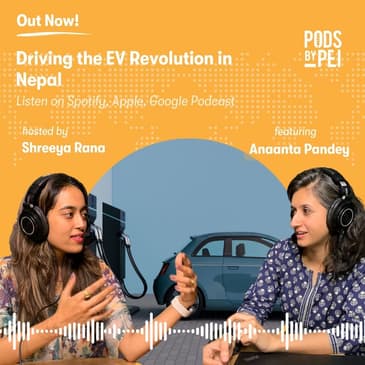
ABOUT THE EPISODE
#Ep.048
Nepal has recently made significant progress in sustainable transportation, particularly electric mobility. As it strives to reduce carbon emissions and improve air quality, electric vehicles are becoming an increasingly important part of its climate action plan. This has also generated a lot of interest in the energy and transportation sectors. But despite the government's targets of 25% electric vehicle usage by 2025 and 90% by 2030, the lack of a stable policy environment and issues related to financing and infrastructure poses a challenge.
In this episode, PEI’s Shreeya Rana sits with Anantaa Pandey to discuss the progress, the challenges, and the solutions in Nepal's electric mobility journey. They unpack challenges in financing, and infrastructure to support electric mobility, while also talking about the policies, which aren’t always aligned. Anantaa is the Senior Program Officer at the Global Green Growth Institute’s Nepal office. She has advised the Nepalese government on policy and technical issues concerning electric mobility, and she has conducted feasibility studies on the deployment of EVs in Nepal. She is currently leading the Sustainable Electric Transport Project.
[00:00:10] - [Speaker 0]
Namaste and welcome to POTS by PEI, a policy discussion series brought to you by Policy Entrepreneurs Inc. My name is Sonia Jimmy. In this episode, PEI's Shreya Rana sits with Ananta Pandey to discuss Nepal's electric mobility journey. They unpack challenges in financing and infrastructure to support electric mobility, while also talking about the policies which aren't always aligned. Ananta is the senior program officer at the Global Green Growth Institute's Nepal office.
[00:00:43] - [Speaker 0]
She has advised the Nepalese government on policy and technical issues concerning electric mobility, and she has conducted feasibility studies on the deployment of EVs in Nepal. She is currently leading the Sustainable Electric Transport Project. We hope you enjoy the conversation.
[00:01:04] - [Speaker 1]
Welcome to the show, Ananta. I'm really looking forward to this conversation with you.
[00:01:08] - [Speaker 2]
It's great that we're keeping the conversation going about an important topic in Nepal's context today. So happy to be here.
[00:01:17] - [Speaker 1]
So before we get started, I would like to briefly bring up a few pointers from our previous conversation on electric mobility. In that episode, we made a case for Nepal to transition to electric mobility as an effort to push forward the global discourse on climate change. We also discussed the topic from a more climate justice perspective, rather than focusing on the nitty gritty of actually making this transition possible. In today's episode, Ananta, I hope that we can really dive into Nepal's EV scenario and really dissect some of these most pressing issues. And with that in mind, let us begin today's episode.
[00:01:54] - [Speaker 1]
Can you start by giving us an overview of the current status of electric mobility in Nepal, taking into account both the public and the private sectors?
[00:02:02] - [Speaker 2]
Well, we all know how successful Safa temples have been in Kathmandu for over twenty five years and have also heard many stories of trolleybuses flying back and forth between Tripurashore and Surabhinayik. So these are successes in Nepal. But a clear shift in terms of transitioning to electric vehicles really began only a few years ago, and I think this is around the time we faced a major fuel supply crisis in 2015. Of course, mostly electric two wheelers or scooters were available then and not a lot of people understood the technology. But the crisis pushed some people to take the risk of owning an electric scooter.
[00:02:43] - [Speaker 2]
That turned out to be a disaster because the batteries being used then were lead acid batteries of very poor quality and it's very different than the lithium ion batteries that we get today. What is interesting is sales of electric rickshaws also started picking up around the same time in 2015. I think we started with around 1,100 or so of electric rickshaws entering the country at that time, and that number shot up fast to above one lakh being operated mostly in the Tarai region by the 2019. In terms of cars, there were little more than 100 electric cars being operated in 2015, 2016, and with the advent of the new Mahindra models, followed by other brands, sales of electric cars also picked up around the same time. According to my estimation, and there are a couple of numbers that are floating in the market, there are more than 5,000 electric cars in the roads of Kathmandu today and around 10,000 electric two wheelers in the country.
[00:03:44] - [Speaker 2]
And this is data by the 2022. What is amazing is that if you go to cities in India, for example, Delhi or Mumbai, you'll probably see that one or two electric cars on the road, whereas in Kathmandu, feels like one car out of every couple of cars is an electric vehicle these days, and this is huge. On the one hand, pickup of electric private vehicles has been quick, which is great to see, but on the other hand, operators have really struggled to switch to electric buses and this is primarily because of the high cost and the lack of incentives for electric buses. Sajai Atayat that was reestablished in 2013 with the intention of operating clean vehicles was clean on exploring opportunities to procure electric buses and gradually transitioning their fleet to all electric. After almost four years, they finally have 40 electric buses on the ground, all of which will be mobilized very soon.
[00:04:42] - [Speaker 2]
In the past two years, sales of electric micro buses have also picked up. There are more than 200 with majority of it being operated in the Kathmandu Sinduli route. So it's harder for public electric vehicles to penetrate the market, but we finally see it gaining some traction in Nepal.
[00:05:01] - [Speaker 1]
I think there's definitely some traction there when we consider the increase in privately owned EVs. But the same kind of enthusiasm, like you just mentioned, is not seen in the public sector. For instance, government of Nepal had committed to spending about 3,000,000,000 to procure 300 buses in 2019 through Sajjaya Riyadh. But the reality is far from it. Now why do you think that this is the case?
[00:05:24] - [Speaker 2]
That's a really good question, and I'm sure a lot of people are also wondering. Just a few days back during an EV dialogue organized by Kantipur, Pooshan sir, who is one of the board members of Sajjayatya discussed the many challenges that Sajjayatya has faced in procuring and operating these buses. They start operation of three more buses, so there were previously three buses that were already on the road and it's been a year almost and now the total has gone up to six buses that are on the road. And why they have only six in operation so far is because there are only three charging stations available where they can fully charge their vehicles overnight. Lack of land to park and charge the buses is the biggest challenge they're facing right now, which is why the remaining 34 buses that are already in Kathmandu are still waiting to be deployed.
[00:06:13] - [Speaker 2]
For an electric public vehicle, location of charging stations is key because the batteries on the bus have a certain capacity and if charging stations are far away from the route, the buses will not be able to complete the set number of trips. Also opportunity charging will not be possible to meet the peak passenger demand. Sajjaya has had to face many roadblocks which they were eventually able to overcome to come to this point. So I think we should celebrate their success and understand it takes a lot of energy for a public private entity like Sajai Atayat to venture into a relatively unknown area of EVs.
[00:06:49] - [Speaker 1]
So in terms of action, there is a definite delay and also the fact that the taxation policy on EV has been so confusing, like it has changed over the past two years multiple times. But on the other hand, there are also provisions which seem to promote electric mobility. For instance, in 2018, the government of Nepal released the Nepal Action Plan for Electric Mobility, with a focus on supporting Nepal's NDC targets for the transportation sector. Could you tell us more about these policies with a focus on the National Action Plan for Electric Mobility, what it entails and the progress we've made so far on this?
[00:07:26] - [Speaker 2]
Sure. We have heard a lot about the change in import duty on private electric vehicles. Before the fiscal year twenty twenty-twenty twenty one, the government only levied 10% customs duty and 13% VAT on private electric vehicles. Then the customs duty jumped from 10% to 40% and on top of this, excise duty of 80% was also levied. This has changed since then and important customs duty slabs on the basis of motor peak power have been introduced.
[00:07:58] - [Speaker 2]
This gives a lot of different signals from the government's side. On the one hand, the government says they want to transition to electric, and the other, they increase taxes on private vehicles without creating a safe and reliable public transport system in the country. The duty and public electric vehicles so far have not changed, although private operators are lobbying to decrease the 13% VAT that has been levied. I think without a holistic vision of what mobility should look like in a country like Nepal, it will not be easy to justify increasing taxes on electric vehicles, certainly not at a time when the country is just warming up to the idea of transitioning to EVs. For this reason, I feel that the National Action Plan for Electric Mobility is an important document that gives strategic direction in terms of the ecosystem that needs to be developed for a country like Nepal to transition very smoothly to EVs.
[00:08:50] - [Speaker 2]
The action plan proposes three priority areas where we think interventions would need to be introduced. The first one is establishing a dedicated unit for electric mobility within the government. This is mainly to oversee all electric mobility related activities within the country. A unit or an entity that's dedicated to electric mobility that understands the evolving technology, and can also identify where policy interventions are required, for example, and if programs are introduced or projects are introduced that these are in line with policies. The second priority proposed is establishing a national plan for program for electric mobility that can facilitate the procurement of electric vehicles.
[00:09:36] - [Speaker 2]
This is mainly to increase adoption of electric vehicles and also establishment of charging stations. The third priority is establishing a national financing vehicle, and this is a critical element As we've seen with the FAME scheme, which is the faster adoption and manufacturing of electric vehicles in India, this could be a driver of change that we would like to see in Nepal's transport sector. This fund or financing vehicle would be able to support projects, spur innovation, and could also act as a catalyst in bringing investment into the country to support our transport sector's transition to electric. There's interest from within the government to take these further, and with the same intention, the government has started the process of establishing a Kathmandu Valley Public Transport Authority. But as you know, with all things government, this is also taking some time.
[00:10:26] - [Speaker 1]
So in addition to the National Action Plan on Electric Mobility, what are the other initiatives which is being implemented by the government of Nepal in order to promote electric mobility in the country?
[00:10:38] - [Speaker 2]
So we have already discussed the 26,000,000 USD or NPR 3,000,000,000 that the government invested in Sajjaya Thayat. This is the biggest to date and a very encouraging decision. The government decision to establish the Kathmandu Valley Public Transport Authority is also a step in the right direction. Although I personally feel that this could have been an institution that managed procurement and operation of public vehicles throughout Nepal and not just Kathmandu Valley. There are fiscal measures that have been introduced, such as increasing the loan to value ratio for EVs to 80%, decreasing the import duty on public electric vehicles to increase adoption, etc.
[00:11:14] - [Speaker 2]
That have also been favorable. There are also policies like the climate change policy that are favorable to e mobility, although we are yet to see these policies being translated into action.
[00:11:26] - [Speaker 1]
So moving on from policies to policymakers and key players, Who are the other major stakeholders who are promoting EVs? A natural guess would be the Nepali Electricity Authority, given that they're producing electricity in surplus now. Have they been encouraging EVs? And what is the role of other donors in this regard?
[00:11:48] - [Speaker 2]
So yes, absolutely to any encouraging EV adoption. As you rightly pointed out, more than eight gigawatt capacity of hydropower plants are in various stages of construction, so it's critical that we increase electricity demand in the long run. This is the reason that NEA is keen on establishing charging stations. So far they have installed 51 charging stations across the country, and this is with ADB support. NEA is also providing support to private sector free of cost in installing transformers that have capacity up to 200, which is a great incentive to businesses willing to operate electric vehicles or charging stations.
[00:12:26] - [Speaker 2]
NEA has also developed an app for consumers to easily identify what charging station is available, its location, costs, etc. Apart from the NEA, the Global Green Growth Institute or GGGI, which is an intergovernmental organization providing technical assistance to the government, has also been very active in supporting development of policies and programs to promote electric vehicles in Nepal.
[00:12:50] - [Speaker 1]
While it does seem like there are many encouraging factors, how do you think Nepali consumers are responding to the availability of electric vehicles? And do you think that there are expectations from the general public for more public electric vehicles?
[00:13:04] - [Speaker 2]
Well, the uptake of electric vehicles by the private sector has been very encouraging, as we discussed earlier. The recent crisis, as a result of the Ukraine war, also has prompted a lot of people to really think about the value of owning their old petrol car versus an electric car. Operating an electric car is at least 40% to 50% cheaper when compared to a diesel or a petrol car. The cost of acquisition is high, however, and has fluctuated in recent years because of changes in customs duty that the government has imposed, resulting in the majority of the population debating whether to take that risk. But the fact that more than 5,000 electric vehicles have been sold with long booking queues for brands like MG Electric or Hyundai is a testament to the fact that people's mindset about EVs is slowly changing.
[00:13:52] - [Speaker 2]
But the public sector, like I mentioned before, is a little different. If we look at our giant neighbors, their public transport system is being operated by public entities. Whereas in Nepal, it is the exact The private sector is running the show here. There have been some efforts from the government side, mainly from the Bangmati Province in twenty twenty-twenty twenty one to work with the private operators, but that did not materialize due to shifting political interests. So although the private sector is interested in switching to EVs, and when I say private sector here, it's the private operators, there are numerous challenges they will need to overcome to make that change.
[00:14:31] - [Speaker 2]
Anxiety about technology is still very prevalent among the operators. Will they be able to add as many passengers in an EV as they have been in a diesel bus, for example? Will the battery capacity be enough to complete eight trips in a specific route? These are some questions they ask and are valid, and I guess it will not be easy to answer these without them understanding the technology better. There are numerous challenges that the private sector is facing also because they have been largely informal, which means they don't have proper accounting systems that result in the financial sector's low confidence in lending to these operators.
[00:15:08] - [Speaker 2]
There have been cases where banks have lent to operators who sold the vehicle to a different person and the bank is not able to track the borrower. Commercial banks therefore have stringent loan terms and high collateral requirements, which is a big deterrent to the private operators switching to public electric vehicles.
[00:15:31] - [Speaker 0]
Hi there. This is Sonia Jimmy from Policy Entrepreneurs Inc. You have been listening to Pods by PEI. We just wanted to take a brief moment here to thank you, our listeners, for your amazing support. It truly means the world to us.
[00:15:44] - [Speaker 0]
Since you have been listening to us for so long, now we want to hear from you. Send us questions that you may have had on your mind or topics that you want us to cover. You can reach out to us via our email address infopei. Center or any of our social media platforms. So thank you once again for your support and for listening to POTS by PEI.
[00:16:06] - [Speaker 0]
We are looking forward to hearing from you. Now let's get back to the episode.
[00:16:13] - [Speaker 1]
Now talking about the challenges like you so rightfully mentioned, finance is a major challenge. From your experience in the sector, how can the upfront financing issue of large and mid sized public buses be tackled? This is
[00:16:28] - [Speaker 2]
a great question, and I think one that a lot of projects in other countries, including the project GGGI and GIZ are working on, has also been thinking about. Since the upfront acquisition cost is a big deterrent, more so for larger electric buses compared to diesel, just to give perspective, a diesel bus costs around 30 lakh Nepali rupees, whereas the same electric bus could cost north of 1 crore Nepali rupees, so more than three times the cost of a diesel bus. Private operators are hesitating to switch to electric buses. There could be a couple of ways to bring costs down. I think I'd like to talk about demand aggregation, which is a very key idea.
[00:17:08] - [Speaker 2]
And here, instead of one private operator reaching out to a manufacturer to procure two buses, let's say, if 100 or 1,000 private operators can come together to purchase 2,000 buses, the price of vehicles could come down significantly. We have seen this happening in India where a public tender was put out for 5,000 electric buses, in which it was discovered that the price that was put forth by manufacturers for electric buses was 27% lower than a diesel bus. In India, they're implementing a gross cost contract model whereby the state pays the manufacturer on a per kilometer basis for operating and maintaining the buses. Traditionally, the state would purchase the diesel buses outright and operate them with a lot of the risk in terms of maintenance or any unknowns in technology falling on the state. But now they don't have to worry about this, and it's a win win for the state as well as the bus manufacturers.
[00:18:01] - [Speaker 2]
And this is amazing. In the same way, I think there could be other innovative business models that could be introduced. Leasing of vehicles or pay as you save could be very interesting models for Nepal. This means there should be an interested company that purchases vehicles in bulk, which can then lease out these vehicles to the operators so that the private operators don't have to bear the high upfront cost of the vehicles. In Kenya, for example, there's a company called Basigo, from which operators purchase the electric buses without the batteries.
[00:18:37] - [Speaker 2]
The operators then pay on a per kilometer basis to cover the cost of the batteries. As you may know, battery is the most expensive and unknown component of an electric bus or vehicle. The cost of battery is almost 60% of the cost of the bus. And if you take that component away, not just in terms of upfront cost, but also the maintenance that's required, then operators feel more confident in procuring the buses. And this could also be an interesting model that we could look into to replicate in Nepal as well.
[00:19:08] - [Speaker 2]
Of course, many different models are being tested in other parts of the world, and in time we will be able to assess what works in Nepal, what doesn't, to really address the challenge of the upfront cost of electric buses.
[00:19:20] - [Speaker 1]
Since you mentioned India and its position on pushing for the uptake of EVs, the role of private sector is quite visible. If you were to talk about the private sector's role in Nepal, how would you assess their contribution and also the importance in investing and setting up infrastructures for EVs? So India and
[00:19:41] - [Speaker 2]
China are Nepal's two big neighbors, which already have very ambitious targets of electrifying their transport fleets. Ambitious policies and incentives from the government side have fueled the market in the sense that manufacturers have also developed targets of switching to electric vehicles. Tata Motors in India, for example, has plans to increase electric car production to 50% of their total passenger car production by 02/1930. And similarly, Nissan also aims to have 40% electric vehicle production by 02/1930. Honda is looking to have 100% electric vehicle production by 02/1940.
[00:20:14] - [Speaker 2]
So like these OEMs, all other OEMs have also jumped into the bandwagon of transitioning gradually to electric. This will definitely have an impact in Nepal because all of our vehicles so far are imported with as much as 80% of the vehicles being imported from India. In addition to what is already happening organically, the private sector here is also focusing on investing in the charging infrastructure. BYD, Hyundai are some companies that were first to install charging infrastructure around Kathmandu when this topic was not even of concern to NEA. The private sector is also playing a big role in sensitizing the public about the monetary benefits of switching to EVs.
[00:20:58] - [Speaker 2]
These are all positives, but we have also heard quite a bit in the last couple of days that maybe fair competition is not at play when it comes to sales of electric vehicles. I think all private parties need to come to a common understanding that although they are running a business, they're also working towards the benefit of the country.
[00:21:16] - [Speaker 1]
Those are some really interesting points. And coming back to Nepal and Nepali financial institutions, do you think that the banks in Nepal have an appetite to finance public EVs?
[00:21:28] - [Speaker 2]
Banks are a little cautious about venturing into new technology, like all stakeholders. Battery is a big question mark. And I guess not just for financial institutions, but also for the operators that are procuring the buses who don't know when they will need to change the battery, for example, which might require another huge investment. So there are a lot of unknowns. Like I said earlier, banks don't have a lot of confidence in lending to private sector operators either, which, and this is largely because their operators have been informal.
[00:22:02] - [Speaker 2]
To increase the banking sector's confidence, what one project is looking at doing is also establishing a partial loss guarantee fund, which means if there is a default on the loan for electric midsize vehicles, this guarantee will cover a certain percentage of the loss. We're hoping with this, the banks also consider reducing the collateral requirement, making it easier for operators to access financing, thereby boosting confidence of the banks, resulting in higher confidence of operators in acquiring the buses.
[00:22:36] - [Speaker 1]
So in addition to the financing issues, I think another major challenge is infrastructure. And like you'd mentioned earlier, NEA is working with support from World Bank and ADB to install charging stations across various places in Nepal. But do you think that the current plan is in line with the infrastructure required for upscaling public EV uptake? Well, think they are in the right direction,
[00:23:02] - [Speaker 2]
but there could be a lot more that could be done in terms of planning for the location and capacity of these charging stations. It is necessary for all parties involved to understand that without a clear vision and a plan, optimization of charging stations already being implemented, or that will be implemented in the future, is going to be very hard to achieve. There's a risk that a few years down the line, many of these charging stations are not used at all, and we can avoid this with clear strategies.
[00:23:29] - [Speaker 1]
So Ananta, as we're coming to the end of the show, can you end the episode by talking about how electric mobility can also contribute to Nepal's sustainable development goals?
[00:23:41] - [Speaker 2]
There are clear benefits, as we all know. One of those is reduction of local air pollutants like PM2.5 and black carbon, to also reducing greenhouse gas emissions. This will have a great positive impact on human health. According to a recent article, right now around 12% of the population of Kathmandu suffers from chronic respiratory problems, and this is exacerbated by pollution from the transport sector. So switching to EVs, which have zero tailpipe emissions, will help in improving people's health.
[00:24:14] - [Speaker 2]
For a country like Nepal, which relies wholly on fossil fuel imports, resulting in trade deficit, electric mobility is a viable solution that will help in bringing down fossil fuel imports, utilizing the electricity produced domestically, increasing the country's energy security, as well as supporting and closing the gap between imports and exports. So there are obvious environmental and social benefits attached to these. There's one important point that I haven't made earlier and that will also contribute immensely to meeting Nepal's Sustainable Development Goals. The fact that this transition to electric mobility could also be an opportunity for Nepal to integrate gender equity and social inclusion in its transport sector is something to consider. We are not just thinking about gender and disability friendly routes, stops and buses, but also talking about understanding the obvious economic and social benefits of having women own and operate electric transport systems, minorities taking the lead on electric mobility projects and making transport systems act as catalysts to everyone in the country, accessing the same opportunities and being treated fairly.
[00:25:25] - [Speaker 1]
Those are definitely some really interesting points to drive home. Thank you, Ananta, for your time on our show.
[00:25:31] - [Speaker 2]
Thank you, Shreya. It was a pleasure.
[00:25:34] - [Speaker 1]
And with that, it's a wrap. Before we end today's show, we do have an update on some of the tax related issues mentioned by Ananta. Since we recorded the interview, the Finance Minister has made public the Nepal budget for FY twenty twenty three-twenty twenty four, which has a number of EV related items. The biggest change is in the subdivision of the under 100 kilowatt category into the under 50 kilowatt and the 50 one-100kW categories. The government has maintained the previous tax of 10% customs duty for the under-50kW category, however, it has increased this to 15% for the 50 one-100kW category in addition to subjecting it now to a 10% excise duty.
[00:26:24] - [Speaker 1]
Interestingly, the government has reduced taxes for EVs between 100 to 300 kilowatt. Here, the EVs in the 100 to 200 range will see a 10% reduction in excise and customs duty, bringing both down to 20%. For EVs in the 200 to 300 range, the excise duty remains at 45, but the customs duty has been reduced to 40%. No changes have been made for EVs above 300 kilowatt whose excise and customs duty remains at 60%. This seems to be an interesting strategy as most of the EVs sold in the Nepali market are in the fifty-one 100 kW category.
[00:26:59] - [Speaker 1]
This may reflect the government's interest in increasing revenue from sales of EVs. Not surprisingly, the EV dealers have stated that this tax contradicts the government's policy of encouraging more environmentally friendly electric vehicles.
[00:27:14] - [Speaker 0]
Thanks for listening to Pods by PEI. I hope you enjoyed Shriya's conversation with Ananta on the current status, challenges and opportunities of electric mobility in Nepal. Today's episode was produced by Nirajan Rai with support from Ridesh, Sapkota, Kushi Hang, and me, Sonia Jimmy. The episode was recorded at the PEI studio and was edited by Ridesh Sapkota. Our theme music is courtesy of Rohit Shakya from Jindabad.
[00:27:42] - [Speaker 0]
If you like today's episode, please subscribe to our podcast. Also, please do us a favor by sharing us on social media and giving a review on Spotify, Apple Podcast, Google Podcast, or wherever you listen to the show. For PEI's video related content, please search for Policy Entrepreneurs on YouTube. To catch the latest from us on Nepal's Policy and Politics, please follow us on Twitter tweet2pei, that's tweet followed by the number two and PEI, and on Facebook at Policy Entrepreneurs Inc. You can also visit pei.center to learn more about us.
[00:28:18] - [Speaker 0]
Thanks once again from me, Sonia. We'll see you soon in our next episode.