
An Environmental Assessment (EA) is a recognized mechanism to assess and predict an infrastructure project's potential environmental, social, and economic impacts. In the context of hydropower development, EAs are conducted to identify, evaluate, and mitigate the project's impact on both the natural environment and the communities. Nepal started EAs in 1997. However, their effectiveness has been in question. In almost all cases, EAs are conducted as a formality rather than to mitigate environmental impacts. Some have even highlighted that developers use political patronage. Similarly, others have argued that since EAs don’t have scientific and practical considerations, their actual implementation and monitoring fall short.
Recently, in the new budget, the finance minister announced plans to expedite the EA processes, to speed the development of infrastructure projects for economic growth, potentially risking the effectiveness of the tool.
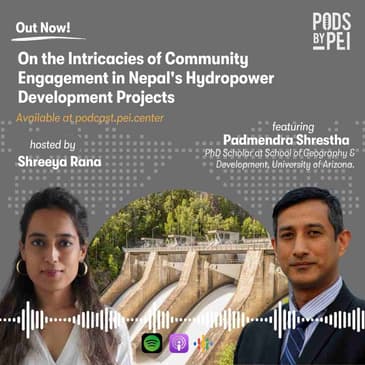
In this episode, we have PEI Colleague Shreeya in conversation with Padmendra Shrestha on the intricacies of community engagement in Nepal’s Hydropower Development Projects.
Shreeya and Padmendra discuss the community engagement processes undertaken by project proponents while developing hydropower projects, and they evaluate how they communicate the environmental, social, and financial risks, responsibilities, and opportunities to community stakeholders.
Padmendra is currently pursuing his Ph.D in the School of Geography and Development at the University of Arizona. Padmendra is an urban and regional planner with expertise in community-based planning and conflict resolution with a concentration on natural resource, environment, and infrastructure-related disputes.
[00:00:12] - [Speaker 0]
Namaste and welcome to Pods by PEI, a policy discussion series brought to you by Policy Entrepreneurs Inc. My name is Kushi Hang, and in today's episode, we have PEI colleague, Shia Rana, in conversation with Podmender Sreshta on the intricacies of community engagement in Nepal's hydropower development projects. Padmender is currently pursuing his PhD in the School of Geography and Development at the University of Arizona. He is an urban and regional planner with expertise on community based planning and conflict resolution with concentration on natural resource, environment, and infrastructure related disputes. Shriya and Padmender discussed the community engagement processes undertaken by project proponents while developing hydropower projects.
[00:01:00] - [Speaker 0]
They also evaluate how they communicate the environmental, social, and financial risks, responsibilities, and opportunities to community stakeholders. We hope you enjoy the conversation.
[00:01:17] - [Speaker 1]
Let's begin today's episode by first understanding why infrastructure projects need to engage with communities and what are some of the mechanisms in place that postulate effective community engagement. Taking the case of hydropower projects, Padmendra, could you briefly give us an overview of the nature of community engagement? Why are these required? And what are some of the policies or guidelines which are available to engage communities in hydropower projects in Nepal?
[00:01:44] - [Speaker 2]
Let me just start with why communities are engaged in infrastructure projects. This happens worldwide. So I'll just give you some few points and we'll talk about where we lie based on these points. So infrastructure projects mainly engage communities for general democratic practice, so citizens can participate in public decision making. It's also used for building knowledge, so citizens get knowledge of how infrastructures are built, how to maintain them, and it can also be an empowering symbol for some of the communities.
[00:02:16] - [Speaker 2]
It can build transparency in terms of how it's operated, how it's managed, and helps to build some kind of ownership of the communities. And this kind of engagements heavily reduce conflicts. They can help manage expectations of different people that are engaged in these infrastructures and then build trust between these developers, local communities, and different stakeholders that are engaged in infrastructures. And this helps in a successful implementation and after implementation also in in terms of managing these infrastructures. And sometimes people's engagement helps in getting some local solutions to some of the problems that comes up in in these infrastructures.
[00:03:00] - [Speaker 2]
And these citizens are engaged in multiple ways. Sometimes they're engaged through public meetings or through interviews, focus group discussions. They can be engaged through polling, workshop. They can be engaged through interactive mapping, things like that. And these public engagement are are required by law.
[00:03:20] - [Speaker 2]
These are specifically mentioned in Environmental Protection Act and regulations where the developers or the proponents have to engage with communities for a public hearing to prepare the report as well as to understand the concerns that citizens have for these kind of infrastructures.
[00:03:38] - [Speaker 1]
You mentioned environmental concerns and social concerns as part of community engagement. So in Nepal, we have this process of conducting environmental assessments. What are the different types of environmental assessments which are in practice, and how do communities engage in this process?
[00:03:56] - [Speaker 2]
The Environmental Protection Act lays the foundation for the environmental impact assessment, which is done at a project level, especially for larger infrastructures. Then we have initial environmental examination, which is similar, but their scope is slightly smaller than the environmental impact assessment. In all these, the only way to engage communities is through public hearing process.
[00:04:20] - [Speaker 1]
So we'll get to public hearing in the next segment, but I think we should dwell more into the environmental assessment process. So overall, the environmental assessment process plays a crucial role in ensuring that infrastructure projects are carried out in an environmentally and also socially responsible manner. Community engagement needs to be transparent. Community engagement should also go beyond immediate transactions between project developers and also those who are directly impacted by the project. It must also consider both present and future impacts.
[00:04:55] - [Speaker 1]
Given that infrastructure projects have both temporal and spatial impacts, how do we make sure that the communities are or the community stakeholders are engaged in this process effectively?
[00:05:07] - [Speaker 2]
Before we move on with the engagement of community stakeholders, we need to define who these local communities are first. And I think when you talk about this, we should differentiate between stakeholder engagement and community engagement. Stakeholder are generally those who are consulted for certain specific topics and those who come under certain jurisdictions like trade experts or government agencies. But when you talk about community engagement, we're only talking about the local citizens. And community engagement is just a smaller part of stakeholder engagement.
[00:05:41] - [Speaker 2]
When you talk about local communities, these communities are generally defined based on whether they're impacted by the project or not. If someone was directly or indirectly impacted by the the infrastructure project, they are part of the community of that project. And normally in Nepal, we have is practice of defining these communities based on administrative boundaries. Either it's based on wards or municipalities or by district. There are some practices where we define the communities based on effectiveness.
[00:06:15] - [Speaker 2]
Like, there are several terms used such as severely impacted population, impacted population, not impacted population. So all these are within that project boundary. And the communication between these community stakeholders and the project is mainly either can happen directly between these parties or generally, what happens in most of the hydropower projects in Nepal is that they have a concerned committee or sometimes they are also represented through these political representatives or war chairman or head of rural municipality, which can take the issues of the community to the project developers. And again, this kind of project should generally engage the citizens throughout its life cycle. But in practice, what we see is that these communities are engaged mostly during the project construction phase.
[00:07:10] - [Speaker 2]
And one of the reasons that they are engaged in this phase is that the communities can be against the project or they can create a lot of problems during construction, which can delay the project or incur a lot of cost onto these developers. And that's one of the reasons why the developers are more keen on engaging communities during the construction process.
[00:07:32] - [Speaker 1]
So in your opinion, how do you think that communities can benefit from participating in these environmental assessments?
[00:07:40] - [Speaker 2]
Based on whatever is being practiced in Nepal right now, there's not a lot that communities can benefit by participating in environmental assessment. So if they are engaged in actually preparing this environmental assessment reports, it helps the community to build knowledge about their community and then also build trust between these developers and the local communities. However, in Nepal, the practice is mostly engaging citizens only after the report reaches certain draft stage or after certain reports are published. And when they do that, the citizen engagement is mostly for gathering information, and they're also allowed to give suggestions for several mitigation mechanisms. But again, basically, it's more about awareness of what are some of the positive and negative impacts on the environment and the society.
[00:08:33] - [Speaker 1]
So in Nepal, we see that there are various developers with different capabilities and scales of projects. For example, taking the case of big investors like IFC, they have their own social environmental safeguard standards for project development. Other communities have similar expectations from projects which may not have investments from IFC, but they do expect the same kind of social and environmental safeguards. Now this has also sort of caused a lot of the independent power producers to push back. And considering that the impacts from projects are similar but the approaches may vary, why is it crucial to establish uniform standards of community engagement in infrastructure development?
[00:09:21] - [Speaker 2]
Okay. First of all, I think the standards for environmental assessment are same, whether they are financed by IFC, World Bank, AGB, or whether they are financed by local Nepali banks or any other financial institutions. Environmental assessment is basic requirement of the government of Nepal and that is done based on the rules and regulations as mentioned in the Environmental Protection Act and the regulations. However, the differences between these different financing organizations can be seen when we talk about the response to those impacts. So depending upon the financial institutions, they may require some additional safeguard measures to put in place.
[00:10:06] - [Speaker 2]
So based on their requirements, some of these projects may have a separate resettlement plan or indigenous people's plan or worker safety plan, or there can be several other plans as required by the financing institution. Let me just give you an example of land acquisition here. Generally, the government of Nepal requires a process of compensation for those land which are acquired for the project. Now, compensation is just a monetary exchange for land. But again, if we talk about the international financial institutions, what they have is that these people who are displaced by these projects have to be given options of land to land compensation or financial compensation.
[00:10:50] - [Speaker 2]
If they choose certain type of compensation, then they have to be resettled. So there are different mechanisms which can be adopted. And major regions that we see difference between these financial institutions and Nepal government's policies is, in Nepal, what you have is more of a technocratic government, which focus more on infrastructures. Just to give you an example of how in this hydropower sector, we focus more on infrastructure than people is if you look at any narrative of total energy required, total daily energy requirement, you'll hear that it'll be some x y z megawatts, which is generally associated with the infrastructure because the installed capacity of power plants. If it were people centered, we would have talked more about kilowatt hour or gigawatt hour, which are the units of energy that's used by the people.
[00:11:40] - [Speaker 2]
And in Nepal, we have more of a requirements for infrastructure, and we are focusing more on infrastructure than on the environment. There's always a trade off when you build these kind of infrastructures. So the government should decide where to draw that line, which is, like, when there's an impact, what's negotiable or what's nonnegotiable.
[00:11:58] - [Speaker 1]
So do you also want to elaborate more on why domestic investors or domestic power producers may not be as ready to deal with some of these impacts versus how international organizations are better suited to take care of these considerations?
[00:12:16] - [Speaker 2]
So for domestic power producers, there's no clear requirement for taking care of all these community engagements and addressing citizens' requirements, whereas this international financing organizations have these examples. And this kinda creates kind of inequitable situation between people. I'll just give an example of where we had different expectations based on the people's experience in different projects. So in Lamjong Middle Maharshanghi, which is funded by some international banks, They had all these safeguard policies in place, and most of the people were resettled. Even those people who had just rented a house in that area were resettled by the project.
[00:13:00] - [Speaker 2]
So when I went there once, there was a guy who was asking a private sector developer to to resettle people whose land was acquired. The people saw middle merchant and they were expecting the same kind of treatment in the private sector developed projects, where private sector cannot do that because that costs a lot of money and they don't have that calculated when they applied for the license. And this makes it difficult for private sector projects to do such kind of resettlement process. And when you talk to developers, the private sector, they prefer less standards because they feel that communities are more extractive because there are very unreasonable demands that communities make, and it's extra cost for engagement. So it all depends upon how you view citizen engagement and how you how you approach this entire process.
[00:13:55] - [Speaker 1]
So we know how crucial community engagement is in hydropower project development in Nepal. The established route for engaging with the community is through public hearings. However, even through some of our large scale surveys, we've seen that these public hearings are often very selective. It's limited to a few group of individuals that limits the representation of the broader community. Can you talk more about this process of how public hearings take place during hydropower project development?
[00:14:29] - [Speaker 1]
What are the key stages and activities? Also, some of the reasons behind why public hearings are still considered to be ineffective?
[00:14:37] - [Speaker 2]
First of all, the term public hearing just signifies that it's a one way process. In Nepal, it's the Sarwazanik Sunwai. So it's just that hearing part that's emphasized. It's not the saying part that's emphasized. So this is not a a good citizen engagement process because there's no dialogue between people in this process.
[00:14:57] - [Speaker 2]
Basically, people are invited for their opinions. They're called upon mainly during the scoping phase where the proponent tries to figure out the scoping part of the environmental assessment or they are asked to give comments on the draft report through these public hearing events. So who is invited? It depends upon who gets the message. And general method of sending invitation in this public hearing process is through public notices in daily newspapers.
[00:15:29] - [Speaker 2]
And those who read the newspapers get the message. Those who don't read the newspaper won't get that message. In Nepal, there's also practice of putting notices in their pinup boards in different public offices, like in wards, in district administration offices. But again, very few people look at these notices. So it has to be called upon by someone who actually knows about these events.
[00:15:52] - [Speaker 2]
And that's one of the reasons why public hearing has been very ineffective because this gives room for developers to bring in selected community members into the meeting just to make sure that they make a check mark for their requirements to get approval for the project. Now other way of engaging community, this is an informal way where projects engage communities through this person called public relation officers that's generally hired by the developer to engage with local communities. But, again, these mechanisms are informal and mainly done not to engage communities, but with a framework of risk avoidance where the developer wants to avoid these risks from these local communities. And citizen engagement is especially problematic when private sector involvement is there because private sector is there to make money, and citizen engagement is just another layer of burden for them because that's the kind of expenditure that is added onto them. And since we don't have this clear clear mechanisms of how to engage communities, it's kind of problematic when the projects are actually implemented.
[00:17:06] - [Speaker 2]
However, if we look at the government requirements, one thing that's clear is the money that needs to go to the communities. So, generally, projects spend some x y percentage of the cost of the project in community engagement. But because of the lack of any kind of process, these engagements are kind of messy, and these can be manipulated by the the powerful ones within the community.
[00:17:32] - [Speaker 1]
When you say money, you mean, like, they need to spend a certain percentage of their budget on these community engagement processes. Is that what you're saying?
[00:17:42] - [Speaker 2]
So money means when they drafted this energy emergency document, they put certain amount, I think 0.5 to 1%, some percent, some number there that needs to be spent on local communities by the builders. And that amount of money, at least there's a clarity on developers on that amount of money that needs to be spent on local communities. But how to spend those money is not very clear. Right? I think I think there's a clear message from the government that project developers have to spend certain amount of money for environmental or social mitigation measures, especially towards engaging these communities or benefiting these communities in multiple ways.
[00:18:26] - [Speaker 2]
But again, how to spend this money, they have to go through a different process. And one of the ways that they engage these communities for spending this money is through public hearing. They'll get a list of requirements where they note down all the requirements and prioritize and allocate certain money on each of the requirements.
[00:18:50] - [Speaker 3]
Hi there. This is Sonia Jimmy from Policy Entrepreneurs Inc. You have been listening to POTS by PEI. We just wanted to take a brief moment here to thank you, our listeners, for your amazing support. It truly means the world to us.
[00:19:04] - [Speaker 3]
Since you have been listening to us for so long, now we want to hear from you. Send us questions that you may have had on your mind or topics that you want us to cover. You can reach out to us via our email address infopei dot center or any of our social media platforms. So thank you once again for your support and for listening to POTS by PEI. We are looking forward to hearing from you.
[00:19:28] - [Speaker 3]
Now let's get back to the episode.
[00:19:34] - [Speaker 1]
So let's talk a little more about the ineffectiveness of public hearings. There have been instances where communities feel that their concerns were not adequately addressed or incorporated into the decision making process. Now in your opinion, what are some of the reasons for such grievances? Could you also suggest some ways to improve community participation and satisfaction? Maybe you could draw from your own experience of working so closely with so many communities which were affected by hydropower projects.
[00:20:03] - [Speaker 1]
What were some of concerns you heard directly when you were working with these communities?
[00:20:09] - [Speaker 2]
All the public hearing events are limited to input of public opinions. In principle, what this means is this provides a list of things that the developers can work on as part of their mitigation or benefit sharing mechanisms. But again, it comes back to the same problem. What is the priority? Is infrastructure priority or is the people in priority?
[00:20:37] - [Speaker 2]
Once we figure out who the priority is, we will be more clear on how this community engagement would be run. If people are priority, our engagement mechanisms would be much more different than if the infrastructure is in priority. Now, from my experience, I think there are a lot of demands that communities have when they engage with the developers. One of the common things that we see from community members is they want these basic necessities such as schools, health, water supply, roads, public buildings, teachers. These are things that the government should have provided even without infrastructure, and these projects have to provide these because there are a lot of demands.
[00:21:19] - [Speaker 2]
That's one of the reasons why there's lot of these tension or or conflicting issues that comes up because of those unmet expectations between the communities and the developers. Also, one of the most demanded things within the communities nowadays is employment. Generally, they want more skilled employment, but communities are not well educated. So only few people get skilled employment, whereas most of the people are engaged in unskilled employment in these projects. People also demand shares.
[00:21:52] - [Speaker 2]
There used to be a lot of demand of shares a few years ago, but now since all hydropower projects are issuing these local shares, I think the voices have gone down a little nowadays. And there are a lot of direct impacts that people want to complain about. There are complaints like drying up of water resources or dust being blown by vehicles passing through or there are, like, infiltration of foreign labors that come into these communities disrupting the the local dynamics. Those kind of things are always there, but there is no space for dialogues. Generally, people have lot of complaints about the projects, but there's no space for them to communicate with the developers.
[00:22:33] - [Speaker 2]
So the big question is why can't these projects implement some percentage of those costs on the local communities? And that's been a big concern for most of the communities.
[00:22:43] - [Speaker 1]
So in your knowledge, has there been any notable case where monitoring implementation of environmental safeguard measures fell short of the expectations that led to some unforeseen or unprecedented impact on the environment or the local communities?
[00:22:59] - [Speaker 2]
There are a lot of shortcomings in the environmental assessment practices in Nepal, and especially the monitoring part is very weak. So we don't know whether whatever is written on the environmental assessment report has been implemented or not. And on top of that, the reports are not readily available for people to verify whether certain things are implemented or not. So that makes things a little difficult. Again, one of the big oversights in hydropower projects is the environmental flow.
[00:23:30] - [Speaker 2]
So there are laws which says 10% of water should flow in these rivers, but they're not done based on those laws. Most of the projects would not release any water, especially during the dry season. And also, we talk about the fish habitats in these rivers, it doesn't fall under any jurisdictions of any of the ministries. And that kind of leaves this issue in limbo for most of the developers to take action. And if one project fails to implement these fist ladders, it impacts the other projects as well.
[00:24:02] - [Speaker 2]
There are also impacts of these landslides that occur because they're because you cannot assess these landscapes in detail when they do these studies. Because of that, when a lot of blastings occur, there are lot of land size in most of these mountainous areas in Nepal.
[00:24:19] - [Speaker 1]
So looking at these instances, how do you think this informs the ongoing efforts to improve the effectiveness of environment assessments in Nepal.
[00:24:27] - [Speaker 2]
So we had this new environmental protection act in, I think, 02/2019. It's a lot better than the previous one because first, they have included climate adaptation part, which was not there before. They also harmonized these different tiers of government, so federalism has been incorporated into the new environmental assessment reports. Now I talked about monitoring before. This new law has provision for environmental inspectors at different tiers of government.
[00:24:56] - [Speaker 2]
So even local governments can now have environmental inspectors, but I'm not sure how they are going to be allocated based on these projects right now. But it's a good effort to put that into laws. And I talked about inaccessibility of information. Now all environmental impact assessments are required to be uploaded in the ministry's website, at least during the comment making period, which is good as in terms of reaching out to the people or giving out the information that's required. So at least government is taking some proactive steps in terms of ensuring those informations are reaching to the general public.
[00:25:36] - [Speaker 2]
Again, despite having revised laws, we do not have this improved citizen engagement plan. So citizen engagement still remains the same as in the previous laws. So which is, again, going back to this policy question, what's our focus? Is it infrastructure or people? And it looks like infrastructure is still the main focus.
[00:25:56] - [Speaker 1]
So in addition to the concerns which were raised about the adequacy and the accuracy of environmental assessments conducted for hydropower projects in Nepal, Another concern raised about these assessments is that there's a lack of transparency and access to information. Along with this, there are also criticisms that the quality of these assessments are not up to the mark. How can the transparency of the environmental assessment processes be improved so that it it ensures that all stakeholders have access to relevant project information and that they can actively participate in decision making?
[00:26:35] - [Speaker 2]
I'll focus here on transparency of the environmental assessment reports. I personally went to all these different places trying to look for environmental assessment report. First, the ministry said they had their reports in their own library in Babar Mall, one of their departments, but it wasn't available. So they only had recent environmental assessment reports and not the old ones. Then I went to the TU library, which has all the environmental assessment reports.
[00:27:04] - [Speaker 2]
But it's super difficult to access these documents because they're not organized serially, and I spent about an hour looking for just one document. And so that took a lot of time to just search for that one document. And they're also available in national library, but not many people would go to these libraries to look for these documents. And it's a very cumbersome process. And if you want to make a copy, you need to photocopy it, which, again, costs some money.
[00:27:31] - [Speaker 2]
So general people would not want to go there and get these documents. These places do not even have initial environmental examination report. Only environmental impact assessments are available in these libraries. Now with the new laws, I think if you look at the Ministry of Environment's website, you would see some environmental impact assessment reports as uploaded mostly during the public notice period. So if they are seeking public inputs, I think people can download the documents from the website.
[00:28:01] - [Speaker 2]
However, I'm not sure whether they are kept there for longer periods. So I think there should be a mechanism where they they are kept as a repository for a longer period of time so that people can look at it whenever they they want to. And and it's not only EIAs, IEEs. The initial environmental examination should also be made public because if you talk about hydropower, less than 50 megawatt projects have to go through the IEE process and more than 50 megawatts go through the EIA process. And since most of the hydropower projects in Nepal are small hydropower projects, I think if we don't have access to IEEs, we're missing out on a lot of those projects.
[00:28:43] - [Speaker 2]
And again, if the government takes these initiatives, it'll be a lot better because proponents don't have any incentives to share these documents because these documents contain all the detailed projects that the project wants to implement, and they're also tagged with the amount of money that they would need to invest or expend on each of these categories. And proponents don't actually want to release these documents publicly because because citizens use this as a baseline to make negotiations with the power projects. However, I think it should be the responsibility of government to share these documents widely.
[00:29:24] - [Speaker 1]
Now that we're coming to the end of the episode, what are some of your reflections on how hydropower projects should engage with the communities in Nepal? And if you were to compare it with some of the global practices, how do you think it compares to those practices?
[00:29:39] - [Speaker 2]
One of the primary objectives of environmental assessment document is to make public aware about the environmental and social impacts of infrastructure projects. And this is kind of missing in Nepal's laws and practices. I think the one of the primary purpose of environmental assessment should be to share it with the public and not just for the bureaucratic requirement. Right now, the entire environmental assessment process is being used as a way to get bureaucratic approval for the project. And this is one of the reasons why developers kind of argue that we need to shorten the time because because it's only taken as a bureaucratic process, but they don't do not see this as a public engagement process.
[00:30:27] - [Speaker 2]
So I think there should be a more transparent process in terms of how to engage these local citizens. Again, if if environmental assessments reports are to be taken as a very technical part of the technical process, you can separate the negotiation process out of that. And if I've seen some countries where they use what they call a benefit sharing agreement. So besides environmental assessment, which is more technical, they have this negotiation between the developers and the and the local communities to prepare this benefit sharing agreement that defines what are the roles and responsibilities of the developer and what are the roles and responsibilities of the local citizens. Again, we need to emphasize on dialogue rather than one way communication in these.
[00:31:14] - [Speaker 2]
So in policy itself, we don't have these provisions for dialogues. And unless we have a dialogue in place, there are always rooms for conflicts to happen. So I think one of the ways to think about this is to create that spaces for dialogue between those who are impacted by the project and those who are building the project so that both of them can work together and help each other in terms of achieving their goals of infrastructure development or in terms of safeguarding the interests of the local communities. If we can have effective dialogues between these different sectors, we'll have a better results in terms of both environment and society.
[00:31:57] - [Speaker 1]
Indeed, effective communication is key. And with that, I would like to end today's episode. Thank you, Padmender, for sharing your insights.
[00:32:04] - [Speaker 2]
Thank you, Shreya.
[00:32:10] - [Speaker 0]
Thanks for listening to Pods by PEI. I hope you enjoyed Shreya's conversation with Padmindra on the intricacies of community engagement in Nepal's hydropower development projects. Today's episode was produced by Nirjhun Rai with support from Sonya Jimmy, Hidesh Sapkota, and me, Kushihang. The episode was recorded at PI Studio and was edited by Hidesh Sapkota and Nirjhun Rai. Our theme music is courtesy of Rohit Shakya from Zindabad.
[00:32:36] - [Speaker 0]
If you like today's episode, please subscribe to our podcast. Also, please do us a favor by sharing us on social media and leaving a review on Spotify, Apple Podcast, Google Podcast, or wherever you listen to the show. For PEI's video related content, please search for policy entrepreneurs on YouTube. To catch the latest from us on Nepal's policies and politics, please follow us on Twitter at tweet to PEI. That's t w e e t followed by the number two and PEI.
[00:33:05] - [Speaker 0]
And on Facebook at Policy Entrepreneurs Inc. You can also visit pei.center to learn more about us. Thanks once again from me, Kushi. We will see you soon in our next episode.