

Khushi is a final year undergraduate of the Social Sciences program at Kathmandu University. She is studying an interdisciplinary course in Sociology, Politics, and Philosophy as a merit-based scholarship holder. Khushi completed her A-levels in Humanities and Statistics from Rato Bangala School and has been a part of various fellowships where she developed her research, project management, education, and advocacy skills. Before joining PEI, she worked for different educational and non-governmental organisations.
At PEI, Khushi is a Research Associate who supplements the different endeavours of PEI with research support. She is also a member of the PEI communications team and is engaged in various branding and production tasks for PODS by PEI.
Besides her interests in research and academia, she is also a theology and philosophy aficionado.
Related Episodes

Curbing Corruption: Narayan Adhikari on Inviting Innovation in Anti-Corruption
#Ep.072 The human pursuit of purging corruption in its social systems has perhaps been as old as the problem of corruption itself. Regardless, the problem persists and grows rampant, accentuating development challenges. While some have given up in the face of corruption’s seeming invincibility, others have mobilized to reimagine anti-corruption strategies to encompass diverse aspects and stakeho...

Rethinking The NID: Inclusion, Data Justice, and Tech Solutionism
#Ep.065 The National Identity Card Project, an effort to digitize nationality through the distribution of a biometric-informed electronic card, began as part of Nepal’s e-Governance mission back in 2008. After years of delay, the NID is now in full swing, with almost 10.3 million individual data collected so far. Although the government initially touted the project for upholding Good Governance, m...
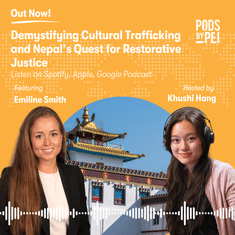
Emiline Smith on Demystifying Cultural Trafficking and Nepal’s Quest for Restorative Justice
Ep#050 When the world took itself indoors and online during the pandemic, a unique virtual movement bubbled in the Nepali social media sphere, one that identified multitudes of Nepal’s cultural objects in the unnatural glass cases of foreign museums and mobilized, in thousands, for their repatriation. For the first time, the Nepali masses collectively denounced cultural trafficking, pressuring w...
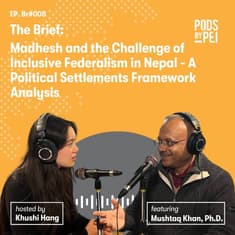
The Brief: Mushtaq Khan on Madhesh and the Challenge of Inclusive Federalism in Nepal - A Political Settlements Framework Analysis
EP. Br#008 Contemporary economics and policy studies struggled with two main paradoxes: while on one hand policies previously successful in some countries remain futile in others, on the other hand, different approaches were capable of solving the same issues in different contexts. A Political Settlement Framework tackles this paradox by acknowledging the need to tailor policies to the idiosyncr...
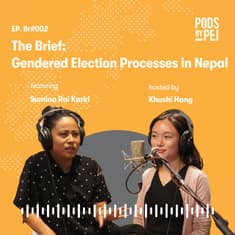
The Brief: Sumina Rai Karki on Gendered Election Processes
Ep. Br#002 The 2017 elections were lauded for their cognizance of the historically bleak presence of women in the political sphere of Nepal, to overcome this, the State mandated a Quota reserve of 40.4% of all nominee seats for women. The policy affirmed the presence and participation of Nepali women in politics, as approximately 14,000 women were elected into different positions in the Nepali G...