
#Ep.072
The human pursuit of purging corruption in its social systems has perhaps been as old as the problem of corruption itself. Regardless, the problem persists and grows rampant, accentuating development challenges. While some have given up in the face of corruption’s seeming invincibility, others have mobilized to reimagine anti-corruption strategies to encompass diverse aspects and stakeholders like never before.
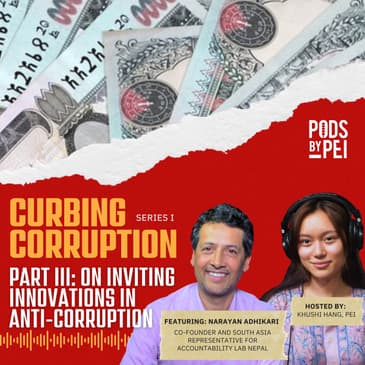
In this episode, PEI’s Khushi Hang and Narayan Adhikari discuss anti-corruption strategies with a focus on the role, significance, and need for innovation in the field. They explore what it means to embrace innovation in anti-corruption, dissecting the different aspects and challenges in reimagining this pursuit. They also go over revered innovative anti-corruption campaigns led by Narayan himself and discuss their impacts and limitations.
Narayan Adhikari is a social entrepreneur and leader in global accountability and governance. He is the Co-founder and South Asia Representative for Accountability Lab Nepal and runs Open Gov Hub Kathmandu to promote transparency, accountability, and civic participation in governance. He is on the board of Trustees to RESULTS UK and Co-Chair for C7, Open, and Resilient Society for 2023, and is a strategic advisor to the #ShiftThePower global movement.
This episode is a part of our Curbing Corruption Series.
Curbing Corruption is a PODS audio series unraveling the complexities of corruption and exploring the strategies to combat this global challenge, where PEI colleagues engage in candid conversations with experts, practitioners, and thought leaders who offer insights into the intricate web of corruption, its impact on communities, and the ever-evolving innovations and strategies to measure and combat it.
If you liked the episode, hear more from us through our free newsletter services, PEI Substack: Of Policies and Politics, and click here to support us on Patreon!!
[00:00:01] Namaste and welcome to Parts by PEI, a Policy Discussion Series brought to you by Policy Entrepreneurs Inc. My name is Selnier Jumi. Today's episode is a part of our curbing corruption series. Curbing Corruption is a part of the audio series,
[00:00:28] and raving the complexities of corruption and exploring the strategies to combat this global challenge. Where PEI colleagues engage in candid conversations with experts, practitioners and thought leaders who offer insights into the intricate web of corruption.
[00:00:43] It's impact on communities and the ever-evolving innovations and strategies to measure and combat it. We have PEI colleague Kushi Heng's conversation with Narayan Adhikari on Inviting Innovation in Anti-Corruption Strategies. Narayan Adhikari is a social entrepreneur and leader in global accountability and governance.
[00:01:04] He's the co-founder and South Asia representative for Accountability Lab Nepal, and runs OpenGov Hub, Kathmandu to promote transparency, accountability and civic participation in governance. He's on the board of trustees to results UK and co-chair for C7, Open and Resilience Society for 2023,
[00:01:24] and is a strategic advisor to the hashtag Shift the Power Global Movement. Kushi and Narayan discussed anti-corruption strategies with a focus on the role, significance and need for innovation in the field. They explore what it means to embrace innovation in anti-corruption,
[00:01:41] dissecting the different aspects and challenges in reimagining this pursuit. They also go over-revert innovative anti-corruption campaigns, let by Narayan himself and discuss their impact and limitations. We hope you enjoy the conversation. Welcome to the show Narayan, how are you feeling today?
[00:02:00] Feeling good and thank you Kushi for having me. Yeah, so we're in the third episode of our curbing corruption audio series, and in this conversation we're heading into anti-corruption strategies, and particularly focusing on the various ways of inviting innovation in this pursuit.
[00:02:18] Social efforts encountering corruption are perhaps as old as the issue of corruption itself, but they've rarely been successful. And in this context, Narayan, your team at Accountability Labs, were one of the few who explored beyond top to bottom approaches to find new ways to counter this problem.
[00:02:37] My first question for you today is what inspired your interest to work in anti-corruption, and then eventually feeling the need to explore innovative anti-corruption approaches in this scene. Thank you, I think it looks like this question, but it's one of the hardest things for me to explain
[00:02:56] what in terms of what inspired me to become a, it one of the champions on anti-corruption. I think I would say, I'm one of the victims of corruption. Just to give you a very short story of when my father,
[00:03:11] in a had a six children and struggling to feed us, and he was looking for some opportunities. We were very small and young, and that time he had to give a lot of favors to the people who had power in access and authorities.
[00:03:26] And I was wondering always like why he had to please these people in order to get a job and to work, and he would explain to me the thing is you have to give favor to someone who is going to give your job.
[00:03:40] So I feel bad about that. And also I sort of get a lot of inspiration from my academic and later on, engaging as a youth activist and seeing everywhere, that things are not working like education held. And then later on engaging with this development work,
[00:03:58] and it's continuing to inspire me to do something, and I found working on anti-corruption or I would not sit anti-corruption, is really about building integrity and promoting good governance. I like how you separated the two ideas and decarruption versus creating integrity
[00:04:13] and we'll come back to that as we move on with the conversation. And thank you so much for sharing that personal story. I think that's something so many people in our country can relate to. So far in this series,
[00:04:25] I think we've adequately defined corruption and lead out its different forms with scholars. However, corruption is a concept that's truly embedded in the Nepalese icon. And you have had this extensive experience working with diverse civil groups on the ground.
[00:04:40] So drawing from that what have you observed are some of the common conceptions and misconceptions about corruption that you have come across so far? I think the first conception about corruption is corruption is everywhere. And it's an act of unethical behavior.
[00:05:00] It's about stealing public resources for private gain, a political or institutional gain. And there's another conception about corruption is not just about stealing money or any public resources, but it's also about people being dishonest and not able to fulfill their duties.
[00:05:21] Because they're not working hard, they're dishonest to their own duties. And they're misusing their interested power for personal gain. And the misconception is it just against this. Like when I say it's not just about money, it's also about stealing the time or you're not presenting your work,
[00:05:41] or it could be too cheap and honestly. And it's also about there's a misconception that corruption is in some context and culture is actually efficient. Some people believe that what's wrong of giving some favors and paying some price and kickbacks,
[00:05:56] if it's going to facilitate your work, simply giving a gratitude to somebody who has done so much of my work. I went to this degree in the office for my citizenship and that official has done so much for me.
[00:06:10] People simply feel so blessed and they simply take it as a normal process of giving. So it's really about accepting corrupt, there's sort of normalization, normal acceptance and the normalization. Yeah. So that's what you see commonly. Absolutely.
[00:06:29] And also another misconception is that when you talk about corruption, the symptoms is actually the cause that makes people institutions a system to be corrupt and having the lack of integrity.
[00:06:41] So the misconception is that if you find somebody, let's say a police officer is taking bribes and you simply cut that police officer and put in jail
[00:06:51] and you see this, this is the end but actually we need to understand why that person is actually not fulfilling that duties. Why a school teacher is not going to school and teaching honestly and why a health worker is actually not working hard.
[00:07:04] We need to understand what are these underlying causes and what actually make that person's corrupt. So we can delve into this later. Yeah, definitely.
[00:07:14] And I'm glad that you brought up this idea of how corruption is not just the symptom but has larger underlying causes that are going on. Which is I think the perfect segue for my next question which is, what do we really mean when we say innovation in anti-corruption?
[00:07:34] And this sort of reminds me of what you said at the really top which is there's a difference between anti-corruption and integrity, which I think is a very innovative way of seeing this whole problem.
[00:07:46] And my question is what are we leaving behind from previous practices as we embrace innovation in this pursuit? Like you mentioned very early that corruption is everywhere and it has been there since civilization started.
[00:07:59] And anti-corruption efforts also started since then and it has always been like I said looking at from the rule of law of perspectives and enforcing laws and rules and giving punishment to the corrupt.
[00:08:14] And never thinking of how we can promote a positive behavior and really create that behavior as a role model to inspire particularly the new generation before they get entrenched in corrupt behaviors.
[00:08:27] And it has been so much of tick-box exercise let me give you an example about a report card what you do is you just go and try to spot light where the, you know where the mistakes are, where the black spots are.
[00:08:39] And you're not really looking at where the signing lights are, you know that may be small but that may play a big role in terms of instigating ideas of anti-corruption and more positive and in shifting values and norms rather than just continue.
[00:08:55] And in forcing laws and rules that are not necessarily inspiring and creating incentives to everyone within an outside no power room.
[00:09:03] And when we talk about innovation I think it's not really about creating new technology or it's not really a rocket science but about doing things differently recognizing the changes that happens in the anti-corruption space as well as in the corruption space.
[00:09:18] In with the proliferation of technology and you know the globalization and the connectivity if you look at corruption network, the well network they're very smart and you know the corruption ecosystem is so efficient.
[00:09:32] But the anti-corruption work and ecosystem is not efficient, it has been working on silos and there's no collective approach there's no, you know the community approach.
[00:09:42] So I think what we need to revive when you talk about innovation is really leave all this you know isolated silos approach and follow through this connected collective approach.
[00:09:55] And that's where we can look for innovation and innovation is nothing other than finding something that is going to work for you it could be a technology enabled innovation it could be use of ours and the cultural practice that we have been doing.
[00:10:09] It could be anything it could be something like what we're doing now is creating a podcast creating a conversation that is leading to some kind of change in a way we want to see the change in making governance working for for all.
[00:10:22] Those are some very interesting observations moving forward with this conversation I think I want to focus a bit more on dissecting global innovations that we've seen in anti-corruption and specifically focusing on the campaigns that you've worked.
[00:10:36] One of the most groundbreaking updates in anti-corruption strategies was perhaps your integrity icon campaign this was intriguing for me personally because we were taking on corruption with a positive attitude trying to focus on amplifying the honest individuals like you said the bright stars and practices than rather than fixating on what is corrupt.
[00:10:58] Can you share how the program worked in about what were its processes and how did you see the impacts unfold? Thank you for mentioning this this is one of my favorite things of course I like it because I'm one of the co-founders of this idea.
[00:11:13] Actually, I have involved about I don't know exactly but seven eight years on a so called anti-corruption movement here and there in Nepal internationally and I found it.
[00:11:25] It's nice to call out people it's nice to see people and it's nice to fingerpoint if you can find the solution for solution for forever. Otherwise just boring you were just wasting your energy just continue keeping a pointing, you know, sporting on what is not working.
[00:11:46] So when we started accountability lab in 2012, you know, we were looking for what we can do something new something inspiring something positive.
[00:11:56] And there's a different approach on anti-corruption and anti-corruption shouldn't always be just catching the bad person and putting in a jail there should be something inspiring which I mentioned before.
[00:12:08] So we came up this name integrity idol so we used to call it integrity idol before but now we changed the name because of the American Idol this claim.
[00:12:16] There are a couple of rights and all but the idea was you know, we went to see different people especially within government and at the same time we also talked to people from media, civil society and my colleagues and friends and everybody sort of wanted some positive narratives on anti-corruption.
[00:12:34] We really not just about fighting corruption but also about building that personal accountability and integrity and really highlighting what is working and using this as a model to inspire more people.
[00:12:46] And it's really about shifting individual beliefs and values and to create an expectation that is integrity become an expectation. It could be a become an expectation versus you know there is always a fear there is always the blame game and there's always naming and shaming.
[00:13:03] So the naming and framing approach we found it it's really helpful and it's really encouraging and it's really it's really about appreciating the one that is working and using the power of individual honesty and integrity in fighting corruption. In other words it's anti-corruption approach but more positive.
[00:13:23] I think the end game is to create a network of honest individuals within the system and then ecosystem around that and they begin to build this conversation where they are. And to use integrity icon as a means to transform you know institutional integrity.
[00:13:39] So using them as a catalyst for change within the public service system. Now that you've set it out loud it makes so much sense to make a network out of individuals who are striving to be honest.
[00:13:52] This particular hit me because when we imagine corrupt individuals we typically imagine us indicate they have a community of their own selves, but the ones who are trying to do it right are often isolated so that's amazing.
[00:14:05] Another thing that popped in my head was that as you were trying to highlight and celebrate these integrity icons, you were also stigmatizing corruption and dishonest behavior which for me ties back to the idea that corruption is so normalized in our societies.
[00:14:23] So amazing something that I really wanted to ask as a follow up of this question is, corruption is something that is as we say in our intro it's painstakingly lucid and it's really hard to measure and define. But so is integrity.
[00:14:40] So in your process, in your campaign how were you able to sort of shortlist this individuals and how were you able to measure your impacts? How are you able to maneuver over these very abstract ideas.
[00:14:54] That's hard I mean thank you for it's hard but we have developed various indicators for this just to give you a short answer.
[00:15:02] We have looked at three basic framework one is we looked at individuals, the individual characters like how honest that person is and again it's hard to define honesty. You may ask me another question how do you define honesty?
[00:15:17] It's really about the conversation that we have with this selected nominees and going through this long conversation and also getting a lot of reference from people. So if you could be a service seeker or other colleagues, media and civil society.
[00:15:32] The first framework what we look is we look within the individuals like how honest that person how dedicated that person looks how approachable that person is how humble that person's looks. It's really a long process of first time to understand that person as a person right.
[00:15:48] While we're looking at this approach we first forget everything else we forget about that person is a public servant or he or she is a joint secretary or our under secretary or officer or assistant.
[00:15:59] We just looked at how this person you know behave behave well with the service seeker with him or her colleagues and and how that person actually recognize as an individual.
[00:16:12] So this individual characteristics the quality, the value system and what that person likes dislikes how he or she behave with others.
[00:16:21] And the second one is we go into the duties the response fillet is because the public servant is min for certain duties and how that person is actually performing his or her duties.
[00:16:32] And that comes with the relationship with the public relationship with departments relationship with stakeholders is really about the work domain right and how innovative that person is. Right everybody does the same things because we don't expect a public servant for example a nurse.
[00:16:49] Be so innovative it's not always about innovation but it's also about how that person is practically six solution to provide to facilitate the public service delivery system.
[00:17:00] How inclusive that person is how humble that person is as a public servant whether that person is creating an environment that people who come for services feel.
[00:17:11] welcoming or perceivable and respected and everybody feel dignified while you were having interaction with that person in relation with the work and the third.
[00:17:21] Domain we looked at is whether that person continue to do the good work with honesty or not. However, we have instances when you award someone today and tomorrow that person turn as a corrupt individuals you don't really know how that person's behavior in the future.
[00:17:38] So the person can be changed with the ambitions and environment could be from the peer pressure of family pressure. So we would also have a lot of conversation and try to understand whether that person will continue to be a fear or not.
[00:17:52] Then we have a panel of judges, we're very experienced and well-respected people and they also verify this information and talk to various people and we try to get the best individuals.
[00:18:02] There is a limitation for us definitely and I think it would be unfair for anyone to expect you to have built this full proof selection process anyways because these are things that are perfected over time right but it's still amazing the effort that you've put in and the thought that goes into this procedure.
[00:18:21] I also wanted to know what are the direct and some of the indirect impacts that you've seen once you've brought in integrity icon of course. There are those that we've already spoken of but also in terms of inspiring successive individuals have we seen cases of that sort.
[00:18:41] When we did this effort one or two years I remember this staff call is providing to upcoming public servants a call us and say hey we would like to invite you in take a day icon to tell their stories so that these upcoming public servants will have some kind of inspiration and also they will be connected and they can work as a mentor.
[00:19:02] So with this conversation with the staff colleagues and with other institutions what we have is even is small it's not big but we started something called integrity innovation lab.
[00:19:14] We also call it integrity school because this school is M for young public servants who have a desire to grow within their administration and have ambitions but they have some level of fears of whether I get in train to into all this kind of bad behaviors and I want to
[00:19:31] to retire with all these allegations and blames I want to continue to work and progress in the job but I need to learn how to maintain integrity and accountability. So with their expectations we started this school and now we're having this school which is going really well.
[00:19:47] So a lot of young people coming and having conversation learning from each other's and this integrity icon because they are a bit experienced. I've gone through lots of ups and downs working within the bureaucracy and they are actually mentoring these people helping them by sharing their experiences.
[00:20:04] And there is a dilemma whether you take a right decisions you think this is a legally right but you know at the same time you're not convinced because this is unethical.
[00:20:13] How do you balance it? How do you make a decisions so that you make the best decisions without happening your relationship with your boss.
[00:20:20] But at the same time you need to put public in the centers. So when you have a dilemma like that you can always call this integrity icon and you get mentorship and you know when we started their individuals were a bit hesitant.
[00:20:33] It's you know very normal human behaviors. You cannot just go out and say hey my name is Chrissy and I'm the most honest person, you know somebody else has to always report what that person is about and there bit hesitant to name themselves as integrity icon because the people and colleagues is like always laughing at them and all you are the most honest integrity icon.
[00:20:53] Wow and now eventually because we've been doing this for 10 years and they're like 45 integrity icons along with these young public servants we call them integrity scholar and future integrity icons.
[00:21:05] And we also do integrity icon fellowship, target young people who are outside the government. So now coming a community and I see that community is something bigger and impactful.
[00:21:15] Hi there this is somitarniobani from policy entrepreneur Zeng. We hope you're enjoying parts by bi as you know creating this show takes a lot of time and resources and rely on the support of our community to keep things going.
[00:21:37] If you've been enjoying the show and would like to help us out, we'd really appreciate it if you could become a patron on Patreon. Patreon is a platform that allows listeners like you to support creators like us with a small monthly donation.
[00:21:52] We support, we go a long way in helping us continue creating high quality content for you. So if you're interested in supporting our show and becoming a part of our community head on over to patreon and become a patron today.
[00:22:07] You can find us at patreon.com slash sports by pion every little bit helps and we can't thank you now for your support. Now let's get back to the episode.
[00:22:18] Yeah, it's really interesting that you talk about young people in the youth because they've been really prominent focus in your campaigns and not just you but even globally,
[00:22:32] we see that a lot of these bottom up efforts against corruptions and other social problems are starting to focus on the youth with larger international programs starting to create forums and channeling funds all focusing on the youth.
[00:22:47] Why do you think young people are taking the center stage for social issues like corruption and maybe as you tackle this question, you can explain your own rational as to why you were looking into working with more youth?
[00:23:00] I think maybe it's the need of a need of time. Young people around the globe are not satisfied in terms of what is working politically and because by the age and ambition, they're always dynamic, you know, vibrant. Maybe for that reason they want to see some change.
[00:23:19] And I'm sure you're speaking from your own personal experience. Absolutely. But there's a lot of, I mean, there's big changes between my time when I was young and today's young generation. There's a fast difference. One thing is that today's young people are more entrepreneur.
[00:23:34] They're more access to information access to technologies. For example, when government banned TikTok, many, many young people, my cousins, they're pissed off with the government because they were starting some business.
[00:23:45] They're selling some stuffs on TikTok and making their livelihoods, right? They're not dependent on their parents. Even though their parents are very rich. So the young people wants to do something and they're not getting a favorable environment, right?
[00:23:58] They are not satisfied with the system and they know that there is corruption. There's lack of accountability. There's no access to opportunity. Access to information. And I think eventually they get frustrated. And they want to get involved in this change process.
[00:24:16] We can also recall this experience with the last election. We could definitely see more young people coming to the seats because, you know, one hand, the young people wanted to intervene.
[00:24:29] But in other hand, there was a growing frustration and people wanted to power the frustration with somebody they see as a potential force to change the society. That is one. That's why the young people, I think, they're more interested.
[00:24:42] And young people today are more connected than ever, totally, right? They have access. They learn from each other's, you know, something that happens in South America today. You know, these young people from here, Kathmandu, they can easily know what's going on there and this is influenced from everywhere.
[00:25:01] And in my experience, I mean, the work that we are doing within Accountability Lab is when we talk about making governance work for people. It is always not about fighting corruption. It is always not about doing a lengthy workshop and conferences and so-called development.
[00:25:15] But it is also about are we investing on the right thing? And are we thinking are we aligning our strategy and thirds towards more entrepreneurial approach in fighting all kind of social evils, right?
[00:25:29] That's why we come up with these ideas called Accountability Incubator where we call young people who have ideas coming from anywhere like someone, you know, someone who knows how to play basketball or good musicians or artists.
[00:25:45] So we call young people who have ideas and we provide a support to build that ideas. That's why we call it Accountability Entrepreneurs. Accountability Entrepreneurs.
[00:25:54] So because we didn't focus much on entrepreneurship, we became more vulnerable. We always looking at the funding, you know, coming from donors and we are doing great and we're so active and vibrant until we have money.
[00:26:07] Then everything gone, right? So what we can do something that is more entrepreneurial and best on somebody's passion interest.
[00:26:15] And if organizations like us, if we begin to invest on innovative ideas coming from young people, it will definitely take up and young people help more time to test ideas and to fail and to learn and to interview.
[00:26:30] Another aspect of innovation that I've observed is a focus on arts, culture and creative media. I'm seeing grants for street art, murals, literature, music and performative arts in the cause of anti-corruption.
[00:26:47] And as I observed this, I think this is a very sharp detour from the traditional top down approach that we previously had. What is the role of these previously undermined aspects of society in creating an effective social mobilization against corruption?
[00:27:03] The one thing, you know, the one risk is that if we are not supporting somebody who loves let's say music, then you are simply losing that person in the fight against corruption.
[00:27:14] If you just keep talking about let's fight against corruption, go to a street do some workshop do some report cards. The person having interest in music will never come.
[00:27:24] And the person who loves the arts and murals, they never come to the so-called anti-corruption movement. So you're literally alienating people, especially young people coming from diverse backgrounds and skill sets and talents.
[00:27:40] So that's why it's bringing you know accepting all kind of ingredients. It could be music, films, theaters and using technology new media is really really important.
[00:27:51] And then you're creating a space for everyone and you're creating a platform. You are using power of music to fight corruption by creating inspiring stories and shifting social values and norms.
[00:28:03] Using arts and similar ways and you are promoting social entrepreneurship that may create something, let's say use of technology on tracking information and creating that information repository and enabling large number of people within information. They need to demand accountability.
[00:28:23] So I understand that it's not only about finding these new expressive ways of communicating the idea, but also bringing more people and more individuals into the movement by drawing into their own passions.
[00:28:37] I like your point about individual, my own observation on how this development work happened in Nepal, especially the citizen-led development or NGO-led development is more institutional.
[00:28:49] But what about individuals? And when we want to bring that true sense of civic movement, if you really want to bring the notion of civic movement versus the NGO movement, we really need to create an environment for individuals.
[00:29:04] Every individual has something to contribute, everybody individuals have potential to bring changes. So I think giving space for innovation and creativity is really about giving space for individuals, and especially individuals coming from unlikely networks and coming from marginalized communities who are often not considered as a community for change rather a community for sympathy.
[00:29:29] That point on marginalized communities, I understand that working with grassroots communities with an intention of empowering those who have been marginalized sounds incredible.
[00:29:40] But obviously the status has its own challenges, especially in our country like Nepal where there are multiple hierarchies that lock free interactions between people of different gender, caste groups, ethnicity or even age groups. There's a huge divide between them.
[00:29:57] Additionally, the benefits of corruptions are distributed in ways that benefit those who are benefiting from the structures or social hierarchies already.
[00:30:06] So what are some of the challenges that came up as you worked with local level social mobilization and how were you able to thoughts some of this social fragility?
[00:30:16] I think one challenge that you rightly pointed out when you go to the community, let's say the marginalized communities, what we noticed is that people who never been in power structures, they always think that politics is not our things and making this is not part of our confetti.
[00:30:34] So people are really, they are self-isolated but the young people from the same communities, they want to change their own society and providing the support that they need in terms of how they want to engage with their own communities
[00:30:48] and also creating that voice and using that voice to continue to build on the structures. You know, the challenges whether that community have the power and access to shift that. So I think that that's the biggest challenge.
[00:31:03] And the second challenge is whether there's a continuing conversation in this process or not, if there is a way where community can assemble, meet, discuss and develop appropriate ways to fight the stereotypes
[00:31:17] and the third is the communities that has been marginalized so many years. They need a push. When I'm saying push is not about like we are deciding what they want is really about giving them more support, helping them to lift up their voices
[00:31:32] and here this will society, the media, the donors and the government is to give more emphasis in terms of allocating more resources and giving more opportunity to the people. And if you continue giving more opportunity and creating space, I'm sure you'll get more innovations coming from that community.
[00:31:53] Otherwise we have never tried and tested and we've never read it, we've never read it, we've listened to these people. So and in anti-corruption space I think the more advanced, effulent and the more elite societies are more corrupt versus you know the poor marginalized and you know very indigenous community.
[00:32:14] So there may be an opportunity where we can get more insights and narratives and how we can be more honest, more ethical and more you know more natural in terms of creating that you know open and inclusive governance structures. So the opportunity is also learning from these communities.
[00:32:39] As we're talking about opportunities, I know you just mentioned the collaboration between governments, organizations and citizens. What further opportunities do you see in innovation in the fight against corruption?
[00:32:54] What more can do you see can be done are there any exciting windows that you see are opening for this cause? I think one is definitely obvious one is you know let's leverage technology, especially the information technology including artificial intelligence.
[00:33:10] Sometimes it's so hard to predict you know that the level of and the intensity of corruption. So using technology will help you not just to access not just to really collect data and evidence but also you know have that analysis
[00:33:29] and to create a better anti-corruption strategy. And the second one is you know the second opportunity is I see this you know the connectivity that young people have globally through social media and other means is an opportunity and and you know and there is also a new opportunity that I see in divisor, you know individual either purely individual are also shaded with the media.
[00:33:56] They started in investigative you know reportings which I think is a brilliant idea and I have also seen that their investigative reporting is also you know object by the civil society and other other stakeholders which I think is really really important.
[00:34:14] Otherwise you have brilliant you know anti-corruption journalists who do a lot of hard work and getting the stories out but then there is no fall-up. So that's a civil society needs to use this as a tool to advocate.
[00:34:28] And then another and there's another last I think is the good opportunity is that and there you know the anti-corruption or building good governance is it doesn't work on silos and it is actually a cross-cutting approach.
[00:34:43] So you can apply this approach you know everywhere you are working from gender to environment climate change and it forms. And you can you can find hundreds of thousands of innovative ideas and the opportunity is to really using this innovative ideas for your own you know sort of entrepreneurship and so that you become you become independent and employed and you know there's opportunity of leveraging this you know this social movement.
[00:35:12] But through the social movement through this entrepreneurial approach.
[00:35:18] So with that we've come to the end of our conversation and before we end the conversation I would like to give you some space for you to send out a message or a parting advice for individuals or organizations who are looking to contribute to anti-corruption efforts.
[00:35:36] I think yeah, okay anything. Yeah sure. I think one would be like when people when I go and talk to people they think that they cannot do anything they help list their powerless. But I'm not already on that everybody has had some potentials and they have power.
[00:35:56] Even if it's about creating a some kind of conversation or providing information or asking questions or or losing some complaints about what's about anything that you see is not going well.
[00:36:13] It's a big contribution so I think there is you know there's a role on individuals so let's continue doing keep you know let's continue play our role to provide you know insights and stories and also you know the questions to the authorities.
[00:36:30] And the third is you know we have done so much individually and we are great and you know and now we need to translate that individual excellence to the collective excellence.
[00:36:42] So that the anti-corruption world doesn't just become like a there's a there's a term they call it collective action problem and principle as in problems.
[00:36:52] And the third is let's not let's never consider that this corruption you know there's a there's a you know there's a perception that people think oh doing a little bit of you know corruption is not a bad idea is actually great incentives no you may see some incentives now.
[00:37:11] But eventually it will erode trust in in our society it'll undermine development and it'll undermine the human potentials.
[00:37:21] So the corruption is always bad right and the third message message is that I mean third or fourth if you don't know whatever I mean it misses so far but anyway I just forget.
[00:37:36] It's all right it's last one. I think that's a great note to end with thank you so much Nairin for being on the show. Thank you thank you for having me and yeah yeah good to have this kind of conversation with you.
[00:37:48] Thank you so much we wish you all the best for your future endeavors. And thank you and I really like your podcast and thank you for you know creating a series on this topic oftentimes people don't like to you know talk about corruption and anti-corruption.
[00:38:04] And to be honest not easy and to be honest it's not so easy to to give you the facts and and and and you know it's not something like your building rules and you know you know you know building a transmission line or our distributing
[00:38:19] Medicines and is it really about sifting values and creating institutions and empowering generation. So thank you. Thank you for doing this conversation. All right. Thank you. Thanks for listening to Pods by PEI I hope you enjoyed pushes conversation with Nairin on inviting innovation in anti-corruption strategies.
[00:38:45] Today's episode was produced by Nairin right with support from Kushihong with the subcutter and me Sonia Jimmy. The episode was recorded at the EI studio and was edited by the they stopcutter and Nairin right. Our theme music is courtesy of really chat here from jindabab.
[00:39:02] If you like today's episode please subscribe to our podcast also please do us a favor by sharing us on social media and leave a review on Spotify. Apple podcast Google podcast over every listen to the show.
[00:39:15] For PEI's video related content please search for policy entrepreneurs on YouTube to catch the latest from us on the buzz policy and politics.
[00:39:25] Please follow us on Twitter at tweet to PEI that's tweet followed by the number two and PEI and on Facebook at policy entrepreneurs aim you can also visit pei dot center to learn more about us.
[00:39:38] Thanks once again for me Sonia will see you soon in our next episode.