
#069
Despite its prevalence across cultures and timelines, corruption is still a painstakingly elusive phenomenon to define, measure, capture, and address. And its impacts fuel some of the most significant socio-economic challenges of our time, including poverty, social exclusion, and climate change.
In Curbing Corruption, PEI colleagues sit in candid conversations with experts, practitioners, and thought leaders to dissect the vast issue of corruption. Over the span of the series, we embrace a multiprong approach to comprehending corruption with discussions that include defining its core concepts, exploring the evolution in anti-corruption and measurement innovations, investigating the role of political and campaign financing, and recounting high-profile cases of corruption in Nepal and beyond. Through these conversations, we hope to contribute to the public discourse on the philosophical and theoretical foundations of the issue of corruption and gain insights into how we may be able to best overcome it.
Join us on this journey as we navigate through the challenges, successes, and innovative approaches to curbing corruption, aiming to pave the way for transparent, accountable, and equitable societies.
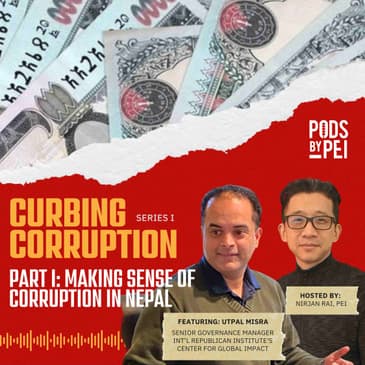
In this episode, PEI's Nirjan and Utpal Misra set the stage right for the series as they introduce key terms, concepts, and ideas in anti-corruption discussions and practices. Drawing from his observations, Utpal defines and illustrates the vast forms of corruption, citing recent high-profile cases from Nepal. They then recount the actions and approaches in anti-corruption and corruption measurement practices and the key actors at the forefront of this cause.
Utpal Misra is the Senior Governance Manager at the International Republican Institute's Center for Global Impact based in Washington, DC. He leads a team of Governance Specialists that support programs on anti-corruption, political strengthening, global policy, and governance issues in different parts of the world. He spent almost a decade in the World Bank headquarters, implementing global anti-corruption and social accountability programs. He started his career as a journalist with the Kathmandu Post and also worked in Kantipur Television, covering politics, policy, and social issues in Nepal.
[00:00:14] - [Speaker 0]
Namaste, and welcome to Despite its prevalence across cultures and timelines, corruption is still a painstakingly elusive phenomenon to define, measure, capture, and address. And its impacts fuel some of the most significant socioeconomic challenges of our times, including poverty, social exclusion, and climate change. In Curbing Corruption, PEI colleagues sit in candid conversations with experts, practitioners, and thought leaders to dissect the vast issue of corruption. Over the span of the series, we embrace a multi pronged approach at comprehending corruption with discussions that include defining its core concepts, exploring the evolution in anti corruption and measurement innovations, investigating the role of political and campaign financing, and recounting high profile cases of corruption in Nepal and beyond. Through these conversations, we hope to contribute to the public discourse on the philosophical and theoretical foundations of the issue of corruption and gain insights into how we may be able to best overcome it.
[00:01:24] - [Speaker 0]
Join us on this journey as we navigate through the challenges, successes, and innovative approaches to curbing corruption, aiming to pave the way for transparent, accountable, and equitable societies. Today's episode is the first of curbing corruption series, and we have PEI colleague Nirjhun Rai's conversation with Utpal Misra on making sense of corruption in Nepal. Utpal Misra is the senior governance manager at the International Republican Center for Global Impact in Washington DC. He leads a team of governance specialists that support programs on anti corruption, political strengthening, global policy, and governance issues in different parts of the world. He spent almost a decade in the World Bank headquarters, implementing global anti corruption and social accountability programs.
[00:02:12] - [Speaker 0]
He started his career as a journalist with the Kathmande Post and Kanthapur Television. Nirjan and Utpal set the stage right for the series as they introduce key terms, concepts, and ideas in anti corruption discussions and practices. Drawing from his observations, Utpal defines and illustrates the vast forms of corruption citing recent profile cases from Nabal. They then recount the recent actions and approaches in anti corruption and corruption measurement practices and the key actors at the forefront of this cause. We hope you enjoy the conversation.
[00:02:50] - [Speaker 1]
Hello, this is Nirjand Rai. I would like to welcome everyone to season two of our policy discussion series PODs by PEI. As noted by Khushi, we are beginning the season with a series on the issue of corruption. We understand that some of the topics that we deal with in our podcast like corruption are quite vast, oftentimes with varying opinions on the matter, And so we hope that taking this on through a multiple episode approach, we can come up with a better understanding of these complex issues. So today, in an attempt to try and make sense of corruption in Nepal, a vast topic on its own, I have with me Uttpal Misra.
[00:03:31] - [Speaker 1]
Uttpal, welcome to Pods by PEI. How are things with you there in Washington DC?
[00:03:35] - [Speaker 2]
Thank you, Nirajan. Things are well, and I'm happy to be part of your podcast. I've listened to the episodes from your first iterations of it. I've loved every podcast of your past iteration, and I'm really happy to be part of your second series of podcast. Before we begin, Nirajan, what I want to say is that our conversations may delve into territories that could be deemed as controversial.
[00:04:05] - [Speaker 2]
So I'll say that the opinions that I've built is on basis of my work and researching the topic for the last twenty years and not necessarily reflect the views of organizations that I have worked with.
[00:04:19] - [Speaker 1]
So with that disclaimer, Aravind, shall we get into our conversation today?
[00:04:23] - [Speaker 2]
Sure, let's begin.
[00:04:24] - [Speaker 1]
All right, so as I mentioned in the intro, this episode kicks off our series on curbing corruption in Nepal. Now given the complexity of corruption as a topic, and since you are our first guest, my goal today is to make sure that we clarify the key terminologies and concepts central to the discussion around corruption. Now, a number of high profile cases did come to the public's attention last year that underscored the deep rooted nature of corruption in Nepal. These include scams like the Lalita Nuhas land grab, the fake Bhutanese refugee scams, and also the smuggling of gold through the international airport, just to name a few. These cases are past their news cycle, but we can be assured that many acts corruption are still happening underneath it all, whether it's in the delivery of services, in the procurement of goods, or just downright policy corruption that benefit a few.
[00:05:31] - [Speaker 1]
Then there is the pervasive issue of corruption in politics, including political party and campaign financing. But our focus today, however, isn't in the nitty gritty of any of these specific cases, although I will ask you to touch upon some for context. Instead, let's stay at the meta level and discuss how these cases fit into the larger pattern of entrenched corruption in Nepal. Drawing on your long experience in the Nepali media and your expertise in global corruption and governance, let's explore the roots of the issues, the broader societal impacts, and steps towards improvement. Before we begin, I'd like to make two points.
[00:06:16] - [Speaker 1]
Firstly, while there is general consensus that corruption in and of itself is bad and the less of it that we have, better off we are as a society. However, the path to eradicating corruption is quite complex and nuanced, and there are clear differences in opinion about how we should approach the ideals of a corruption free society if there is anything as such. And secondly, the topic of corruption and anti corruption is quite vast, and I'm sure that we will not be able to cover everything in one single episode. It is for this very reason that we have decided to tackle this issue in a series of podcasts. Over the next month or so we will be examining various facets of corruption from issues of conflicts of interest, leptocracy to innovative anti corruption measures, political and camp and finance, local level corruption and many more.
[00:07:15] - [Speaker 1]
I do hope our listeners find our conversation today engaging and stay tuned for the upcoming episodes as well. So having said that, let's begin by doing the obvious, by defining corruption. I think we should start here because while all of us, I'm sure, have an understanding of what corruption is, given that we've all experienced corruption in different ways, this might actually make it more confusing in trying to have an in-depth conversation. So Utpal, if you were to try and define corruption to someone who has not worked in the sector for long, how would you go about it? Or let me put it another way, How would you explain why corruption exists in a society?
[00:07:59] - [Speaker 2]
Nirajan, as simple as the question sounds, the answer is not that easy. It depends on human behavior and how humans view different sets of incentives in different ways. But if you are to scale it up and just at a base level define corruption, then I would say it would be breach of trust. Breach of trust by an agent who has been assigned to do certain tasks in favor of a certain person, but works to benefit himself or herself, and not necessarily the people who assigned that task to him. In other words, it's also a matter of trust.
[00:08:46] - [Speaker 2]
So if somebody or a group of people are abusing the entrusted power for private gain, then that would be corruption. And in public sector, could define it as abusing the public resources for private gain. I think this is as simple as it gets, As you mentioned, it comes in different ways. It has different scale. Also, since corruption is a very dynamic thing, it comes in different forms and it evolves as per the situation.
[00:09:19] - [Speaker 1]
Before we get into the specific questions about corruption in Nepal, do you think it would be helpful, Paul, if you could give some background on how folks like you in the anti corruption sector discuss the the many types of corruption out there? And as you're doing this, it would be helpful if you could refer to the different cases and types of corruption that we hear and experience in Nepal on a regular basis.
[00:09:45] - [Speaker 2]
Sure, and I think there would not be a type of corruption that limits itself to a certain country, but then of course I could try to relate to the Nepali experience to define certain aspects and kinds of corruption. And as I said in my earlier answer, that corruption is dynamic, and it's really hard to identify the kinds of corruption. But for academic and for implementation purposes, what has been done is that corruption has been broadly defined into several categories. The basic form of corruption would be petty corruption, which is when a citizen goes to a service delivery provider and is expected to grease their palms, or to pay something to get the service that they intended to get, or I would say if you're paying traffic police to get out of a situation. So those all of those would be considered as petty corruption where the transaction is not much, but then it is not legal, the payment is not documented, and it's done covertly.
[00:11:03] - [Speaker 2]
The other kind of corruption is defined as grand corruption, where it's a larger group of people, especially the political actors or the business elites, are engaged in corrupt behavior, but the transactions are large. There are huge amounts of money being transacted. For example, it could be in large scale procurements, contracts, large infrastructure projects, and so on, where the payout is huge, and everybody gets their piece while the general public suffers. There's another type of corruption when we talk about the political or bureaucratic corruption. That is intended to kind of separate the kind of corruption that is done by political and bureaucratic elites, which normally pertains to the political decisions or enactment of some laws and rules that benefit a few in political power or in the government, these political and bureaucratic corruption can be petty as well as grand, but done by certain people who have the authority to enact laws and rules and norms in particular countries.
[00:12:20] - [Speaker 2]
For example, when you talk about tax manipulations or licensing or creating certain kind of allowance for an office holder, which does not seem appropriate to the task that they are functioning. So those can be defined as political or bureaucratic corruption. The other aspect is what we now have begun to call cryptocracy, which is a bit different. It has a transnational aspect of things where the corrupt behavior is not limited to one country or one legal jurisdiction, but it crosses boundaries and then it relates to money flow internationally and so on. But we can get into the details later.
[00:13:02] - [Speaker 1]
And these are not mutually exclusive, right? They can go from they can all happen at the same time?
[00:13:08] - [Speaker 2]
Yeah, they can all happen at the same time and at multiple places at the same time. So for example, petty corruption can be an outcome of a kleptocratic structure that exists within a country, or if you just think that something is petty corruption because a local level administrative staff keeps on asking for money every time you go into that office, it could also mean that there's institutional corruption in that office, and everybody's in cahoots, and this person is just functioning as a front man. So there are many possibilities, and it can only be clear if you do proper research, if you're talking about specific examples. But in broad terms of sense, when we define corruption, I think that that's enough to get started talking about corruption.
[00:13:58] - [Speaker 1]
Right. Okay. So now that we have established a manner in which to categorize this vast number of corruption that we come across, How do you see the increasing level of corruption in our society? What do you think are the implications? Now, I should note that I am assuming that corruption is on the rise, but please correct me if I'm wrong.
[00:14:20] - [Speaker 2]
The beauty, in lack of other terms, would say, the remarkable attribute of measuring and working with corruption is that it's very hard to get proof. It's very rare that you get enough proof to implicate somebody for corruption. And since it's done in secret, it's done covertly, nobody comes up and says, Hey, I've been involved in corrupt behavior. So when you look at corruption, the best indices so far have been based on perception. So it's about the perception of the people in Nepal that corruption in Nepal is getting worse, and that will have implications because everything is related to social behavior.
[00:15:12] - [Speaker 2]
Now having said that, there are a couple of things that we can see, not just in Nepal, but also in many other countries that are in very similar stages as in Nepal, is the normalization of corruption. So we see that people consider corruption to be an integral part of daily practice, of service delivery, or any transactions that you undertake. So the thing is, if you have that notion in your mind that this is the way how things are done, and you've internalized it, and you've normalized it, then that also means that the act of corruption or corrupt behavior is going to go on. And then also it's the question of values, social values, and not just the legal definition of what is corrupt and what is not corrupt. It's also what is acceptable in society and what is not.
[00:16:12] - [Speaker 2]
And we think that for the perception of corruption to increase, as you said, you didn't even say perception, you just said that in very definite terms that the amount of corruption in Nepal is increasing, which means that for a large swath of people in Nepal believe the corrupt behavior is existent, and it's everywhere. So it has multiple implications. One, it's about the quality of services that is provided by the government or any work that's being done. So you think that at the base level, it will not be done properly if you're not engaging in a corrupt behavior, you're not paying extra for it. So there's a premium for everything that you do.
[00:17:00] - [Speaker 2]
Then that's why everything gets expensive. Doing business, for example, or starting new line of work, or getting anything approved. And then when this phenomenon starts to infuse itself, and then, of course, the corruption is going to stay, and it's going to be entrenched. And then, as you can see, there's this growing sense of frustration among the youth in Nepal that they're leaving the country because they don't see any opportunities in Nepal, and I feel that this perception that everybody's corrupt, nothing is going to happen, has a large role in this phenomenon. And there's also the political implication as to when the dissatisfaction level rises, and you see that there is this disenchantment of political actors, political systems, and so on.
[00:18:02] - [Speaker 2]
And then you can hear that kind of narrative in media or in public discourse these days. Right? So what I see is corruption has a very, very, very important role to play in how a country is progressing and in the development of the country.
[00:18:21] - [Speaker 1]
So now let's switch gears and discuss the various measures that we have taken to combat corruption in Nepal. I know, for example, we are a signatory to the United Nations Convention Against Corruption. We have promulgated a number of legislations that speak directly to the issue of corruption, for example, the Prevention of Corruption Act, and also indirectly through legislations such as the Public Procurement Act. But one thing we often hear in government policy circle is that we are great in devising policies but bad at implementing them, right? And as cliched as that may sound, the truth is this is also perhaps the case in our laws against corruption, right?
[00:19:09] - [Speaker 1]
So, Sotpal, despite all these laws in place, why have we not been able to curb corruption? What would you say are the limits of the existing measures? What stops us from making these laws effective?
[00:19:24] - [Speaker 2]
Yeah, that's a great question, and a million dollar one, that anti corruption practitioners all over the world have been trying to grapple with for a long, long time now. And I think, as I mentioned, the key points here that we need to remember is that corruption is dynamic, and the rules and regulations and the treaties and the contracts come after. Right? So it always takes time for the rules and regulations and laws and the treaties to catch up with the corrupt actions. The instruments to fight corruption also need to be constantly updated, which I think there's always a lag, And that's why you see that they may not be as effective at a given time.
[00:20:16] - [Speaker 2]
And since it's a very dynamic thing, you need to be more innovative. You need to be on your toes all the time. So maybe if I can give an example of implementation, as you said, yes, we are good in signing laws, but we are very bad at implementing it. But the thing is, from one of my research in Nepal, what I realized was it was mandated that all the government offices that deal with financial transaction need to have CCTVs attached, right, so that it can be monitored that there's no physical evidence of financial transactions between the people who've come to get service and the service providers that are there who are government employees. But then it occurred that the corrupt actors had beaten the measures that were implemented to curb corruption.
[00:21:11] - [Speaker 2]
Of course, nobody was going to take a bribe in front of a CCTV camera, but what they did was they worked with a pawn shop outside the office where you'd need to go and buy a pan, and the price of pan would vary depending on the service that you're getting. And it could be 5,000 rupees' ban, or it could be 5 lakh rupees' ban, depending on what the services you are getting. So this kind of, I think, gives a very great example of how dynamic corruption is, and how difficult it is for it to be contained just by acts and laws and rules. So that's why the implementation part is very, very difficult. And I would not blame the reformers or the bureaucrats who are involved in making these laws in Nepal as responsible because this is a global phenomenon.
[00:22:11] - [Speaker 1]
That Panchturi is an interesting one, right? Innovations outdoing the institutions we've established. I guess the end part of it would be the person who would buy the pun, take the pun and give it to the official, and that would be the transaction. But then the official would work with behind the scene with the pun shop and get whatever. So away from the scenes of the CCTV camera, the transaction will happen.
[00:22:38] - [Speaker 1]
There's no way you can actually, you know, get that in footage, right?
[00:22:41] - [Speaker 2]
Yeah. And it also occurred that the way that the plan was rolled signaled to the the officials behind the desk if the transaction had been made or not. Yeah? So so, you know, it's it's almost impossible for an agency to be on watch all the time in front of every single office. Right, right.
[00:23:02] - [Speaker 2]
Right? So this is a great I thought this was a great example that we could get, you know.
[00:23:07] - [Speaker 1]
Yeah, as long as there's an intent, you know, there'll always be innovations. But moving on, because there's limited time, how about the institutions that we've put together to put a check on corruption? You know, we can go directly to the obvious, the Commission for the Investigation for Abuse of Authority. While CIAA has had some success in high profile cases, there are also significant criticisms about its overall effectiveness of curbing corruption. Can you speak to the evolution of the institution and give your thoughts on its effectiveness and challenges it faces in prosecuting corruption cases in Nepal?
[00:23:47] - [Speaker 2]
Yeah, I mean, before going to the CIAA or any anti corruption agencies, I think I would like to mention something called the political wealth. Depending on, like, you know, no matter what kind of government you have, it depends on the political will of the ones in the top to implement the anti corruption measures and how effectively to implement anti corruption measures. And we have seen in Nepal in the past that, as you mentioned, very high level incidents of corruption being investigated by the CIA, and the cases being filed in courts, and very high level politicians, including ministers, being charged and also sentenced for corruption. So it's not that CIA has not been doing its job. It has.
[00:24:39] - [Speaker 2]
So if we talk about the nineties and early two thousands, we've seen these cases like Lauda and Dumuzas. You know, we we have these, like, you know, ironic scandals back then where a lot of politicians, a lot of ministers were charged and convicted. But then in later years, what we've seen is, given the political upheavals and how the anti corruption agency was used fairly to charge political actors or to get back at political actors, and where the anti corruption agencies were playing the role of judge and the jury at the same time. So I think in our latest iteration to CIA, I think the political actors were spooked because of that, and they kind of scaled it back. So as you can see, in the past, let's say, beyond 1990s, the agency was known as Prastatya Nyaraniuk, which is the, you you're trying to completely eradicate corruption.
[00:25:39] - [Speaker 2]
Right? So as the name suggests, it's an agency to eradicate corruption. But now it's the CIAA, which is the investigation of abuse of authority. Right? So they're just going to do the investigation, and then they're going to provide the evidence to the attorney general who's going to go to the court, and if the court finds the people guilty, then they'll be charged.
[00:26:04] - [Speaker 2]
But now there's a problem, right? One, the CIA is also it struggles with capacity issues. They're not enough staff. They're not well funded. And so they have to prioritize which cases to fight and which not to fight.
[00:26:19] - [Speaker 2]
And they've also been accused of avoiding big thirst and focusing on the small ones. Again, I come back to political will because we also have to recognize that the CIA chief is always politically appointed by political parties. And then there is this perception that the CIAA will only prosecute corruption cases relating to the opposition party and not to the party of the person that appointed the CIAA chief. Right? So again, then it comes back to the political will, political appointment, and political interference.
[00:26:59] - [Speaker 2]
But having said that, whatever we've seen that the CIAA has done so far, it cannot be considered bad. Know, it seems like it is doing their job, but, of course, there's a lot of room for it to do a better job.
[00:27:12] - [Speaker 1]
On that issue of cooptation, you know, political appointee and and cooptation, let's take that a little further. You mentioned in terms of CIAA, but it's not just CIAA, right? We've seen it with other we've heard it about other institutions also. For example, in last year's scams, it was reported in the media that the government had transferred some of the key officers of the Nepal Police, thereby interfering with its ability to conduct a thorough investigation, right? What are your thoughts on the broader implications of, you know, these political elites undermining these institutions of accountability?
[00:27:46] - [Speaker 1]
What what sort of messages is the general public getting and, you know, and what it means for for us?
[00:27:51] - [Speaker 2]
I think that's that's a very important point. And as a governance practitioner for for many years, what I've seen is the political interference are one of the most destructive to building strong institutions. And we always talk about that a country like Nepal lacks strong institutions, but what comprises of strong institutions is that the institution that functions of proper laws, and function the way they should. But taking this example of the police officers being transferred, that those were involved in the investigation, including the Burmese refugee scandal. What that gives is, first, it is very bad for the morale of the institution.
[00:28:39] - [Speaker 2]
Second, it also gives way for people to question democracy in itself. And as you can see globally, corruption has been one of the biggest challenges for democracy. Democracy is a system where there's check and balances, And if you interfere with an institution that is there for creating balance and to check on certain things, then of course, things are going to go downhill. And so what I would want to say is that it's not just for anti corruption measures or the benefit of certain parties, but that it is affecting a country in a way where its institutions are getting weaker, where the faith in democracy is getting weaker. And that also gives room to political instability and turmoil, where it gives space for people to raise fingers against the system itself and say that, Oh, this democratic system or this decentralized system does not work.
[00:29:38] - [Speaker 1]
Indeed. So it's a very well put point, Upad. In the interest of time, we have to move. I mean, we could spend a whole podcast on just this, but let's move to another topic as well. Let's move on to something besides state institutions.
[00:29:52] - [Speaker 1]
So the key players being the media and the civil society in terms of trying to bring some level of accountability to political actors, right? And in Nepal, both of these have you know, there have been successes and there have been some criticisms as well. Let's begin with the role of media, and to give where credit is due, some of the Nepali media has done a very commendable job in exposing corruption at the highest level. Even some of the cases last year, it was reported quite extensively. How would you as an ex Nepali media person and now a corruption expert, evaluate the role of Nepali media in this regard?
[00:30:32] - [Speaker 2]
Everything is relative, right? What I would say is Nepali media, I think they're doing great. The type of stories that they bring, it's really good. If you look at other countries in South Asia, I think Nepali media can still be considered one of the best in terms of its impartiality, in terms of how it covers certain stories, and so on. So I do think media is doing okay.
[00:31:00] - [Speaker 2]
For example, you have the Center for Investigative Journalism, or the CIJ, that were instrumental in publishing the Nepali involvement in the Panama Papers and Paradise Papers. They did investigate, they did release the report implicating certain individuals in Nepal and then coming up with this assertion that there were $450,000,000 that the Nepalese were parking abroad legally. So media in general in Nepal have been covering big corruption cases, but then as you can see, as with most media, the continued coverage is missing, as you kind of signal to the new cycle. But, also, what we can see is there's a lot of room for Nepal media to improve. We see a lot of ad hocism in terms of how these stories are prioritized and covered.
[00:31:52] - [Speaker 2]
And lately, as not just in Nepal but worldwide, we see a lot of misinformation and disinformation, where a lot of media outlets are purposefully pushing information that is not true or tweaking the truth and presenting it in a certain light. You need to sensationalize the story. And the only thing where media could do better is they have not been as successful in getting the political actors to respond. But that's, I would say, not just the role of media. You know, there's the larger part, larger society involved in that.
[00:32:27] - [Speaker 2]
And also, can see some evidences of media agencies in Nepal working for corporate interest and the business interest and the political interest, and not really serving the people, giving them impartial information and news.
[00:32:43] - [Speaker 1]
Let's talk about the the one they said, you know, it's beyond just the media, so I'm assuming one of the biggest roles would be of the civil society. Your take on civil society and corruption in Nepal?
[00:32:54] - [Speaker 2]
Well, I think the civil society scene in Nepal is pretty vibrant. But then again, it's a question of capacity and the resources that that kind of plagues various sectors. The civil society also is not immune to it because being able to work on anti corruption reforms, usually they're not cheap. The investigation itself takes a lot of time and effort and risk, but also for the civil society to work on issues like transparency and accountability, promotes anti corruption in the operations of the government and so on. So we see that there are not many.
[00:33:36] - [Speaker 2]
And also because most of the civil societies are not just focused on one task. They have, like, hundreds of things that they are working on. They are not really focused on anti corruption measures because they are doing, for example, I don't know, building sustainable roads, or kind of environmental governance and so forth. But so they're not really they're all over the place. So, of course, when we talk about anti corruption and CSOs role, the focus is not there, not enough.
[00:34:07] - [Speaker 2]
But also, we've seen that CSOs, as in multiple sectors in Nepal and in other countries, have you know, some of them are like, you know, there's the politicization side of it. Right? So they are kind of close to certain political parties and working to promote their agenda and so on. But, of course, having said that, you cannot put all the CSOs in in one basket. But overall, I would say they're still vibrant, but then there's a lot that can be done by the CSOs.
[00:34:38] - [Speaker 2]
And primarily, I think for a country like Nepal, it's to do with capacity and resources rather than the will or the intent to to to to work on anti corruption measures.
[00:34:50] - [Speaker 1]
Fair enough. So let's move into more of of how to deal with corruption. Now you you've painted quite a a complex picture of what corruption is and what it looks like in Nepal, and the the impacts it has in our society. Right? So besides saying the obvious, you know political leaders should be more accountable or that the governing authorities should show commitment to anti corruption or that political parties should adopt transparency and accountability measures to gain people's trust, you know, all these, you know, common rhetoric we hear.
[00:35:26] - [Speaker 1]
So how do you go beyond this, in many ways, meaningless statements? As someone working in the anti corruption field, what are your thoughts on what incentive structures can be targeted or reworked in order truly try to bring corruption down in a society.
[00:35:43] - [Speaker 2]
Talking about incentive structure, I think it's very important for one and all to understand that the existence of corruption or corrupt behavior is not in your interest, or not in the interest of anybody. Just because the impact that you see is not directly relevant to you does not mean that it does not have a bigger implication on your life. And this is a very complex topic, and we found that it's very difficult to educate the masses on this, to see how people behave, and to see howand of course, when you're talking about the government actors or the institutions, they're all people from the same country. They have the same values. They have the same moral code.
[00:36:33] - [Speaker 2]
And that's how they operate. For example, how corruption is viewed and is seen in Scandinavian countries is very much different than how it's seen in countries like Nepal or any other South Asian countries. So when you're talking about going beyond the rhetoric and the meaningless statement, and I don't think any statement would be meaningless, but I think you have to maintain a boundary, you have to maintain a narrative that corruption is bad, especially for the young people who are making that perception, and also looking at what is the threshold of tolerance of corruption for them. So it changes with time, one. So when you're talking about how are we managing corruption, there are a couple of things.
[00:37:21] - [Speaker 2]
Right? One is the preventive measures. Those need to be there. There needs to be proper laws. There needs to be proper policies, and there needs to be proper protocols.
[00:37:30] - [Speaker 2]
And as you're saying, implementing those laws, policies, and protocols, and engaging in institutional reforms constantly is as important as engaging in instituting those laws. And then you have the punitive measures, where you're taking strict action on the basis of laws, policies, and protocols that you have instituted. And now talking about the incentive structures as such, I mean, we've seen globally that, for example, for public sector corruption, you know, increasing civil servant salary has worked in some countries. Incentivizing more capable and honest individuals to join the public sector, or kind of promoting honest officials. There's like saying that, hey, there's going to be a positive result if you engage in positive actions.
[00:38:20] - [Speaker 2]
Right? And that also helps to build a narrative of what is allowable and what is not, what is accepted and what is not. But then again, for a country like Nepal, is lately struggling to pay the salaries of its public officials, I don't know how practical it would be to raise the salaries of the civil servants and so on. But then the other part of it is, I would say, going back to the system of democracy and trying to look at, again, strengthening these institutions and getting the honest officers to run the show and give some of autonomy to strong institutions like the police force. And as we've seen in Nepal, right, it's not that these institutions don't have the capability or the will.
[00:39:04] - [Speaker 2]
When the opportunity arises, they have performed, which means they're totally capable, given the right conditions, they will be able to deliver. So, I mean, there are different set of structures, but in the end, I think what it comes down to is what is socially accepted and what is not, and who defines it? That's a very important question. And then that revolves to general education, understanding of corruption, how it is bad for your country and your system and your lives and the lives of the next generations to come. Once you have that awareness, then I think we can deal with corruption better.
[00:39:46] - [Speaker 2]
But having said that, there's no magic wand that you can come and say like, Hey, we're just going to stop corruption all at once. It certainly takes a lot of effort, a lot of intent, and a lot of time. And one other thing that I will make is it's not just by one party or one person who can do it, right? It's collective action. So it needs to be done by all the sectors, right?
[00:40:08] - [Speaker 2]
We're talking about a country, the public sector, the private sector, the CSOs, media, you know, everybody has to join hands.
[00:40:16] - [Speaker 1]
Let me just take this last statement that you made and kind of question you on that. So in order to reduce corruption, I'm assuming there are certain conditions that have to be inherent within a society. I remember reading a Nepali article once about how we all seem to hate politicians, and yet we take pride in when they bless us with their presence in our weddings and other social events, right? Or that we say something like, know, no, not again, but exclude members of our own families, because we all know we need one high ranking politician to expedite things for us, right? It's usually what we do whenever we get into trouble, we look for who is the closest relative at the top, right?
[00:41:06] - [Speaker 1]
So do you think that the Nepali society has what it takes at the moment? I'm guessing it's an evolving question, but has what it takes, that these conditions, these necessary conditions that help bring the level of corruption down?
[00:41:21] - [Speaker 2]
Absolutely. I think every society has what it takes to reduce corruption because people are very smart, and people find ways to function in certain environments. And of course, it's to survive or to thrive. That's the general tendency of people. But when you're talking about corruption, again, if the right systems are in place, if the right institutional procedures and protocols are being followed, having contact with a high ranking officer in one office is not going to help you.
[00:41:54] - [Speaker 2]
And once you realize that, Oh, this is not going to help, this is not how things are done anymore, then the social behavior will change instantly. For example, I mean, not corruption related behavior, but I was very impressed with the map essay in Nepal. Once the police started seriously testing for drunk drivers, the number of drunk drivers just went down. Or when it had experimented this time with the horns. I remember how loud the Kathmandu streets were, and everybody was honking just like that, and once the rule is implemented, and they kind of realized that they are serious about implementing it, the phenomenon's reduced.
[00:42:36] - [Speaker 2]
It went away. Similarly, when we talk about corrupt practices and behaviors, if the people in political power, if the people in authority make the right statement, I'd say that maybe not all, but majority of the problems would just come down. But having said that, of course, every society has its characteristics, and it's relative, right? You cannot expect to have a zero corruption overnight. And as I was saying in my earlier answer that it evolves.
[00:43:07] - [Speaker 2]
You need to be patient. Has to be the rules of the youth is important so that the threshold of tolerance for corruption is reduced as you go on, and things may improve later on. But again, I want to come back to the democratic structure. If you look at the Transparency International's Perception Index, you'll see that more democratic countries where you have democratic institutions, those do much better than than those who have, like, the, you know, the democracy is not settled yet or kind of struggling to stress or the authoritarian environment. And democracy is also a beautiful structure where the people who govern are not the only ones who are responsible, but every citizen is responsible.
[00:43:55] - [Speaker 2]
So if you start introducing or practicing participatory democracy, right, if there's more ownership of the processes, if the public starts taking more ownership of the decisions being made, then I would say that naturally the tolerance for corruption will also go down, and that's going to change the conditioning of the youth and the promotion of democratic values. I think we can, and every society can be shaped into certain ways. There's no reason why Nepal cannot improve on corruption, the perception of corruption, or Nepal can eliminate corruption.
[00:44:35] - [Speaker 1]
Well, that's wonderfully put. That's about all the time we have today, I know we covered a lot, while only scratching the surface of each of the topics. But like I said in the beginning, this is just an introduction to the topic of corruption in Nepal. But I wanted to make sure that we touch as much as we could. Over the months, we will be having more in-depth conversation on many of these topics that we glanced over today.
[00:45:00] - [Speaker 1]
But before we leave, Paul, is there anything else you would like to convey to our listeners? You know, maybe give some insights into some of the work that you're currently engaged in?
[00:45:09] - [Speaker 2]
Thank you, Indurjan. As you mentioned, you know, we've only scratched the surface very barely. We've just hopped from one topic to the other about corruption. And you asked me about what I was working on, and one of the issues that I'm very keenly involved in is the issue of global kleptocracy and how it's shaping up globally, and just not in Nepal. And we very briefly touched upon it earlier, but when we talk about cryptocurrency, we're just not talking about a set of bank actors.
[00:45:44] - [Speaker 2]
We're talking about the political and business elite supported by a wide range of professionals, like doctors, lawyers, financiers, art dealers, working to hide the money internationally. There's the international aspect of it. And it's really fascinating, and it's a very new phenomenon, and it's an evolving phenomenon. And we have been seeing signs of cryptocracy globally in different contexts. And what I would like to tell our listeners is that when you look at corruption moving forward, just keep in mind that it may not just be a local thing that's happening.
[00:46:30] - [Speaker 2]
So when we're talking about corruption in Nepal, it's not just about some corrupt political actors engaging in a scheme to enrich themselves, But you see this as a global phenomenon. If I may refer, work that we published back in 2021, it's called The Kleptocrats Playbook, where we, for the first time, we talk about the tactics that we've seen technocrats use all over the world. These are political and legal tactics, economic and financial tactics, the course of violence based tactics, branding and narrative tactics, and that they use different tactics to deal with different sets of anti corruption agencies, to beat some laws, to transfer money from one jurisdiction to the other. And looking at the news, reading the news news and lately, what I've seen is perhaps we can find a lot of those signs in not just in Nepal, but countries like Nepal. So what I would like to say is when we talk about corruption and anti corruption measures in Nepal, I think it's equally important for us to be mindful of this global phenomenon as cryptocracy, and also understand that even if we are just dealing with petty corruption, that there could be a large part that you've not seen.
[00:47:48] - [Speaker 2]
Right? I know this is a very dire message, but the topic that we are talking about is that, and we've just kind of touched upon the tip of the iceberg here. And that's the way things are evolving, and it's very important that corruption is something that everybody needs to be mindful of, not just for the betterment of your life, but also for democracy and for development. So let me stop at that. I could go on.
[00:48:19] - [Speaker 2]
We could talk about a lot of things. Maybe, Nirjan, I don't know. Maybe if you have time, and if we can, maybe talk about certain aspects of it some other time. But this has been great, and I hope that our conversation is able to inform a lot of our listeners and that all of us can work towards creating a society that's free of corruption.
[00:48:46] - [Speaker 1]
We'll definitely look forward to having you back on the podcast in the future. But in the meantime, thank you very much, Woodpull. It was some very insightful information you provided us, and thanks for accepting our invitation to come to Pods by PEI.
[00:49:02] - [Speaker 2]
Well, you, Nirjoon, and thanks to the PEI team for inviting me for this talk. I think what you're doing is great, delving into these very important topics that relate to development of Nepal. And I wish you all the best.
[00:49:18] - [Speaker 0]
Thanks for listening to Pause by PEI. I hope you enjoyed Nirjan's conversation with Utpal on making sense of corruption in Nepal. Today's episode was produced by Nirjan Rai with support from me, Kushi Han, Pridesh Satkota, and Sonia Jimmy. The episode was recorded remotely and was edited by Nirjin Rai and Videsh Sapkota. Our theme music is courtesy of Rohit Shak Kyo from Zindabad.
[00:49:41] - [Speaker 0]
If you liked today's episode, please subscribe to our podcast. Also, please do us a favor by sharing us on social media and leaving a review on Spotify, Apple Podcast, Google Podcast, or wherever you listen to the show. For PEI's video related content, please search for policy entrepreneurs on YouTube. To catch the latest from us on Nepali policy politics, please follow us on Twitter tweet2pei, that's TWEET, followed by the number two and PEI, and on Facebook at policy entrepreneurs inc. You can also visit pei.center to learn more about us.
[00:50:17] - [Speaker 0]
Thanks once again from me, Kushi. We will see you soon in our next episode.