
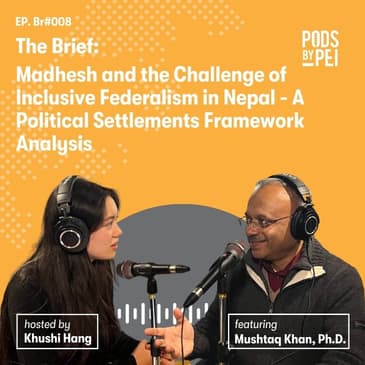
EP. Br#008
Contemporary economics and policy studies struggled with two main paradoxes: while on one hand policies previously successful in some countries remain futile in others, on the other hand, different approaches were capable of solving the same issues in different contexts. A Political Settlement Framework tackles this paradox by acknowledging the need to tailor policies to the idiosyncrasies of each society. Within the framework, the primary focus is on understanding the social context as it studies the interaction between groups (organizations) and the rules they are subjected to (institutions).
In this episode, PEI colleague Khushi Rai sits with Prof Mushtaq Khan on his political settlements analysis of the Madhes Province. The conversation is based on an upcoming publication that he has co-authored, titled: “Madhesh and the Challenge of Inclusive Federalism in Nepal”. This briefing paper is based on a provincial settlement study drafted from a tracking exercise at the national, provincial, and local spheres of governance in Nepal by SOAS and PEI under the Research and Evidence on Nepal’s Transition project.
Mushtaq is a Professor of Economics at SOAS University of London, where he heads the Anti-Corruption Evidence Research Consortium and is also the joint lead for the Research and Evidence on Nepal’s Transition project. He is a leading thinker on political settlements.
The two explore the process of mobilization in Madhesh, the drivers of their movement, and how all of that culminated in the Constitution that was eventually promulgated. They also examine the role of Madhesh in the implementation of federalism, the evolution of new settlements with the emergence of newer actors, and what all this means for the future of inclusive federalism in Madhesh. They end with three plausible scenarios in this regard and also discuss the possible implications for federalism in Nepal.
[00:00:08] - [Khushi Rai]
Namaste and welcome to Parts by PEI, a policy discussion series brought to you by Policy Entrepreneurs Inc. My name is Khushi Rai. In today's episode, we have my conversation with Mushtaq Khan on the evolution of the politics of Madish and the challenges to inclusive federalism in Nepal. Mushtaq is a professor of economics at SOAS University of London, where he heads the Anti Corruption Evidence Research Consortium. He is also the joint lead for the research and evidence on Nepal's transition project, a four year research implement by SOAS, Yale University, Governance Lab and PEI.
[00:00:46] - [Khushi Rai]
Mushtaq is a leading thinker on political settlements, the analytical framework which studies how the distribution of organizational power affects the formal and informal ways in which rules and laws are implemented. In this episode, Mushtaq and I discuss an upcoming publication that he has co authored titled Madhish and the Challenge of Inclusive Federalism in Nepal. This briefing paper is based on a provincial settlement study drafted from a tracking exercise at the national, provincial, and local spheres of governance in Nepal by SOAS and PEI under the research and evidence on Nepal's transition project. We begin by discussing what his political settlement's analysis of Madhesh adds to the existing discourse. We then explore the process of mobilization in Madhesh, the drivers of their movement and how all of that culminated in the constitution that was eventually promulgated.
[00:01:39] - [Khushi Rai]
We examine the role of Madhesh in the implementation of federalism, the evolution of new settlements with the emergence of new actors, and what all this means for the future of inclusive federalism in Madhesh. We end our conversation with three possible scenarios in this regard and also discuss the possible implications for federalism in Nepal. Hope you enjoy the conversation. The politics of Madhesh, especially in reference to federalism is perhaps one of the most dissected topics in recent scholarly works in Nepal. Clearly there is an interest in understanding how Madhesh factors into the future of Nepali politics.
[00:02:23] - [Khushi Rai]
So Mushtaq, what makes your study unique in this regard? What value addition does it offer to the existing Madhish discourse?
[00:02:32] - [Mushtaq Khan]
So you're right. Madhesh is a very sensitive topic in Nepal. And Nepal is going through a fantastic experiment of a new constitution of federalism. And this is addressing many years of conflict and many years of mobilization by different groups. So we know that Nepal is going through a transition.
[00:02:59] - [Mushtaq Khan]
We know that there was a lot of anger amongst many ethnic groups and the Madhesis are one of the groups that were particularly dissatisfied with the way in which the old Nepal was working. I dare say there's still a lot of dissatisfaction with how the constitution is being rolled out, implemented, understood. I think what our framework does is by looking at in a in a very structured way how power and interests and rules interact, and that is the political settlements framework. We are able to track, how rules are changing, but more importantly, how rules are being implemented and how this feeds back into the power of different groups. So there is a loop between organized power, both formal organized power, but also the power of informally organized networks and groups, and how that affects the evolution of rules, which include everything from constitutional rules to how policy is being implemented, and how that in fact, in turn, determines the power of groups.
[00:04:13] - [Mushtaq Khan]
So this circuit from power of groups to how rules are being implemented to how that impacts the power of groups is a way of tracking whether the constitution as it is now is moving towards more inclusion and moving towards a better distribution of power or it isn't. And if it is not, then it also allows us to think about what needs to be done to nudge it in the right direction. So what it brings to a very supercharged discourse is a way of stepping back and looking at the drivers of change here, and then asking ourselves, well, this is what is actually happening on the ground. How do we interact with that from our normative perspective? Because I think we and everybody else listening to this podcast want to see a more inclusive Nepal, want to see a better Nepal.
[00:05:08] - [Mushtaq Khan]
How do you nudge this ongoing process? And I think the fundamental point that the political settlements framework brings is that unless we understand how power and institutions are already interacting, you can't change it. So we need to first understand how it has been interacting, what direction it going in, what are the opportunities, where is it possible to intervene with policies, with programs, to nudge it in a better direction. And if you have no idea about what's happening, at the ground, then you can't really influence change. I think this is what it brings to the discourse.
[00:05:45] - [Khushi Rai]
So these key concepts that you use regarding rules and groups that interact with each other, you've defined these concepts as institutions, organizations and these particular terms have very different and peculiar definitions as you employ them in the framework. Could you please elaborate on them?
[00:06:08] - [Mushtaq Khan]
That's a very good question. So we are institutional economists and we have a very specific definition of these things. So institutions for us are rules. Rules describe human behavior. So if people are systematically behaving in a particular way, they are actually following rules.
[00:06:29] - [Mushtaq Khan]
You can describe their behavior as following rules. Some of these rules are enforced by the state. So those are formal rules, formal institutions, laws, policies, constitutions. But we also follow a lot of rules for a lot of different reasons. Some rules are enforced by us.
[00:06:46] - [Mushtaq Khan]
For example, we generally tell the truth, but nobody is observing and testing us all the time or punishing us. So there are also rules which are which can be described as cultural rules or social norms. People behave in particular ways because they behave in those ways. So a lot of rules are informal rules. And particularly in developing countries, a lot of the behavioral patterns that people have are informal.
[00:07:13] - [Mushtaq Khan]
They're not enforced by anyone in a formal way, but they may be enforced by each other by society itself. So a lot of things, if you are in Nepal or if you are in any other developing country, people know that if you want to get this done, this is how you do it. And that might involve informality, it might in in involve, knowing the right people and having tea and coffee with them, it might sometimes involve exchange of money or favors. All of these are informal rules. And we are completely not taking a moral position about this.
[00:07:48] - [Mushtaq Khan]
Right? So you can describe some of this as corruption or patronage or clientalism. We are not are we just want to get an understanding of how society works in terms of rules. So that's one side of the story. Every society has patterns of behavior which we describe as formal institutions and informal institutions.
[00:08:07] - [Mushtaq Khan]
Those are rules. On the other side are the people who are subject to these rules. Those are the organizations. So organizations are groups of people and ultimately could also be individuals in some cases who are following the rules both formally and informally. And And the interesting thing about developing countries is that a lot of these groups are not formal.
[00:08:31] - [Mushtaq Khan]
They might be formal parties, but actually much more important in developing countries might be the informal factions operating within parties. And how those factions network with each other and how they swap from one party to another party. Those informal organizations are very important. A lot of businesses in developing countries are informal. They're not registered anywhere, but they are activities.
[00:08:54] - [Mushtaq Khan]
So we are just as we are interested in informal institutions, we are also particularly interested in informal organizations. And the link between these two things is that organizations use rules to get incomes and benefits to reproduce themselves. And organizations will try to change rules that don't give them enough income or benefits. Right? So organizations are always not just following the rules, but they're also trying to change the rules.
[00:09:28] - [Mushtaq Khan]
And this is where power matters. Right? So organizations have different levels of power. And by power, we mean if there is a contest between organizations, which one is more likely to win? That's the more powerful organization.
[00:09:41] - [Mushtaq Khan]
And that organizational power is based on who can mobilize more money. So economic power is one element of it. But it's not the only element of it. The richer organization doesn't always win. Another element of organizational power is their ability to organize.
[00:09:58] - [Mushtaq Khan]
If you can successfully bring together a lot of people and you can commit them to work together, then you have a lot of power. So money helps, but money is not enough. A lot of organizations are very powerful because they mobilize informal networks. They can mobilize a kinship. They can mobilize caste.
[00:10:18] - [Mushtaq Khan]
They can mobilize ethnicity. They can mobilize ideology. So organizational power can depend on lots of things apart from just money. And thirdly, ideology is very important because how people mobilize and and fight for things depends on their belief in the justness or rightness of their cause. So when you when we look for organizational power, we look for the behavior of organizations and who is winning and who is losing, and that tells us who's more powerful.
[00:10:50] - [Mushtaq Khan]
Now why is all this important? Is that organizational power will be used to change the rules in ways that give organizations benefits. So think of it this way. If I'm a little less powerful than you are, and if I'm getting a little less than you are in terms of jobs and and employment and subsidies and benefits, I might want more, but I know that I'm not likely to win if I fight against you. Right?
[00:11:19] - [Mushtaq Khan]
So I'm not going to try very hard to change the rules. But if I'm a lot more powerful than you are, and I'm not getting as much as you, then I'm likely to engage in some contestation, political, economic, and otherwise, to try and change the rules because I think I should get more than you. I think the rules should be changed in my favor, and I'm also more likely to win. So what the political settlement says is that there's likely to be some kind of correspondence between the power of organizations and the rules that exist, both formal and informal. And in developing countries, the informal rules are particularly important because a lot of powerful organizations will influence the implementation of rules, for example, through patronage or clientelism or corruption or simply not following them, so that their incomes are in some sense proportionate to their power.
[00:12:18] - [Mushtaq Khan]
In in more advanced countries where the rule of law is stronger, this adjustment happens through changes in the formal rules. In developing countries, it's both formal rules, but also informal rules. So this is a broad framework, and that helps us to track how organizations are mobilizing and how they're trying to change rules including in this case constitutional rules.
[00:12:40] - [Khushi Rai]
Mhmm. Yeah. And we'll definitely come back to relating this framework to whatever we've seen in Madhesh so far. But for now, with how you explained the framework I gather that this is a very holistic multifaceted approach and it seems that the political settlements framework requires a lot of grounded information that come from both formal and informal sources. How have you gone about collecting the necessary information for your analyst analysis so far?
[00:13:12] - [Mushtaq Khan]
That's a very good question. I I think to do a good political settlements analysis or any in fact, any good political economy analysis, you need to have a lot of ground level understanding of how people are behaving. And that behavioral issue of how informal and formal organizations are behaving formally and informally requires you to have an almost anthropological approach. So we've been working in Nepal for on this program for about five years, and the political settlements work in Madesh has been more than two years. We have teams of people who are working right down at the local government or Palika level.
[00:13:57] - [Mushtaq Khan]
We are tracking how mayors and deputy mayors interact with businesses, how resources are allocated to whom. At the provincial level, we are tracking how provinces work. And at the national level, we look at how all this connects in national politics. We Apart from our tracking exercise at the local government level, we have dozens of key informant interviews where we triangulate different perspectives because every society has radically different perspectives. How a a Dalit leader in Madhesh will describe their experience and situation is very different from an OBC, very different from a hill upper caste.
[00:14:38] - [Mushtaq Khan]
And all of these perspectives are legitimate. So so everyone is looking at the problem from perspective and their interests and their experience. Our job as analysts is to collate all this information and triangulate it and look at this complex mosaic of organizations jostling with each other, trying to get restructuring of rules and rights and negotiating a a change. And that through that process and through continuously testing our ideas back with our audience, we sign finally build a picture which is robust. And I think we are just about reaching that point where we think we have some robust things to say about how power and institutions are are developing in Nepal, but particularly in in Madesh, which is our first paper, and we plan to reproduce this provincial political settlement analysis, then in Lumbini, and then also in Province 6.
[00:15:41] - [Khushi Rai]
Alright. So now that we've established an understanding of the political sentiment framework, let's get into some examination of the issues that are pertinent to the Mandish province. Can you tell us what were some of the most significant patterns or events that mobilized this region to collectively disturb their contemporary political settlement?
[00:16:04] - [Mushtaq Khan]
So I think if you want to understand Madish and its politics, you have to go back quite a long time. And we do that in our analysis. And Madhesh is a border region. It comes between and in you know, if you go back in history, countries didn't have very stable borders. This is really a very modern phenomenon where we have internationally recognized borders and in if you go back in history, even South Asian history, a lot of these borderland territories were indeterminate.
[00:16:38] - [Mushtaq Khan]
Who owned it? They swapped hands. They belong to one kingdom now and another kingdom then. And Madhesh was like that. It swapped between sort of geographies which are now Indian, but at that time even India wasn't indeterminate.
[00:16:52] - [Mushtaq Khan]
There were many, different kinds of, states within India. And Madhesh was sometimes more Indian than Nepali and sometimes more Nepali than Indian and it was swapped. It was also an an open border. People were coming and going. And I think that one of the sources of discontent is that for whatever historical reasons, a lot of non Madhesi Nepalis looked on Madhesh with some element of suspicion that are they really Nepali or are they more Indian?
[00:17:25] - [Mushtaq Khan]
Can we trust them? And so and that citizenship debate still goes on today. So one element of this is history. History. And on top of that, Nepal also is a society which quite apart from the Madeshi's had for a long time power concentrated in a narrow segment of its society.
[00:17:48] - [Mushtaq Khan]
And I think everybody knows that it's the upper caste hill hill people who dominated, not all of them, but but the if you look at the dominant power brokers in Nepal, they tended to come more from that community. And so it's not that the Madhesis were the only relatively excluded group, but they had multiple dimensions of exclusion. Mhmm. And within Madhesh, of course, there is also internal division between castes and and communities. So it's a very complex picture and different subsets have different, sources of anger and frustration at what they were getting.
[00:18:29] - [Mushtaq Khan]
Now, this is of course a long historical thing. What happened in the conflict is that a lot of different mobilizations came together. And part of this dynamism came from the Maoist movement who were mobilizing it. But in Madhesh, there was also an ethnic identity based movement, which was trying to fight for a citizenship or or treatment as equals. And all of these things came together at a time when the economy of Nepal was also undergoing change.
[00:19:01] - [Mushtaq Khan]
So what we also do in our paper is look at how the economy of Madesh was changing from a territory which in the late nineties was still exporting agricultural products was quite rich in terms of agriculture, had a lot of industry. And as a result of India increasing its food production, production, exports from Madish began to decline. Right? So the agriculture became stressed. There was a lot of migration out of Nepal including Madish, which resulted in wages rising and that caused a lot of the industry to de industrialize.
[00:19:44] - [Mushtaq Khan]
You have new sources of income coming in from remittances. You have a decline of the old agriculture and industrial base, and you also have more government spending starting to increase. Whenever you have big shifts in sources of income, you have disruptions in society. Right? People who were powerful now feel less powerful, new groups mobilize, and that results in churn.
[00:20:11] - [Mushtaq Khan]
And all these things come together. Right? So the economic de industrialization, the growth of the remittance economy coming together with the mobilization of other groups in Nepal for in during the conflict, the growth of Maoist parties, the armed struggle, the move mobilization of other groups, and on top of that, the historic Madhesh identity. Are they really Nepali? Are they not?
[00:20:37] - [Mushtaq Khan]
Should should other Nepalis take them seriously or not? It's not surprising that there were there was a lot of conflict. Right now, that I think is known. The question is what happened then? Mhmm.
[00:20:54] - [Khushi Rai]
Those are some very convincing observations and you're right. The events that followed are very important for us to know. But before that, I just want to take a step back and ask you to define these Modesty actions and events that you just traced particularly in terms of the framework itself. This is so that our listeners can get a sort of meta narrative that helps them to relate political affairs with the theory that we just discussed earlier?
[00:21:25] - [Mushtaq Khan]
So I think I would put it this way. I think that you have to locate the Madhesh movement within a churn that was happening across Nepal and in involved many other communities and many other groups. That moment, which led up to the 2015 constitution, is a really complicated one. And I think that here you have to go a little take one step back and ask yourself, how how do what does devolution of power mean? Because actually, Nepal had various forms of decentralization earlier.
[00:22:06] - [Mushtaq Khan]
Panchayat the Panchayati system was one. In the Panchayati system, you had a strong center and lots of what we would now call local governments. Right? Now, if you have lots of local governments and you have a strong center, actually, it becomes possible to have a high degree of centralization because a center can play divide and rule across all these hundreds of different local governments and the local governments are not strong enough to really drive any change. What was interesting about the Madhesh mobilization so everybody in Nepal was angry about the centralization.
[00:22:43] - [Mushtaq Khan]
Everybody in Nepal wanted power to be much more broadly based than it was in the past. What was distinctive about the Madhesh movement and one or two other movements, the Tharu movement is is also an element of that. But these groups had an ethnic identity and they wanted a territory which reflected this ethnic identity. And as you know, the Madish movement started initially asking for the entire Terai to be a Madish. Right?
[00:23:12] - [Mushtaq Khan]
So they wanted to include the Tharus and the Madish in a in a big chunk of territory, which was basically the entire border regions of Nepal with India. That mobilization had many internal divisions. The Tharus did not necessarily want to go along with that entirely, and there were also internal divisions in in other ways. I think what happened at that point is that other groups in Nepal, including the old powerful groups, but also many other groups, and this is really unfortunate, they began to see the Madhesh movement as a threat to Nepal sovereignty. Because they began to see that if this happened, then there might there was a risk of independence or there was a risk of greater allegiance towards India.
[00:24:04] - [Mushtaq Khan]
These are very sensitive topics, but as an outsider looking in, I can say that this is what I I can see as a kind of perception problem. And as a as a result of that, there was a pushback against the idea of strong provinces. And the pushback against strong provinces came from not just the old elites, but from a number of other sources. And the and the reason why this is a a misfortune, I think, because if you want devolution to really succeed in the longer run, you actually need strong provinces. You need strong provinces because with 750 plus local governments in the new constitutional arrangement, if you don't have a level between the federal or the Kathmandu level and the local government, the local governments are too many in number to really coordinate and achieve the kind of a better distribution of power and resources over time.
[00:25:05] - [Mushtaq Khan]
You need an intermediate level of coordination, which the constitution recognized, but the constitution gave provinces very limited powers. And that limited power of the province in the constitution, I think, reflects that balance of power leading up to the 2015 constitution where you have the Matesis being kind of isolated by the others. And unfortunately, the blockade that happened in the run up to the 2015 constitution was had a very negative effect because other Nepalis saw the blockade as Indian intervention in favor of Madish. The Indians, of course, deny this. The Madishis deny this, but this was widely perceived that, you know, this whole Terai region becoming more autonomous was something India wanted.
[00:26:01] - [Mushtaq Khan]
And I think it's when you talk about India and Nepal, these are complex entities. I'm sure there were forces in India who wanted it, and there were other forces in India who couldn't care very much. But the perception in Nepal was this was in in a unfair intervention. The blockade hurt a lot of Nepalis, and that actually united people against the maximalist Madheshi demand. So the consequence of this was, yes, there was provinces did emerge, but Madhesh itself became a much smaller territory in in and and Lumbini was defined as a separate territory.
[00:26:39] - [Mushtaq Khan]
The Tharus got a relatively bad deal because they were split between three provinces, And the other provinces were deliberately constructed to mix up the ethnicities quite deliberately because it was kind of perceived that mixing up ethnicity with provincial identity was a source of problems. And this may be a correct position or a wrong position. I I have no but this was certainly the game that was going on. And so you have a lot of provinces which have the same ethnicity split between different geographic territories. And of all the provinces that emerged, the Madhes is the most ethnically homogenous, actually.
[00:27:22] - [Mushtaq Khan]
So it emerged out of its very complex process, but it emerged because there was this fear that we shouldn't have provinces which overlap with ethnic identities. And while this is understandable in one sense, from our perspective, the problem with it is that having weak provinces makes federalism quite hard to entrench. So in terms of the framework, going back to the framework, what we would describe this as as is that a lot of informal networks emerged in the Terai region during the conflict. These informal networks were initially completely informal, were networks of people acting together as activists, and they were mobilizing for changes in rules. Now here the important point is that these economic changes that happened prior had already disempowered some of the older groups.
[00:28:26] - [Mushtaq Khan]
New remittances were coming in. New groups were power feeling more powerful, but they could only entrench their power if they could change the constitutional rules and policy rules so they would get resources in line with what they perceived to be their real power. So actually, what the Madhesis were fighting for, like all groups in history, whereby mobilizing and and organizing initially, informally, they were trying to change the constitution and and the rules of the game so that they would get resources in proportion to their new power, and that would entrench their power and stabilize that power. Right? And so what I've described is that while they succeeded to some extent, they managed to unite all other groups against them, and so actually they got less than what they wanted by a long shot.
[00:29:16] - [Mushtaq Khan]
They didn't get the whole of the Terai, and they didn't get a constitution which fully recognized the power of the ethnic province called Madesh, now called Madesh, initially called Province 2 because even Madesh was too sensitive a term to use at that time. So they didn't get the province with the geography they wanted, but more importantly, they didn't get a province with the powers that they needed. So the province could not exercise a lot of powers. For example, formally, the province in in the Nepali constitution has very limited tax raising power. It has very limited spending powers.
[00:29:56] - [Mushtaq Khan]
It has coordination powers, but without money. So so the province has a sphere of governance as is deliberately weak. And what is worse and in going forward, even what is there in the constitution is not being fully implemented. So for example, in terms of the provincial bureaucracy or provincial police or a lot of things like that, there is a lot of informal resistance because powerful groups are resisting the implementation even of the formal constitution. So it shows that the power of the organizations in Madhes is still not sufficient to convert into a a fully effective provincial set of rules which would allow those organizations to fully develop their power.
[00:30:47] - [Khushi Rai]
So one of the key characteristics of political settlements is that they are highly dynamic. The settlements leading to the creation of Madish Province has not been the same five years into the federalism of Nepal. For now, I'd like to take our focus to the post constitution phase in Madish. How do you think the new political reality which was ushered by the 2015 constitution took shape or materialized and what impact did this materialization have on the evolution of the political settlement in Madesh?
[00:31:22] - [Mushtaq Khan]
Yes. So the political settlement as a description of a distribution of power in society is always evolving. The point is it doesn't evolve randomly or very rapidly. The distribution of power in a society changes because new organizations emerge initially, informally, and gradually more and more formally, and they're able to change the formal and informal rules so that they can reproduce their power by getting access resources. Okay?
[00:31:50] - [Mushtaq Khan]
So what we've seen is that in the run up to the conflict and through the conflict, new groups were mobilizing in Madesh. And so by definition, the configuration of power changed. By definition, you have new groups, particularly political organizations and entrepreneurs from the OBC groups, Yadavs and other OBCs. They were particularly successful in mobilizing. And and and much of these mobilizations were what we would call informal because it didn't necessarily have party labels, some of them did, but others were much more fluid groups which could move from one party to another party, giving their support here or there depending on where the benefits were, greater benefits were promised.
[00:32:41] - [Mushtaq Khan]
So we are seeing a a period of quite a lot of flux. These provincial level politics has become a lot stronger, a lot more important. And I think one of the things that has happened after 2015 is that parties operating in Kathmandu have to take provincial political dynamics much more seriously. Now that's both the kind of old parties like the Nepal Congress or the UML, but also new provincial parties. And to some extent, the fact that new groups have organized at the provincial level, it doesn't really matter whether they operate within the UML or congress or they set up their new parties.
[00:33:22] - [Mushtaq Khan]
There is a new reality. And the new reality is that these provincial level political entrepreneurs, their mobilizations are taking on increasing shape. Now, that doesn't mean that this is going in a particular direction of greater inclusion or lesser inclusion till we know whether these new form, formations are actually being able to influence the implementation of rules, policies, and constitutions in ways that consolidate that power. So this is what our tracking exercise is doing. It's tracking exactly as best as we can what is happening to the new, resource allocations.
[00:34:07] - [Mushtaq Khan]
And there is some really interesting observations we have here. One of it is that the growth of local governments and the bumping of resources into local government activities are creating new alliances between business and politics at the local government level. So mayors, sometimes deputy mayors are, working with local businesses. Sometimes these are their own businesses. Sometimes they are businesses of their political allies.
[00:34:37] - [Mushtaq Khan]
And circuits of business government resource allocation are developing. Okay. So this is exactly how you expect power, and institutions and money to coalesce. So we are seeing that happening at the local government level. And for us, the really interesting question is whether these local government power, blocks that are emerging will revert back to the old Panchayati type of pattern where they directly deal with Kathmandu, or whether they will start reinvesting some of their resources into further strengthening provincial level political mobilizations, which will then strengthen provincial level politics.
[00:35:21] - [Mushtaq Khan]
For us, this is a really critical issue, and tracking that will tell us whether the constitution will develop in the direction of stronger provinces and and genuine devolution or whether the constitution will be interpreted as a new version of Panchayati Raj.
[00:35:45] - [Khushi Rai]
You have been listening to Pods by PEI. This is a quick reminder to all of you to do us a favor by sharing us on social media and leaving a review on Spotify, Apple Podcasts, Google Podcasts or wherever you listen to the show. Now, let's get back to my conversation with Mushtaq. I like to pick up on the topic of meaningful representation. It is a pretty contested topic and there are significant groups that still feel that they're not being represented in a valuable way in a meaningful way especially those in Madesh and also those in the Tharu region.
[00:36:25] - [Khushi Rai]
Your paper explains that there is something functionally flawed in the current federal system which has to do with the reluctance of the state to devolve actual power to the provinces. Can you add more on why do you think the province level is important?
[00:36:42] - [Mushtaq Khan]
So that's a really important question. Okay? I think what what we want to see in Nepal and across the world actually is inclusion. Inclusion means not just that every group and ethnicity and caste has some proportionate number of people in political spaces or representative spaces. That is desirable, but it's actually not necessary.
[00:37:06] - [Mushtaq Khan]
Because you might have people from your own community representing you, but they don't actually represent you. They don't work for you. They work for themselves or they work for somebody else. So we are less interested in the identity of people in parliament and in provincial assemblies or in local government, although that's important. We're not saying that's not important.
[00:37:25] - [Mushtaq Khan]
It's not what is the goal. The goal is that you should we should have an inclusive society where different groups have economic opportunities. They're not discriminated against in jobs. They're not discriminated against in getting bank loans. They have opportunities of upskilling.
[00:37:41] - [Mushtaq Khan]
They have opportunities in education so that the creation of new economic opportunities is inclusive. And if that if representation of different groups helps that, that's a great thing, but it's not sufficient. So here is the the question. You know, when you take a province in Nepal, it actually has something like a 100 local governments on average. Right?
[00:38:06] - [Mushtaq Khan]
So I have seven provinces and 750 plus local governments. If you were trying to sit in Kathmandu and say, do we allocate resources fairly so that we make sure that every bit of Nepal and every community is getting a fair shot. It actually becomes quite difficult with the best will in the world. With the best will in the world, someone sitting in Kathmandu won't know that this local government is getting a bit more and that one is getting, you know, is falling behind. How do we help that, you know?
[00:38:40] - [Mushtaq Khan]
So this was exactly the problem with Panchayati Raj. It's not just that people are mean and and, you know, there's just too much to to look at. So if you just have lots of local governments and a center trying to coordinate and making decisions about, you know, how do we allocate resources, you're likely to get it wrong. And you're likely to get it wrong by putting too much into people who already have and not enough people who don't have, and then after a while you have another set of anger and and Whereas if you have a provincial level, you are bringing that calculation closer to the a manageable number. Right?
[00:39:21] - [Mushtaq Khan]
And a provincial politician who's trying to get reelected isn't just getting reelected from a particular local government. They are going to be elected from a constituency which includes several local governments. And there will be contestation between different representatives of the provincial assembly over resources. And those conflicts will actually even out some of the resource allocation problems. I think that is the kind of constitutional arrangement that evens out the the negotiation over resource allocation.
[00:39:57] - [Mushtaq Khan]
If you have too many entities clamoring for resources, actually the stronger will suck in more resources. Whereas at the provincial politics level, people will be saying, okay, these areas are being left behind. I'm going to lose out there. I have to make sure that those people are getting something. And so it's more likely, not guaranteed, it's more likely that a provincial politician will be more concerned with inequality within their territory than is possible for someone in Kathmandu.
[00:40:26] - [Mushtaq Khan]
So this is why we think that in terms of inclusion, it's like it's better to have a very lively and and robust and competitive provincial politics because that gives different ethnicities, castes, regions within the province who are being left behind to shout and more likely to be heard than they're likely to be heard in Kathmandu. So this is essentially now I think that in one sense, the Nepal constitution is a huge success. You know, I think we often look at it very negatively and and say this is not working, that is not working. Nepal is one of the few post conflict countries which have had a peaceful transition, had had several elections. These elections have been successful and and the and it's been entrenched.
[00:41:14] - [Mushtaq Khan]
It's being entrenched because the constitution still gives emerging powerful groups ways of accessing resources which are reproducing their power and that is changing the distribution of power. It's not going as far as we want it to go, but we should be very careful not always to say it's half empty. It's also half full. And and that's where I think what we are saying about the provinces is that it's a job in progress, but we should celebrate what has been achieved. It's been quite a remarkable achievement compared to other post conflict society.
[00:41:48] - [Khushi Rai]
So moving forward, Mushtaq, what does the political horizon look like for Madessh? You know, now that we have a good grip on the historical and contemporary tendencies of the Madheshi political spare, what can we expect to observe next?
[00:42:04] - [Mushtaq Khan]
So in our research, we've been tracking what is happening to the new, groups, informal and formal, who are developing at the local government level with money and power and organizational capabilities and what are they doing with these new resources. Where are they investing it both in terms of political reinvestment, but also in terms of economic reinvestment. Because that tells us how sustainable, how inclusive this process is, and whether the outcome will be strengthening the provincial sphere or power will see back to the central sphere, the Kathmandu. And here we had we have tracked, three scenarios. In the first scenario, which we can roughly describe as a return gradually to a Panchayati Raj system.
[00:43:00] - [Mushtaq Khan]
You have these new groups emerging. You have these new organizers and these new organizers are getting access to resources. They're getting access to resources largely through local government. The local government is pumping massive amounts of resources into, different parts of Nepal. And you see this in things like new investments in tourism and hotels and in in casinos or in infrastructure and in local community infrastructure.
[00:43:30] - [Mushtaq Khan]
Massive amounts of investment is happening and contractors and businesses and others associated with those local governments are making money. This is exactly what you would expect, a kind of business government partnerships of different types. In the first scenario, and we see some evidence of this, these, new actors and new sources of money begin to reinvest some of their money in central level politics because they think, well, to keep on getting access to resources, we must have patrons in the center. We must have patrons at the top of, you know, conventional parties, UML, congress, whatever. So I'm going to put my eggs into the basket of building my relationships with the center, beginning to fund their politics, beginning to fund their activity, so that once they are in power or in coalition, I keep on getting resources which I need to reproduce my power.
[00:44:26] - [Mushtaq Khan]
So the first strategy, you still you have a growth of new businesses and new, politics at the provincial level, but indirectly they're strengthening the central level. And you will have gradual move back towards a very strong center, very strong local governments and local businesses, but a weak provincial level. Right? Now that's not a bad outcome, but it's a a less good outcome from our perspective in the long run for the reason that I've discussed earlier, which is that it's quite difficult to coordinate 750 plus local governments from Kathmandu with the best will in the world. You will have areas which are going to be left behind, communities left behind.
[00:45:11] - [Mushtaq Khan]
And that in a highly diverse society like Nepal, which is exceptionally diverse, is a source of anger and frustration which led to the conflict. So I'm not saying that that's going to happen again, but it will there will be discontent. So that's the first scenario. But there is a much more promising and attractive second scenario that is also emerging. And in the second scenario, you have the new businesses and new, money and political connections also investing in local level businesses and investing in other local level mobilizations because these people see their future as being able to mobilize and generate money locally.
[00:45:56] - [Mushtaq Khan]
In other words, they are less dependent on what is coming from Kathmandu, but they're trying to reproduce their power locally. And these politicians and these businesses will be looking for provincial level coordination, and particularly if the central level doesn't have enough resources to satisfy all of them. So I think that's a very important dynamic. Why do people get interested in the province is if the center isn't being able to absorb all the entrepreneurs, all the forces, all the political factions and groups, if they can't all be satisfied by positions in Kathmandu parliament or in in in policy or projects or contracts coming from Kathmandu, some of them will be frustrated. Some of them will be say, where else can we find a space to mobilize and create demands and and create demands for resources and and therefore changing rules?
[00:46:55] - [Mushtaq Khan]
Well, the province level. So in the second scenario, these entrepreneurs also start clamoring for provincial rights. For example, demanding to strengthen the provincial bureaucracy, demanding to initially starting with getting the constitution properly implemented. Because the constitution does give provinces certain rights and and privileges. And if you don't have a provincial bureaucracy, if the bureaucracy is look looking really to commands coming from the center, then the resource allocation at the province level won't work.
[00:47:27] - [Mushtaq Khan]
So there is a you can beginning you begin to see some of these processes where there is a demand for, better provincial administration to start that system, the police, etcetera, better coordination. And that process pushed by these interests. So for us, you see, rules and and and institutions will only happen if there is strong pressure for them. But we are beginning to see that strong pressure. It's coming up.
[00:47:56] - [Mushtaq Khan]
And if that strong pressure continues, then the provinces will get stronger. And for the reasons that I explained, I think this is for us a slightly better route and and a route that will entrench devolution. The third scenario is a mixed scenario, and actually that's where we are. You have both sorts of tendencies going on. You have some players who are betting on federal politics and some players betting on local politics, and there is a kind of confusion.
[00:48:24] - [Mushtaq Khan]
But the third scenario, in our view, is not a long run scenario. It will either flip towards a greater strengthening of scenario one or a strengthening of scenario two. So after in five, ten years, it will be clear which one is getting stronger. So scenario one doesn't mean that the province doesn't matter. Scenario is one means the the federal system was or rather centralized resource allocation and the discretionary power of central politicians matters more.
[00:48:57] - [Mushtaq Khan]
And in the second scenario, that again remains important. Of course, Nepal will remain a strongly federal country where Kathmandu will be very important. But in the second scenario, the province becomes quite important. And a lot of resource allocation decisions, which local governments get what, which projects happen, where the roads are built, which kinds of health and education, Those decisions increasingly come under provincial debate, provincial political contestation, and provincial implementation. At the moment, it's not clear what's happening.
[00:49:30] - [Mushtaq Khan]
A bit of both is happening, and that's the third scenario. So but we we take we stick our neck out a little bit in the paper, and we say that we are we are seeing actually enough evidence of the move towards scenario two for us to say that it's actually quite likely to eventually move in that it might not look like that. So in you know, it might look like, you know, the central parties are winning, provincial parties are are losing, but we are not that's the wrong way of looking at it because it's not which parties are winning, but which factions and groups are are strong, how are they being incorporated into provincial or central parties? And where are they reinvesting their resources? Where are they investing?
[00:50:16] - [Mushtaq Khan]
And that, I think the provincial dynamic is getting stronger. So this is our the promising perspective. And I think that overall, we would say we are in scenario three, moving towards scenario two, but with a good chance that we will go into scenario one if we are not careful. And scenario one in the longest run is a recipe for problems. It's a recipe for problems because you will have lots of pockets of underdevelopment, lots of pockets of anger building up at the provincial level, which will be quite difficult to then address.
[00:50:49] - [Mushtaq Khan]
This is our overall assessment.
[00:50:53] - [Khushi Rai]
Mhmm. So you see that there is a distinct likelihood that we might end up in scenario one which is a move backwards if we're desiring provincial consolidation. Are there policy interventions or certain policy ways that can influence this settlement that can help us design the upcoming political settlement towards the direction that resembles the second scenario?
[00:51:26] - [Mushtaq Khan]
Yes. I would say the the risk of a full move towards scenario one is not very high. But it's contested. I think there are so this is where the political settlement analysis is useful. Right?
[00:51:38] - [Mushtaq Khan]
So which rules get enforced and the direction of evolution of institutions depends on the power of competing organizations and their interests. And so once we understand that, we understand that actually the future is to a large extent open, but there are enough powerful organizations which will have to take the province as their base, which will be reinvesting in the province, which will be reinvesting in businesses and political mobilization at the provincial level. So it's not for us to say what's good or bad. We are just observing that there are these twin dynamics. Right?
[00:52:19] - [Mushtaq Khan]
Some organizations want a strong center, some organizations want a strong province. What we are saying is that, you know, a gradual move towards a strong province without threatening anyone is actually good for the integrity of Nepal, for the sovereignty of Nepal, and for the prosperity of Nepal. So I think that So the first thing is to persuade people who are threatened by a strong province that this is not against your interest. This is number one. Number two is we can do a lot of things in terms of designing policies by from the Nepal government side or programs from the development partner side, which actually encourage the province to play a better coordinating role.
[00:53:05] - [Mushtaq Khan]
Because if you look at the provinces, they have very few capacities of doing things. Right? So they're they're under capacitated, they're underfunded. Here, I think we would want the Nepal government to actually see that in their long run interest, of those who are centralizers, having strong provinces is not against their interest. I I think a lot of this problem is a perception that strong provinces will threaten Nepal's integrity.
[00:53:32] - [Mushtaq Khan]
And we need to challenge that as a as a as a kind of political statement, not people like me from outside. But Nepalese who want a strong Nepal should challenge statement that why is a strong province against Nepal sovereignty and integrity. And then we need to support those forces which are already demanding stronger provinces with policies and programs, as I say both Nepal government but also development partners to strengthen the province. And I think that that is a way of actually weakening paradoxically ethnic identity as a mobilizing force. Ethnic identity becomes a mobilizing force when in fact a lot of people are excluded.
[00:54:15] - [Mushtaq Khan]
And I think that the the fact that other provinces in Nepal don't have an ethnic identity is actually great because it means that if provinces become stronger, those other provinces can also use provincial rights and provincial resources for more equal development. But I think one of the things you find is is that people who want a strong province are always saying, let's watch what province two does. Right? Because they know that the demand for the strong province has always been at the forefront of province two for somewhat, I would say the wrong reasons because of this ethnic anger and history and so on. But even if you exclude all of that, a strong province is good for federalism.
[00:54:57] - [Mushtaq Khan]
So if it's coming from Madesh, so be it. But but it ultimately, it is good for even provinces which don't have an ethnic identity because this coordination of local governments is going to be a much better with strong provinces.
[00:55:13] - [Khushi Rai]
Alright. So we're almost at the end of our conversation. But before we end, I think the conversation would be incomplete without considering the latest elections. As you know, 2022 was a pretty big year for Nepal as it just completed its second rounds of election post federalism. Now that the general elections are over and the initial results are rolling in as we speak, what are some new aspects that you would like to investigate next?
[00:55:39] - [Khushi Rai]
What new angles intrigued you as an analyst of the Madheshi political settlement?
[00:55:45] - [Mushtaq Khan]
So as analysts, you know, we work in a number of developing countries. We have researchers from India, from Bangladesh, we work in many African countries. One of the really interesting things about elections in developing countries is that while parties are important, the informal organizations within parties, the factions, the individuals, and how they mobilize is just as important, sometimes more important. So while, you know, it's one thing to track, you know, okay, some provincial parties have lost ground and some central parties have gained ground. That's one cut.
[00:56:22] - [Mushtaq Khan]
What we would be interested in looking at is how did this happen? And we suspect it's because the central parties took a more provincial position. They were appealing to provincial power blocks. They were appealing to provincial entrepreneurs and and political entrepreneurs. And maybe some of these informal organizations switched and swapped the regions and mobilized their supporters to vote this way or that way.
[00:56:46] - [Mushtaq Khan]
So we would be particularly interested in going below the kind of headline of which parties won and which parties lost to see which informal networks won and lost. How are they mobilizing? How are they generating their money? What is the basis of their organizational economic power? And if we can track that and we can track who is becoming more powerful as an informal organization and how they're connecting with businesses and investments and contracts, and what their strategies of reinvestment are, and whether they will be satisfied with the kind of positions that might emerge from the kind of coalitions that will now form in in Kathmandu.
[00:57:29] - [Mushtaq Khan]
What will they do next? How will they respond if some of them don't get the positions they are hoping for or the policies or programs that they're hoping for, will they switch allegiance to what? So this comes back to our scenarios. Right? So if the scenarios if if if these are regardless of who is winning, if we find that these new powerful organizations and networks are beginning to invest more in provincial level businesses and politics and mobilizations, then regardless of who has won, we would say scenario two is getting stronger or otherwise.
[00:58:06] - [Mushtaq Khan]
So tracking how these scenarios are unfolding in the future is an ongoing task as is using some of this information to influence policymakers to nudge things in a more progressive and inclusive direction.
[00:58:20] - [Khushi Rai]
Brilliant. Thank you so much, Mushtaq, for joining us today. Thank you for sharing your time and knowledge with us. It's been a pleasure.
[00:58:27] - [Mushtaq Khan]
Thank you.
[00:58:32] - [Khushi Rai]
Thanks for listening to Pods by PEI. I hope you enjoyed my conversation with Mushtaq on the evolution of the Madhesh politics and its impact on the future of inclusive federalism in Nepal. Today's episode is a part of the brief. It was produced by Saurav Lama with support from Nirjan Rai and Chhedon Kansakar. The episode was recorded at PEI studio and edited by Chhedon Kansakar.
[00:58:55] - [Khushi Rai]
Our theme music is the courtesy of Rohit Shakya from Zindabad. If you like today's episode, please subscribe to our podcast. Also, please do us a favor by sharing us on social media and leaving a review on Spotify, Apple Podcasts, Google Podcasts, or wherever you listen to the show. For PEI's video related content, please search for policy entrepreneurs on YouTube. To catch the latest from us on Nepal's policy and politics, please follow us on Twitter tweet2pei, that's T W E E T followed by the number two and PEI, and on Facebook at policyentrepreneursinc.
[00:59:33] - [Khushi Rai]
You can also visit pei.center to learn more about us. Thanks once again from me Khushi Rai. We'll see you soon in our next episode.