
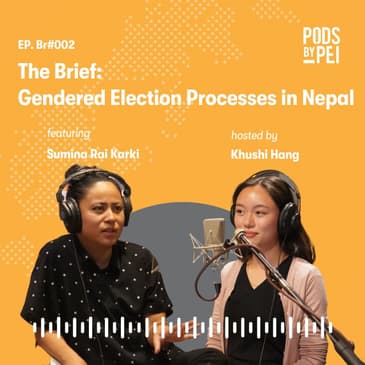
Ep. Br#002
The 2017 elections were lauded for their cognizance of the historically bleak presence of women in the political sphere of Nepal, to overcome this, the State mandated a Quota reserve of 40.4% of all nominee seats for women. The policy affirmed the presence and participation of Nepali women in politics, as approximately 14,000 women were elected into different positions in the Nepali Government.
In this episode of The Brief: PEI colleague Khushi Hang sits with Sumina Rai Karki to discuss the latest paper she co-authored, “Beyond Capacity”. As the tenure of the first set of elected officials in this particular inclusion quota comes to an end, Sumina Rai Karki et al. gauge the effectiveness of the affirmative action policies for women against the backdrop of Nepali patriarchal psycho-social contexts in their paper “Beyond Capacity”. The two explore what gendered implications exist in the informal or unofficial aspects of Nepali elections that hinder women’s chances at merit-based political opportunities during candidacy and their agency once they assume office. Sumina shares their findings on the challenges that limit the supply of politically ambitious women and signals the need for smarter policy interventions from the State and Development Partners that address the barriers that prevent women from fulfilling the space and responsibilities of the quota.
Sumina Karki is a development professional and researcher with ten years of experience in gender equity, social inclusion, governance, and peacebuilding. Currently, she is the Assistant Director of Social Development Programs at the Asia Foundation Nepal office. She is a founding member of Chaukath, a feminist collective that organized the Vote for Women Campaign and several feminist reading sessions along with March as Women in collaboration with Martin Chautari.
[00:00:10] - [Speaker 0]
Namaste and welcome to Pods by PEI, a policy discussion series brought to you by Policy Entrepreneurs Inc. My name is Kushi Han. In today's episode, we have my conversation with Sumina Raikaki on gendered election processes in Nepal. Sumina is a development professional working in the areas of gender equity, social inclusion, governance and peace building. She is currently the assistant director of social development programs at the Asia Foundation Mibail Office.
[00:00:39] - [Speaker 0]
She's also a founding member of ZO Cut, a feminist collective that organized, among many other things, the Vote for Women campaign. In this episode, Sumina and I discuss a paper she recently co authored, Gendered Election Processes, Networks, and Informality in Local Governments in Nepal. The paper gauges the effectiveness of the quota system introduced to address the chronic minority status of women in Nepal's politics. Grounded on their analysis, we explore the gendered implications that exist in the informal spaces of Nepali elections that hinder women's chances at merit based political opportunities and their agency if and when they get to assume the political office. We end with a brief discussion on the challenges that limit the supply of politically ambitious women in Nepali politics and possible policy interventions to overcome them.
[00:01:32] - [Speaker 0]
We hope you enjoyed the conversation. Welcome to the show Sumina. How are you feeling today?
[00:01:40] - [Speaker 1]
I'm a little under the weather, but I'm so glad that I'm here.
[00:01:47] - [Speaker 0]
All right. So we are here today to discuss your paper, which is Beyond Capacity, Gendered Election Processes, Networks, Informality in the Local Government in Nepal. This is a policy note you published in March 2022 with Doctor. Sierra Tamang, Omol Acharya, Sijana Nepal for the Asia Foundation. Right off the bat, the paper claims to be surveying the gendered implications in Nepali election processes.
[00:02:13] - [Speaker 0]
What does it mean when we say that there are gendered implications to something, whether it be a process, an institution, or even a system?
[00:02:22] - [Speaker 1]
So gendered implications in process, institution, the way we work, right, basically means, we're trying to look into, overrepresentation of male leaders in, political sphere, public life, which also means that, we're looking into how, the governance or the political realm is masculinized. Right? Which means that it has very narrow space for innovation, creativity, empathy, ruling by empathy, basically. It has very limited space for, like I said earlier, new ideas, voice of minority, voice of marginalized groups, because those voices and ideas tend to threaten, the already established power. And it also means, looking into underrepresentation of women and underrepresentation of, minorities, marginalized groups, communities, which means that it is very narrow space for other kind of narratives.
[00:03:38] - [Speaker 1]
And so the current the current system is basically, is benefiting from this, this narrative, which is very established, a very established narrative that women lack capacity. Women are not interested in political life because they have already had that, you know, opportunity. But a lot of, you know, women are going back to their domestic life has been the claim. Right? So and, also, they don't have qualification to run for political parties.
[00:04:16] - [Speaker 1]
Now that has been established narrative. But the paper on the other hand, what we're trying to see is that we're looking beyond that established, approach and lens that have been taken by several, scholars and, researchers. And it primarily looks into, political parties as, highly gendered organization. And the process the procedure they have taken, especially when it comes to candidate selection and nomination, finalizing candidates, how this particular process is highly gendered. It already favors men who are in the power.
[00:05:00] - [Speaker 1]
It it it maintains certain, clientele patronage system that is heavily dominated by male. So research, our research is our research takes a different approach in this way.
[00:05:14] - [Speaker 0]
In the paper, you insist that in order to trace gendered implications, one needs to go beyond the formal procedures and probe into the informal nuances. Why is it important to dig into the casual informalities, these belief systems and convictions that people hold so privately when we're dissecting the very formal and official realms of politics?
[00:05:36] - [Speaker 1]
So, formal institutions and processes, are heavily, shaped by informal values and norms and belief system, that individuals hold. Therefore, it was very crucial for us to assess informal procedures and process as well, in this research. For instance, the election law, which is a formal mechanism, law of the land, right, had a specific clause to nominate either a woman or man in the position of mayor or deputy mayor, especially if the political parties were fielding candidates for both the position. However, this clause, when it came to reality, it was interpreted, as the deputy has to be a woman. So if you see, the underlying informal rule of the game was that the more powerful position, in the local election should go to, men.
[00:06:36] - [Speaker 1]
Besides this, the political parties had the set of formal but very vague list of criteria and qualification to, select, candidates for the local elections. Qualifications included, loyalty towards political parties, seniority, someone who has invested in the, party and has sacrificed, their formidable years, in the party and the political movements. Now all these criterias were established by, leaders of the certain generation, and they created a doorway to maintain and continue the prominence of older generation of male politicians. Now this has deliberately excluded young and aspiring candidates, including women since men from certain generation have had longer and more visible, political careers. They have had more opportunities to serve in the party as well, climb that political ladder, and build influence and network as well.
[00:07:41] - [Speaker 1]
But woman on the other hand, even, you know, the even though they have played very important role in political movements in Nepal, but they are seen as less capable when it comes to, male politicians, male political leaders. And they're also seen as someone who needs constant capacity building. So we are so fixated at building capacity of woman leaders. We have not been able to move beyond the narrative of let's build capacity of women. But we've not looked into or assessed how political parties are so gendered, a very gendered institution and organization, which produces and reproduces gendered way of doing things.
[00:08:28] - [Speaker 0]
Alright. So in your answer, you just said that you slightly grazed upon the topic of networks. And I found this really interesting in your paper because one of the resources in politics that often goes unrecognized is the social capital of networks, and you have titled this as an old boy's club. Could you please illustrate how political networks and patron client settings help candidates during elections and how women in particular struggle with accessing this resource compared to their male counterparts?
[00:09:02] - [Speaker 1]
So in both the elections, two thousand seventeen and twenty twenty two, evidence shows that the candidate final finalization process is highly centralized. The evidence collected during this research also shows that the candidates who, secured the election tickets have been found close to leaders at central level and to key people at different levels like province, district, selection committees. And in this multilevel political setting, which is already, male dominated, Woman from local level barely have access to leaders at federal level, provincial level, and at even at district level. And this trend seems to have continued till today. For instance, in a municipality which was under our study, so whenever central leader, a central leader from Kathmandu, let's say, was visiting that particular municipality, he met the local, male leader, the mayor, but he didn't, the central leader didn't make an attempt to go and meet, the, deputy mayor who was a woman.
[00:10:17] - [Speaker 1]
So this basically shows that how women cannot access that particular network, which is dominated by men in general.
[00:10:29] - [Speaker 0]
So the bleak participation of women in politics is very well recognized by the Nepali state, and hence the quota system was brought in. What do you think about affirmative action policies? Do you think, according to your study, such policies are useful in ushering actual meaningful participation for women in Nepal? Especially, I want to know about the part of their political career where they already assumed the office. Has this sort of policy been able to help them gain their agency once they've already assumed office?
[00:11:03] - [Speaker 1]
So affirmative action policies have proven to be beneficial, especially to, usher, woman's representation, representation of minority group, marginalized groups. Right? And because of such policies, we saw a large number of women enter elected offices in Nepal. But if we further unpack the numbers, very few of them hold executive positions. At present, we have somewhere in between, 39 to 40% of women elected at the, local government offices.
[00:11:45] - [Speaker 1]
And if we break down the numbers, maybe 90% of them are ward members. The case was same in February election, and it's the same in 02/2022 as well. In '2, in 02/2017, there were only 18 woman mayors. And in 02/2020, there has been slight increase. 25 of them are, mayors.
[00:12:10] - [Speaker 1]
We have 25 woman mayors at present. So if we unpack the numbers, there are not a lot of women in the executive position. And not being in executive position limits their ability to establish network and relationship and access different kinds of resources. So affirmative action has a positive side, but then more needs to be done as well. Now, regarding, women's agency and performance once they have entered the office, the elected office, several evidence have shown some incredible programs and policies designed and implemented by, woman elected officials.
[00:12:50] - [Speaker 1]
They have taken they took up, social development programs and policies which were severely neglected by male representatives. However, there have been severe constraints that have limited their agency as well. Evidence show that male clientele patronage is prevalent within municipal executive and assembly between chief administrative officer and male mayors. As a result, woman elected representatives' legitimacy was constantly undermined. For instance, the committees that were supposed to be chaired by woman elected representatives were handed over to ward male chairpersons.
[00:13:33] - [Speaker 1]
Even in power ranking, deputy mayors were ranked lower than ward chairs, chief administrative officers who wear men.
[00:13:41] - [Speaker 0]
So, evidently, there's a vicious cycle going on when it comes to Nepali women trying to participate in politics, meaning they cannot get in because of their lack of experience and resources. All the while, they cannot accumulate those experiences and resources in the absence of a political presence. What would be the proper policy interventions that your study suggests that the state can take to accommodate fair elections for women?
[00:14:10] - [Speaker 1]
So the state should ensure that finance, expenditure provision related to elections, should be strictly followed. Woman political leaders have been advocating for stricter reinforcement of, political finance regulation as there is evidence that women's access and decision making power over resources is highly gendered topic. Right? And like I pointed out earlier, when we unpack the number of, woman elected representatives at local governance level, The ones at executive level is very minimal. Therefore, proportional representation should be ensured at all levels, as mandated by the constitution and, non not only at ward level, but at mayoral, at deputy, level as well.
[00:15:04] - [Speaker 1]
It is the same, for provincial federal level elections as well. Women are largely confined, within proportional representation PR election model, when women leaders have been advocating, that the state should ensure at least 30% of nomination of women at the first past the post election part as well.
[00:15:30] - [Speaker 0]
So among these policy interventions that you just stated, have some of those or others been taken this election that makes you hopeful as we move forward?
[00:15:41] - [Speaker 1]
Well, there were specific requests from woman leaders. Right? Like I pointed out earlier, they didn't want to be confined only at a proportional representation, election model. They were demanding, for 30%, at the first pass, post the side or at least abide by the constitution because constitution says proportional representation at every level. And this particular request was not taken into into consideration at all to be direct and honest about it.
[00:16:24] - [Speaker 0]
Alright. So lastly, are there any words or messages that you would like to convey to your listeners?
[00:16:30] - [Speaker 1]
So, the message to the audience is that please, find our policy note on, Asia Foundation's website. It is, an outcome of, hard work, a lot of research, and a big shout out to my coauthors as well. Doctor. Sarah Thammang, who's been our mentor, Amol, and Srizana, for their hard work as well. And also a special request, I think, we should start exploring other narratives, You know, dominant narratives like women lack capacity, women are not interested in politics is something that is, I would say, you know, old way of looking into things, you know, traditional way of looking into things.
[00:17:17] - [Speaker 1]
So, I think a request to research, researchers as well that, you know, let's start assessing political parties as organization which are highly gendered, and then they tend to produce and reproduce, gendered outcomes, by, you know, especially focusing on women only and how they, lack capacity in general. So yes.
[00:17:42] - [Speaker 0]
Thank you so much, Sumina, for being on the show and sharing your time and knowledge with us.
[00:17:46] - [Speaker 1]
Thank you, to you, Kushi, and PI team for inviting me.
[00:17:52] - [Speaker 0]
Alright. Congratulations to you and your team for the paper. It's truly an outstanding piece, and good luck with your future endeavors. Thanks for listening to Pause by PEI. I hope you enjoyed my conversation with Sumina on Nepal's gendered elections.
[00:18:09] - [Speaker 0]
We explored how gendered norms infiltrate and contour Nepali elections through informal processes and what policy solutions exist to fix the gendered cleavages in the Nepali political sphere. Today's episode is a part of The Brief. It was produced by Sohrablama, with support from Nirgenre. The episode was recorded at Mint Studio and was edited by Solo Blama. Our theme music is courtesy of Rohit Shakyo from Zindabad.
[00:18:36] - [Speaker 0]
If you liked today's episode, please subscribe to our podcast. Also, Please do us a favor by sharing us on social media and leaving a review on Spotify, Apple Podcasts, Google Podcasts, or wherever you listen to the show. For PEI's video related content, please search The Policy Entrepreneurs on YouTube. To catch the latest from us on Nepal's politics and policies, please follow us on Twitter tweet2pei, that's TWEET followed by the number two and PEI, and on Facebook at PolicyEntrepreneurs Inc. You can also visit pei.center to learn more about us.
[00:19:16] - [Speaker 0]
Thanks again from me, Kushi Hang. We will see you soon in our next episode.