
Ep#075
On the second of this month, Prime Minister Dahal hosted a high-level side event at COP 28 entitled “Call of the Mountain: Who Saves Us from the Climate Crisis?”. Nepal, from its first pavilion ever at COP, spoke of the disproportionate impact on its ecosystem and local inhabitants despite having near-zero emissions -finally gathering the world’s attention for an agenda it heralded for more than a decade.
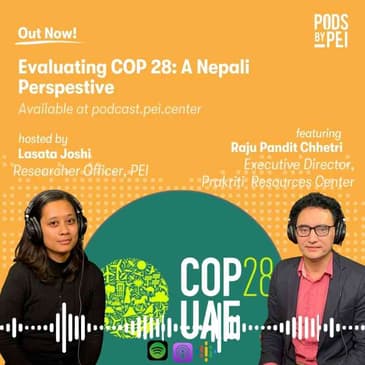
In this episode, PEI colleagues Lasata Joshi and Raju Pandit dive into the pivotal themes and outcomes of the recent COP. Recounting Raju’s participation in this and multiple previous COPs, they explore the significance of COP Nepal and the real-life experience of Nepali delegates. They discuss recent critical shifts in the climate narrative on fossil fuels, proactive participation of major oil industries, global stocktake, loss, and damage, and Nepal’s push for the mountain agenda.
Raju Pandit Chhetri is the Executive Director of Prakriti Resources Centre (PRC), an environment and development organization based in Kathmandu. He has over fifteen years of experience in climate change policy and sustainable development. Raju has followed UN climate change negotiations under the UNFCCC and Green Climate Fund (GCF) for over a decade. He closely works with the Government of Nepal and the Least Developed Country Group at the climate negotiations. He has written and contributed to several papers on climate change. Raju passionately advocates for ambitious climate actions and sustainable development.
If you liked the episode, hear more from us through our free newsletter services, PEI Substack: Of Policies and Politics, and click here to support us on Patreon!!
[00:00:01] Namaste and welcome to Parts by PEI, a Policy Discussion Series brought to you by Policy Entrepreneurs Inc. I'm Sonya Jimmy wishing you all a happy new year 2024. As we return to PEI from our holiday break,
[00:00:16] we're eager to embark on what promises to be announced standing here, both for our parts by PEI, Part Cask and our overall initiatives. In today's episode we have PEI Khali last Saturday in conversation with Raju Pandit on Evaluating COP28, A Nepali Perspective.
[00:00:36] Raju Pandit's head 3 is the Executive Director of Procuitary Sources Centre, an Environment and Development Organisation based in Kathmandu.
[00:00:46] He has over 15 years of experience in climate change policy and sustainable development. Raju has followed UN Climate Change negotiations under the UN FCC and Green Climate Fund for over a decade. He closely works with the Government of Nepal and the least developed country group at the Climate Negotiations.
[00:01:06] He has written and contributed to several papers on climate change. Raju passionately advocates for ambitious climate actions and sustainable development. In this episode, Lasta and Raju dive into the pivotal themes and outcomes of the recent COP.
[00:01:22] We're counting Raju's participation in this and multiple previous COPs. They explore the significance of COP Nepal and the real life experience of Nepaliy delegates.
[00:01:32] They discuss recent critical shifts in the climate narrative on fossil-filled, proactive participation of major oil industries, global stock take, loss and damage and Nepal's push for the mountain agenda. We hope you enjoy the conversation. Nama State, this is Lasta Josie. Nama State, I'm Raju Pandit Chetri.
[00:01:55] Welcome to Buds by PEI Raju. Thank you very much. Starting off, could you share what it is like to attend and participate at COP? Those who attend share it as one of the most hectic two weeks.
[00:02:08] As someone who has participated in COP for many years, how do we navigate this maze of events and track what's happening when you attend these meetings? Well, the conference of the parties or what we call a COP happens every year.
[00:02:23] And every year, it's quite an interesting experience given that different countries hosted. And they have the only style of hosting it given what the venue looks like and how big the conference that they would like to organize this time over 85,000 people attended COP 28 in Dubai.
[00:02:43] Of course, it was held from 29th November to 12th December. It extended by a day given the complexities, politics and trying to come to a conclusion at that. So there was a lot of things happening at the COP.
[00:02:58] Now when you talk about the conference of parties is basically under the United Nations Framework and Vision and Climate Change, we talk about how do you want to tackle the problem of climate change.
[00:03:08] But having said that the COP venue is also a venue where lot of practices, signs, policies are discussed on the sidelines. So countries are publicans, they are side events being hosted by the UN App�cyclicer, to share experiences on the ground.
[00:03:25] So the thousands of activities happening almost every day. So in order to really navigate that, if you're a first timer, tell a lot of complications. You'll have to know what the agenda is for the day. You have to be familiar with the venue.
[00:03:40] You'll have to also know what kind of people are attending. What way do you belong to? Where do you have to really go apart from that also practical aspects like, you know, we do eat, we're going to rest. Where is your next meeting going to really happen?
[00:03:55] So there are a lot of things to navigate during the COP. However for me, being in this process for quite some time, I've learned how to really do this work for myself. Given my past experience. It sounds like a lot of work on the ground.
[00:04:08] You mentioned that these events discuss issues of climate change. Why are these talks on climate change crucial? Well, if you look at globally now, we all said that the climate change is the biggest threat to humankind, right?
[00:04:23] So in that particular context, we have no choice of not tackling climate change. And for a country like Nepal and for us, UN is the only forum where the multilateralism really takes place. That's the place where we go and share our thoughts, our put-out. Isn't that?
[00:04:40] And this is also a place where about 198 countries globally come together to find the common solutions to climate change. We know that this is quite a complicated issue given that this is just not an environmentally issue, but it is also related to socioeconomic aspect of the society.
[00:04:57] So it's quite a massive political challenge I would say because there are interest groups that develop countries have their own way of view. They own way of dealing things, developing countries that have a certain demand given what the UNUP triple C convention has really laid out.
[00:05:13] Or the Paris addubian that was agreed in 2015 laid out. So in order to implement that, this is the forum where all the countries can come together and find the solutions in tackling climate change,
[00:05:24] whether it be looking at from a mitigation angle, adaptation angle or providing resources and technology, and how we all debate to really come to our consensus where every country can go home and apply actions or policies so that they are contributing to tackling climate change.
[00:05:42] So indeed, a must have conversation of the moment. Now jumping into the COP28 which just concluded in December, it was a crucial year. The global temperature reached 1.1 degree of of pre-industrial levels, nearing the critical 1.5 degree mark in the Paris Agreement.
[00:06:02] The urgent need for rapid emissions reduction has remained a clear and call to avoid this impending crisis. However, controversies surrounded this COP from the start. First UAE, a top-old producer led by Sultan Al Jueber, CEO of our National Old Company,
[00:06:20] sparked skepticism as he led discussions on fossil fuel phase out. We also witnessed a staggering 400% surge in participation from old companies and lobbies compared to the previous year.
[00:06:35] What should take on this climate narrative shift at COP28, considering consecutive cops have been hosted in petrostates and there is an increased oil representation?
[00:06:48] Do you view this trend as a barrier or a catalyst for climate action given the need for a significant transformation particularly in the oil industry? Also, how do you perceive this proximity to measure oil companies during this type of climate talks?
[00:07:04] Of course, there was a lot of controversies and a lot of doubts and skepticism on how this incoming COP presidency all led to the UAE has a precedent of the COP would take this call forward given that it's an oil-producing country and
[00:07:19] what it's modernised as built on oil money. There's a lot of skepticism for sure, but people also looked from a positive side that maybe an oil-producing country, if given responsibility,
[00:07:30] maybe they will have to even force phase saving reasons that they will be more ambitious in tackling climate change. We have been calling for phase out of the fossil fuel for a long time.
[00:07:42] Before a country like Nepal, where climate impacts are very huge given melting glaciers within the Himalayas or having climate industries disasters yearly,
[00:07:53] a lot of these impacts are growing over the years. It's just an Nepal, but also in similar countries like ours in least type of countries or now even in the type of countries with the climate disasters growing.
[00:08:04] We know the real cause of this is the fossil fuel exploration and burning of the fossil fuel, that's what is creating the problem. But now when country like UAE that's the oil-producing country host, there's a lot of skepticism as I said,
[00:08:19] but a good signal from the COP 28 has an outcome. For the first time, it uses wordings like transitioning away from fossil fuel. This is a very big signal to the global explorer who rely on fossil fuel, who really sell and make money out of fossil fuel.
[00:08:38] Now, the global community will have to look into finding solutions to these fossil fuel and rely more on renewable energy. It has not only said that, but it has also reflected saying that we want to triple the renewable energy source.
[00:08:52] We want to double the energy efficiency. We want to provide technologies that really works in favor of renewable energy. So when you see what the outcome has really been, I would take this as a very mediocre outcome, not as a big wind.
[00:09:06] However, good signal for the international community investors, private sector, to really say that tackling climate change and moving away from fossil fuel is a fundamental issue. Of course, how this will be translated into action is yet to be seen, but the signal seems positive for now.
[00:09:21] Definitely, it was commendable that this COP managed to put conversation on fossil fuel on the table till the end despite a few hiccups in between.
[00:09:30] Now, continuing with the winds and misses of this year's COP, how far do you believe that this year's COP has contributed to advanced climate action since the conclusion of COP 27 and Paris Agreement?
[00:09:45] Conversely, whether any new table shortcomings or areas where stronger actions or agreements were expected, but perhaps fell short. Well, in this COP, what of the major things that we would be discussed was what we call a technical term, the globalist talk take.
[00:10:02] In 2015, Paris Agreement was adopted and came into force in 2018. So in the last five years, what has been the achievement of taking Paris Agreement into action was being reviewed?
[00:10:14] So one and half years of this technical tribute process, went clearly not on track in meeting the 1.5-degree target that the Paris Agreement sets as an objective.
[00:10:24] Now, this was a very serious issue because we were looking to the mitigation targets, the world's temperature is already rising by 1.1 degree, and the objective is to maintain 1.5-degree and we will have a wind by 2030.
[00:10:38] So in that particular sense, we were expecting a quite an ambitious outcome given that do definitely move away from the fossil fuel. In the past, we dived into how do you move away from coal?
[00:10:52] But for the first time, this COP has brought in the fossil fuel as an entire and transitioning away from that really giving focus on the renewable energy technologies.
[00:11:01] Second thing was related to the loss and damage fund because there were five meetings that took place in 2023 through a transitional committee that prepared how a loss and damage fund that was agreed last in last COP in COP 27 really would be set up.
[00:11:16] So in the very first day, the COP presidency was very smart to adopt this decision. So in that particular sense, it was a good wind going forward. Over $700 million were also placed to the fund.
[00:11:28] So this was a good trust building exercise that took place at the very first day of the COP. But having said that what we also wanted to see was these funds, these transitioning away from fossil fuel,
[00:11:39] we wanted that to be backed by the strong finance and technology support as well. Of course, that did not quite happen. There are a lot of mitigation and adepression actions that has to be built.
[00:11:49] And country like Nepal has prepared something called Nestle, Detimment contribution or Nestle adepression plans submitted to the UN at FCC. But what it needs to be done? And these plans need to go into action. And we have said, these plans are conditioned.
[00:12:03] We will only implement that if the financial and technology support is given to us. Fortunately, this COP was not in a position to really back that financing to say that we will support those actions prepared by country like Nepal.
[00:12:17] So in that particular sense, expectation were not fully met but lastly there was a good signal that climate change needs to be tackled well. And also that the fossil fuel will have to end at some point of time.
[00:12:28] Seems like there is a lot to unpack here and a lot had happened at this year's COP.
[00:12:33] So let's start with global stock take. As you mentioned earlier, this year's COP was centered around the culmination of the first ever global stock take, which is a massive milestone in achieving the Paris Agreement and was the most contested draft during the negotiations.
[00:12:52] Especially around the use of long vision in action around fossil fuel phase down. So much so that this COP had to overrun the official deadline by a day. As an expert on this topic, Raju, can you give our listeners a 101-unglobal stock take and why it is essential?
[00:13:11] Well, the design of the Paris Agreement was such that it would be the culmination of both top-down and bottom-up approach. So every country would provide the national commitment what they would do in terms of reducing global greenhouse gas emission. And this would be reviewed every five years.
[00:13:31] So this was the design when the Paris Agreement would agree. So in the last five years, the global stock take was to see whether the implementation of the Paris Agreement was on track or not.
[00:13:43] If you were not on track, then we needed to do a course correction. So this helpless look back what and see what has been achieved in its implementation.
[00:13:50] And what they reveal is we are not on track. We are not in track of meeting little-one 1.5 degree but we are in the track of 3 degree by the end of the century.
[00:14:01] So that's what the global stock take really saw us. In terms of when your temperature goal is not being made, that means you have a massive investment you will need to do in adaptation.
[00:14:09] Loss at damage cost is going to be extremely high as well. But then just knowing what the problem is not sufficient. So we need it to see what will be the forward-looking process now.
[00:14:19] So that's why we call this global stock take back what looking but also guiding the forward-looking approach. So for this, the political decision had to be made. So this basically looked into the various issues about mitigation targets being met or not.
[00:14:34] Adaptation actions being done or not. Educated finance was being mobilized for the developing countries to take climate action or not.
[00:14:41] So all that was reviewed and it came out that it was not on track. So now this has given an indication that this will have to work on it.
[00:14:48] Finance, mitigation and so on and so forth. And it also talks very clearly that by 2030, 43% of the global greenhouse gas emission must be reduced.
[00:15:00] And by 2050, 60% must be reduced. Only then will be on track in a meeting 1.5 degree by the end of this century. That is a very clearly indication because the objective of the Paris Agreement.
[00:15:11] If you look at there is an objectic on the mitigation and 1.5 degree there is an objectic on building a resilience and sustainable development.
[00:15:20] So all this objective has to be met and this is given a signal that the global stock take has given a very clear signal saying that okay, this needs to move forward. We will see what the actions probably from the next year.
[00:15:37] That was an excellent explanation on global stock take. So we are not really on track for 1.5 degrees as according to Paris Agreement but has this global stock take provided a clear roadmap for policy makers?
[00:15:52] Yes, well the global stock take was a very excellent approach of mirroring on what the implemented so the Paris Agreement was and very clearly so that if the globe is in track of meeting 1.5 degree or not.
[00:16:08] And it clearly so it's not. So in that particular sense is given a very clear signal to say that all the developed and developing countries the world is heading into 3 degree world. So in the particular sense, the kind of plans that has been put forward are significantly insufficient.
[00:16:27] So we need to ramp up our actions in terms of really cutting down our greenhouse gas emission and what it has also said to all the parties is by the end of next year to provide the nestled it to be in contribution or long term strategy in reducing greenhouse gas emission.
[00:16:46] Because the current plan is insufficient so every country needs to really ramp up their ambition. So that has been a very clear signal and not just that this has to be backed by financial support whether it's in the developed countries or supporting the developing countries in moving away and adopting a low carbon resilient development that investing in that particular line is key.
[00:17:10] Whether it is the nestled budget that needs to align with the climate friendly policies or it is the developed countries supporting the developing countries to meet their nestled determined contributions that looks into the reduction of the greenhouse gas emission.
[00:17:22] So that clarity has been really given my of course now it is up to the countries to really accept that and take that plans forward.
[00:17:30] But I would also emphasize that it is just not the countries but also it's very good signal to the multinational companies especially coal or oil or fossil fuel companies who have been profiting out of selling this fossil fuel to them that you don't have a long term future you need to divest from there you need to move away from investing in fossil fuel and then invest in more renewable energy future.
[00:17:54] And why was including action around fossil fuel important in this global stock take?
[00:17:59] In the global stock take the language on whether to face out fossil fuel or face down fossil fuel was a big debate and this did not it's just start in COP 20 it was already reviewed in COP 26 in 2021. Since then we wanted this to be faced out.
[00:18:20] I can't do like Nepal then I smell all in that I have a very high climate vulnerability wanted to face out fossil fuel. It means that there will be no longer investment into fossil fuel exploring or investing in building pipelines and things like that.
[00:18:36] But given the very strong lobby of the fossil fuel companies and others that was not possible. Even coming to COP 28 the language still continues to be transitioning away from fossil fuel which means that you can reduce fossil fuel but not really stop using fossil fuel.
[00:18:55] So we still have a very dubious kind of outcome in a way to say we want to stop using fossil fuel but then we just say it is face down face down reddied means reducing of the using of the fossil fuel.
[00:19:07] But at some point of time what we want is a clear action to face out which means that at some point of time we have to stop using the fossil fuel.
[00:19:16] Was there any clear roadmap on just transitioning away from fossil fuel like who transitions first is transitioning away from fossil fuel based on equity principle common but differentiated responsibility. As there are many countries specially developing ones who rely mostly on coal for the economic benefit or economic development.
[00:19:40] Well if you look at the climate actions to be taken forward it is very clear that the developed countries those responsible for the cause of climate change will have to take the leadership.
[00:19:51] That they will have to so to the world that first they are taking steps to move away from using fossil fuels. Whether it's for the energy usage or transportation or economic purpose they have to take the leadership of course developing countries.
[00:20:05] Can support in that action provided that the developed countries are also supporting them with finance and technology. But now what we also can say is developing countries in recent decades are one of the highest emitter of greenhouse gas emission.
[00:20:20] Do we also have to take into account that they also gradually start transitioning away from using fossil fuel. But for countries like LDCs and since we have very low capacity poverty is still an issue many do not still have access to energy for them.
[00:20:34] Immediately moving away from fossil fuel would be quite difficult so they might take longer time but the leadership should definitely come from the developed countries and higher emitting higher capacity developing countries as well.
[00:20:47] Hi there this is somitarniobani from policy underpintersing we hope you are enjoying parts by bi as you know creating the show takes a lot of time and resources and rely on the support of our community to keep things going.
[00:21:02] If you've been enjoying the show and would like to help us out we'd really appreciate it if you could become a patron on Patreon. Patreon is a platform that allows listeners like you to support creators like us with a small monthly donation.
[00:21:17] We support will go a long way in helping us continue creating high quality content for you. So if you're interested in supporting our show and becoming a part of our community head on over to patreon and become a patron today.
[00:21:31] We can find us at patreon.com slash sports by pia. Every little good helps and we can't thank you now for your support. Now let's get back to the episode.
[00:21:46] Now moving on to loss and damage which you mentioned was one of the biggest wins of this year's cop. This year we saw numerous incidents of climate change in just disaster in our neighborhood and throughout the world.
[00:22:01] So we need to recognize that countries did come together and that there's an agreement as historic as loss and damage and operationalization of loss and damage fund, which has been a long standing call from vulnerable nations for at least 30 years.
[00:22:19] As someone who has worked for several years on the topic of loss and damage, how do you view the significance of this milestone acknowledging the complexities surrounding fund allocation and distribution?
[00:22:32] And again pressing on the road map, have we gained any clarity to whom and when the fund will be operationalized? Yes. At this cop one of the major outcome was the operationalization of the loss and damage fund.
[00:22:48] As a great result, it was a very strong trust building and a very strong signal given to the world because the loss and damage was swept under the cop with almost over 30 years.
[00:23:00] It was a very long dedicated fights by the small island developing states and LDC country in having this fund and this fund going forward. Climate change disasters are happening all around the world. It is just not the issue about developing countries or countries like Nepal.
[00:23:16] It's happening in the northern hemisphere as well, if you look at Europe or it is a US everywhere, it's happening. Because of the lack of appropriate or timely actions on climate change, the loss and damage is becoming in every people now.
[00:23:30] It's countries are having huge climate use disasters that is displacing thousands of people. People are having to migrate both economic and non-economic losses. So in order to really address this, this cop has really made an effort to give a signal that we need to address loss and damage.
[00:23:49] That's a good sign, particularly of this cop. There was also a set of 70 million dollars to the fund. But this money is not going to come very soon. That's my understanding. The mechanism will have to be set up. The fund is yet to be set up.
[00:24:07] The fund secretary is yet to be established. The policy procedures and what basis the funds will be distributed. All those criteria are yet to be set up. So in that particular context, I would say it will take a couple of years.
[00:24:21] And the money that is coming into this fund is only peanuts given the extent or problem that is globally being seen. So we will need hundreds of billions of dollars if you want to really tackle loss and damage.
[00:24:35] So just having over $700 million is going to set up the fund, policies in place, things like that. So in order to support countries, you'll have to massively scale up in raising more funds. And having those policies and criteria is in place as quickly as possible,
[00:24:52] so the fund can really support countries like Nepal. And that really needs to show that it is just not about agreeing to our fund, but actually delivering funds. So the people on the ground, the communities on the ground can feel that this isn't in cop 20-28,
[00:25:08] but actually, in fact, for us. So that realization have to be given. That can only happen when the money actually flows to these countries and communities. And so what will happen in the meantime as the fund gets collected, this type of disaster would not stop.
[00:25:25] For example, what happens if incident like male and female clothing happens again? How does a country or the community rise up from these type of incidences? Well, if you see in the last couple of years in Nepal as face extreme climate industries,
[00:25:43] you saw the male MCKs, we saw the Manang flood in 2021 and also this year in Mustang. So these are, we can say that these are very much related to climate industries.
[00:25:55] But of course, country like ours will also have to work and to prove that this kind of events that are happening, the trend that is taking place is due to climate change. So it will have to be backed by both science and also by social perspectives.
[00:26:10] Now in order to do that, we'll have to work on scientific information, data and so on and so forth. While that preparation is taking place at the same time, Glossent Dam is fund is also being in place.
[00:26:22] So as I said, it might take a couple of years to come from that particular fund. But of course, the community cannot wait. The country like ours cannot wait. That the fund will get operationalized. Although money will come from there, that is not going to be sufficient.
[00:26:34] So Nepal or country like ours will have to explore on what are the other avenues of funding. Because having a lessen time is fund is one thing, but that is not the only source.
[00:26:45] We'll have to see whether we can receive resources from green climate fund or their adaptation fund or other multilateral and bilateral sources in order to support communities like in Malamchi or in Manang or in Mustang. Only that will actually help the communities on the ground.
[00:27:03] Otherwise we'll be waiting for a very long time, because this fund is, as I said, is still very uncertain and how that will be coming and operationalizing in terms of actually delivering to society. Now moving away from Lossent Damage Fund by continuing on climate finance,
[00:27:19] fixing climate finance was one of the stated aims of COP28. How do you see the narratives surrounding climate finance evolving? Notably when the pledged $100 billion per year in 2015 appears in adequate and hardy met.
[00:27:38] Yes, this $100 billion per year goal was set up not just in 2015 but going back to 2009 when the COP29 in a climate summit took place. Then we talked about two funding. One was what we call the first start finance. For three years, 2010, 11 and 12,
[00:27:57] developed countries would give developing countries $10 billion per year. And that is the total of four years worth $30 billion. And that resources would rise up all the way to $100 billion per year by 2020. So when it came to 2015 there was a decision that the $100 billion goal would be per year
[00:28:17] would be from 2020 to 2025. But we have the report that the developed countries have not been able to meet their target of $100 billion per year. So there is a lot of exercise being done how to really realize this goal.
[00:28:33] And there's also a lot of frustrations among the developing countries that this was promised almost a decade ago has not been met realized yet. So this is a very big issue for developing countries.
[00:28:43] This is the resource that many developing countries have prepared their indices or naps thinking that the resources will come and will be able to take climate access on the ground. When these resources are not being available, there's a lot of frustration.
[00:28:56] Of course when the quantum has not been met, similarly the access process has also been extremely difficult. So even if there's money, the money getting to the countries has been extremely complicated, complex, cumbersome, lengthy, difficult to understand. So there's a lot of effort.
[00:29:15] Now how do you simplify this access process as well? So one of the outcome of the global stock take was also looking into the finance that how much has been delivered in last five years.
[00:29:26] And then whether the access of that money was really easy or not, looking at the qualitative side, not just from the quantitative front, but also looking at the qualitative side. So there is frustration, but development is upside that they are willing to meet their commitment.
[00:29:40] So one of the major things in the crop issues always becomes a financial issue. And this is always dealt at the end because it also you know, in touches with the other issues. So there's a process now agreed.
[00:29:53] While the attempt is to fulfill the 100 billion target, there's also an attempt next year that there will be a new goal being worked on an identified. So the countries will work on having a new goal from beyond 2025, like from the floor of 100 billion goal.
[00:30:06] What will be another target that the development countries will have to provide developing countries with climate finance? So that process is continuing and I hope that there will be a decision next year. Definitely the pledging sounds promising, but how are these climate finance being channeled in developing countries?
[00:30:24] Mayors reports suggest that the nature of climate finance is mainly in form of loans and repurposing of development aid. What are its implications for countries already grappling with that and vulnerable to extreme weather events? And those countries requiring such assistance in development?
[00:30:44] Yes, so when it comes to climate finance, there has always been controversy over whether the climate finance is additional to the official development assistance that the development can be. The assistance that the development countries have been giving to developing countries or not.
[00:30:57] What I've said as a LDC country, Nepal and other countries have always said, the climate change problem is an additional problem, because we already have problem with poverty, reduction, food security, other disasters like North Creek and others.
[00:31:14] Economic development, health, education, water, all these things has to be met. The climate change impacts, the problems are growing and this is being added to that problem. Hence, the finance that has been provided to developing countries, the climate finance also has to be additional to the resources.
[00:31:30] But unfortunately what we have also seen from various reports are that a lot of the resources that the development countries have been providing are not really additional to the development aid that has been given. So that is one of the major issues.
[00:31:44] The other issue that developing countries have been continuously raising is a lot of the assistance that is coming to developing countries is coming in the form of loans.
[00:31:53] While the countries are only indated while they are doing the development, now countries are given debt so there are further in a punished. On one hand, the climate impacts are growing, on the other hand, they have been overburdened by debt.
[00:32:08] So instead of debt, the development countries should provide grants to the developing countries in tackling climate change. So that has been asked for a very long time.
[00:32:18] Nepal and L.S. countries have continuously emphasized that we cannot be debt burdened now because our resources instead of tackling and helping our people were having to pay back the principle and interest on the debt.
[00:32:30] So there has been a huge call how to move away from the MDBs to reforming them so that the more grants can be provided country like Nepal. But at the same time also not double count with the development aid that has been provided for developing countries.
[00:32:46] Now going closer to home, Nepal did get a rare visibility this year at COP. For the first time, it has its own pavilion. The UN Security General visited the country just before the conference and highlighted the country's climate issue in global arena.
[00:33:03] Nepal also hosted a high level segment chaired by the country's Prime Minister, which caught some attention in the national media. What were the key points delivered in these segments? And where are our resources in gaining and retaining the attention at home and abroad?
[00:33:22] Moreover, whether any encouraging signs of progress or actionable steps stemming from this heightened visibility? This year, Nepal did play and prepare quite well for COP28. Given that there was several meetings being organized here in Kathmandu or Prime Minister himself was given quite a lot of interest in that.
[00:33:42] That's what it appeared and it a lot of the news came out in media as well. Just before the COP, UN Secretary General, the greatest also visited Nepal.
[00:33:51] So that also put Nepal on this spotlight and he very clearly from the, in every space camp and at the underpone of the space camp, he really clearly gave a message saying that how the climate change impacts were happening in the Himalayas.
[00:34:03] So that was very good for Nepal to highlight its case that the mountain was a serious issue. And for Nepal this year, I have a few things. One of course getting engaged into the negotiations as a part of the process in the COP.
[00:34:20] The other one also doing a lot of side events in its own pavilion that was for the first time in Nepal at a pavilion. Other than that, also so-kasing and exchanging sharing experiences by civil society organizations, Indigenous people,
[00:34:32] youth, government agencies and other areas in the platforms and forums. I think that sense it was quite encouraging participation. But having said that one of the very notable things that Nepal did this year was how to highlight and bring the Ezendah mountains.
[00:34:49] There was a proposal not by Nepal, by Andura like to have a mountain as an Ezendah to be discussed during the COP. Of course that was not realized. But a part from that Nepal did focus its activities around mountains.
[00:35:04] So in Nepal's Prime Minister, Chad and Facility on High Level Dialogue on Mountain Issues, where you insectivisional participation, country like Krisegistan and Andura, Vatan participated. So it was quite encouraging event. So because of the Nepal's encouragement and also way to take this mountain as an effort,
[00:35:24] and of our word, its alignment with Vatan, Krisegistan and Andura, mountain issues has been for the first time. You know, really, you know, come out very strongly in the global stock-take documents. Also in the global goal and adaptation, as I've been mentioned.
[00:35:44] Now one of the things that I would call as a good sign is it has been very clearly stated that in coming June, June, a triple C will organize an expert meeting on climate change and mountains.
[00:35:57] I think for this itself to happen and give that action point forward is quite a big win for Nepal. So the first time this has been done.
[00:36:04] So probably now this is a win but of course if you just sit back and do nothing it may not happen much. But when the meetings happening in June Nepal will have to be proactive to say that this is what we want to present
[00:36:15] and outcome of that meeting to be really reported during the COP and really taken from there. But leadership will have to so I strong diplomatic and other form of, you know, leveraging in a way to say that this is our seriously,
[00:36:28] we are confident that we can take this forward and use all the forums. And opportunity to really move this isn't a forward. So that has been quite a big win for Nepal. What challenges do we face as a vulnerable nation to climate change,
[00:36:42] invoicing our concern and issue in this massive arena? They are quite a lot of challenges in furthering our interest in this climate change, multi-lateral process. Because sometimes we negotiate with our development partners. Sometimes going into those forums and really being harsh and negotiating is a tough thing.
[00:37:02] So usually what Nepal does in positioning itself is rather than an individual country in furthering. It's interest it aligns itself with the list of countries group. So sometimes it's also easier for the country to work in a group.
[00:37:16] Otherwise the preparation will have to be much more to deal individually. Of course, in the EU, you inform every country and deal individually. But at the same time Nepal does the work in alignment with the LDCs interest. Because that's a common interest for all the LDC countries.
[00:37:32] But this time the good thing is though with that acknowledging that challenges on mountain issues in Nepal did go ahead individually. But they also are the country like Vatan, which is tied to a line with. And I think it was a small group but an effective work.
[00:37:45] But in order to really move our agenda strongly, the challenges that I see is the continuation of the negotiators going their regularly. Because frequently we have changes in our negotiating team. The second is how do we recalling the history?
[00:38:00] Let's say what happened in the past because when there's a frequent changes in the office, that also makes it quite difficult. And also the challenges that comes is when you frequently change people as building relationships and networks as other countries.
[00:38:13] Because for other countries there are people continuing in the process for many, many years. So it is very important that same people continue so that they know the history and also what they're looking for next time they can prepare accordingly.
[00:38:24] So those are some of the challenges that I see from Nepal going forward. But of course this is a process that we'll have to continuously engage. So in the line of climate commitments and ongoing challenges, what were the main expectations or aspirations going into this year's COP event?
[00:38:40] Where there are specific areas of focus or initiatives that stakeholders were particularly eager to address during this conference. Aside from the amount in agenda.
[00:38:50] Well one of the major things that Nepal wanted to really I think take forward was how do we have partnership and processes to implement this? To implement the our Nestled Determined Contribution and the Nestled Repression Plan.
[00:39:06] Nestled Determined Contributions, majority of the actions that is put there is related to the mitigation part. In that document it has clearly laid out that by 2045 Nepal wants to achieve net zero emission. So there are certain sectors like for instance by 2030 Nepal wants to generate 15,000 of hydropower electricity.
[00:39:30] And 5000 is unconditional but another 10,000 it conditionally provided resources will do that. Similarly there are also targets on transport for instance by 2030 Nepal wants to have the self electric vehicle to reach 90% private vehicles and public vehicles by 60%. We want to convert our cooking from gas to e-cooking.
[00:39:54] So there's been target to have e-cooking promote buy gas and others as well. So we are very particular targets on how we want to move both in terms of production of renewable energy at the same time using renewable energy in the country.
[00:40:08] So that is a part of our mitigation action of going forward. We also say that by 2030 we want to have at least 20 kilometers of railway lines run by electricity.
[00:40:18] So I think there's some of the very good actions point that is put into the indices and some of it. But of course we definitely like resources in terms of implementing them.
[00:40:27] So one of the point going into this cop was also to talk to various development partners and international global climate funds where resources can be mobilized so that our indices and Nestled Repression Plan can be really taken for us. But when we say that, that two aspects.
[00:40:45] One we look for resources and networking and we do networking to have more partnerships where it's a public, private, all these things and attracting them to invest in country like Nepal.
[00:40:56] But the other thing is also what we'll have to make ensure is any resources that is coming into the country. Are we utilizing that or not? Are we being able to absorb that in an efficient manner or not?
[00:41:07] Because there are projects which agreed we have the resources but our expenditures is also extremely low. I think that side also needs to be worked on. So just having plans and documents is not sufficient.
[00:41:18] But equally what is important is when you have the resources we need to invest them on time so that the communities and the entire country can benefit.
[00:41:25] Now that this year's cop has concluded in your perspective, what would you identify as some of the pivotal takeaways from cop 20 years? How might these lessons influence and more than nations for coming climate strategies and policies?
[00:41:44] Well the outcome of cop 20, it will have to be looked from two different perspectives. One are global perspective, one at the Nestle perspective.
[00:41:53] So the global perspective would be like as I said in the GST when it talks about tripling, renewable energy investment or moving away from fossil fuel transitioning away from fossil fuel. It means that Nepal will also have indirect benefit.
[00:42:10] So when the more mitigation actions are taken place, fossil fuel are not being used or explored, it means that we can immediately temperature goal. We will literally help us save our mountains and that means less climate energy disasters and impacts of climate change.
[00:42:25] So that is an indirect benefit that we will have on that front. But having said that we also have a direct benefit in terms of how we can advance our plans and strategies or whatever the programs that we have said.
[00:42:40] For instance there have been funds being announced into least development countries fund or adaptation fund or green climate fund.
[00:42:47] We can make projects based on our indices and naps and really submit these projects to these funds so that more resources can come and then we invest in our communities. That is one thing. The other thing is of course Nepal is very rich in renewable energy.
[00:43:01] It means that tripling the renewable energy base means that we hope that there will be more resources also flowing in Nepal so that we can explore how to power solar power and other reform of renewable energy in the country. So that will also help us move economically.
[00:43:18] And the third part is that when you do more investment potentially the amount of fossil fuel that we import primarily from India. We import about two billion US dollars a fossil fuel every year.
[00:43:30] So probably there will be less imported fossil fuel and the money that goes in terms of dollars into buying fossil fuel can be invested in other climate change impacts like in disasters or in renewable energy or in five structure housing health education and other forms.
[00:43:47] So I think those kind of benefits we can definitely see. But again, but I would say that this benefits don't come just by the global agreements. This actions only happens with our own initiatives, own way of working and really trying to see that our commitment is being missed.
[00:44:02] We'll have to work towards meeting those in the goals. Moving on, Raju. What can we anticipate on the road to Azerbaijan in COP 29? What is installed for us? What must we work on to move from commitment to realizing the targets?
[00:44:18] Are there any significant meetings, activities or agenda for the next year? For the next COP? Well, COP 20 had it had just ended. We have just back from Dubai. Having said that what I would say is the climate change actions should not be from COP to COP.
[00:44:38] But there are a lot of things that we'll have to do nationally at home. And before I think about the next COP, I really want to see that whatever the commitment and opportunities that the outcome of COP 28 gave.
[00:44:51] What effort do we make as a country in implementing that? How is the outcome of the COP 28 going to impact our communities on the grounds that have been impacted by climate change?
[00:45:04] Things in agriculture sector or in terms of renewable energy access or it's a managing climate industry disaster. So I think that actions of nationalizing or localizing the outcome of the COP is extremely important. That would be my first priority.
[00:45:21] But having said that of course, once we do this actions nationally, then we'll have a lot of things to take to 29 in Azerbaijan. So that a lot of experiences, a lot of difficulties that we face in accessing resources and implementing work.
[00:45:35] That experiences we can take and really in the agenda item that is being shaped. We can help influence that number one. Number two, we have said that mountain is a very key part.
[00:45:45] And we have really seen that this year for the first time the issue has been embedded into globally stocktake. That will be able to build on that mountain issue and then really make much more stronger case in Azerbaijan. That will be the second part.
[00:46:00] And the third part is next year is expected to be a finance COP. It means that next year, we will decide on a new number of what will be the finance that will be provided from the development committee to developing country like the 100 billion goal.
[00:46:13] We will have a new collective target next year. So that process will be there and we'll be able to also contribute to that process to say that this is our need both based on the quantity,
[00:46:24] but also on the qualitative side that we'll be able to contribute to that debate and discourse. Lots to do then. We feel that everything depends on the COP, but definitely much more goes beyond the COP. On this note, we have reached the end of today's episode.
[00:46:39] Thank you so much, Raju, for joining. Thank you very much for giving me this opportunity to share my thoughts. Thanks for listening to parts by PEI. I hope you enjoyed last time's conversation with Raju Pandit on evaluating COP28 a Nepalipuspective.
[00:47:02] Today's episode was produced by Najen Rai with support from Kushihang, Riddish Sabgota and Miso Nya Jimi. The episode was recorded at PEI Studio and was edited by Riddish Sabgota and Najen Rai. Our theme music is courtesy of Rohit Shaka from Jindabad.
[00:47:20] If you liked today's episode, please subscribe to our podcast. Also, please do us a favor by sharing us on social media and leave a review on Spotify, Apple Podcast, Google Podcasts, or wherever you listen to the show. For PEI's video-related content, please search for policy entrepreneurs on YouTube.
[00:47:40] To catch the latest from us on Nepal's policy and politics, please follow us on Twitter, at tweet to PEI. That's tweet followed by the number two and PEI, and on Facebook at policy entrepreneurs' aims. You can also visit PEI.center to learn more about us.
[00:47:57] Thanks once again for Miso Nya. We'll see you soon in our next episode.