
#Ep.077
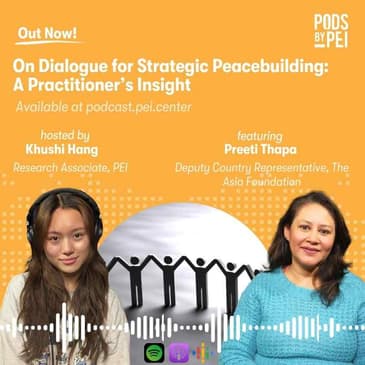
In this episode, Khushi and Preeti discuss strategic peacebuilding and the role of Dialogue in it. The two explore the core principles of dialogue as a conflict-solving tool and the wide scope of issues it has helped tackle professionals like Preeti in inviting resolution. They place the significance of dialogue & peacebuilding in the specific context of Nepal and highlight how underlying contentions impact aspects of society and development. They then discuss Preeti’s view on the nexus of peace building and justice and recommendations to improve the State’s efforts for sustainable progress in this front.
Preeti Thapa is a peacebuilder, lawyer, mediator, and certified master trainer in mediation and dialogue with more than 21 years of experience. She is The Asia Foundation’s deputy director of Justice and Governance in Nepal. Her expertise lies in access to justice and strategic peacebuilding through community mediation and multi-stakeholder dialogue. Preeti has worked with Nepal’s Ministry of Law and Justice on mediation policies and, in particular, contributed to the passage of the Mediation Act and Regulation. Preeti is a member of the Nepal Bar Association and of the Community Mediators’ Society Nepal. She is also a visiting faculty member at Kathmandu University, the Army Command and Staff College, and Folke Bernadotte Academy, Sweden on Mediation and Dialogue.
If you liked the episode, hear more from us through our free newsletter services, PEI Substack: Of Policies and Politics, and click here to support us on Patreon!!
[00:00:12] - [Speaker 0]
Namaste and welcome to Pods by PI, a policy discussion series brought to you by Policy Entrepreneurizing. My name is Ridesh Sapkota. In today's episode, we have PEI colleague Krissy Hung in conversation with Priti Thapa on Dial up for Strategic Peacebuilding, a practitioner's insights. Priti Thapa is a peacebuilder, lawyer, mediator and certified master trainer in mediation and dialogue with more than twenty one years of experience. She is the Asia Foundation's Deputy Director of Justice and Governance in Nepal.
[00:00:42] - [Speaker 0]
Her expertise lies in the access to justice and strategic peacebuilding through community mediation and multi stakeholder dialogue. Preeti has worked with Nepal's Ministry of Law and Justice on mediation policies and in particular contributed to the passage of Mediation Act regulation. Priti is a member of Nepal Bar Association and of the Community Mediators Society Nepal. She is also a visiting faculty member at Kathmandu University, the Army Command and Staff College and Fort Bernadotte Academy, Sweden on mediation and dialogue. In this episode Khushi and Preeti discuss strategic peacebuilding and the role of dialogue in it.
[00:01:19] - [Speaker 0]
The two explore the core principles of dialogue as conflict solving tool and the wide scope of issues it has helped tackle professionals like Preeti in inviting resolution. They place the significance of dialogue and peace building in specific context of Nepal and highlight how underlying contentions impact aspects of society and development. They then discuss Preeti's view on the nexus of peace building and justice and recommendations to improve the state's effort for sustainable progress in this front. We hope you enjoy the conversation.
[00:01:57] - [Speaker 1]
Namaste, I am Kushi Han.
[00:01:59] - [Speaker 2]
Namaste, I'm Preeti
[00:02:00] - [Speaker 1]
Welcome to the show Preeti, how are you doing today?
[00:02:03] - [Speaker 2]
Thank you, I'm doing good
[00:02:05] - [Speaker 1]
Alright, we're so glad to have you here Preeti, you're a lawyer, a peace builder and a certified master trainer in mediation and dialogue Your work at TAF's regional dialogue process, which is now known as the multi stakeholder dialogue program, was perhaps one of the most significant. And there you invited and facilitated dialogue between diverse interest groups to work on local cleavages. So as we begin, can you tell us more about this project and your role in it? And particularly, I'm interested to know about the different themes and topics that emerged, in these conversations as the project took its course.
[00:02:43] - [Speaker 2]
One of the issues that Isha Foundation has worked for a very long time is access to justice and human rights. So based on our work in 02/2002, we started working on community mediation to strengthen access to justice for the local community. While working on this project, apart from strengthening access to justice, we also saw the culture of conflict resolution being built in the places where we were working. And at that time, Nepal was in conflict. And there was lots of demand on working on social cohesion, building relationship.
[00:03:29] - [Speaker 2]
So we started looking at community mediation from the peacebuilding lens. In early days of community mediation, we were only resolving interpersonal conflicts. But as mediators got recognition, got respect from the community, when they were trusted by the community members, all kinds of cases start coming, including cases related to identity, public lands, natural resource. So from interpersonal, we moved into multi stakeholder dialogue. And from multi stakeholder dialogue, we started working on regional level dialogue programs.
[00:04:14] - [Speaker 2]
And this regional level dialogue program started in 2012, which was built on the success and modality of Nepal Transition to Peace Forum. And this was track 1.5 because in this forum, people from different political parties sat together with government officials, which was facilitated by two individuals who were highly respected in and within political parties. And different civil society members also had high regards. So this forum, though it was informal, had lots of legitimacy and credibility. And they worked on political dialogue at the national level.
[00:05:07] - [Speaker 2]
But what we realized was this kind of forum is also needed at the regional level. Because during the constitution making process, there were lots of contentious at the local level related to identities, related to boundary demarcation of federal structures. So we felt that even a very successful peace process can be derailed if we do not have spaces like NTTP forum at the local level. So we started regional dialogue forum in three districts, which was considered as conflict hotspots. One was in Thapa.
[00:05:49] - [Speaker 2]
And in Thapa, there were lots of identity groups. And there were lots of issues related to Limbuan, Kimbuan, Kochila, and even Daesh issues. The other was in Dhanusha because there was a Modesh movement going on. And one in Dang. And in Dang and surrounding districts, there was big movement of Taruhota requesting for a separate province for them, right?
[00:06:17] - [Speaker 2]
And this is how we have expanded.
[00:06:20] - [Speaker 1]
A lot of things have come up. But first, I have to say I'm really impressed by the diverse and vast scopes or areas you've covered through this project and how it evolved. Right now, I want to zoom into a little bit on the Dialogue Forum itself because yes, dialogues are basically conversations, but there have to be these set standards and housekeeping rules that make the space better. Can you share some of these standards that you were aiming for in this project and why it was important for the project to pursue them in the first place?
[00:06:52] - [Speaker 2]
So when you talk about dialogue, dialogue is a process. It's a process to craft informal, safe, and confidential space for genuine interactions and conversation between different parties where people listen deeply. And because they listen deeply, they understand each other's perspective. They understand each other's needs and interests and fears and emotions. When you do that, it builds relationship across different divides.
[00:07:30] - [Speaker 2]
And you will be able to come up with a joint or mutual joint actions. So dialogue has a process. And process is the strength of dialogue. When you look at the dialogue forum, we have a facilitator who does manage the process and the principles of dialogue. So when we talk about dialogue, dialogue really promotes participation.
[00:08:00] - [Speaker 2]
It promotes voices of diverse group and community. Dialogue is a confidential process, and it is also transparent. So confidential and transparent, it is like different.
[00:08:17] - [Speaker 1]
Yeah, it contradicts.
[00:08:18] - [Speaker 2]
Contradicts, right? But whatever is discussed in the dialogue forum remains confidential. But the process, you have to be very transparent. For example, dialogue has different phases. So they need to first identify whether they can really take that issue or not.
[00:08:41] - [Speaker 2]
And that they can only do after a preliminary analysis of the context. And in the preliminary analysis, they look at, okay, what is the problem? Who are the people involved in this conflict or dispute? And what are the processes used to address this issue earlier? And if these other processes were used, why were they not able to resolve it?
[00:09:13] - [Speaker 2]
And the other is power. Like, what are the power dynamics between different stakeholders? And what are the policies that will influence this process? So there are different things that the dialogue forum members and the facilitators, they will analyze. And if they feel that they can take this issue, then what they do is they will then go and talk with the stakeholders and ask them whether they are willing to come into the process because it's a voluntary process.
[00:09:48] - [Speaker 2]
Once the stakeholders agree, then they do different meetings first with each and every stakeholders or each and every parties to identifying the underlying needs. What is the real issue? And what are the options that they have to resolve or to transform this issue? So after multiple, shuttle dialogues or separate meetings, when they feel that now there's a common understanding of the issue and people are ready and willing to sit for the joint meeting. And whoever comes to the joint meeting, they have to have this power to make the decision.
[00:10:35] - [Speaker 2]
And once the decision is made, dialogue does not end there. Then there's follow-up also. Implementation of the agreement is also very crucial. And then they make action plans and dialogue for a members facilitated. They do monitoring also.
[00:10:53] - [Speaker 2]
Because of this, it is different. And dialogue is guided by various standard. And as I mentioned earlier, so these standards are representation, confidentiality, transparent respect, voice, equal treatment, and having the power to make their own decisions.
[00:11:14] - [Speaker 1]
So all in all it's about fostering this environment where they feel equal agency in the table. Alright. So I remember something you said as you first introduced this program which I quote is the culture of conflict resolution. Now obviously one of the immediate and face value impacts of this dialogue in general is conflict resolution but there's also an idea of creating a culture about it so I wanted to know what are the different long term and less measurable or less tangible impacts of hosting conversations between conflicting groups.
[00:11:53] - [Speaker 2]
So there are long term impacts and immediate gains. So in each and every dialogue forum, we have a facilitator. They are there to help parties understand each other better, to explore option and come up with joint actions. So when we were choosing the facilitator, facilitators are those kind of person who are trusted by everyone, who are inside partial. I say inside partial because they belong to the community.
[00:12:34] - [Speaker 2]
Sometimes they are part of the issue or they are very close to the issue. But they have the discipline of not taking sides. And these facilitators, they are trusted by all the people who sits in the dialogue forum. They go through a rigorous training to become a facilitator. So they have this skill to facilitate.
[00:12:58] - [Speaker 2]
They have that capacity to bring people together, to understand the power dynamics. Because Nepali society is very hierarchical, and there's lots of power imbalance. So in this kind of space, it's a big role of dialogue to understand these underlying causes of conflict. And the dialogue facilitators first were able to bridge the gap between the members because the forum was and is very diverse. There were different diverse group representing the forum.
[00:13:40] - [Speaker 2]
And they felt that their voices are heard. In a traditional system, it was very difficult for the voices of women, marginalized community, and youth to be heard in decision making process. But they, being part of the dialogue, they were able to represent their constituency and able to share their own issues. And their ideas were heard. So they felt that they have this agency, that social prestige, which was not there earlier.
[00:14:15] - [Speaker 2]
In the long term, we have started seeing cultural and structural changes. When I say structural changes, there are lots of policy changes. For example, I can talk about one of the rural municipality named Rajapur, where there was a settlement called Mahatenya. And this Mahatenya was really disconnected from the mainstream state programs and services. So Mahatenya was divided by the river.
[00:14:53] - [Speaker 2]
And in this place, there were like 400 people residing and there were 84 households. But in this place, like 14 people had died just crossing the river because there was no road connectivity. And they had to cross river to go to the rural municipality to take services. And many pregnant women had died because they had no health service or health access. Dialogue is not only reactive, it is proactive also.
[00:15:30] - [Speaker 2]
And in this case, one of the forum members came and talked about Mahatenya's disconnect, their situation in one of the dialogue forum meetings. And this person was a journalist and he had visited this area. So they came and said that, Okay, we really have to do something. It was not a big conflict. But it can lead to conflict.
[00:15:58] - [Speaker 2]
And it had a huge impact in people's life. And they were marginalized. They were disconnected. And most of the people who stayed there belonged to Tharu community or Dalit community. So they took up this case.
[00:16:17] - [Speaker 2]
Many journalists started writing about the situation of Mahatenya and then Dialogue Forum went and started its work. So it started, I think it was in 2018, this thing happened. And that forum members, they were able to bring the local community of Mahatanya, the local government of Rajapur together to talk about the issue. First, the local government said that now they can put money to build road. But the thing was they cannot build road along the river because they felt that in the monsoon season, it will be because of the river.
[00:17:02] - [Speaker 2]
It it won't be a temporary solution. And what they said was they can build the road through the forest. But in Nepal, it is really difficult for the forestry people to give permission to cut trees. There was consensus after lots of discussion that they can build the road across at the edges of the forest. So there was this consensus and in June 2019, the road construction was completed.
[00:17:32] - [Speaker 2]
The government started allocating budget from the Development Fund to this area. Health post was opened. And then even there was only pre primary school. And the school was upgraded into, I think, grade four. If you look at the cultural aspect of impact, what has happened is, like earlier, we always used to depend on third party to come and resolve local disputes.
[00:18:03] - [Speaker 2]
But now, there's this capacity at the local level where people can resolve their own local disputes. And when local people are in charge of their problem, they are able to find better solution because they are very close to the problem. They know the real issue. They know the context. So they have really creative and innovative ways of exploring options and coming up with the solution.
[00:18:36] - [Speaker 2]
And because they are local community, it is also very easy to sustain that because they are there. They are embedded in the community and that capacity is there. So even when the project ends or when the program ends, this local capacity embedded in the community will continue working. Before we head into diving deeper into this conversation on dialogue, I think we would be remiss to not talk about the alternate justice delivery mechanisms that already exist in Nepali society. Some of the known ones are Mukhia system in Mustang, Tharu Bodkar, and in my community we have Shiro Tauni.
[00:19:24] - [Speaker 2]
What about these existing mechanisms? What significance do they hold in peacemaking? If you look at Nepali society, third party conflict resolution was there for a very, very long time, from generation ahead. Like, Nepali is a very diverse community. We have different ethnic groups.
[00:19:46] - [Speaker 2]
And all these ethnic groups, in one way or the other, they have their own systems of conflict resolution or some system of coming together to resolve local conflicts. But these forums, they were very effective earlier. But as society became more diverse or because of urbanization, because of migration, there was change in the composition of the community. And most of these systems were very homogeneous. But as communities started becoming heterogeneous, then the indigenous mechanisms started disintegrating.
[00:20:33] - [Speaker 2]
They were not able to really respond to the challenges. And the other thing was all these structures, they had their own shortcomings too. Most of these structures were patriarchal, colored by different cascas value systems. And the people, if you look at the people who sat or who gave decisions, were all powerful males. There was a need for restructuring in that system too.
[00:21:05] - [Speaker 2]
So the culture of dialogue is very important. But the other thing is for the dialogue space to be effective, it has to be inclusive. It has to be able to address the issue of marginalization, discrimination. It has to address power imbalance. And the earlier systems were not structured in such a way to address all this problems.
[00:21:37] - [Speaker 1]
Definitely. And this goes back to the conversation we were having earlier about the standards that you do and you need to maintain in a dialogue that wishes to resolve a conflict. In your personal view, do you see any way in which we can integrate these traditional alternate justice delivery mechanisms into institutional efforts like yours?
[00:22:01] - [Speaker 2]
Yeah, we can. And even in the forums, what we have tried to do is, like, we try to complement. It's not a competition. For example, we work in where the majority of the people are Tharu, and they have their own bodkar system. We try to bring or invite people who are working as bodkar.
[00:22:27] - [Speaker 2]
So it is not a competition. We try to really complement each other and then we try our best to integrate the voices of that community too. When you have this safe space and when you use dialogue as an approach to talk about different issues, then these spaces has to be inclusive. And these people are key actors, right? And they can bring their own people there and that will build more trust in the system.
[00:23:04] - [Speaker 2]
But if we keep them outside this whole process, then they can also act as a divider, which is not good to this process. And if we see that the systems are there, people are there who are already working for generation in some kind of conflict resolution process, then definitely we need to include them, we need to hear their voice, and we can always incorporate the strength of that process.
[00:23:39] - [Speaker 3]
Hi there this is Somit Rinupani from Policy Entrepreneurs Inc. We hope you're enjoying Parts by BI. As you know creating this show takes a lot of time and resources and we rely on the support of our community to keep things going. If you've been enjoying the show and would like to help us out we'd really appreciate it if you could become a patron on Patreon. Patreon is a platform that allows listeners like you to support creators like us with a small monthly donation.
[00:24:08] - [Speaker 3]
Your support will go a long way in helping us continue creating high quality content for you. So if you're interested in supporting our show and becoming a part of our community head on over to Patreon and become a patron today. You can find us at patreon.com/thoughtsby PEI. Every little bit helps and we can't thank you enough for your support. Now let's get back to the episode.
[00:24:37] - [Speaker 1]
So Preeti, now I want to contextualize the idea of dialogue within the Nepali society. And the Nepali society has its own historical baggage as the state actively tried to homogenize and centralize its resources. This included efforts to undermine diverse identities which has recently resulted in contentions like the ones we've talked about earlier. So my question is how have you as a practitioner observed that underlying conflicts and contentions affect different aspects of the Nepali society development governance how important is it Or better phrased, why is it important for us to look into these underlying conflicts?
[00:25:25] - [Speaker 2]
When we look into big development projects, most of the projects are either delayed or stalled because of conflict. And when you dig deeper and see why, the conflict is because of lack of information, lack of participation, and lack of having a voice in the designing of the projects. So the community feel left out and they feel that they do not have a stake. That has lots of negative implication for the project. And this is just lack of planning and then these people they feel that either it's because of time constraint or they are in a rush to start up the project they miss going and talking to the people on the ground which will have a very huge impact later when the development projects are stalled.
[00:26:26] - [Speaker 2]
For example, in Dang District Nepal Electricity Authority initiated the expansion of the transmission line to Tulsipur from Hapuri Kola. And for that, they had to build 23 kilometers of new transmission line. And after 20 kilometers of the expansion was finished, few villagers, they disrupted the construction and they vandalized the electricity poles. Then they had to stop the project. There were lots of tension.
[00:27:06] - [Speaker 2]
And initially, the electricity authority called the police, the contractors, they used lots of force to control that protest. And people were really unhappy with the force that was used. And there was a real impasse. They were not able to move forward with the project. So after some time, they called the people for conversation.
[00:27:38] - [Speaker 2]
But the people, they refused to come because they had no trust. And their earlier experience of conversation and interaction with them was not so respectful. And they felt that even if they go, they won't be heard. So they refused to go. When they were not able to do anything, they approached the dialogue forum facilitators and members to support them, to help them facilitate this dialogue.
[00:28:10] - [Speaker 2]
So this happened around 2016. And for one and a half years, the project was delayed. So in 2018, dialogue forum started working. In this issue, they had multiple separate meetings with different stakeholders, including the government, including Nepal Electricity Authority, the contractors. And in 2019, they were able to resolve this issue.
[00:28:41] - [Speaker 2]
And the transmission line was completed. So dialogue forums, they have worked to break the impasse and to bring or to move things, which was not possible in formal structures and systems.
[00:28:59] - [Speaker 1]
So essentially, we're just overlooking the existing issues and trying to sort of push new developments and ideas. But, Preeti, I think we must acknowledge the fact that the Nepali state has been aware of its historical mistakes, and has introduced corrective initiatives. Right? The state has put up efforts to resolve some of the contentions existing in the society. Can you maybe recount some of the state's initiatives in conflict resolution?
[00:29:34] - [Speaker 1]
What has the state done so far that have been significant to you?
[00:29:39] - [Speaker 2]
So to your question, state has thought or envisioned different mechanism of conflict resolution. If you talk about our comprehensive peace agreement, in that agreement, there were lots of structures envisioned, like local peace committee, Truth and Reconciliation Commission, Disappearance Commission, state restructuring Commission, like different commissions, and even Ministry of Peace and Reconstruction was created around that time. But all these structures, they really struggled to be impactful and helpful to the community, to the victims. To take one example, there was a very good concept of local peace committee. When the people envisioned local peace committees, they had thought of making this committee very inclusive, where there'll be local government, victims, people from civil society, activists, and even business people.
[00:30:52] - [Speaker 2]
But, like, sadly what happened was when Local Peace Committee was formed, it was a very top down approach because the Ministry of Peace and Reconstruction, they formed it. And the main office was in Kathmandu. And at the local level, it was at the then village development committee level and their direct connection at the local level was chief district officer. But because the concept was bottom up, but eventually what happened was it was a very top down approach, It was not as effective as it was envisioned. A few local committees were very impactful and effective because it was led by a very good leader but the impact of local peace committee varied because the approach was not bottom up.
[00:31:54] - [Speaker 2]
And if you look at the Truth and Reconciliation Commission and Disappearance Commission, We have formed it, but we have not really seen or felt the impact of this commission. Some work has been done on the truth side of things, but we have not done much on the reconciliation aspect.
[00:32:20] - [Speaker 1]
I think those are some really insightful observations, Preeti. And it has also brought this conversation to an interesting place because now we're talking about truth and reconciliation and this brings up the topic of justice. Now theoretically justice is a prerequisite to peace building so much so that the lack of just conditions is regarded as a negative state of peace. However, justice is easier said than done. Right?
[00:32:47] - [Speaker 1]
Often the delivery of justice is ambiguous and often not feasible. Previously on our show we had Jaya Liu Till from the story kitchen and she talked about how it's necessary to reimagine justice not just as retribution or just as revenge but beyond that she was talking about taking a holistic form where we think about the victim themselves. So I want to know what is your take on reimagining justice? What does justice mean to you and does strategic peacebuilding facilitate justice delivery?
[00:33:21] - [Speaker 2]
We have to look at justice in a holistic way And the word justice is very subjective. It means something to me, but it may mean something else to you. So when we hear the word justice, people automatically think about courts, police, And they are all part of the retributive system. But if you ask what justice is, for me, justice is remedy. It's respect.
[00:33:53] - [Speaker 2]
It's having a voice. It's like being able to make a decision. It is having control over my life. So justice for me is much bigger than just police and court structures. So yeah, to work on the holistic justice, you have to have a connecting space.
[00:34:19] - [Speaker 2]
Or you have to work with different people with different discipline. It's like working with legal aid lawyers. It's working with shelter homes. Like, if you think of from a survivor victim's perspective, like, our system is retributive. And in retributive system, if punishment is done, if a court case is decided, then justice is done, right?
[00:34:45] - [Speaker 2]
But if you think from a victim perspective, for that person, that is not justice, right? This person needs a dignified life. This person needs employment. And for victims, justice may vary. Some may need psychosocial help.
[00:35:06] - [Speaker 2]
Some may need shelter homes. So the state has to be prepared to provide this kind of service for victims. And if you look at the perpetrator, perpetrator should also have to have some support system. And even in jail, they need to prepare. This person will come out one day and has to be reintegrated into the community.
[00:35:34] - [Speaker 2]
So some kind of support system to help this person smoothly reintegrate into the community. And if you look at peacebuilding, peacebuilding work is not only there when there's violent conflict. Peacebuilding seeks to prevent, reduce, transform, and help people recover from violence. And it is also from structural violence. So like if you look at the Nepali community, I think more than half the population, we have faced structural violence in somewhat ways.
[00:36:14] - [Speaker 2]
So peacebuilding also addressed that. So even when we talk about peacebuilding, we have to look at it in a holistic way. And peacebuilding empowers people to foster relationship at all levels. Peacebuilding is very much linked with relationship. And when we talk about relationship, it is about power.
[00:36:38] - [Speaker 2]
It is about marginalization. So you have to take that into consideration. And peace building becomes strategic when resources, actors and approaches are coordinated to address multiple issues. So even justice has to be holistic, but at the same time, peacebuilding also has to be strategic.
[00:37:03] - [Speaker 1]
Yeah, think that was really beautifully put by you and we're moving forward towards the end of our conversation. And here I want to talk about how peace building as a process can be taken ahead in Nepal. You previously talked about the deficiencies in the state's peacebuilding efforts and you based that on your observations and experience working in this field. So what are some of the necessary changes that you would recommend for the Nepali state to adopt?
[00:37:34] - [Speaker 2]
Yes. For me, I think, as I said earlier, we need to think about peace building and justice in bigger holistic way. And for that, I think one thing very important is we cannot work in silos. So to work on holistic justice and peace, we need coordination and cooperation from different disciplines. I think in Nepal, there's not many physical spaces or connecting spaces for collaboration.
[00:38:15] - [Speaker 2]
So we need to bring people working on human rights, legal judicial system, people working on early warning, trauma healing, restorative justice, transitional justice, all these people together. And when we collaborate, we can work for bigger peace and bigger justice. And the other thing that is also important is about linking efforts horizontally and vertically. We need to amplify the voices of voiceless. We need to empower them.
[00:38:59] - [Speaker 2]
And when I say empower, it's just being there, accompany them in their journey and providing support to their ideas to give them confidence and give them if they need technical solution or technical ideas, give that. And the other thing is we really have to be strategic on working with the actors. We work really closely with John Paul Ledrack and most of our work is based on John Paul Ledrack's theory of conflict transformation. So he talks about strategic who and strategic what. So on the strategic who, we also be very mindful of people that we work with.
[00:39:49] - [Speaker 2]
Yes, at the community level, we work with people and they are big in number but comparatively they have less voice. But if you work at the national level with top politicians, they are few in number but they are very very powerful. They can make policy changes. They can make structural changes. So we need to match.
[00:40:16] - [Speaker 2]
We need to really, bring up community voices to make intervention at the policy level so the policies are well informed by the ground realities. And this kind of work is very much needed in Nepal.
[00:40:36] - [Speaker 1]
Yeah, definitely. And I think that's a good note not just for big institutional reforms but also in our interpersonal lives. I think that's something that we can take, with us. So I think that's the end of the show today. Thank you so much Preeti for coming and sharing your valuable experiences and ideas with us.
[00:40:57] - [Speaker 1]
I hope the experience was as great as it was for us.
[00:41:01] - [Speaker 2]
Thank you Kushi. It was really lovely talking to you. I was like reflecting on all my work that I did earlier.
[00:41:10] - [Speaker 1]
I'm glad. Thank you. Thank you so much.
[00:41:12] - [Speaker 2]
Thank you Kushi.
[00:41:16] - [Speaker 0]
Thanks for listening to Pods by PEI. I hope you enjoyed Kushi's conversation with Preeti Thapa on Dialogue for Strategic A Practitioner's Insights. Today's episode was produced by Kushi Han with support from Neesan Rai, Sonya Jimmy and me, Didesh Sapkota. The episode was recorded at PI Studio and was edited by Nirjan Rai and me, Didesh Sapkota. Our theme music is courtesy of Rohit Sake from Jindabad.
[00:41:41] - [Speaker 0]
If you like today's episode, please subscribe to our podcast. Also, please do us a favor by sharing us on social media and leave a review on Spotify, Apple Podcast, Google Podcast or wherever you listen to the show. For PEI's video related content, search for Policy Entrepreneurs on YouTube. To cast the latest from us on Nepal's policy and politics, please follow us on Twitter tweet2pei and on Facebook policyentrepreneursing. You can also visit pei.center to learn more about us.
[00:42:14] - [Speaker 0]
Thanks once again from me, Ritesh. We will see you soon in our next episode.