
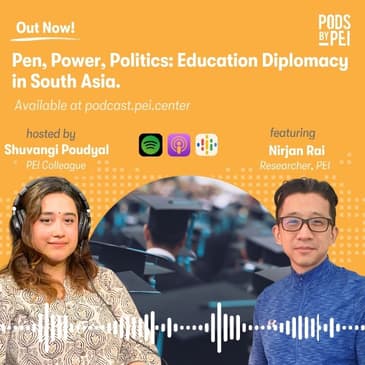
#Ep.095 Pen, Power, Politics: Nirjan Rai on Education Diplomacy in South Asia | Nirjan is a researcher with over 20 years of experience of designing, managing, and leading analytical studies in Nepal and the United States. He specializes in political economy analysis and has examined critical reforms in the electricity sector, water governance, and geopolitics. Nirjan is the primary author of the recent PEI report “Pen, Power, Politics: How China and India wield soft power through education diplomacy in South Asia. Nirjan and Shuvangi discuss the strategic use of education diplomacy by China and India in the South Asia region, drawing insights from his research. They explore how both countries leverage educational initiatives as a tool of soft power to extend their influence, defining soft power and emphasizing the significance of "education diplomacy." We review India's evolving educational diplomacy, highlighting its "neighbor first" approach, and China's initiatives to internationalize its higher education system and the growing appeal of Chinese universities in the region. They also consider competing perceptions about Chinese and Indian education diplomacy, contrasting these with Western strategies, explore the future dynamics of geopolitical influence through education. Find more about us on our official website and for more video related content, find us on Youtube . If you liked the episode, hear more from us through our free newsletter services, PEI Substack: Of Policies and Politics, and click here to support us on Patreon!!
[00:00:01] Namaste and welcome to PODS by PEI, a policy discussion series brought to you by Policy
[00:00:18] Entrepreneurs Inc.
[00:00:19] I am Shivangi Paudyal.
[00:00:21] In today's episode, I am having a conversation with PEI's Nirjan Rai on PEN Power Politics
[00:00:26] Education Diplomacy in South Asia.
[00:00:29] Nirjan is a researcher with over 20 years of experience of designing, managing, and
[00:00:33] leading analytical studies in Nepal and the United States.
[00:00:36] He specializes in political economy analysis and has examined critical reforms in the electricity
[00:00:42] sector, water governance, and geopolitics.
[00:00:44] Nirjan is the primary author of the recent PEI report, PEN Power Politics, How China
[00:00:49] and India wield soft power through education diplomacy in South Asia.
[00:00:53] Nirjan and I discussed the strategic use of education diplomacy by China and India
[00:00:58] in the South Asia region, drawing insights from his research.
[00:01:02] We explore how both countries leverage educational initiatives as a tool of soft power to extend
[00:01:07] their influence, defining soft power and emphasizing the significance of education
[00:01:11] diplomacy.
[00:01:13] We review India's evolving educational diplomacy, highlighting its neighbor-first approach
[00:01:18] and China's initiatives to internationalize its higher education system and the growing
[00:01:22] appeal of Chinese universities in the region.
[00:01:25] We also consider competing perceptions about Chinese and Indian education diplomacy,
[00:01:30] contrasting these with Western strategies to explore the future dynamics of geopolitical
[00:01:35] influence through education.
[00:01:37] We hope you enjoy the conversation.
[00:01:39] Hello, Nirjan and welcome to Pods by PEI.
[00:01:48] How are you doing today?
[00:01:49] Hi, Shivani.
[00:01:50] Thank you for having me here today.
[00:01:51] I'm doing all right.
[00:01:52] Although I should admit that it does feel a little strange being on the other side
[00:01:57] of the mic.
[00:01:58] I guess I am a little nervous, but I think it's a good thing.
[00:02:01] I think it shows that I'm excited about today's conversation.
[00:02:04] So let's do it.
[00:02:06] I can't wait for today's conversation.
[00:02:08] So let's get right into it.
[00:02:10] The report, I think, has a very interesting title, Nirjan.
[00:02:13] It's called Pen, Power and Politics.
[00:02:16] I really want to begin the conversation by exploring why you decided on that title
[00:02:20] and what it says about the nature and narrative of the report.
[00:02:24] So as you are aware, Shivangi, one of the most difficult tasks of doing research
[00:02:31] is actually coming up with the title.
[00:02:34] You want it to be original, you want it to be catchy, while also one that fully conveys
[00:02:40] the true meaning of the research framework.
[00:02:43] Here as well we tried a number of ideas until we landed with the three words, pen,
[00:02:51] power and politics, which I think reflects our intentions of the research.
[00:02:57] So let me begin with the first P, pen.
[00:03:01] Now, usually in discussions around foreign policy, the first thought that comes to mind
[00:03:07] is a sword, right?
[00:03:08] Meaning military power and not a pen, which we refer to education.
[00:03:14] But we know the relationship between a pen and a sword.
[00:03:17] And what we wanted to do here was toy with this idea.
[00:03:21] The second P, power, is to introduce the concept of hard and soft power that countries
[00:03:27] wield in diplomacy.
[00:03:29] The third P, politics, is to denote that at the end of the day, this is all a political
[00:03:34] endeavor.
[00:03:35] So these are what we wanted to capture with the main title.
[00:03:39] And I should note that the subtitle is actually quite straightforward.
[00:03:44] It's how India and China wield soft power through education diplomacy in South Asia.
[00:03:50] It's quite self-explanatory, and I don't need to say much about that.
[00:03:54] But the nuances within that is what we want to capture in the report and is the topic
[00:04:01] of our discussion today.
[00:04:02] Yeah, so let's go straight into how the report discusses the growing competition among
[00:04:08] nations, particularly China and India and South Asian region.
[00:04:13] And as a context of your research on soft power and education diplomacy, what call
[00:04:18] for a research like this?
[00:04:19] Why do you think pen, power, and politics is something you wanted to write about
[00:04:23] in this context?
[00:04:24] So for the last decade or so, there has been a growing interest globally in the rise of
[00:04:30] China and its impact on the existing world order.
[00:04:34] This is also the case in our part of the world, South Asia, which has traditionally
[00:04:39] been seen as being under India's sphere of influence.
[00:04:44] Here, China is said to be trying to increase its influence.
[00:04:48] Right.
[00:04:49] Now, we know that countries use different approaches to compete for influence, which
[00:04:55] is largely through that blend of hard and soft power diplomacy.
[00:05:00] Here, hard power would be things ranging from economic sanctions to outright warfare.
[00:05:06] Right.
[00:05:07] But in today's world, we seem to see a lot of this kind of hard power with
[00:05:12] the wars like the Russia-Ukraine war and now the war in Gaza.
[00:05:17] Generally, this approach is somewhat controversial and discouraged.
[00:05:22] Right.
[00:05:23] On the other hand, soft power diplomacy, which is all about getting others to see
[00:05:29] things your way without using force, is more widely accepted and encouraged.
[00:05:35] Right.
[00:05:36] So I guess one of the examples of soft power that we are all familiar with is
[00:05:41] foreign aid. But then you have soft power through cultural diplomacy, which would
[00:05:45] be things like Hollywood and Bollywood.
[00:05:48] Right. At PI, we're also studying how donor countries use financing of
[00:05:52] infrastructure projects in recipient countries to project influence.
[00:05:57] And this research is about how countries use education diplomacy as one of the
[00:06:02] tools of soft power diplomacy.
[00:06:04] Right. I mean, you went quite in on highlighting how education diplomacy is a
[00:06:10] form of soft power. But what is its significance in expanding influence as a
[00:06:14] foreign policy tool?
[00:06:16] In its modern form, in the modern area, education diplomacy has largely been
[00:06:21] used by the Western powers like the US and the UK.
[00:06:25] And it's usually done to project power.
[00:06:27] It's done to build relationships, to gain influence, as well as to push
[00:06:34] certain economic and political agendas to other countries.
[00:06:37] But in recent times, it's no longer just a Western thing.
[00:06:41] For example, by 2018, China, which we'll get into detail later, is set to be
[00:06:46] spending close to five hundred million dollars on scholarships for
[00:06:49] international students. So now the most popular form of education diplomacy
[00:06:54] involves providing scholarships where donor governments provide financial
[00:06:59] assistance to students from recipient countries to pursue a generally long
[00:07:04] term academic degrees in the institutions of higher education.
[00:07:08] We've heard of examples such as American Fulbright.
[00:07:11] We've heard of the British Schevening Awards and a few more like the
[00:07:16] Australia Awards. Right.
[00:07:18] The second most popular form are short term training programs where donor
[00:07:22] governance provide trainings to enhance the capacity of bureaucrats and other
[00:07:27] relevant individuals of recipient countries.
[00:07:29] But then there are other forms as well, for example, to develop language
[00:07:33] skills, be it in French, Chinese or even English.
[00:07:37] Right. Then there are others like education exchanges, military study
[00:07:40] programs. One thing about education diplomacy that I would like to note is
[00:07:45] the role in development.
[00:07:48] There is a lot of cynicism around aid and development as a tool of foreign
[00:07:51] policy. While I have my issues around the politics and the effectiveness of
[00:07:57] aid, I still think that it is driven by both the pursuit of diplomacy and
[00:08:02] development. And I think education diplomacy really ties these two together
[00:08:07] because it helps in two fronts.
[00:08:08] On the one hand, it enhances the skills and knowledge of individuals and
[00:08:13] government officials of recipient countries.
[00:08:15] And on the other hand, it's a way for donor countries to share their
[00:08:21] values and ideals without pushing too hard.
[00:08:24] So, in a way, it's about helping and influencing at the same time.
[00:08:27] Right. Getting deeper into the report, I'd like to understand how India
[00:08:31] and China in particular use education diplomacy.
[00:08:35] As you mentioned, both of these countries have been employing this as a
[00:08:38] foreign policy tool since the beginning or at least in modern India and in
[00:08:42] modern China. Let's take them one at a time.
[00:08:45] And beginning with India, could you describe how India has implemented
[00:08:48] education diplomacy, especially in the context of how it has transformed
[00:08:53] over the years?
[00:08:53] So India and, rightly said, modern India has been exercising soft power
[00:08:59] diplomacy since the very beginning, from the time of its independence.
[00:09:02] Right. There are two important things that India did back then under
[00:09:07] Prime Minister Nehru, which contributed significantly to how India
[00:09:11] advances its education diplomacy.
[00:09:14] The first was the investments in developing research and other
[00:09:19] academic institutions such as the IITs that still hold a lot of prestige
[00:09:24] in India and in the region.
[00:09:26] The second is the establishment of two particular institutions, namely
[00:09:31] the Indian Council for Cultural Relations, the ICCR and the Indian
[00:09:38] Technical and Economic Cooperation Program for the ITEC.
[00:09:41] So ICCR was tasked with promoting Indian language, literature and arts,
[00:09:48] as well as fostering cultural relations between India and other countries.
[00:09:54] It was initially established as a unit under the Ministry of Education,
[00:09:58] but was later transferred to the Ministry of External Affairs,
[00:10:02] commonly known as MEA, which I think highlights the shifting
[00:10:05] significance of the role assigned to ICCR.
[00:10:08] ITEC, on the other hand, was an initiative dedicated to transferring
[00:10:12] technical knowledge to government bureaucrats of partner countries.
[00:10:17] ITEC is also within the architecture of MEA and it manages
[00:10:21] a significant part of India's education diplomacy.
[00:10:25] Besides these two, India also has other windows.
[00:10:28] For example, it provides scholarships, trainings and technical assistance
[00:10:32] through its participation in the Colombo Plan.
[00:10:37] However, despite all its aspirations and investments in these
[00:10:42] institutional arrangements, I think India's use of soft power,
[00:10:46] including through education diplomacy, was limited by its
[00:10:50] structural limitations.
[00:10:51] Now, what I mean by this is that there was this glaring contradiction
[00:10:57] between India's ambition and its reality.
[00:11:00] So while India was doling out aid and trying to project power,
[00:11:05] it was also the largest recipient of aid worldwide.
[00:11:08] You know, India received over 50 billion dollars in aid from the 50s
[00:11:14] to the 90s. But things did change for India as the economic reforms
[00:11:19] that it embarked on during the early 1990s began to pay dividends.
[00:11:23] And as the economy grew, the Indian confidence also grew
[00:11:29] to project itself not only as a regional but also a rising global power.
[00:11:35] And it made a conscious effort to rebrand itself, including as a
[00:11:38] net provider of aid by limiting the amount of aid it receives
[00:11:42] and increasing the aid it gives out.
[00:11:45] And I think education diplomacy was also part of this rebranding.
[00:11:49] Firstly, we see some increases in the number of scholarships that
[00:11:53] India begins to offer.
[00:11:54] And in 2005, there was this proposition during the 13th Sark
[00:11:58] summit to establish the South Asia University.
[00:12:01] And around this time, there's also this increasing
[00:12:05] acknowledgement of the benefits of international education,
[00:12:08] especially in terms of the financial benefits.
[00:12:11] And so you see institutions like the University Grants Commission,
[00:12:14] the Association of Indian Universities, starting to pay closer
[00:12:20] attention to internationalizing India's higher education.
[00:12:24] And in 2002, we see the International Division of IGNUM,
[00:12:28] which is the Indira Gandhi National Open University being upgraded
[00:12:33] from a small cell to being a full-fledged division in an effort
[00:12:36] to increase its intake of international students.
[00:12:40] More recently and to be more precise, around 2014,
[00:12:44] with the rise of China and its increasing engagement in South Asia.
[00:12:49] I think there's more pressure for India to engage directly
[00:12:51] with its neighbors.
[00:12:52] Prime Minister Modi, who also came to power in 2014,
[00:12:55] is keen to project India's soft power.
[00:12:58] And we've seen him do this through different channels.
[00:13:01] However, I'm not sure how successful India has been
[00:13:05] with its education diplomacy, which we can discuss in detail later.
[00:13:10] The government has introduced a number of initiatives.
[00:13:13] For example, in 2018, it launched the Study in India initiative
[00:13:17] with the goal of attracting more international students
[00:13:20] through scholarships that give around $3,000 per year.
[00:13:24] Right. You have laid out and covered the larger institutional aspects.
[00:13:29] But I'm still curious if there are any specifics about how
[00:13:32] India implements its education diplomacy in South Asia.
[00:13:35] Sure. But before I get to the specifics, let me just note
[00:13:39] that India's diplomacy or for that matter, any country's diplomacy
[00:13:43] is rooted or takes place within the larger political context
[00:13:48] of their bilateral relationship.
[00:13:50] Right. So in India's case, India maintains a distinct
[00:13:55] relationship with each of the three South Asian countries
[00:13:58] that are part of this study.
[00:13:59] And all of these are marked by significant but somewhat
[00:14:02] varying degrees of similarities in terms of culture and history.
[00:14:06] But sure, let's say about India and Nepal relationship.
[00:14:08] It's primarily defined by its open border.
[00:14:11] And India's desire to try to influence the Nepali system
[00:14:15] to ensure its security with Bangladesh.
[00:14:18] The relationship is shaped by the history of partition
[00:14:22] and the role that India played in the formation of Bangladesh.
[00:14:27] With Sri Lanka, India's involvement in its domestic conflict
[00:14:31] is well documented.
[00:14:33] We just had our colleague Sushav recently do a podcast
[00:14:36] on this very topic with noted Sri Lankan journalist Dilruxi.
[00:14:40] If anyone is interested, I would highly recommend that episode.
[00:14:44] Having said that, let me get to some of the specifics
[00:14:47] and I'll keep myself brief in the interest of time.
[00:14:51] So one of India's biggest components of education diplomacy
[00:14:55] is its scholarship program that is administered by the ICCR.
[00:14:59] The ICCR annually awards around 3000 scholarships
[00:15:03] to foreign nationals from around 190 countries or so
[00:15:08] to study in Indian universities.
[00:15:10] These scholarships have various funding sources
[00:15:13] and are offered under a number of schemes.
[00:15:16] The largest of these schemes come from its own source,
[00:15:19] which are provided through schemes such as the
[00:15:22] Atal, Bihari, Vajpayee scholarship.
[00:15:25] The total number varies annually,
[00:15:27] but generally there are about 500 seats every year.
[00:15:31] And there are other schemes as well,
[00:15:32] like the Commonwealth Scholarship Scheme
[00:15:34] designated for students from the Commonwealth countries.
[00:15:37] Now, ICCR also manages other scholarships
[00:15:41] that are funded through different sources.
[00:15:43] For example, it has from the MEA itself.
[00:15:46] And these are earmarked for very specific countries.
[00:15:49] For example, Bangladesh has the India Scholarship Scheme.
[00:15:52] For Nepal, there is the Sylvia Jubilee Scheme.
[00:15:55] And for Sri Lanka, there's the Nehru Memorial Scheme.
[00:15:58] So these are earmarked for that particular country.
[00:16:01] These scholarships generally pay for tuition
[00:16:04] for undergrad and post-grad studies,
[00:16:06] living allowance and few things that are assumed, of course.
[00:16:10] So that's the primary window of education diplomacy.
[00:16:15] The second type of education diplomacy is through the ITEC.
[00:16:20] ITEC claims to have since its establishment in the 1960s,
[00:16:24] it has trained over 200,000 officials from 160 different countries.
[00:16:30] So the way it works is ITEC puts out a calendar of training
[00:16:34] that are offered at the various institutions
[00:16:37] of either higher education or training facilities
[00:16:40] and are open to applicants from eligible countries.
[00:16:43] Now, it's difficult to get the exact number,
[00:16:45] but all three countries that are part of this study
[00:16:48] have benefited from these specific opportunities.
[00:16:51] For Nepal, this can be traced as far back as the 1970s,
[00:16:55] when hundreds of Nepali engineers studied in India
[00:16:58] as part of the technical training developed,
[00:17:00] some of the larger hydropower projects that were being discussed back then.
[00:17:04] Besides that, like I said earlier, this Colombo Plan offers
[00:17:06] around 500 placements of scholarships, largely administered by ME itself.
[00:17:12] And there are other initiatives, those that have to do with arts and cultures.
[00:17:15] We have the B.P. Karela Trust, an Indian Nepal Trust Foundation,
[00:17:19] Indus Sri Lanka Cultural Elections Program, so on and so forth.
[00:17:23] Right. Nishan, you noted earlier
[00:17:26] that PM Modi signaled towards prioritizing the neighborhood
[00:17:29] in his first term as prime minister.
[00:17:32] Even in the report, you note that for India,
[00:17:34] in terms of education diplomacy, the neighborhood is still first.
[00:17:38] Could you please expand on that?
[00:17:39] Yes. So we know that India has a policy to put its neighborhood first.
[00:17:44] Right. The debate on whether or not that is a successful policy
[00:17:48] is a topic for another podcast.
[00:17:52] But for now, this neighborhood first policy is there.
[00:17:56] And it's not really surprising, right, because India wants to maintain
[00:17:59] its hegemonic control over the region.
[00:18:02] And we see India use both hard and soft power diplomacy to achieve this goal.
[00:18:08] And this is also evident in the number of scholarships
[00:18:11] that are offered to South Asian students.
[00:18:14] So a significant percent of these scholarships
[00:18:17] are awarded to students in South Asia.
[00:18:20] India does have interest in other parts of the world,
[00:18:23] such as Southeast Asia and Africa.
[00:18:25] And you can see an increasing number of scholarships
[00:18:27] that are being given to these regions as well.
[00:18:30] But if you just look at the numbers itself with regard to education policy,
[00:18:34] I would say that the neighborhood still gets the highest priority.
[00:18:37] Right. Well, what about the bull factor with regards to India's education diplomacy?
[00:18:42] I mean, what were some of the reasons that you found in your research
[00:18:46] as to why South Asian students are drawn towards pursuing higher education in India?
[00:18:50] This is an important point, because at the end of the day,
[00:18:53] it is about what students want, where they want to go.
[00:18:56] Right. And here there are a number of things that really draw
[00:19:00] South Asian students to India.
[00:19:02] The first huge advantage that India has is all of the historical
[00:19:07] and cultural ties, right, from language, religion
[00:19:12] and even food with its neighboring countries.
[00:19:15] India has historically been a destination, including for the academics
[00:19:19] or the pursuit of knowledge for many in this region.
[00:19:22] And this is particularly true for those in Nepal.
[00:19:26] As a result, South Asia represents the largest share
[00:19:29] of the foreign students in India.
[00:19:32] Then there is the influence of Bollywood,
[00:19:34] the quintessential soft power of India and how that has brought
[00:19:39] everyone a lot closer.
[00:19:42] I think this is especially in the ability to understand the language.
[00:19:45] But even besides Hindi and perhaps some regional languages,
[00:19:49] the acceptance of English in India, both in terms of the daily use
[00:19:54] or in the academic settings, makes it very easy for
[00:19:58] foreign students to navigate around.
[00:20:00] The third, I would say, is the reputation of Indian institutions.
[00:20:06] In South Asia, the IITs are still considered
[00:20:09] to be some of the finest institutions.
[00:20:11] This coupled with the fact that the lower cost of higher education
[00:20:16] has made India a preferred choice for a lot of the South Asian students.
[00:20:20] Indian institutions are known for their technical studies,
[00:20:24] so engineering, computer science, etc.
[00:20:27] But students are also equally interested to enroll
[00:20:31] in a lot of the non-technical courses as well.
[00:20:34] And finally, some of the students that we interviewed
[00:20:37] also mentioned India's economic rise and the fact that there are many
[00:20:42] multinational companies setting up shop,
[00:20:44] that their higher education in India would open up professional
[00:20:48] opportunities for them.
[00:20:49] So these, I would say, are the key pull factors for India.
[00:20:53] Moving on to India's neighbor, we shift our focus now to China.
[00:20:57] Now, this is especially interesting given China's rise as a superpower
[00:21:02] and its ambition to have global influence.
[00:21:04] How has China viewed its education diplomacy
[00:21:07] and how has it evolved over the years, given its own transformation,
[00:21:11] to make this an effective tool of its foreign policy?
[00:21:13] We know that soft power is key for China.
[00:21:17] And perhaps the biggest strategy here is its investments
[00:21:21] through the Belt and Road Initiative.
[00:21:23] Besides this, China has used many other such tools,
[00:21:27] for example, from hosting major sporting events like the Olympics
[00:21:32] to providing humanitarian assistance.
[00:21:34] But it is quite evident that China also considers education diplomacy
[00:21:39] as one of its key tools of foreign policy.
[00:21:43] So taking a look back, China's foreign aid begins in the early 1950s.
[00:21:49] And most of these are directed to fellow communist countries
[00:21:53] and probably one of the first non-communist countries
[00:21:55] to receive China's aid, right?
[00:21:58] Even in terms of education diplomacy, we see that at that time,
[00:22:02] most of this is targeted towards communist countries,
[00:22:05] especially from Eastern Europe.
[00:22:08] By the 1960s, we see data that there are around 2000 international students
[00:22:14] from around 40 different countries, mostly from Asia and Africa.
[00:22:19] Then as Mao begins his Cultural Revolution, starting around 1966,
[00:22:25] China announces that it would not be accepting any international students.
[00:22:29] And all of the students that are in the country are asked to leave.
[00:22:34] Now, it would take another six years or so
[00:22:36] before China would once again welcome international students.
[00:22:41] By 1976, China had once again around 2000 international students.
[00:22:47] Then in 1978, Deng Xiaoping comes to power
[00:22:50] and we see China embark on a huge reform effort,
[00:22:53] which includes a mission to acquire knowledge from all around the world.
[00:22:58] Something that I think China is still continues to do to date, right?
[00:23:03] So I saw this number that between 1978 and 2015,
[00:23:08] nearly four million Chinese students studied abroad, mainly in the West.
[00:23:14] And about 20% of them were on government scholarships.
[00:23:17] Now, this is also a type of education diplomacy
[00:23:20] where a country sends its students to other countries.
[00:23:23] But this is something we don't cover in our report
[00:23:26] because this is not so applicable in our case.
[00:23:28] But it's still worth noting, right?
[00:23:31] So moving back to China, since Deng Xiaoping,
[00:23:34] China has continued to encourage international students.
[00:23:37] And this is evident in some of the policy decisions
[00:23:40] that China has made over the years.
[00:23:42] One of the important one is the China education law
[00:23:47] that provisioned for the external exchange and cooperation
[00:23:50] in terms of education.
[00:23:52] And in 1977, China establishes the China Scholarship Council
[00:23:58] under the Minister of Education.
[00:23:59] Which is given the responsibility for coordinating all of the support,
[00:24:04] including for both Chinese students that are going to study abroad
[00:24:07] as well as foreign students that are studying in China.
[00:24:11] Now, another important part here is that China's growth
[00:24:16] and becoming one of the largest economies of the world,
[00:24:20] it fuels this demand for skilled workforce in the country.
[00:24:25] And what this does is it brings a lot of investments,
[00:24:28] both from the public and the private sector,
[00:24:30] that results in some of the most internationally renowned universities in the world.
[00:24:37] Then in 2004, there is another important activity that China undertakes.
[00:24:41] And this is the establishment of its Confucius Institute.
[00:24:45] This is done to promote Chinese language and culture around the world.
[00:24:49] By December 2019, China had built over 500 Confucius Institutes
[00:24:55] around the world in 162 countries.
[00:24:59] And it states, according to its website,
[00:25:02] that it has educated over 9 million students in the Chinese language.
[00:25:06] So that's an important feat that it has achieved.
[00:25:10] By this time, China has also arrived in the world stage as the other superpower
[00:25:15] and started to flex its muscle with the arrival of Xi Jinping as the leader.
[00:25:20] Now, under Xi Jinping, there is also continued investment
[00:25:24] in this particular area to make China a global hub for international students.
[00:25:28] So, for example, in 2015, China launches the Double World Class Project,
[00:25:33] which is aimed to produce more top-tier schools in China.
[00:25:37] Now, the success of these initiatives are clear in the numbers.
[00:25:41] At the end of 2012, there are around 300,000 international students studying in China
[00:25:48] with about 8% receiving government scholarships.
[00:25:51] By 2018, this had increased to about 500,000,
[00:25:57] with about 13% receiving government scholarships.
[00:26:01] Today, China ranks third in terms of attracting international students
[00:26:05] behind only the US and the UK.
[00:26:07] So that is an incredible feat by China over the years.
[00:26:16] China does its education diplomacy in quite a scattered manner
[00:26:21] and so it's difficult to put into neat little bins of how China actually does this.
[00:26:26] But we've tried our best in our report to do this
[00:26:28] and I'll try to explain some of this here.
[00:26:32] The largest component of China's education diplomacy
[00:26:36] are the China government scholarships that are administered by the CSC.
[00:26:42] Now, these are generally established in accordance
[00:26:46] with the cooperative agreements between the governments of China
[00:26:50] and the respite country and are available to students
[00:26:55] from all eligible countries around the world.
[00:26:58] Through the CGS, the government also supports many other types of scholarships.
[00:27:03] For example, there's like the China University Program, the Silk Road Scholarship.
[00:27:08] There are other targeted scholarships like the EU program
[00:27:11] for students from the EU countries
[00:27:14] or the ASEAN University Network Program for students from ASEAN countries.
[00:27:19] There's quite a lot of variety in that.
[00:27:22] Now, CSC also manages other scholarships that are sourced to other agencies.
[00:27:27] So for example, one of them is the degrees education program
[00:27:30] that is funded through the Ministry of Commerce
[00:27:32] and these are generally extended to government officials
[00:27:36] at a very senior managerial level
[00:27:38] and it requires approval of relevant agencies of recipient governments.
[00:27:42] Besides these, there are other scholarships like Youth of Excellence Scheme of China
[00:27:46] or the China Trade Union Road Scholarship
[00:27:49] offered to trade union officials of BRI countries.
[00:27:52] These scholarships are generally offered for the duration of the academic program
[00:27:57] with an additional year at the outset
[00:27:59] for the students to take Chinese language courses.
[00:28:02] This is an important aspect of the program
[00:28:05] because given the challenges for many students with the Chinese language,
[00:28:10] recently the Ministry of Education began requiring
[00:28:13] a one-year undergraduate foundation program for international students
[00:28:18] to prepare them for what they call communicative competence
[00:28:22] in the Chinese language and also in terms of cross-cultural context of China.
[00:28:27] So students must pass this final exam of the program
[00:28:31] to be qualified for the scholarship.
[00:28:34] In addition to those scholarships administered by CSC,
[00:28:39] there are other scholarships.
[00:28:41] One of the most prominent ones being those offered by the provincial
[00:28:45] and the municipal governments to students to study in their particular jurisdiction.
[00:28:51] So for example, there's the scholarship provided by the Yunnan government
[00:28:55] to students from Southeast and South Asia
[00:28:58] to study in the Kunming Medical University
[00:29:00] or the scholarships provided by the Shanghai government
[00:29:04] to study at the Shanghai University of Political Science and Law.
[00:29:08] Besides these, there are short-term trainings provided to bureaucrats of recipient countries.
[00:29:14] There is a growing military relationship with South Asia
[00:29:17] and while this falls outside the scope of this research,
[00:29:19] just wanted to mention there are scholarships for military officials
[00:29:23] and military institutions, academic exchanges, joint military exercises.
[00:29:29] One more, I have to mention the Confucius Institute.
[00:29:32] So there's Confucius Institute
[00:29:33] and there are the offshoots of Confucius Institute called Confucius Classrooms.
[00:29:37] Now these are entities that are established in recipient countries
[00:29:43] in partnership between a Chinese university
[00:29:46] and an academic institution in the host country.
[00:29:49] And their primary role is to support the teaching of Chinese language,
[00:29:53] particularly Mandarin.
[00:29:54] Since 2009, the government has been offering Confucius Institute scholarship program
[00:30:00] with the goal of developing Chinese language experts
[00:30:04] as well as an international pool of Chinese language teachers.
[00:30:08] These scholarships are towards the pursuit of bachelor's and master's degree
[00:30:12] in the area of teaching Chinese to speakers of other languages.
[00:30:16] You laid out China's economic diplomacy strategies and activities globally,
[00:30:22] but now focusing on South Asia a little bit more,
[00:30:25] how has Chinese education diplomacy played out in this region?
[00:30:30] So as with the case of India, I think it is important to acknowledge that
[00:30:35] China's diplomacy also happens within the larger geopolitical context.
[00:30:41] Here, the first thing to note with regards to China and South Asia
[00:30:46] is that China's increasing presence in South Asia
[00:30:49] is often portrayed as being an anomaly, right?
[00:30:54] And it's always maybe it is, but we should note that
[00:30:59] China is in a peculiar way a part of South Asia.
[00:31:03] China is direct neighbor to five of the eight South Asian countries,
[00:31:10] if you were to consider Afghanistan as well, right?
[00:31:13] Now, there is also a history that China shares with some of these countries.
[00:31:19] This is particularly true in the case of Nepal
[00:31:22] with its shared history and border with Tibet,
[00:31:24] often called China's soft underbelly.
[00:31:28] And China has a huge interest in that matter, right?
[00:31:30] With the other two countries that are part of this study,
[00:31:32] things are a bit different, I think, in that this is more about the present
[00:31:37] and the future that China is looking towards.
[00:31:40] With Bangladesh, it's the population of the 170-odd million.
[00:31:45] There is a significant interest of China to develop better economic ties.
[00:31:50] With Sri Lanka, which sits in this strategic area within the Indian Ocean,
[00:31:56] China has an interest to ensure its maritime security.
[00:31:59] For the most part, there is general consensus that
[00:32:02] South Asia being under India's sphere of influence,
[00:32:06] but this is clearly being challenged now, right?
[00:32:09] And I think infrastructure diplomacy has been the key strategy for China.
[00:32:14] But there are elements of education diplomacy
[00:32:18] that we also see that is being played out here, right?
[00:32:21] Number-wise, it's quite difficult to get specific numbers for each of these countries.
[00:32:27] For Bangladesh, based on various notices put out by the Chinese embassy,
[00:32:33] that as of 2020, China has offered over 2,500 scholarships to Bangladeshi students.
[00:32:42] For Nepal, we came across a number of MOUs
[00:32:45] where the two countries had agreed on a number of scholarships,
[00:32:48] not total, but on an annual basis.
[00:32:51] So for example, in 2016,
[00:32:54] a joint statement says that China is willing to offer around 400 training opportunities that year.
[00:32:59] In another MOU, there is an agreement we saw
[00:33:02] where there is an agreement to increase the number of students from 20 to 200.
[00:33:07] For Sri Lanka, we found in a speech by a Chinese ambassador
[00:33:10] that Sri Lanka was receiving around 200 scholarships per year,
[00:33:15] for which 80% of the students were from the MOU.
[00:33:18] On the Confucius Institute part,
[00:33:20] so the first one was established in South Asia in 2005,
[00:33:23] and today there are 17 such institutions across the region.
[00:33:27] All three countries in our study,
[00:33:30] there are two Confucius Institutes in each.
[00:33:32] In Nepal, the first was established in 2005,
[00:33:36] and the second one was established in 2006.
[00:33:39] And the third one was established in 2007.
[00:33:42] So we have a number of institutions across the region.
[00:33:45] So we have two Confucius Institutes in each.
[00:33:47] In Nepal, the first was established in 2007 in Kathmandu University,
[00:33:52] which was in partnership with
[00:33:54] Hibay University of Economics and Business.
[00:33:56] The second one was recently established in 2019 in Cuban University,
[00:34:01] and this was in partnership with the East China University of Technology.
[00:34:05] It is, however, difficult to state how many students
[00:34:08] have actually received the Confucius Institute scholarship,
[00:34:11] given the lack of a centralized database.
[00:34:14] It really doesn't say how many in total.
[00:34:16] So that's about how the education diplomacy is happening in South Asia,
[00:34:21] the specifics of it.
[00:34:34] Yes, indeed.
[00:34:35] This observation is about the priority
[00:34:39] that the Chinese government has placed in improving the quality of its higher education,
[00:34:46] and also in internationalizing its institutions of higher education.
[00:34:53] And I think the former really helps with the latter.
[00:34:56] So for example, it has a number of initiatives,
[00:34:59] such as Project 211, Project 985,
[00:35:04] which is in addition to the double world class project that I mentioned earlier,
[00:35:10] that is all about developing Chinese institutes of higher education
[00:35:15] at par with their Western counterparts.
[00:35:18] Another example is the initiative that China launched in 2004,
[00:35:22] allowing Western universities to establish satellite campuses
[00:35:27] in collaboration with local universities.
[00:35:31] As a result of this, today there are over two dozen such institutions in China
[00:35:37] that are affiliated with Western universities.
[00:35:40] Now, I think this has really helped China offer itself
[00:35:44] with regard to higher education as an alternative to the West.
[00:35:50] So what about China's pull factors in terms of education diplomacy?
[00:35:54] What are your observations on things that are attracting South Asian students to China?
[00:35:59] The emergence of China has a political and economic superpower,
[00:36:04] and the future development prospects that it entails
[00:36:09] is the key point of attraction for most of the students,
[00:36:14] whether they're South Asian or other international students.
[00:36:18] The other point that was raised by many of the student respondents in our study
[00:36:24] was the Kunquot modern degrees that China was offering,
[00:36:29] or the Chinese universities were offering.
[00:36:31] Students seem to be attracted to China's emphasis on scientific and engineering education,
[00:36:38] with many students mentioning cutting edge industries like robotics and AI.
[00:36:45] Others were more practical about having a degree from China,
[00:36:50] and also the ability to understand the Chinese language and the culture,
[00:36:56] and how that would bring or how that would give them an advantage.
[00:37:01] This was both in terms of getting placements in Chinese companies
[00:37:05] that they anticipated to be investing in their own countries,
[00:37:08] but also in terms of the potential business
[00:37:11] and other partnerships beyond their immediate coursework.
[00:37:16] So those, I would say, were the key pull factors for students wanting to study in China.
[00:37:21] Are there any other interesting observations you'd like to highlight
[00:37:24] that you've already not spoken about?
[00:37:27] I think the most important observation is how China is investing in promoting
[00:37:33] the Chinese language.
[00:37:35] Clearly one of the biggest challenges that many students stated
[00:37:39] in terms of studying in China was getting used to the Chinese language,
[00:37:43] both in terms of starting out in China and having to navigate a completely new environment,
[00:37:50] but also this has to do with in-class activity where even some of the courses
[00:37:55] that were taught in English had to be done in an environment that is predominantly Chinese.
[00:38:01] But many students also stated that the support systems in the Chinese universities,
[00:38:07] as well as the available technology, made it quite easy for them to adjust.
[00:38:13] The Chinese government seems to be aware of this challenge
[00:38:17] and has both a short-term and a long-term strategy.
[00:38:21] So in terms of short-term, I would say it would be the foundational program
[00:38:25] that focuses on the ability of students to speak the Chinese language,
[00:38:30] as well as the ability to adapt to the Chinese culture.
[00:38:34] The long-term strategy seems to be through the promotion of
[00:38:37] the Chinese language and culture through the Confucius Institutes.
[00:38:41] And I guess there's one more observation that I think would be interesting to share,
[00:38:46] and that is the choice of students to study liberal arts courses in China
[00:38:51] and includes courses such as journalism.
[00:38:54] Now I say this because we generally associate these field of study
[00:38:59] with a lot of critical thinking, which appears somewhat contradictory to the perception
[00:39:05] of heavy censorship by the Chinese government.
[00:39:09] So when we asked around, when we asked the students,
[00:39:12] the most general response that we got was that while in China,
[00:39:16] they learned to keep their politics to themselves.
[00:39:19] And that's that.
[00:39:20] Now that you've established in detail how the two countries implement their education diplomacy,
[00:39:26] can you give us an overarching observation about who's doing better in terms of execution?
[00:39:33] And why is one doing better than the other?
[00:39:36] So that's a good question, Shivangi.
[00:39:38] But I don't think there is a definite answer to that.
[00:39:45] The impact of soft power is subtle and the results of diplomacy,
[00:39:51] typically done through a blend of different strategies,
[00:39:54] come in a package that can't really be attributed to just one aspect of it.
[00:39:59] And I should note that our goal of the paper was also not to pit
[00:40:03] one China versus India, one against the other.
[00:40:06] Having said that, I think there is one interesting number that we noticed
[00:40:11] and that has to do with the number of students from South Asia
[00:40:14] in Chinese and Indian universities.
[00:40:16] I should note that this point has also been raised by other studies,
[00:40:21] including one by a prominent Indian think tank,
[00:40:25] which asks in its title, is India still the neighborhood's education hub?
[00:40:31] If you look at the data from about 2016 and 17,
[00:40:36] we see that China is receiving about double the number of students from South Asia than India.
[00:40:43] Now, even if we are to discount the Pakistani students from this equation,
[00:40:50] for whom India is not a readily available choice,
[00:40:54] you would still have equal numbers of South Asian students in these two countries.
[00:41:01] So this clearly points to one thing,
[00:41:04] that the Chinese, despite being a late entrant into this,
[00:41:09] are doing much better in terms of selling their education
[00:41:12] to the current generation of students.
[00:41:15] I think there are a few things that work to China's favor here.
[00:41:19] The first is the fact that many South Asians,
[00:41:22] including those from Bangladesh, Nepal, Sri Lanka,
[00:41:25] there's a fairly favorable view of China.
[00:41:29] A lot of this has to do with how China is seen in relation to India
[00:41:34] as a counterbalance to India's hegemonic behavior in the region,
[00:41:39] as well as its alleged interference in domestic politics.
[00:41:44] In contrast, China's foreign policy of non-interference
[00:41:48] resonates well in these countries.
[00:41:51] The second is the rapid development of China,
[00:41:55] especially of its economy and also of its infrastructure,
[00:42:01] which is admired by many in South Asia
[00:42:04] and serves as a model for many in these developing countries.
[00:42:08] But the biggest draw I would say
[00:42:10] is this global recognition of Chinese universities that I mentioned earlier.
[00:42:15] Now, if you were to look at some of the world rankings,
[00:42:18] it is clear that the Chinese universities are doing much better.
[00:42:23] In contrast, despite having reputed institutions,
[00:42:27] especially of these legacy institutions like the IITs,
[00:42:30] Indian institutions do not have the same level of reputations
[00:42:34] as their Chinese counterparts globally.
[00:42:37] So for example, in one of the rankings,
[00:42:40] there are about five Chinese universities in the top 50 in the world.
[00:42:46] With Peking and Tsinghua University ranking as top 15,
[00:42:51] the highest ranking Indian institution is 155.
[00:42:56] Now, I'm fully aware of the flaws and limitations of these rankings,
[00:43:01] but nevertheless, I think it does give an indication
[00:43:04] of how these are being perceived by the general public.
[00:43:08] And I think that the lack of investment by India
[00:43:12] in internationalizing its education system
[00:43:16] is one of the biggest reasons for this.
[00:43:19] It's not that there hasn't been an effort.
[00:43:21] For example, that I mentioned earlier,
[00:43:23] there was this bill in 2013,
[00:43:25] the foreign education bill that was introduced,
[00:43:28] allowing more international investments in Indian institutions,
[00:43:31] but these initiatives have stopped.
[00:43:36] And all this is not to diss India.
[00:43:38] India has a lot going for itself
[00:43:39] in terms of its effective use of education diplomacy.
[00:43:43] We discussed the shared culture, the shared history,
[00:43:47] and there's still a lot of potential for goodwill from India's neighbors,
[00:43:51] especially if India plays a card well.
[00:43:53] Indian scholarships are still highly coveted,
[00:43:56] and I think that the ITEC programs are very helpful
[00:44:00] in terms of building the capacity
[00:44:02] of the government officials of recipient countries,
[00:44:05] but also in terms of contributing towards building goodwill
[00:44:09] and good relations between the neighboring countries.
[00:44:12] In your answer, you briefly touched on how a country is perceived
[00:44:17] and how that is important.
[00:44:18] That's actually my next question,
[00:44:20] because in the report you also discussed the perception
[00:44:23] in the recipient countries
[00:44:25] of how the two countries are executing their education diplomacy.
[00:44:29] So what are your observations on that?
[00:44:31] Indeed.
[00:44:32] While it is generally understood that donors use education diplomacy
[00:44:37] for political purposes,
[00:44:40] there is a notable perception, particularly in Nepal,
[00:44:44] that these are very politicized.
[00:44:47] By this I mean that scholarships are often seen as being used
[00:44:51] as rewards for bureaucrats and politicians by the embassy.
[00:44:56] The Nepali media has reported politicians and bureaucrats
[00:45:00] even asking for scholarships from the Indian embassy.
[00:45:03] But this is not only limited to India.
[00:45:06] Students that we interviewed who were studying in China
[00:45:10] also mentioned how important political connections
[00:45:14] and endorsements were to getting Chinese scholarships.
[00:45:19] This is not something we came across
[00:45:21] in the case of Bangladesh and Sri Lanka,
[00:45:24] where most of the offerings seem to come from within academic circles.
[00:45:29] However, subtler forms of education diplomacy,
[00:45:33] such as exchange programs,
[00:45:35] were said to be used to encourage journalists
[00:45:38] to develop and to convey a positive image of China.
[00:45:42] But let me also note here that this is a strategy
[00:45:45] that is highly used by Western countries, right?
[00:45:48] You mentioned it at the very beginning of today's episode
[00:45:53] and have reiterated it again
[00:45:55] that education diplomacy is a big part
[00:45:57] of how Western countries engage with the world.
[00:46:00] From the British Council to Alliance Francais to American centers,
[00:46:04] these institutions promote their respective countries' language and culture.
[00:46:09] Then there are Western scholarships
[00:46:10] like the Chivining, Australia Awards and Fulbright.
[00:46:14] How would China and India's approach to education diplomacy
[00:46:17] compare with how the West handles it?
[00:46:20] So we do not explicitly examine
[00:46:22] how the Western countries implement their education diplomacy.
[00:46:26] This was slightly beyond our scope of work.
[00:46:29] But because this topic arose frequently during our lit review
[00:46:34] and the interviews that we were conducting with relevant stakeholders,
[00:46:38] we had to take a crack at it.
[00:46:40] And here I'd like to begin by the fact
[00:46:43] that the Chinese and the Indian education diplomacy
[00:46:47] look quite similar when compared with how the Western countries do theirs.
[00:46:53] So the Western countries, the US, the UK, Australia and others,
[00:46:58] have their scholarship programs.
[00:46:59] You mentioned the Chivining, the Australia Awards, the Fulbright.
[00:47:02] Then they also have their short-term trainings
[00:47:05] that they offer, exchange programs.
[00:47:08] And they also have these capacity development programs
[00:47:11] that organize a lot of these junket tours for the bureaucrats.
[00:47:15] I should also add that these countries are also top destinations
[00:47:20] for international students, a lot of which are done by private entities,
[00:47:24] but with a lot of help from their respective governments.
[00:47:28] So the most significant difference we found
[00:47:32] is in the perception of the political motivation behind these initiatives.
[00:47:37] So while all forms of education diplomacy
[00:47:42] involve some sort of political influence,
[00:47:45] or the attempt to politically influence,
[00:47:47] Western approaches are perceived to be less political.
[00:47:51] So for example, the Chinese government claims,
[00:47:54] confuses institutes as a way of promoting Chinese language and culture.
[00:47:59] But critics, particularly from the West
[00:48:03] and not so much from the general public in South Asia,
[00:48:06] see these as Chinese government's propaganda machines.
[00:48:10] Western institutions that have a similar mandate,
[00:48:13] you mentioned the British Council, the Alliance France,
[00:48:16] do not get these criticisms
[00:48:18] as they are seen largely to be independent from the governments.
[00:48:23] This is also similar for scholarships,
[00:48:25] as Western scholarship schemes, the Fulbrights, the Chivining,
[00:48:28] seem to be less political and more standardized and transparent.
[00:48:33] The other key difference we noticed was that
[00:48:38] students saw their pathway to Indian and Chinese universities
[00:48:42] as temporary migration.
[00:48:45] So this would be for short-term ventures,
[00:48:48] like to attain a degree,
[00:48:50] to network for potential business,
[00:48:53] or to work for a few years.
[00:48:55] But the goal was to return home.
[00:48:58] But this is different from the pathway to Western universities.
[00:49:03] Especially the United States, the UK, Australia, Canada,
[00:49:07] where many students consider this as a longer-term endeavor
[00:49:12] and even towards a permanent migration.
[00:49:15] This is, I think, due largely to the immigration policies of Western countries
[00:49:21] that encourage high-skilled international students to settle down.
[00:49:24] These differences, I think, explain why India and China,
[00:49:28] many students see India and China as stepping stones rather than end destinations.
[00:49:41] I've skipped a lot of the details in our conversation today,
[00:49:44] in the interest of time.
[00:49:45] But in the report, we go into quite a detail about the process
[00:49:49] of how these scholarships are administered
[00:49:52] and what some of the actual numbers are.
[00:49:54] I think this is information that some people may be interested.
[00:49:57] So if you are, you can download it from our website.
[00:50:00] We just released it, which is pei.center.
[00:50:04] That's it.
[00:50:05] As someone who spent five years studying in India,
[00:50:08] I would not have imagined the nuances and various dimensions
[00:50:11] that make it all possible.
[00:50:12] This has been extremely informative
[00:50:14] and I'm sure it gives us all an alternative way
[00:50:16] to view diplomacy and foreign policy.
[00:50:18] Thank you so much for your time, Nishan.
[00:50:20] Thank you, Shivangi.
[00:50:21] It's been a pleasure talking to you.
[00:50:29] Thanks for listening to Pods by PEI.
[00:50:31] I hope you enjoyed my conversation with Niranjan
[00:50:33] on pen and power politics, education diplomacy in South Asia.
[00:50:37] Today's episode was produced by Khushi Hang
[00:50:39] with support from Ridesh Thapkota.
[00:50:41] The episode was recorded at PEI studio
[00:50:44] and was edited by Ridesh Thapkota.
[00:50:46] Our theme music is courtesy of Rohit Shakya from Dindabad.
[00:50:49] If you liked today's episode, please subscribe to our podcast.
[00:50:52] Also, please do us a favor by sharing us on social media
[00:50:55] and leave a review on Spotify, Apple podcasts,
[00:50:58] Google podcasts or wherever you listen to the show.
[00:51:01] For PEI's video-related content,
[00:51:03] please search for policy entrepreneurs on YouTube.
[00:51:06] To catch the latest from us on Nepal's policy and politics,
[00:51:09] please follow us on Twitter at tweet2pei.
[00:51:13] That's tweet followed by the number two and PEI.
[00:51:17] And on Facebook at policyentrepreneursinc.
[00:51:20] You can also visit pei.center to learn more about us.
[00:51:24] Thanks once again from me, Shivangi Bodehal,
[00:51:26] and we'll see you soon in our next episode.