
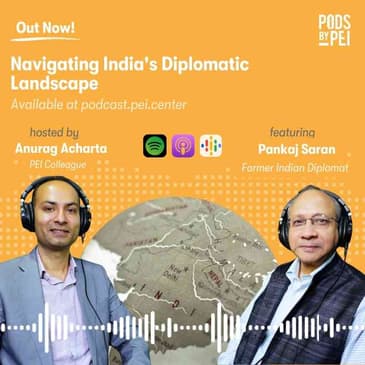
#Ep.087 Pankaj Saran on Navigating India's Diplomatic Landscape
Pankaj Saran on Navigating India's Diplomatic Landscape - Pankaj Saran is a former diplomat. He has served as India’s Ambassador to Russia and India’s High Commissioner to Bangladesh and as Head of the Northern Division in the Ministry of External Affairs dealing with Nepal and Bhutan. He has worked in different capacities with successive Indian Prime Ministers in the Prime Minister’s Office, contributing to decision-making at the highest levels in a diverse range of sectors, including foreign affairs and national security, Pankaj is presently Convenor of NatStrat, a Delhi-based independent Centre for Research on Strategic and Security Issues. He is a Member of the National Security Advisory Board and a Distinguished Fellow of the National Maritime Foundation. Anurag and Pankaj explore the evolution of India’s foreign policy from the perspective of the former diplomat himself. They cover recent historical landmarks from the tectonic shifts in global geopolitics during the Cold War's end to India's strategic maneuvering amidst the complexities of the Indo-US nuclear deal to explore how each shaped India’s foreign policy. With a keen focus on India's contemporary aspirations on the global stage, they explore the significance of forums like BRICS and India's hosting of the G20 summit in shaping its foreign policy priorities. As Pankaj candidly shares his experiences, the conversation also uncovers unique insights into the high-stakes, high-octane lives of diplomats.
If you liked the episode, hear more from us through our free newsletter services, PEI Substack: Of Policies and Politics ( https://policyentre.substack.com/welcome ), and click here ( https://patreon.com/podsbypei ) to support us on Patreon!!
[00:00:00] Namaste and welcome to PODS by PEI. A policy discussion series brought to you by Policy Entrepreneurs Inc.
[00:00:19] I am Progate Krakhi and in today's episode we have PEI colleague Anurag Acharya in conversation
[00:00:25] with former Indian diplomat, Pankassarun on Navigating India's diplomatic landscape and inside
[00:00:31] of view. Pankassarun is a former diplomat he has served as India's ambassador to Russia
[00:00:37] and India's high commissioner to Bangladesh and as the head of the Northern Division in Ministry
[00:00:42] of External Affairs dealing with Nepal and Bhutan. He has worked in different capacities
[00:00:47] with successive Indian Prime Minister in the Prime Minister office contributing to the
[00:00:51] recent making at the highest level in a diverse range of sectors including foreign affairs
[00:00:56] and national security. Pankass is presently a convener of NADSRAD, a Delhi-based independent
[00:01:02] centre for research on strategic and security issues. He is a member of National Security
[00:01:07] Advisory Board and a distinguished fellow of the National Maritime Foundation. Anurag
[00:01:13] and Pankass explored the evolution of India's foreign policy from the perspective of the former
[00:01:17] diplomat himself. They cover recent historical landmarks from the tectonic shift in the
[00:01:22] global geopolitics during the Cold War and to India's strategic maneuver amidst the
[00:01:27] complexity of the Indo-US nuclear deal to explore how each ship India's foreign policy.
[00:01:34] With a keen focus on India's contemporary aspiration on the global stage, they explore the significance
[00:01:39] of forums like bricks and India's hosting of G20 summit in shaping its foreign policy
[00:01:45] priorities. As Pankass candidly shares his experience, the conversation also uncoveres a unique
[00:01:51] insight into the high stake, high octane life of a diplomat. We hope you enjoy the conversation.
[00:01:57] Namaste! I am Anurag Acharya.
[00:02:02] Namaskar! My name is Pankassaran. Thank you.
[00:02:06] Welcome to the conversation Ambassador Saran. Let's start the conversation with your personal
[00:02:11] journey into the foreign service. Why did you decide to join and how was your initial
[00:02:17] journey? Well firstly thank you very much Anurag for hosting me here at your podcast. It's a great
[00:02:23] privilege to be here and talk to you. It's interesting. I mean, I really didn't plan to join
[00:02:30] the foreign service as such. I was very enamored though of the whole world of international diplomacy
[00:02:36] because I happened to live close to the diplomatic and slave-entelli. As a college student,
[00:02:43] I would go there almost every day and I would see those flags flying and those beautiful
[00:02:48] buildings. I realized that there is something about this whole atmosphere which is so appealing.
[00:02:55] And then just the charm and the adventurousism involved of discovering other countries,
[00:03:01] other cultures and also being able to then not only work in the traditional sense but
[00:03:09] also to do some intellectual pursuits and understand other cultures and what makes the
[00:03:16] world the way it is. So these were basically what drove me to the foreign service. I must
[00:03:23] say I had a very romantic view of the world and of the job. I just thought it was an
[00:03:28] extremely cushy and a very privileged job. But I was somehow attracted to the whole job description,
[00:03:34] if I can put it like that because it seemed to me to combine travel, intellectual pursuit,
[00:03:40] analysis, writing, scholarship and also in the process helping your country and bringing
[00:03:50] the world closer to your country. Although as a young college kid, it was not as if one had some
[00:03:58] very fixed notions about national interest which I have today. So it was more of a discovery
[00:04:06] and an adventure. So that's why I think and how I got into this. Luckily we have a very rigorous
[00:04:14] examination and I was fairly casual about it to be honest. And I gave the exam and I always had
[00:04:23] internalized the fact that it's a very difficult exam. And if you get in, it's good. I'll consider
[00:04:30] myself lucky, fortunate. But if I don't, I'll do something else. So it was not as if it was a
[00:04:36] make or break to be honest. Sounds quite fascinating. I mean during your career spanning of four
[00:04:44] decades, you've been assigned several high profile jobs including in Russia and in Bangladesh.
[00:04:51] You've also headed the Ami's and North Division that looks at Nepal and put on. But tell us about your
[00:04:57] personal experience during these assignments and how it shaped your worldview as a diplomat.
[00:05:02] You were just mentioning about how you stepped in to the foreign service, not understanding the entire
[00:05:09] gamut of things that you were up for. But tell us how it actually shaped your worldview as a diplomat.
[00:05:15] Yeah, I realized very early on that the profession of diplomacy and the world of diplomacy
[00:05:25] was a very, very tricky and a very complicated universe. It required a very different and very
[00:05:33] specific skill sets which you had to acquire to be a successful diplomat. And then the question would
[00:05:41] always arise in my mind what is a successful diplomat? Who is a successful diplomat? And what does
[00:05:48] success mean in diplomacy? And I grew as I progressed over the last let's say four decades starting from
[00:05:57] a young diplomat. So as a young diplomat, I would simply observe seniors and how they conducted
[00:06:05] negotiations and not just negotiations even the simple act of how you dress, how you speak,
[00:06:12] how you engage other people. So it starts from the most rudimentary simple tasks and activities
[00:06:22] to the more complicated jobs of negotiating agreements, treaties, etc. So in the initial years,
[00:06:31] I mean my first assignment was Moscow. I began from Moscow. We had to learn Russian.
[00:06:36] So must we quite interpret it? It was I landed. I still can never forget January of 1984.
[00:06:43] We talking 40 years ago and it was minus 25. I didn't even have an overcoat when I landed
[00:06:50] and I remember it was pitch dark and all that we saw was two, three feet of white snow. So it was
[00:06:56] a white city and the language was alien and the whole thing looked in a sense unreal. And the
[00:07:04] question was how do you communicate? How do you find your way to the market to do your basic
[00:07:10] personal affairs. But then as I walked into the embassy for the first time and we had a beautiful
[00:07:16] heritage embassy, it was another world where you know you saw people sitting quietly in their chambers
[00:07:23] going about their business immersed in their papers and their analysis and their study
[00:07:29] and the whole thing looked very intimidating. But then you know things began to improve. I mean
[00:07:34] you started moving around traveling around. And if I can fast forward to when I became a mid-level
[00:07:41] diplomat and of course finally as ambassador to Russia which was my last ambassadorial
[00:07:47] assignment. So I was actually it was quite an emotional journey. The began in Moscow and ended
[00:07:52] in Moscow but it was a different country because I began in the... You must have been a different
[00:07:57] diplomat. Yeah I was you know battle hardened. I don't know whether I was wiser but certainly more
[00:08:02] battle hardened, more bruised, more experienced and before that I was high commissioner to Bangladesh.
[00:08:09] I always tell my friends that I walked into my IR lectures as an idealist and I walked out
[00:08:14] as a thorough realist. I can imagine what it must have been for you. Yeah I mean it's completely
[00:08:21] different when you get into the business of diplomatic affairs. You realize that the
[00:08:28] appearances of let's say comfort and luxury and lifestyle are only that much. Underneath all that
[00:08:39] surface lies a very very intense struggle to defend your country's interests
[00:08:49] and to promote your country's interests. And you are pitted against the best in the business.
[00:08:56] So the battlefield is actually that's what I would call it, is flat, is equal because it's one man
[00:09:05] against another man. And it all depends at the end of the day on individual skills.
[00:09:11] And what makes a negotiation successful or a failure and then when you look back
[00:09:18] you do recall that some things which you did really were successful or you were proud of doing.
[00:09:26] And the second thing of course is you graduate in this business because in the initial stages
[00:09:31] you're the backroom boy, you're not in the camera lights, you are doing the real hard work,
[00:09:36] the speedwork. But as you kind of evolve and grow into the career and move up in the ladder,
[00:09:45] then the cameras begin to look at you. And then you have no one to look back at it's you
[00:09:50] and nothing else. So the responsibility of what you say, what you do, how you act,
[00:09:58] how you craft policy, how you report back to your capital, how you implement directions from
[00:10:07] your capital. These all become very, very critical. But briefly I mean the job description
[00:10:15] of the Indian ambassador to Russia and the Indian high commissioner to Bangladesh were like
[00:10:20] the North Pole and South Pole. Bangladesh was a completely different and I spent seven,
[00:10:26] eight years in that country over two periods. It was a completely different set of challenges.
[00:10:32] We can talk about it. And Moscow was a very, very different set. So you also realize
[00:10:39] how your country is positioned in different capitals of the world. In certain capitals you could be
[00:10:47] a dominant player because of various reasons. Whereas in some capitals, you're just one among many.
[00:10:56] But I found that over a period of time as India grew in stature, as an Indian diplomat,
[00:11:02] you definitely had more overall to play. You were counted more. You had a greater visibility
[00:11:13] and therefore the job became even more challenging and interesting.
[00:11:18] That's quite a fascinating description. And thank you for that personal sharing of experience.
[00:11:23] I'm sure for in service, as per your own country will also be benefiting from that point.
[00:11:29] Now allow me to take the conversation to the year when the coal war ended and probably you were
[00:11:36] also young and new to foreign service. Then after the Soviet disintegration, the global
[00:11:42] political landscape sort of changed and so did India's economic and political worldview,
[00:11:48] especially vis-a-vis a United States and Russia. And professionally you started your career
[00:11:55] in the foreign service during the final years of the coal war and have had a ringside view
[00:12:01] to this tectonic shift in the global and South Asia's regional geopolitics.
[00:12:08] Tell us about the deliberations that led to such a shift in India's foreign policy and what it meant
[00:12:14] for Indian diplomat posted not just yourself but across the world.
[00:12:21] Yeah, no thank you. This is a really interesting question and it brings back many memories for me.
[00:12:27] You know in terms of India's deliberations that went on in India and what it meant for Indian
[00:12:33] diplomats, let me take the first part. To be honest, India was a recipient and kind of a
[00:12:43] rule-taker. We were not a rule-shaper. We were not a country which was actually influencing
[00:12:50] these global events. When I joined the foreign service and my generation, for us the most important
[00:12:57] global capital was Moscow because the most important relationship India had was with the Soviet
[00:13:03] Union and we had the Indo-Soviet Treaty of 1971. That was in some sense a strategic anchor
[00:13:10] for India. So when and this was during the coal war but when the coal war ended,
[00:13:15] it ended abruptly. It ended without a single shortping fired. There was no military conflict.
[00:13:25] It actually ended because of the collapse of the Soviet state, the emergence of Mikhail Gorbachev
[00:13:32] as a general secretary. So for us it was a huge setback strategically speaking because the stability
[00:13:41] and the security that we had taken for granted from the Soviet Union had disappeared overnight.
[00:13:48] So it was a strategic setback and we had to go back to the drawing board to find out what do we do
[00:13:56] because that was the period in which our relationship with the United States and the West
[00:14:01] was very strained. Remember we had just gone through 1971 where the United States and India were
[00:14:08] exactly in the opposite sides of the whole situation. The United States had a military alliance
[00:14:14] and extremely close relationship with Pakistan, China was somewhere in the middle.
[00:14:20] So the deliberations in India essentially related to how do we contain the damage
[00:14:28] and what do we do? So that was one aspect. The second aspect was that at the same time,
[00:14:33] and we were talking now 1991, was the year in which the Indian economy collapsed
[00:14:40] and we were forced to mortgage our gold reserves to the IMF because we had run out of foreign exchange.
[00:14:47] We were in the thick of an economic crisis. And again out of compulsion just as in the case of
[00:14:54] the disintegration of the Soviet Union, we had no choice but to embark on a huge economic
[00:15:01] reforms process, basically to dismantle the license range that we inherited from the British.
[00:15:08] So we had two parallel processes going on in internal crisis and an external crisis.
[00:15:14] So the period of the 90s, the whole decade was a very difficult period. And on top of the economic
[00:15:21] crisis, we had a huge political crisis. In India, we had successive governments coming in for 12
[00:15:27] months, 13 months. So there was a lot of political instability. So all this meant that was the time for
[00:15:33] India to regroup at a global level, lie low, just kind of pick up the pieces and try to rebuild India
[00:15:45] both internally and externally. So for diplomats outside, Indian diplomats who were posted
[00:15:50] outside, we were all busy making sense of what was going on. And that was the time when thinking
[00:15:58] began in India that maybe we needed to have another fresh look at our relationship with the West
[00:16:05] because remember that time when we went to the IMF and to the World Bank, etc. These are all
[00:16:11] institutions controlled by the West. So unless and until you did not have a certain
[00:16:16] relationship with the West, you would not get the kind of help that you needed.
[00:16:21] So that I think began that decade of the 90s saw a recalibration or the beginnings of recalibration
[00:16:30] away from the Soviet Union, away from Moscow towards the West.
[00:16:34] Do you have a personal experience of that time that you can share when all this happened and
[00:16:39] this conversation that you were talking about? Can you share some of your personal experience?
[00:16:43] Yeah, of course I was in the Prime Minister's office for five years. So I saw five different
[00:16:51] Prime Ministers come say for periods of 12 months each, coalition governments, you know it all
[00:16:58] to give credit to the Indian bureaucracy and the Indian institutions. They managed to run the country
[00:17:06] despite these frequent changes. I of course was not in Russia that time, I was back in Delhi
[00:17:17] but we you know we went through a very difficult period away with there were political
[00:17:22] assassinations in India. So everyone, each one of us tried to put in our best to make sure that
[00:17:30] we contributed to strengthening the nation. And there was confusion, I mean I remember I was also
[00:17:38] posted in Washington in the early 90s and again that period was a period in which India was going
[00:17:46] through a huge problems in Punjab because of the Kalistan issue in Kashmir and I was assigned to
[00:17:51] the Congressional hill to the Capitol Hill as part of the embassies outreach to the US Senate and
[00:17:59] the Congress. And I remember as a young diplomat walking the corridors trying to convince and meet
[00:18:07] staffers, young staffers and trying to explain to them what was happening in India because in the
[00:18:14] Congress India was facing a very, very difficult time. There was a huge pressure on India on the
[00:18:21] human rights issues, lot of hostility and so my job was to go and explain to the staffers and
[00:18:30] India was not so visible on the US radar at that time. So to explain to them what India is,
[00:18:36] what was Punjab, what was Kashmir, why to explain what was happening, why it was happening,
[00:18:43] the role of Pakistan, we were basically with our backs to the wall. So every day I'd come back
[00:18:48] from the hill to the embassy, report back to the ambassador and you know we used to have these
[00:18:55] almost strategy sessions every day what to do because every day was a new day was a new challenge
[00:19:02] and a new situation where you would get hit or attacked by one congressman or the other
[00:19:09] and we had very few supporters in the Congress who were ready to stand up and speak for India
[00:19:15] so that I that of course I certainly remember. Yeah, I mean the another significant year for India's
[00:19:21] post-Cold War foreign policy is the year 2005 when India signed a historic civil nuclear agreement
[00:19:29] also known as Indonesia's nuclear deal. There was obviously a context to that deal on the American
[00:19:36] side which had entered into what it calls a war on terror after the 9-11 attack.
[00:19:43] But tell us how did India oppose this deal and how did it contribute to New Delhi's
[00:19:49] now strong relationship with Washington you know compared to you know what you just described
[00:19:53] earlier. Yeah, so I think we can continue from where I left off. I talked to you about the turbulent
[00:19:59] times of the early 90s in the India-US relationship and then you entered what was called the Unipolar
[00:20:05] moment. The Soviet Union had disappeared there was only one single global power which was not very
[00:20:12] friendly to India so in the period leading up to 2005 you also had another development you had
[00:20:20] Vladimir Putin take over as the president of Russia in the year 2000 and that was the beginning
[00:20:28] of the rejuvenation of the Russian nation. But by the time we reached 2005 already as I said because
[00:20:37] of the assistance we got for our economic reforms from the West and also remember there was another
[00:20:44] event which took place which was not just 9-11 which was 2001 but in 1998 India went nuclear
[00:20:54] and when India went nuclear the relationship with the United States broke down. We were put under
[00:21:00] sanctions we were literally it was much worse than the early 19s which I described to you
[00:21:07] but the fact is that the Indian government of the day decided with open eyes to go nuclear.
[00:21:14] So we had a situation where we were complete at loggerheads with the western world including
[00:21:20] Japan, Canada, the United States everyone else and this is a remarkable twist of how global events
[00:21:29] can turn around in such a short time so from this moment to 2005 was a dramatic turn and 2005
[00:21:39] and the events leading up till 2008 when the civil nuclear deal was negotiated it took three years
[00:21:45] negotiated that was the foundational transformation of the India-U.S relationship
[00:21:52] so from adversaries, from suspicious partners, uncomfortable partners we actually moved into a
[00:22:00] very different terrain of being strategic partners and the United States the same country which
[00:22:06] at sanctioned us which was pillering us on human rights and everything else actually
[00:22:14] led the world to lift the nuclear apartheid against India despite our nuclear explosions
[00:22:21] enabled us to lift all the sanctions against us, enabled us to get the technology we needed
[00:22:29] and in a sense brought India back into the mainstream of the nuclear system and access to technology.
[00:22:39] Now of course there are many reasons why this happened but it was a leap of faith for both the
[00:22:46] Indian government under Prime Minister Manhansing and successive US President George W. Bush
[00:22:52] and of course before that Bill Clinton had begun the process.
[00:22:56] So this is the whole saga where you literally challenged yourself but you believed
[00:23:06] I mean there were actors out there, Condoleez Arise, a president on this side,
[00:23:11] Manhansing, Nathwa Singh and all these people who actually believed that you could actually do this
[00:23:19] there was a lot of resistance from within the Indian system, from within the American system
[00:23:25] but the only reason why the deal succeeded and happened was because of the push from the White House
[00:23:33] and the PMO in India because the ministries and the bureaucracies were generally opposed
[00:23:40] and were very uncomfortable so this I think marks the turnaround.
[00:23:45] Now despite its growing global standing India's relationship in its own neighbourhood
[00:23:52] remains quite frosty. A major reason for this from where I see it is due to India's
[00:23:59] boundary disputes with its neighbours particularly with China. Do you feel New Delhi's close partnership
[00:24:05] with the Washington especially through Quad has further complicated its relationship with
[00:24:11] Beijing you talked about the Indo-US nuclear deal and you know right up to the Indo-Pacific strategy
[00:24:18] and Quad. I asked this because in September 2014 India rolled out Red Carpet to Chinese
[00:24:27] President Xi Jinping and signed several MOUs that promised to bring in Chinese investments to
[00:24:33] India. What followed in the next few years we are not Chinese MNCs landing in New Delhi
[00:24:39] but the troops of the two countries clashing in Dockland tri-junction and in Galwan Valley.
[00:24:47] How did it come to this?
[00:24:49] Yes so there are many questions and ideas in your questions which I'd like to unpack a little
[00:24:55] bit one by one if you allow. So firstly I would not agree that India's relations with the
[00:25:01] neighbours is frosty I think we made huge progress in terms of the relationships with our neighbours
[00:25:08] particularly in the last 10 years. Today the level of integration that we have in our subcontinent
[00:25:15] is far higher than it has ever been since let us say 1971 or 1965 so there's been massive progress
[00:25:22] you know you are aware of the energy pipelines the highways the civil flights I mean there's a whole
[00:25:28] world out there which is happening and this integration is for real. So yes there are moments
[00:25:36] where we have tensions with our neighbours but that is to be expected because when two sovereign
[00:25:42] nations interact and are close to each other there would be areas and moments of difficulty
[00:25:49] but we have to get over those because in my view we have no choice but to live together
[00:25:56] for now and forever but we believe that the neighbourhood first policy and I myself actually
[00:26:03] was deeply involved in different neighbours of India and we really believe that we have to have
[00:26:10] a good relationship because that is the kind of starting point so that's on the neighbourhood
[00:26:16] and I think we've done well but I do admit there have been moments including with Nepal which
[00:26:20] have created difficulties. We will talk more about Nepal and neighbourhood later but you know
[00:26:26] I'm talking about the border disputes between India and China. So on China you know look this
[00:26:32] thing goes back to the MacMohan line I mean to the Chinese occupation of Tibet because China was
[00:26:40] never India's neighbour then India's neighbour was Tibet it was only when it became the people's
[00:26:45] republic of China when the communist takeover of Beijing and the integration of Tibet that China
[00:26:52] became a neighbour of India and the MacMohan line actually divided British India from Tibet
[00:26:58] so the boundary issue is not so much a dispute over boundary as a dispute or a difference of
[00:27:06] perceptions of where the boundary lies. So we had the war which China in 1962 and after that
[00:27:16] we've had many discussions with them on the alignment of the line of actual control
[00:27:24] and we've had many mechanisms with China on how to address the boundary question.
[00:27:30] 1988 Prime Minister Rajeev Gandhi visited and that was the first visit of the Prime Minister
[00:27:35] and the compact wars that we will maintain peace and tranquility on the border for which we
[00:27:41] arrived at several agreements which China and the idea was that till you settle the boundary
[00:27:47] we will maintain peace and tranquility and we will continue with the rest of the relationship political
[00:27:52] relationship economic relationship cultural relationship etc as two normal states.
[00:27:59] And that packed held until the turn of the century I think things began to go south after 2013
[00:28:08] especially after 2014 I mentioned how when Prime Minister Narendra Modi came to power
[00:28:15] he rolled out red carpet to Chinese several MOUs were signed and then next couple of years
[00:28:21] you have Dokelam you have Gullwain Valley. Yeah come to that.
[00:28:24] Yeah no but you know I mean look we had a huge issue in 1986 in Sondarong Chhu Valley
[00:28:30] we had a problem in 2013 so it doesn't start from 2014 there were problems with China which predate
[00:28:39] the Modi government the Modi government when it assumed office made all efforts like you have
[00:28:46] mentioned to establish a Modi's vivendi with China. The Prime Minister Modi and his counterparts met
[00:28:54] many many times in Delhi, in China in other capitals to try and so the question I would put it like this
[00:29:03] in my assessment in my opinion China is in many ways responsible for driving India closer to
[00:29:11] the United States. China doesn't view it like this but that is the truth if China were to be able
[00:29:18] as a bigger power, as an aspirant global power be able to conduct a relationship and form a
[00:29:27] relationship with India which is based on accepted principles of international law
[00:29:33] and give respect to India's concerns and to show by its actions not just by words
[00:29:40] that it recognizes India's aspirations as an emerging country in the Indo-Pacific region
[00:29:46] then our relationship would be very different but the Chinese actions have actually been exactly
[00:29:54] the opposite and they have created insecurity in India Delhi in India that has led India's
[00:30:01] that is accelerated India shift towards the United States as I told you India and the United
[00:30:06] States have always historically had very difficult relationships so it was not a natural movement by
[00:30:12] India towards the United States so in 2020 which was the last big kind of standoff
[00:30:21] the Chinese had about 150 or 200,000 troops on the line of actual control we lost 13 soldiers
[00:30:32] that was the biggest and the bloodiest clash on the boundary with China
[00:30:36] that I think was a moment in which China I would say lost India both in terms of public opinion
[00:30:44] and in terms of its foreign policy options so we have to be very clear what was the action
[00:30:50] and what was the reaction the court didn't come before 2020 everything has to be seen in the
[00:30:58] cycle of life the way one action generates another and India has the full right and the
[00:31:10] and the and the it has as a nation it has to protect its interests so it has to find partners
[00:31:18] it has to increase its own national power so I would say that for if you want to look at the
[00:31:25] India China United States triangle it's a complicated triangle a lot of the owners for today's
[00:31:35] situation rest on China China has to return back to the status quo prior to 2020
[00:31:42] it has to adhere to the agreements on peace and tranquility which had violated
[00:31:47] and because of which we've had many rounds of modern negotiations at the official level since
[00:31:53] 2020 so if we if we have a situation where China accepts that they have to return back
[00:32:03] and maintain peace and tranquility and go back to the original arrangements then we can have a
[00:32:09] normal relationship with China well it's a very interesting relationship the political and
[00:32:14] diplomatic side of relationship remains very tensed whereas economically I think the trade between
[00:32:23] India and China keeps on increasing but we'll not talk about that talking about boundary disputes
[00:32:29] boundary disputes I want to talk about how Nepal also has an ongoing boundary disputes with India
[00:32:35] which has also created tensions in the bilateral relationship in the recent years we've had a long
[00:32:42] conversation over it with Ambassador Ranjit Rhe in our podcast back in 2022 so I will not go too
[00:32:48] much into it but let me ask you about India's historical land boundary agreement in 2015 with
[00:32:54] Bangladesh which which ended decades of dispute on the eastern borders you were heavily involved
[00:33:02] in shaping the outcome of that agreement you were in office then you are posted in Bangladesh
[00:33:09] take us through the complex journey of confidence building and negotiations and how two sides
[00:33:15] reach that agreement given the state of affairs between Nepal and India on the boundary disputes
[00:33:22] boundary disputes what lessons could such an agreement hold for Nepal I mean yeah Nuraq this is
[00:33:29] a long story so I'm not going to get into I'll just you know make only a few couple of observations
[00:33:36] number one the success of that land boundary agreement was an outcome of the political will on both sides
[00:33:44] you had an alignment of political leaderships in Dhaka and New Delhi which enabled this to happen
[00:33:50] number two the political leaderships in both capitals or both countries were fully empowered
[00:33:58] they didn't have to look back because in India you had a majority government strong stable government
[00:34:06] similarly in Dhaka you had a strong stable government that was the second thing where you have not
[00:34:12] just the will but you have the capability of addressing difficult issues and number three I think
[00:34:21] there was a enlightened understanding that we were both Bangladesh and India the victims of some other
[00:34:30] people's mistakes we were the outcome of mistakes made by the British and there was no reason for us
[00:34:39] to continue that colonial hangover so the agreement the first agreement again was signed between
[00:34:47] Indira Gandhi and Sheikh Mujeevan 1974 again at the high point of the India Bangladesh relationship
[00:34:53] and that agreement consisted of three parts I won't go into that but guess what that time you had
[00:35:01] again good leadership strong leaderships yet was that enough it wasn't enough for implementation
[00:35:06] you had the first agreement in 74 and then nothing happened for 30 40 years because of
[00:35:15] the fact that both countries went in different directions and then in 2011 finally you actually
[00:35:22] did a survey you had a protocol which defined how you would solve the issue the basic principle
[00:35:29] there were many issues but the most important was the exchange of enclaves so there were these
[00:35:33] pieces of territory inside Bangladesh cut off from the Indian mainland which were Indian territory
[00:35:40] and you had pieces of territory inside India which were actually Bangladesh's territory but cut off
[00:35:45] from Bangladesh so the agreement was it's one of those most unique agreements in diplomatic history
[00:35:52] where both sides agreed that we will not count the area that you lost again we will not go down
[00:35:59] arithmetic or on a piece of paper calculate the square kilometers we will be more human if we will
[00:36:07] be more statesmen like what we will do is whatever enclaves of India that exist in Bangladesh
[00:36:14] Bangladesh can keep them and the sovereignty of those enclaves will be transferred from India to
[00:36:21] Bangladesh we will count them we will add their areas we will add the populations but we will not
[00:36:30] do some balancing similarly the Bangladeshi enclaves in India which a Bangladeshi territory will be
[00:36:38] absorbed into the Indian Union and become Indian territory and secondly it was even even beyond that
[00:36:47] we will not insist on any transfer of population so the populations who are living in those enclaves
[00:36:52] which are actually Indian inside Bangladesh we said we'll give them a choice you want to come back
[00:36:59] to India you're welcome you but you want to continue in Bangladesh because you've been living
[00:37:03] there for 70 years 80 years you're welcome to be Bangladeshi and similarly on this side and guess what
[00:37:09] when we finally actually exchange the enclaves with the sign of a paper with the with the with that
[00:37:16] agreement on one fine day on the appointed day all the Indian enclaves in Bangladesh became
[00:37:22] Bangladeshi territory all the Bangladeshi enclaves in India became Bung Indian territory all there was
[00:37:28] no transfer of population because the people said we are happy where we are so till yesterday an
[00:37:33] Indian citizen became a Bangladeshi citizen and similarly on the Indian side he was Bangladeshi
[00:37:40] Bikipa came Indian and yes there was some you know loss and gain but the remarkable thing was
[00:37:47] that it happened peacefully I was personally involved in the exchange of people in the weaver worried
[00:37:55] will there be migration are we going to see another replay of 1947 nothing happened nothing so today
[00:38:04] it has been so good for the poorest of the poor because that's what they were small villagers landless
[00:38:11] labor the most deprived voiceless and that was the beauty of this agreement it was a fantastic
[00:38:19] example of how two countries neighboring countries with the most complicated you know a simple thing in
[00:38:25] a border is okay you know you hold my territory I would but what about an enclave which is like 100
[00:38:30] kilometers away from the border and imagine those people who were living in that enclave and there
[00:38:36] were thousand in some enclairs there were thousands of them in some they were maybe 70 80 thousand
[00:38:40] in some there were maybe a few hundred though these people were stateless so I think it was a great
[00:38:47] example and it happened as I said because of the domestic situations and the alignment of stars
[00:38:54] and Manman Singh's government tried to do it I was part of that effort also it failed
[00:39:01] it was the Modi government which succeeded because he came in he came into office in 2014
[00:39:06] he did it in 2015 in one year and this was supposed to be a right wing anti-Muslim kind of government
[00:39:14] this that but he understood the strategic importance and the political importance and after doing
[00:39:21] it he visited Bangladesh I was there as Prime Minister of India and went to say hugely successful
[00:39:27] visit he was greeted with open arms it was a celebration and people looked at him and said you have
[00:39:34] solved what could not be solved since 1947 it's quite a fascinating description and most importantly
[00:39:43] it resolved decades of dispute between the two countries and now let's move the conversation from
[00:39:50] India's challenges to India's achievements despite difficulties in the neighborhood India's global
[00:39:56] outreach in the last decade has increased significantly what has been the hallmark of Indian foreign
[00:40:03] policy pursued in the last decade especially vis-à-vis US Russia and West in general yeah I think
[00:40:13] hallmark if you were to ask me of the policy has been to be more ambitious to be more risk-taking
[00:40:23] and to have a vision for the future so whether you look at our relationship with the United States
[00:40:32] or with Russia or in the early days even with China or with other countries we significantly
[00:40:40] accelerated the pace and the content of each of these relationships we shed the inhibitions
[00:40:50] or the hesitations that were marking our policies in the past so we decided and we chose to see
[00:41:00] what is it that India needed from each of these partners and once you have arrived at that kind of
[00:41:07] assessment or a determination then the view was go for it because time is not on your side
[00:41:15] because if you want to transform the country you have to have these kind of very very intense
[00:41:22] relationships so as I we just discussed the US relationship a little bit on the Russia relationship
[00:41:30] the Russia relationship under Putin from 2014 also proceeded at a fair pace we again there were frequent
[00:41:39] meetings annual summits between Prime Minister Modi and President Putin there was healthy interaction
[00:41:46] in all areas including military etc similarly with Europe we move forward significantly
[00:41:54] but a lot of this was possible because as I said again of the political stability inside India
[00:42:03] and the very authoritative and kind of stable leadership provided by the Prime Minister himself
[00:42:11] I mean remember this was someone who had been denied a US visa when he took office
[00:42:17] so you had a situation where the Indian Prime Minister actually had been denied a visa to enter
[00:42:23] the United States and so the first visit overseas that he made was to the United States so all
[00:42:30] things have happened we have seen a lot of things happen unimaginable so this was the hallmark I would
[00:42:37] say where national interest dominated personal interest and there was this belief that India can
[00:42:45] and must also contribute to international institutions to international global issues on climate change
[00:42:54] for example India was always considered a naysayer that an obstructionist someone who would always say no
[00:43:01] but in the last 10 years we have shifted from being a naysayer to being a solution provider
[00:43:07] on climate and on global warming and we have let the way in terms of green transition
[00:43:13] in terms of renewable energies etc so there is a there is a big fundamental shift
[00:43:19] similarly on the civilizational personality of India there is a greater confidence self-confidence
[00:43:27] that India has something to put on the table and we will put it there is also when it comes to
[00:43:34] say challenges security challenges that we pose that we face an equal candor that you know India
[00:43:42] will defend its security interests from wherever they are threatened so I would say all in all
[00:43:50] this was the way in which foreign policy has been conducted and obviously it's been successful
[00:43:55] and therefore you know there is a feeling in New Delhi that whatever you've done has actually worked
[00:44:03] for India. I'm also looking at how India has interestingly sort of balanced between its relationship
[00:44:11] with the United States and Russia at a time when there is a kind of you know proxy war between
[00:44:17] the West and the Russia especially due to ongoing Ukraine war so you know how would you look
[00:44:23] at India's position in this very complicated landscape. Yeah it was difficult I mean to be honest
[00:44:29] because it remains challenging. It remains challenging and it tested India's diplomatic skills,
[00:44:34] it tested India's political leadership because we had friendships and good relations with both sides
[00:44:42] with Russia, with the United States, with Europe. We were friends with all of them
[00:44:47] and there's huge stakes involved in each of these friendships so the question was what does India do
[00:44:54] and I think what India chose to do was to avoid getting sucked into this proxy war through its
[00:45:02] diplomatic statements and other things and we advocated a return to negotiation and diplomacy
[00:45:09] because the memories of the Cold War still remain but at that time we were much less powerful,
[00:45:15] we were more vulnerable. This time around after 60 years we are most self-confidence so we said listen
[00:45:25] you have to solve this peacefully on the negotiating table not in the battlefield. We did not condemn
[00:45:32] any party, we did not condemn Russia. The Prime Minister announced publicly this is not an error of war
[00:45:40] and we have maintained channels with all sides of this conflict in terms of high level contacts
[00:45:49] in terms of hearing the concerns from both sides and we believe this is the optimal path for India.
[00:45:59] Of course it comes with a price. There were people on the western side in the United States and Europe
[00:46:06] who were not happy with the Indian position and there were similarly people on the Russian side
[00:46:11] who felt India should be more supportive of Russia but this is a conscious decision taken and I
[00:46:17] think it is a continuum of the larger strategic perspective that India kind of brings to bear
[00:46:28] global issues and on the international system.
[00:46:33] Now one of the major agenda India has been raising at the global summits and gathering of
[00:46:39] world leaders in the recent years has been the issue of exclusion of global south in the
[00:46:46] United Nations Security Council. In 2006 it joined Russia, China and Brazil with South Africa
[00:46:54] joined later in 2010 to create bricks and challenge the established power of the west,
[00:47:02] the G7 in shaping global agendas. How significant has bricks been to further India's own ambitions
[00:47:10] to take the global center stage? Yeah so again I mean on the Security Council and bricks I think
[00:47:16] these are two separate issues. On the Security Council India's views are very well known. They've
[00:47:22] been repeated multiple times in multiple forums. We believe that the current Security Council
[00:47:29] is an agronistic, it is a creature of something that happened after 1945 as a foreign minister
[00:47:40] Dr. Jessica Roten has recent book Why Bharat Matters. This is a classic example of freezing the moment.
[00:47:47] You took a moment in the march of human history and you decided that these five will be
[00:47:56] anointed as the permanent members of a small body which is mandated to preserve international
[00:48:02] peace and security. Clearly that body has failed to discharge any worthwhile function
[00:48:09] and secondly it represents nobody. It does not represent the vast majority of mankind
[00:48:17] and India as the most populous country in the world and a growing economy has to have a place
[00:48:24] in such a forum which represents the United Nations mandate and charter to govern international
[00:48:33] peace and security. So that position remains. Now the question is it has not happened yet
[00:48:39] India's membership of the Security Council and people in India are very realistic, they don't
[00:48:44] expect it to happen in the near future but the point is that does not take away from the Indian
[00:48:51] position that the Security Council is defunct. It has not been successful recently in Ukraine
[00:48:58] nor in Gaza. It has not been successful in any venture at all. Now on the BRICS issue
[00:49:06] this is very much part of India's own image of itself that it is not a it is not a lucky of the
[00:49:14] West. It is an old civilization 5,000 years old. It brings its own characteristics to bear
[00:49:22] and its own mindset and its own perspectives on the global order. And Russia, China, South Africa
[00:49:32] are all big powers in their own regions. So the BRICS grouping was actually initially set up
[00:49:40] when it began with an economic agenda largely not a political agenda and in BRICS
[00:49:46] while Russia and China were permanent members and China of course opposes any expansion
[00:49:51] and blocks India's membership. Both South Africa and India were demanders, I mean both of us said
[00:49:59] including Brazil for example that you know it is high time that you listen to the rest of the world
[00:50:06] and they have to have a seat inside and a representation. And this issue came up most recently
[00:50:13] in the context of what India called the global south. The global south is a metaphor for those countries
[00:50:21] who developing and somewhat dispossessed from the international system. So Brazil, South Africa,
[00:50:29] India were on one side who want change whereas Russia and China are on the other side inside
[00:50:37] the Security Council. So I think India is interacting with the BRICS membership and the grouping.
[00:50:44] We participate, we try to make use of the grouping in ways that can help India, let's say for example
[00:50:53] in the new development bank India is one of the largest beneficiaries of their loans and grants.
[00:50:59] We also then can talk freely about the deficiencies of the current global order which was actually a
[00:51:07] western lead and a western created order. So we are able to talk about all these things.
[00:51:12] So the Indian footprint if I can use that word on global issues has expanded because of BRICS
[00:51:22] and BRICS has led and enabled India to talk about different issues without fear of favor.
[00:51:32] Now continuing on the conversation about the global south leadership, India also hosted the 2023
[00:51:39] G20 summit in New Delhi with an ambition of what Indian external affairs minister
[00:51:46] as Jaisankar has framed as preparing India for the world and preparing the world for India.
[00:51:52] Where do you think India is headed after the G20 summit especially in terms of its own foreign
[00:51:57] policy priorities on economy and security? Yeah so I think the G20 of 2023 was held under very
[00:52:07] very difficult circumstances because of the Ukraine conflict and the world was divided down the middle
[00:52:13] between the west and the rest, between the G7 and the G20 and the political standoff
[00:52:20] between Russia and the west was the worst it has ever been since the end of the Cold War
[00:52:26] or it was it was worst it has been since the Cold War. So the split vertical split in the globe
[00:52:35] was visible during the entire year of 2023 when India was chairing the G20. So it was a very
[00:52:44] very challenging moment for Indian diplomacy because you had two three choices either
[00:52:51] you to promote the G20 as a grouping of countries which was responsible for global economic and trade
[00:53:00] and financial issues. So if you failed the G20 would simply kind of break up or become a toothless
[00:53:09] body or it would become a victim of these political divisions that was a real danger. So Indian
[00:53:17] diplomacy led by the prime minister exerted every sinew in its muscle to ensure that it brought all
[00:53:26] these two sides together and finally it did succeed. It had a communique, it had a consensus document
[00:53:34] and finally the G20 came up with an agenda for the future. So this is given a lot of confidence
[00:53:41] to India because if India could manage this it means that the west allowed this to happen
[00:53:51] and it also means that Russia and China also allowed this to happen. So in a sense you can argue
[00:53:58] that all of them actually gave India the success because if one of these parties had decided
[00:54:05] to play the spoiler the India would not have been able to show the success it did. So it is interesting
[00:54:14] how each of these powers and parts of the multi polar system enabled India to show this success.
[00:54:22] So that confidence which India has got again has given it the feeling that what it is doing is right
[00:54:31] you know nothing succeeds like success. So today what India, the second thing which India brought to
[00:54:37] the G20 when you talk about the future and the lessons is that India was able to put things on
[00:54:44] the table which it could not do in the past. And what was that? That was to exhibit and showcase
[00:54:54] its own successes in its own economic and domestic transformation, things like digital economy,
[00:55:00] digital public infrastructure, green transition and many many other approaches that India has
[00:55:06] successfully implemented within India. It also was able to talk about the global south and reflect
[00:55:14] the global south's positions on so many issues. So I think for the future in a post 2023 G20 situation
[00:55:23] you will find India being more active, more visible on global issues in each of these relationships
[00:55:31] and leveraging its successes at home to contribute to global good and global stability.
[00:55:41] We've had a fascinating conversation so far with regards to India's foreign policy pursuit
[00:55:47] over the past decade and its future ambitions. What does India's increased global standing mean
[00:55:53] for South Asia region especially with regards to its neighborhood for first policy?
[00:55:58] Yeah, that's a great question. I mean look it is a given that for any country to be able to pursue
[00:56:08] its global emissions it actually has to have good relations with its neighbors and what I can say
[00:56:17] is that if India grows fast in a balanced manner in an atmosphere of stability within a democratic
[00:56:28] framework all this will contribute and will contribute to making a better neighborhood.
[00:56:38] It will open opportunities for the smaller neighbors to benefit from and to participate in this
[00:56:46] growth story. If I put it another way round if you had a situation where India was not growing
[00:56:54] was rife with internal disturbances, was unstable or was a stagnant economy faced with
[00:57:02] myriad problems we would all have suffered. So it is in the interest of the region
[00:57:08] that there is a growth pole that there is an anchor of stability in the region.
[00:57:14] So I am convinced that an India which grows in a healthy fashion, in a sustainable fashion
[00:57:23] and in an inclusive fashion can actually lift to use a Chinese metaphor all the smaller
[00:57:32] boats around it in the ocean. That's what the Chinese say about their neighbors and I think
[00:57:38] it applies equally to India's neighbors that when the waves are rising the small boats can also rise
[00:57:44] along with the wave and that's the way we see it. The fundamental approach of the neighborhood first
[00:57:52] policy is prosper thy neighbor not beggar thy neighbor and to respect sovereignty's interests
[00:58:02] allow neighbors the space they need to pursue their national interests as they see fit
[00:58:09] and collectively grow and find the mechanisms, the creativities. I would say for example our
[00:58:16] relations with Bangladesh today and for the last 10 years or more the kind of things that have
[00:58:22] happened would have been unthinkable 15 years ago. There is literally a revolution underway
[00:58:29] in the kind of connectivities and projects and things that Indian-Mangalites have been able to do.
[00:58:35] So there are good examples but I would also admit there are bad examples
[00:58:42] but on the whole I would say if India succeeds on the global stage as an emerging force for global
[00:58:51] good that will definitely have positive externalities within the region.
[00:58:59] Now despite what you just claimed globally we are also witnessing smaller states struggling to
[00:59:04] manage competing ambitions between big powers including the United States and China.
[00:59:09] Now in South Asia we are already seeing this translate into domestic power political polarization.
[00:59:16] In countries like Nepal and Sri Lanka we have seen that over MCC and recently also in Maldiivs.
[00:59:24] As a resident power on the rise what could India do to ensure such a competition does not have a
[00:59:31] spillover effect to destabilize the region or is India's preoccupation with its own interest vis-a-vis
[00:59:38] Indo-Pacific and Quad or its differences against China and Pakistan too important to be distracted
[00:59:45] about what is happening in small neighboring states.
[00:59:48] No not at all I mean this whole Indo-Pacific Quad etc is happening at a different level.
[00:59:54] I mean that has got nothing to do with how India is approaching the neighborhood.
[00:59:59] I mean the whole of South Asia is very much part of the Indo-Pacific region so that I think
[01:00:05] has nothing to do with how India's yes India definitely would not like power play and contestation
[01:00:12] to disrupt the normal flow of relationships in this region.
[01:00:19] We do not want disruptive forces or disruptive policies here.
[01:00:24] We respect small states, we respect their choices and we respect their autonomy.
[01:00:31] After all all these are three things which India itself has canvassed loudly on the global stage.
[01:00:38] So when it comes to the smaller nations in the South Asian region absolutely we stand by all
[01:00:43] these principles. Therefore it is important for major powers whether it's the United States or China
[01:00:50] or anyone else to respect and give the same respect to these same principles which India has prepared
[01:00:57] to give and what India is saying is that we don't live in a vacuum, we live in a real world and
[01:01:04] that real world means real geography, real history, real civilizational connect, real cultural bonds.
[01:01:14] Any activity or power or force which seeks to disrupt and rupture any of these attributes
[01:01:26] which we have inherited over the last thousands of years is going to create more problems than do
[01:01:33] any good and we have every right therefore to question the motives and the intent behind such activities.
[01:01:41] We do not want any adversarial or inimical power to come to the region to create disruptions
[01:01:48] but at the same time we respect the decisions of these small nations and we will not force
[01:01:55] any of them to make choices which are unviable or unrealistic.
[01:02:00] Whether you are Nepal or your India or your Bhutan we have to remember that every nation
[01:02:08] till as long as we agree that the nation state is a peace on the geostrategic is an entity
[01:02:18] recognized by law international law has the right and has security concerns and has the right
[01:02:26] to protect those security concerns. So it doesn't mean that large states do not have security concerns
[01:02:34] or interests and if you have to live together it is important that all of us big and small
[01:02:42] live in this compact where we respect each other's concerns and we promote each other's happiness
[01:02:51] and stability. I would have loved to pick your brain on some of these issues but I am afraid we've
[01:02:57] run out of our allotted studio time thank you for this open and candidate conversation Ambassador
[01:03:02] Saran. Thank you so much Anurag, pleasure to be with you thank you so much.
[01:03:08] Thanks for listening to Pots by PEI I hope you enjoyed Anurag's conversation with Pankasharan
[01:03:14] on navigating India's diplomatic landscape and inside of you. Today's episode was produced
[01:03:19] by Nyejandri with support of Kushi Hang with a subcota and me Pragerikaikhi. The episode was
[01:03:24] recorded at PEI studio and was edited by with a subcota. Our theme music is courtesy of Rohit Shakir
[01:03:31] from Zindabad. If you liked today's episode please subscribe to our podcast also please do us
[01:03:36] a favor by sharing us on social media and leave a review on Spotify, Apple Podcast, Google
[01:03:41] Podcast or wherever you listen to the show. For PEI's video related content please search for policy
[01:03:46] entrepreneurs on YouTube to catch the latest from us on Nepal's policy and politics. Peace follow us
[01:03:52] on Twitter at tweet to PEI that's tweet followed by the number two and PEI and on Facebook at policy
[01:03:59] entrepreneurs ink you can also visit PI dot center to learn more about us thanks once again
[01:04:05] from me Pragerikaikhi and we will see you soon in our next episode.