
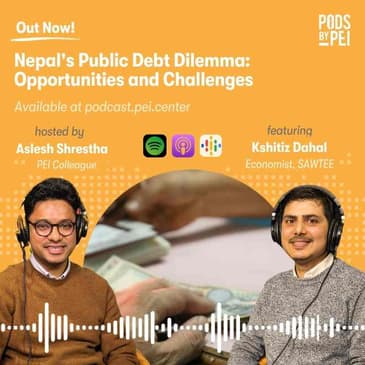
Kshitiz Dahal on Nepal's Public Debt Dilemma: Opportunities and Challenges | PODS by PEI
Ep#089
Kshitiz Dahal is an economist at South Asia Watch on Trade, Economics and Environment with key interests in international trade, development economics, and econometrics. He has worked extensively in Nepal’s international trade, trade in digital services, migration and remittances, Nepal’s industrial policy, and public debt. He has contributed to the research initiatives of international organizations, including the Asian Development Bank, United Nations Economic and Social Commission for Asia and the Pacific and Organisation for Economic Co-operation and Development.
Aslesh and Kshitiz discuss Nepal’s public debt, exploring its origins, implications, and current scenario. Beginning with an examination of the concept of public debt and historical examples worldwide, they unravel the rising concerns surrounding Nepal's per capita debt. Through an analysis of various indicators and drivers behind the recent surge in public debt, they navigate the intricate landscape of debt financing and its repercussions on the Nepali economy and society. From understanding key lenders to dissecting the explicit and implicit costs associated with debt servicing, we shed light on the multifaceted nature of this economic phenomenon.
If you liked the episode, hear more from us through our free newsletter services, PEI Substack: Of Policies and Politics, and click here to support us on Patreon!!
[00:00:00] Namaste and welcome to PODS by PEI, a policy discussion series brought to you by Policy Entrepreneurs Inc.
[00:00:20] I am Khushi Hang and in today's episode PEI colleague,
[00:00:24] Ashleesh Shrestha is in conversation with economist Chitiz Dahal on Nepal's public debt dilemma, opportunities and challenges.
[00:00:31] Chitiz is an economist at South Asia Watch on trade, economics and environment with key interests in international trade, development economics and econometrics.
[00:00:43] Ashleesh and Chitiz discuss Nepal's public debt, exploring its origins, implications and current scenario.
[00:00:50] Beginning with an examination of the concept of public debt itself and historical examples worldwide, they unravel the rising concerns surrounding Nepal's per capita debt.
[00:01:00] Through an analysis of various indicators and drivers behind the recent surge in public debt, they navigate the intricate landscape of debt financing and its repercussions on the Nepali economy and society.
[00:01:12] From understanding key lenders to dissecting the explicit and implicit costs associated with debt servicing, they shed light on the multifaceted nature of this economic phenomenon.
[00:01:22] We hope you enjoy the conversation.
[00:01:26] Namaste, I am Ashleesh Shrestha.
[00:01:28] Namaste, I am Chitiz Dahal.
[00:01:30] Welcome Chitiz to PODS by PEI, we are very glad to have you here.
[00:01:34] Thank you very much Ashleesh, I really like the environment here, very warm and cozy studio.
[00:01:39] So what are your current engagements which major areas of interest are you researching on?
[00:01:45] So as I said we do research on various economic themes. Right now we just finished a research on the state of public debt in Nepal, which is the topic of today.
[00:01:57] And we are also engaged in research around various related themes such as the development finance assessment of Nepal.
[00:02:05] And we do a lot of studies about the international trade of Nepal, so basically I'm engaged in those kind of stuff right now.
[00:02:12] Right, you pointed out today's discussion will be on Nepal's public debt scenario but before going into the Nepalese context, would you like to introduce the concept of public debt?
[00:02:23] Why and how do governments access public debt? Can you slightly trace it in economic history when public debt generally started or states generally started to access debts from sources beyond their budget?
[00:02:41] And if there are any interesting examples, you can also list them.
[00:02:47] Thanks Ashleesh, I think that's a great place to start our podcast with. Let's start with the idea of public debt.
[00:02:54] We know that government assumes various expenditure responsibilities. For instance government spends on various areas like education, health, social security, defense, infrastructure building like road building and other infrastructure.
[00:03:13] And the government also has the authority to raise taxes and other revenues. And they also receive grants from abroad, so all this makes up the revenue of the government.
[00:03:27] So the government has expenditure responsibilities and the government has revenue collection.
[00:03:33] So in some cases the revenue collection is used to finance government expenditure but it is sometimes the case that the revenue that government raises is not adequate to fund government expenditure.
[00:03:49] So in those cases the government borrows funds to finance its resource gap.
[00:03:56] So for instance, in a year if the government borrows money to finance its resource gap that will be called the fiscal deficit of that particular year which is equivalent to the public debt that the country accumulates in that particular year.
[00:04:14] And when this deficit adds up that is the public debt stuck of the country.
[00:04:19] Now regarding the next question about how do government access these funds, the government basically access these funds through borrowing money from the public.
[00:04:30] So they issue what is known as bonds. It is basically government going up to the public and requesting a portion of their savings in return for interest rate or discount rate.
[00:04:46] So when the bond is used in the context of mobilizing domestic savings it is the domestic bonds.
[00:04:54] But sometimes the government also issue bonds in foreign currencies and these are known as international sovereign bonds.
[00:05:01] And in the case of countries like Nepal we also borrow from other bilateral sources from other countries and we also borrow from the multilateral sources like the Asian Development Bank and the old bank.
[00:05:18] So all of these constitute the public debt of the country.
[00:05:26] And now on the history of public debt I think it goes a long way back.
[00:05:32] The United States has had public debt since its inception.
[00:05:36] I was reading somewhere that during its revolutionary war it incurred a debt of around $75 million borrowed from domestic investors and also from the French government to buy war materials.
[00:05:52] And I also read an article by Paul Krugman which says that the United Kingdom has been incurring debt.
[00:06:00] It has not been debt free since at least 1692.
[00:06:04] So what I'm trying to hint at is public debt is not always bad.
[00:06:08] The governments also use public debt to enhance growth and welfare.
[00:06:13] We'll come to that portion later on.
[00:06:17] But before that I would like you to clarify another concept, primarily the indicators of debt.
[00:06:23] So you already mentioned about the total debt stock of a country but beyond that we have another important indicator which is per capita debt.
[00:06:33] And in general for listeners who do not follow these kind of indicators in a regular manner, how should they interpret this indicator?
[00:06:44] Yes you are right Asles. The per capita debt is an indicator that I have seen thrown around a lot in Nepal's media discussions.
[00:06:54] Strictly in the sense of economic analysis I don't think per capita debt is a very useful indicator because it does not indicate how big or how small the debt is related to the economic output of the country.
[00:07:08] Furthermore the indicator may also be somewhat misleading.
[00:07:14] So I have met some people who think that the public debt, the per capita debt, the people may be compelled to go into their bank accounts and pay off the debt to get rid of the public debt which is not true.
[00:07:31] And the name of the indicator it makes it seems like it's a debt owed by the public but in fact it is a debt owed by the government to the public so it could be somewhat misleading.
[00:07:44] And there are various other useful indicators that provide a better overview of the debt situation.
[00:07:52] I think there are other indicators right one of them most popularly used maybe is debt to GDP ratio. What other indicators can be used to understand the context of debt in a country?
[00:08:04] Thanks Asli that's a great question. So I think it may be practical to list these debt indicators into two broad pillars.
[00:08:16] Whenever we use debt indicator it might be useful to first assess the magnitude of the debt. So how we do it? We use the indicators which provides indication as to how big the public debt is in relation to the economic activity or other economic features of the country.
[00:08:36] For instance as you pointed out debt to GDP does that it points out how big the debt is in relative to the total economic output of the country. That's why it's one of the mostly used indicator and it also allows for cross-country comparison among different countries.
[00:08:55] And in that category another indicator is public debt to revenue ratio expressed as public debt as a percent of revenue indicates the capacity of the government to fund its debt through its revenue collection.
[00:09:13] And the other category of public debt indicator is what may be called the debt financing indicators. These could also be called as debt sustainability indicators because what debt sustainability boils down to is the ability of country to comfortably service its debt.
[00:09:35] And some of the indicators used in this category are the common indicators like debt to export, debt to revenue, debt servicing to GDP, interest attracted by public debt to GDP and many other indicators.
[00:09:53] So differentiate between domestic debt and external debt because sometimes they have different interest rates and they have different conditions.
[00:10:05] So we also try to look into how vulnerable or how sustainable the stock of external debt is. So we also use the indicators we talked about previously but focusing solely on external debt.
[00:10:21] So indicators like external debt to GDP, external debt servicing to GDP, external debt servicing to revenue, external debt service to exports because in most of the countries exports is what earns foreign currency to finance this deficit.
[00:10:39] These are the commonly used indicators to assess the debt state of the country.
[00:10:45] You did point out about debt sustainability. I have a question on that but before that let's talk about the Nepali context of public debt. In the recent decade public debt has been a very widely discussed topic in Nepal specifically.
[00:11:00] Maybe discuss about when public debt started in Nepal and how has it transitioned.
[00:11:09] Nepal officially embarked on its journey of issuing bonds and getting foreign loans through an act which was endorsed in I think 1960 somewhere in the vicinity of 1960 when it endorsed its first public debt act which was called the Rastriya Reed Ein 2017.
[00:11:38] So I think that paved the way for the collection of public debt for Nepal and I had read in a journal paper that Nepal started collecting domestic debt since 1962.
[00:11:54] So which is a couple of years after the promulgation of that act and foreign loans since 1993 and Nepal's first creditors of foreign loans where the USSR and the United Kingdom.
[00:12:08] And we have come a long way from that now. So if we look at the history of Nepal's public debt accumulation we see that there was a major spike in public debt around the 80s and 90s and then we saw a sudden downturn and then we have seen another rapid debt accumulation in the last decade or so.
[00:12:35] Yeah as you mentioned the debt accumulation has been quite rapid. The total debt has reached 2.38 trillion in last fiscal quarter which is 44% of our GDP and to add to that in the last five years our public debt has increased by around 1.3 trillion.
[00:12:58] Nepali rupees right and if you go further before the 2015 earthquake our public debt was only 540 billion Nepali rupees right. So why has the debt grown so rapidly what are the major structural issues or what are the major projects that have led to Nepali government accumulating so much debt in so short time.
[00:13:24] So first we need to note there have been two big crisis faced by Nepal in this period of rapid public debt accumulation. So firstly we had a devastating earthquake in 2015 necessitated huge amount of public expenditure for the reconstruction and recovery purposes.
[00:13:51] So that necessitated government borrowing to finance these expenditures and as we all know we also witnessed the devastating pandemic in the form of COVID-19 which caused huge losses of lives and health which required massive form of government response in the form of fiscal stimulus in the form of consensual loan.
[00:14:21] So that means we had to keep business afloat in the form of subsidized vaccines in the form of subsidized healthcare. These are instances where government had to respond and it responded the public debt accumulation through these expenditure is justified but they don't tell the whole story.
[00:14:40] So that's one of the other structural factors that have also contributed to our rapid accumulation of public debt. I would like to briefly discuss upon them. So the first one is somewhat of a paradox after the promulgation of our new constitution after the elections when we developed our current development plan the 15th
[00:15:03] plan there was a lot of aspiration from the people so we had a very ambitious plan laid out for instance the GDP growth target was set around 10.1% annual GDP growth target and to achieve these the plan in this is that a significant portion of that would be achieved through increasing government expenditure
[00:15:31] somewhere like 44% of GDP and the political parties were also in a lot of pressure to deliver since people had a lot of aspirations after suffering through the long period of insurgency after suffering through the devastating earthquake.
[00:15:49] People also had huge aspirations with the government and as we know that the development plan also gives the basis for formulating the annual budget. So what happened was each government after the election they presented a very inflated budget and the expenditure allocated was also huge.
[00:16:12] Having government expenditure for growth is not bad but at the same time our public expenditure institutions had many issues. We had issues like project selection we had issues of issues such as we couldn't finish projects in time
[00:16:31] we had many wasteful expenditure and then the capital expenditure which is the productive expenditure is usually way short of the target so that contributed to increased expenditure but without the necessary returns needed to justify these massive expenditure.
[00:16:52] So the next thing I want to discuss is how increased expenditure also coincides with our implementation of federalism. So there have been some flaws in the implementation of federalism which has likely prevented the results we had expected from the new form of governance.
[00:17:13] For instance the institutions in sub-national governments lack capacity to make laws, lack capacity to spend properly and they have very small own source revenue sources most of these sub-national governments.
[00:17:31] And the other issue is that while the constitution provides the sub-national governments with exclusive and concurrent powers and authorities still in many areas it is not clear what specific powers these sub-national governments have.
[00:17:49] So all these have contributed to sub-optimal implementation of federalism the result being the rise in recurrent expenditure without the expected return.
[00:18:00] And I want to talk about how rise in social security expenditure has also been contributing to our increased expenditure which contributes to public data accumulation.
[00:18:12] So if we look at the data in fiscal year 2015-16 our total social security expenditure was somewhere in the vicinity of Nipalese rupees 50 billion which has now gone up somewhat close to 250 billion rupees.
[00:18:30] So that's a huge rise and huge portion of these social security expenditure is in the form of social security.
[00:18:37] So there has been a huge rise in the social allowances and there is nothing wrong with maintaining certain level of social welfare but what is problematic is that these social allowances are also criticized for having electoral motivations.
[00:18:56] There have been media accounts of these.
[00:18:58] There have been other debates that the political parties have often used these allowances as tool to gather votes.
[00:19:06] For instance in a run-up to the recent election if you look at the manifestos of major political parties, both of the major political parties they talk about making the old days pension more generous by reducing the qualification as or by increasing the size of the transfer.
[00:19:25] So when the social security allowances are used for political purposes then that risks increasing the expenditure haphazardly and this has also increased our government expenditure and added to our public stock.
[00:19:44] And then the next thing I want to talk about is how the changing official development assistance landscape has also contributed to our public debt accumulation.
[00:19:57] So if we look into our official development assistance data what we see is until fiscal year 2017-18 grants outspaced loans in our official development assistance receipts.
[00:20:13] In its peak in 2013-14 I think grants composed about 68% of total official development assistance receipts compared to the rest for the loans and technical assistance.
[00:20:26] But after the loans exceeded the grants in fiscal year 2017-18, loans constitute a predominant share of our official development assistance receipts.
[00:20:38] Loans constitute roughly about 70% of our official development assistance receipts with grants occupying around 20% and the rest being the technical assistance.
[00:20:52] So this changing official development assistance landscape where we rely more on loans has also contributed to the accumulation of public debt.
[00:21:04] I would also like to talk about how our weak institutional structure also contributes to the increased public debt accumulation.
[00:21:14] For instance we have major institutional issues such as weakness in project selection.
[00:21:22] There are major issues of project cost overruns, time overruns and we also have institutional issues in realizing the
[00:21:38] the concessional foreign assistance that is usually targeted in the start of the fiscal year.
[00:21:45] For instance we get only about 50% of foreign assistance than what was targeted in the budget.
[00:21:53] So institutional issues such as inability to fulfill the procurement and other standards, inability to conduct timely agreements
[00:22:03] and other issues contribute to this scenario. We have a serious issue in mobilizing capital expenditure.
[00:22:11] They are usually way sort of their targeted amount and even the quality is low because mostly the capital expenditure is spent only towards the end of the fiscal year
[00:22:24] and the quality suffers. These institutional issues have also contributed to increased expenditure but a low return on these expenditures.
[00:22:33] And lastly while our revenue structure looks very superior on the surface we have one of the highest revenue to GDP ratio if you compare it to other peer countries.
[00:22:47] However it hides an unsustainable base. Our revenue structure, our taxation structure is heavily dependent on imports.
[00:22:55] Around 40 to 50% of our total tax receipts are collected through taxes and on imports.
[00:23:04] And even in the inland taxes and structure only a quarter of our inland tax receipts is obtained through income taxes and the rest is through indirect taxation.
[00:23:17] So these kind of revenue structure sometimes has adverse impact on the growth prospects.
[00:23:24] And there is ample scope for expansion of tax space. So this narrow revenue band has also contributed to the public debt issue.
[00:23:35] There was a very comprehensive answers and I think the following questions will be based on the points you've made out in this answer.
[00:23:42] Could you maybe break down the composition of public debt that Nepal currently has in terms of internal and external debt and maybe donor wise distribution of external debt and what kind of projects the donors have been funding?
[00:23:59] Sure. The governments primarily borrow funds through what is known as treasury bonds or treasury bills.
[00:24:09] So in the case of Nepal, the government borrows domestic debt through the issuance of the short term treasury bills and the long term treasury bonds.
[00:24:22] The treasury bills mature within a year and some have their maturity as low as 28 days.
[00:24:30] So the government issues these short term treasury bills and they constitute about roughly 40% of Nepal's total domestic debt as per the data of the last fiscal year.
[00:24:46] And the government also raises debt in the form medium to long term development bonds, the treasury bonds and the development bond constitutes about 59% of Nepal's total public debt holding.
[00:25:04] And there are other different such as the citizen saving bonds, the foreign employment bonds but they occupy a very small share of Nepal's treasury bond at the moment.
[00:25:15] In terms of our domestic debt instruments, these domestic debt instruments are predominantly owned by the public through their ownership by commercial banks.
[00:25:31] So the commercial banks are the largest investors in these domestic debt instruments. I think a very small share of the treasury bills is owned by Nepal Raster Bank, the central bank which is sometimes referred to as the intra-governmental holdings but it's a very small share of Nepal's total domestic debt.
[00:25:52] Now in terms of external debt, we do not borrow through the swings of foreign currency denominated bonds.
[00:26:02] So our foreign borrowing is entirely in the form of borrowing from bilateral partners, the other donor countries and borrowings from multilateral institutions like ADB and the World Bank.
[00:26:18] And in terms of their composition, the borrowings from multilateral institutions has seen a rising trend and as of last fiscal year, borrowings from the multilateral institutions accounted for almost 88% of Nepal's total external debt stock.
[00:26:37] And even among the multilateral institutions, two institutions, World Bank and the ADB account for about 80% of Nepal's total external debt stock.
[00:26:50] World Bank or the IDA accounts for roughly 50% of Nepal's total external debt stock and the Asian Development Bank accounts for roughly 30% of Nepal's total external debt stock.
[00:27:04] And in terms of our bilateral external debt, which accounts for about 12% of our total external debt stock, Japan, India and China are the largest creditors.
[00:27:20] Japan's share in our total external debt is roughly 5% of our total external debt. China, India accounts for about 3.5% of Nepal's total external debt and China accounts for similar 3.4% of Nepal's total debt stock.
[00:27:41] So what I also want to mention is that our external debt is largely of a concessional nature, which means we borrow under conditions which have low interest rates and longer maturity period, which means they do not prove to be a burden in terms of our debt financing.
[00:28:05] Okay, now you just transitioned into my next question.
[00:28:11] So I was wondering regarding the costs of public debt, right?
[00:28:16] So you previously mentioned about debt servicing costs and when it comes to the interest rate that various different types of instruments have, which kinds of loans are favorable for Nepal?
[00:28:32] You already mentioned about the concessional loans.
[00:28:36] Apart from that, what kind of loans are more favorable for the Nepali government?
[00:28:41] And given that public debt servicing costs have risen in the past few years and we can see that in the budget allocation for debt servicing in the last budget was around 18% of the total budget, right?
[00:28:56] So given these rising costs, what kind of loans are more favorable for the Nepali government?
[00:29:04] That's a great question, Asles.
[00:29:06] And you have rightly pointed out that Nepal's debt servicing cost has seen a rapid rise, which I think is one of the most concerning things about our public debt scenario.
[00:29:21] In the fiscal year 2021-22, I think our debt financing cost as a share of GDP was about 2.5%.
[00:29:33] But in the last fiscal year, it jumped to about 4.1% of GDP, which is a huge figure for a country like Nepal,
[00:29:43] which has relatively low share of its budget directed towards the development expenditure.
[00:29:51] So when the debt servicing is that high, it takes away the valuable resources that could have been spent on the development expenditure and other productive forms of expenditure.
[00:30:03] So having said that, the debt servicing burden has primarily come through our domestic borrowings because we are paying extremely high interest rates on our domestic treasury bills and bonds.
[00:30:23] For instance, if I remember the figures correctly, the average interest rate on the treasury bills in the fiscal year 2020-21 was about 2.5%.
[00:30:39] But this average interest rate on the same bills in 2021-22 climbed to about 5.8% and in 2022-23 it jumped further to about 7.8%.
[00:30:57] And we saw similar trends in terms of the average interest rate incurred by the development bonds as well.
[00:31:03] So in terms of the aggregate interest rates, the aggregate interest rate on our domestic debt was about 4.9% in 2020-21.
[00:31:15] But then it jumped to about 8% in 2021-22 and it jumped to 9% in 2021-22-23.
[00:31:26] So these high interest rates is what is driving up the debt financing cost gone down.
[00:31:38] So we are back to borrowing at a much lower interest rate.
[00:31:42] So what this means is in couple of years, we can expect that the interest rates and domestic debts will go down.
[00:31:49] However, the domestic debt instruments that were borrowed in the past are yet to fully mature.
[00:31:59] So we will still be witnessing higher debt financing costs for at least one more fiscal year or two.
[00:32:07] So the debt financing costs incurred through domestic borrowing has been a primary issue here.
[00:32:17] And regarding your question about what kind of loan instrument or what kind of debt instrument is more favorable to country like ours,
[00:32:27] the answer is it depends. The usual answer by the economists.
[00:32:31] So in terms of interest rates, it is correct that the long-term consistent loans that we get from donors and the multilateral institutions are much more affordable.
[00:32:46] And we do have some fiscal space to get more of those loans as well.
[00:32:52] Our external debt to GDP stock is around 21-22% of GDP currently.
[00:32:57] And the government had recently introduced a public debt management act where the ceiling put on the external debt is at around one-third of GDPs.
[00:33:09] We still have more room for getting these foreign loans.
[00:33:13] But if we look into the examples of other countries, it is because of the external debt that the countries usually face more trouble, at least in the recent history.
[00:33:25] The example of Sri Lanka is fresh in our mind because the major brunt of the debt distress faced by Sri Lanka relates to its external debt.
[00:33:37] So as long as we can obtain the concessional loans like the loans we are receiving now, I think we can increase our stock of external loans.
[00:33:51] But I think we'll discuss it later.
[00:33:53] In the current situation, domestic debt is more expensive to service. But we have more control over the servicing of domestic debt.
[00:34:05] Rightly pointed out that maybe the foreign loans or ODAs are cheaper because of the interest rate and the time given for the servicing.
[00:34:18] But in the context of Nepal, as you said, the internet has been rising quite rapidly in the recent years.
[00:34:26] And will this not have an effect on the economy given that there's a possibility of crowding out private investments?
[00:34:35] Yes, that's a great question.
[00:34:37] So one of the adverse impacts of high level of domestic debt is definitely the crowding out of private investment.
[00:34:46] Because the government and the private sector, when they compete for the domestic public savings, the interest rates may go up.
[00:34:57] And if the government pours in high amounts, then relatively less public savings is available for the private sector.
[00:35:06] And they might have to pay much higher interest rates for their borrowings.
[00:35:11] I mean, there might have been some impacts in the form of higher interest rates and such.
[00:35:19] But I don't think it has been an extremely adverse impact.
[00:35:24] What I am basing my answer is based on the data that Nepal's credit to the private sector, it's one of the highest in the region.
[00:35:35] I think the credit to the private sector is about 100% of GDP or even more than that, which is significantly higher than other regional peer countries like India and other countries.
[00:35:48] Until the last couple of fiscal years, Nepal's credit to the private sector was growing at an extremely rapid pace, which suggests that perhaps there was no crowding out of private investment.
[00:36:03] It's another question as to what that excessive amount of credit to the private sector contributed to the economy.
[00:36:12] But I don't think we have yet seen a significant impact on the crowding out of private sector.
[00:36:19] And in terms of your question about what has been the impact of this rapid accumulation of public debt and the economy and people,
[00:36:28] I think until now we have largely been insulated from the impact of public debt accumulation.
[00:36:37] However, if we keep on accumulating public debt at this pace without delivering growth, then we might be veering towards unsustainable path of debt accumulation, which will have problems.
[00:36:56] So let's just take a very quick walk down a very hypothetical lane.
[00:37:02] So let's say we enter into one of those situations.
[00:37:05] So what happens is, let's say our debt servicing is so large that it's a significant chunk of our government expenditure.
[00:37:14] So what can the government do in that situation?
[00:37:17] I think the government will have a couple of options.
[00:37:19] It could raise taxes to increase its revenue.
[00:37:23] But as we know that it's not always the optimal option because raising taxes means less disposable income for the residents and less profit for the corporations,
[00:37:37] which may then lead to low investment in the economy and the companies cutting down on jobs, which will create unemployment.
[00:37:47] So the individuals cutting down on their expense will create a state of low aggregate demand and this may fuel economic problems.
[00:37:57] And raising taxes is not always politically feasible, so the government may have hard time doing that.
[00:38:03] So the other option that government could choose is cutting down on expenditure.
[00:38:09] And that's not always a pleasant option because the expenditure of government in education, in the health sector, in the form of subsidies,
[00:38:25] they play a very crucial role in maintaining the economic welfare of the country.
[00:38:32] So that will also have a significant impact on the welfare of the population.
[00:38:38] And let's say the government becomes somewhat smart and chooses to finance its public deficit through getting the central bank to buy its public debt.
[00:38:50] Theoretically, there is no problem because the interest rates on the public debt that is paid to the central bank will once again come back to the coffers of the government.
[00:39:02] So what can happen is that will be akin to printing money and that could result in extremely high inflation rates.
[00:39:11] So if we embark down on this path of unsustainable accumulation, we will see these unpleasant impacts on the economy and people.
[00:39:23] But I think until now we are largely insulated from the impact of this rapidly accumulating public debt.
[00:39:31] You've painted a very interesting picture but hopefully we don't reach that scenario.
[00:39:38] Exactly. I think we are nowhere near that situation.
[00:39:43] We are in a comfortable zone when it comes to public debt accumulation.
[00:39:48] The only concern is that it has been accumulating at a very rapid pace and even different assessment, they say that Nepal's public debt to GDP may be very high.
[00:40:00] They peak at around 50% of GDP in 2025-26 and even Nepal government's medium term debt framework, it targets the medium term debt to GDP at 50%.
[00:40:12] So the picture what I have painted, we will not reach that situation.
[00:40:17] It's just to paint an example of what the real impact of debt distress looks to the economy and people.
[00:40:24] But debt, public debt can have a very positive impact on the economy and sound policies.
[00:40:32] I hope the sound policies will prevail and we will not reach that stage.
[00:40:37] Okay. In your previous answers you did make certain comparisons with India and Sri Lanka regarding the debt conditions or the debt distress.
[00:40:49] So I'd like to ask you another question regarding the debt to GDP ratio of various countries in the South Asian region.
[00:41:01] In the South Asian region Nepal is as the second lowest public debt only behind Bangladesh.
[00:41:08] And we can see India, Maldives, Sri Lanka have quite a higher debt to GDP ratio.
[00:41:15] But in general because of the size of the economies, in the stature of the economies, this indicator may not be comparable.
[00:41:25] So what are the factors that people should look into before making judgments regarding the debt to GDP ratio?
[00:41:36] In the context of Nepal 50% may be higher but in the context of India maybe that threshold is much higher because of their economic capacity.
[00:41:45] Or what factors should we look into?
[00:41:48] As you have rightly pointed out that debt to GDP while a good indicator may not always be a precise indicator of the level of debt sustainability.
[00:42:01] For instance a book by Reinhardt and Rogoff points out that the defaults have occurred at a much lower debt to GDP level of 40% of gross national income.
[00:42:18] So defaults do occur at a very low level of debt to GDP as well.
[00:42:24] And as you have pointed out that we need to look into the various facets of public debt to get an idea of the sustainability of public debt.
[00:42:37] And the recent examples also show that debt to GDP may not always indicate the level of sustainability of debt.
[00:42:46] What I am hinting at is for instance the advanced countries like Japan and the US they have a really high debt to GDP ratio
[00:42:57] but they have so far been successful in servicing their debt without creating much problem for the economy.
[00:43:06] And I think a couple of factors play a crucial role in making the debt sustainable.
[00:43:19] So I think the first observation is that the debt to GDP, the debt repayment capacity it is increasing in GDP.
[00:43:28] So what I mean by that is the value of debt to GDP that an economic and service is higher for countries at a higher level of output.
[00:43:43] So for instance two countries have similar debt to GDP but it appears that country with higher level of GDP is more comfortable servicing the same debt to GDP ratio.
[00:43:59] So that is one factor and the other factor is that we see that the developing country at higher income level and the advanced countries they can borrow at a much lower rate
[00:44:18] because of their deep financial institutions and also because of the perception that the bonds they offer are safe assets.
[00:44:26] So they incur a very low interest rate on their public debt which means that they can service their public debt even at a higher level of debt to GDP.
[00:44:40] So let me present you statistics here.
[00:44:44] So I was going through the public debt state of the United States and I saw that their debt financing expenditure was about 16% of their total government expenditure
[00:44:58] which is slightly lower than what Nepal has been paying this fiscal year.
[00:45:03] Nepal's debt financing expenditure as a share of its total government expenditure for this fiscal year is projected at around 17.5% of GDP
[00:45:14] but Nepal's debt to GDP ratio is much lower than that of the United States.
[00:45:20] So the interest rates also play a role and finally the institutions matter.
[00:45:25] So the countries with better public finance institutions they have better capacity to collect taxes.
[00:45:34] They have ample avenues for enhancing their revenue and they are better equipped to plan their government expenditure.
[00:45:43] So all of these factors also play a role in the sustainability of public debt.
[00:45:48] However having said that Nepal looks comfortable compared to most of its regional peers at this state.
[00:45:58] As you pointed out Bangladesh has a slightly lower public debt to GDP ratio and India has a much higher public debt to GDP ratio than Nepal
[00:46:08] but it is not in a state of debt distress.
[00:46:13] But apart from these two neighbors other Sark neighbors are witnessing debt distress in different forms.
[00:46:21] The example of Sri Lanka is fresh in all of our minds.
[00:46:25] Likewise Pakistan while it has not defaulted on its loan is still struggling with its foreign loans.
[00:46:32] At one point it had only the foreign exchange reserve of equivalent to service one month of imports
[00:46:43] and it is undergoing negotiations with IMF to access funds to manage its external debt situation.
[00:46:50] In the case of Bhutan, Bhutan has been categorized as country with the moderate risk of debt distress by the World Bank IMF debt sustainability assessment.
[00:47:00] In the case of Bhutan we see that much of its debt is in the form of external debt in hydropower investment mostly owned by India.
[00:47:11] Maldives also has some form of debt distress as we see from the same assessment.
[00:47:19] It has a significant amount of its debt in the form of external commercial borrowing so that has also played a role in debt distress.
[00:47:29] So since you mentioned that interest rates are primarily favorable for OECD or developed nations because of their capacity to pay.
[00:47:39] But in the other sense in this development and in also development of the world economy shouldn't
[00:47:46] least developed countries or developing nations get more favorable instead of the high income countries who can pay at a higher rate.
[00:47:57] Why do you think this scenario?
[00:48:01] Yes, you are right Asles and that is actually what happens.
[00:48:05] The low income countries get the most favorable loan terms and conditions.
[00:48:12] For instance as an LDC when we borrow from the World Bank we know interest on their loans.
[00:48:21] We only pay service fees and commitment charges.
[00:48:25] In the case of ADB as well we only pay about 1 to 1.5% on the loans we procure.
[00:48:34] So we do get the consensual loans as LDC but the funds they provide is also scarce.
[00:48:44] So it is not always the case that we get the amount of consensual loan that is required to finance our expenditure needs.
[00:48:56] So in those cases once countries climb up the income ladder and they have some sort of credit rating they go to the commercial funds.
[00:49:09] They issue international sovereign bonds which are bonds denominated in foreign currency.
[00:49:16] So they try to raise the savings of the foreign residents.
[00:49:23] So in that case these are commercial loans.
[00:49:26] So these loans the interest rate is determined through the market mechanism.
[00:49:32] So in that case given their sub-par credit ratings they face a higher interest rate than do the other advanced countries.
[00:49:45] And these are usually shorter duration than the consensual loans provided by organizations like ADB and World Bank.
[00:49:55] So higher interest rate and shorter maturity means they impose additional debt financing burden.
[00:50:02] So where is the primary reason that Sri Lanka had to default on their debt stock?
[00:50:09] Yes, I think it was one of the different factors contributed to Sri Lanka's default but this was definitely one of the reasons.
[00:50:19] How is Nepal's situation different from Sri Lanka's because we know that during the crisis in Sri Lanka various steps were taken by the central bank and our government
[00:50:30] and some would say that those steps were very rash given Nepal's economic condition which led to the reduction of the import waste revenue specifically.
[00:50:42] So did Nepal have to panic because Sri Lanka went into a crisis?
[00:50:48] Yes, the measures taken by our central bank which was the measure related to import restriction.
[00:50:55] So we implemented some import restriction measures like cash reserve requirement and we also imposed ban on some imports.
[00:51:06] And I don't know how much the example of Sri Lanka played a part in the implementation of those policies.
[00:51:14] They may have been a catalyzing factor but those policies were put in place against the backdrop of rapidly declining foreign reserve that we saw over the period of few months.
[00:51:29] So first that now let's talk about before comparing Nepal's situation with Sri Lanka.
[00:51:36] Let me first briefly paint a picture of what may have led to Sri Lanka's defaulting and debt distress.
[00:51:45] So Sri Lanka as we hear in Nepal in South Asia we take Sri Lanka as an example of economic growth of development.
[00:51:55] It has superior income per capita and it achieved significant progress in its human development despite its long civil war period.
[00:52:08] However if we look closely into its statistics we see that along with the increasing growth in development that growth and development did not translate into an increased revenue collection for Sri Lanka.
[00:52:24] So Sri Lanka had a revenue of around 17.5% of GDP in 2005 I think if I'm not mistaken then it actually slide down to around 13.5% of GDP in 2018.
[00:52:44] And even when the situation was dire even when the debt was accumulating very rapidly Sri Lanka took a very counterintuitive approach.
[00:52:55] It had just finished elections and it had made election pledges to fulfill the election pledges.
[00:53:01] Sri Lanka actually took a tax cut in 2019 which further eroded its tax to GDP ratio.
[00:53:09] So after 2019 its tax to GDP ratio was below 10% around 8-9%.
[00:53:16] The inability to improve the tax structure, the tax collection and over reliance on the foreign commercial loans
[00:53:26] which happened to be the politically palatable option.
[00:53:32] So Sri Lanka chose the option of borrowing foreign loans to finance its deficit.
[00:53:40] So that factor contributed to Sri Lanka's default but its default was also brought about by its policy mistakes in couple of other fronts.
[00:53:50] For instance it banned in an effort to promote organic agriculture it banned the import of chemical fertilizers and pesticides.
[00:54:01] And the impact was that the domestic production declined which means that the export of food and agricultural products also declined low export revenue
[00:54:16] in an economy which is already facing foreign exchange crisis.
[00:54:21] So that also compounded to its debt problems.
[00:54:25] And when all of this was happening the tourist inflows which constitute a significant portion of Sri Lanka's foreign exchange revenue was decimated by COVID-19.
[00:54:40] So all of this meant Sri Lanka seriously lacked foreign exchange reserve to finance its growing external debt service.
[00:54:51] And as a result of all of these Sri Lanka had to default on its loan.
[00:54:56] So now extending this analysis we can see how Nepal's situation may be different from Sri Lanka's.
[00:55:04] First of all we have a much superior tax and revenue collection although I did say before that it is somewhat narrow and heavily based on import structure
[00:55:17] notwithstanding that Nepal's revenue to GDP is one of the best in the region.
[00:55:22] So that is different than Sri Lanka's case.
[00:55:25] And we have zero commercial foreign loans.
[00:55:30] So all of our external loans are based on low interest rates and longer maturity period.
[00:55:39] So our debt servicing obligation on external debt is rather low.
[00:55:43] And we have a comfortable foreign exchange reserve as well which means we don't have to worry about not being able to service our external debt.
[00:55:53] And finally Sri Lanka and Nepal also differs in their source of foreign exchange earnings.
[00:56:01] Sri Lanka is more reliant on their export earnings and tourist inflows whereas in the case of Nepal it is heavily based on remittance inflows
[00:56:12] which have been very robust over the years.
[00:56:15] So that's how we differ from Sri Lanka in terms of our different vulnerabilities to debt.
[00:56:24] Very interesting analysis here because we've mentioned about debt sustainability again and again.
[00:56:32] And like you pointed out in the case of Nepal the World Bank and IMF debt sustainability analysis shows that Nepal is at very low.
[00:56:44] Not that distress right. But after that report has been published Nepal has added another 500 billion to its total debt stock.
[00:56:55] And in recent fiscal year or the past few years we can see that major infrastructural projects like the two international airports
[00:57:05] have failed to generate any kind of revenue for the Nepal economy.
[00:57:09] And given that there has been delays in other infrastructural projects and like you said choosing wrong projects delay in capital expenditure low quality of expenditure.
[00:57:21] Can we still say that Nepal is at low debt distress?
[00:57:25] Slays you are right there has been rapid piling up of public debt. The World Bank IMF debt sustainability assessment I think the latest one was carried out in 2023.
[00:57:39] I think it also says that Nepal's risk of debt distress is low.
[00:57:46] And even if we look into some of the commonly thrown around thresholds for instance the mass street criteria of 60% of debt to GDP ratio
[00:57:58] and the famous Reinhardt and Rogoff ratio of 90% of debt to GDP ratio as being the threshold.
[00:58:07] However we also need to note that not all is well with Nepal's public debt accumulation.
[00:58:15] Even the assessment which said that Nepal's risk of debt distress is low it points out to some vulnerability for instance it points out that in two of its indicators
[00:58:28] I think those were the external debt to exports and debt service to exports.
[00:58:37] In those two thresholds our values they bridge the sustainability threshold which would mean a moderate risk of debt distress.
[00:58:48] So it was only on the basis of good performance and other indicators like external low, external debt to GDP ratio, low external debt service to revenue ratio
[00:59:02] and unusually high level of remittances that they use the adjustment call to say that Nepal's risk of debt distress is low.
[00:59:11] And even in their assessment they point out that Nepal's debt sustainability over the long term still hinges on the right implementation of the medium term debt framework
[00:59:28] carrying out of necessary tax and spending reforms.
[00:59:31] So what all this means is we are not yet at a crisis level but the way we are accumulating the public debt and as you rightly pointed out
[00:59:43] the infrastructure projects that incurred a significant share of government expenditure they haven't been generating returns as in vis-a-vis.
[00:59:52] All these issues hint towards the government needing to take a more cautious approach but given the current level of debt and the composition of our debt and other factors
[01:00:07] I think we are still not in a crisis situation.
[01:00:11] Thankfully we cleared that out but given that we are graduating from our LDC status in 2026 that would mean we will have to do away with certain type of concessional loans
[01:00:27] and maybe in the bilateral funds that we get we'll maybe have to pay a higher interest rate.
[01:00:33] So what are the long term microeconomic implications that LDC graduation can have specifically on public debt?
[01:00:46] You rightly pointed out that LDC graduation may have some impacts but we are also witnessing another kind of graduation.
[01:00:59] What I mean is we recently graduated from World Bank's low income category to lower middle income category.
[01:01:08] That will also have consequence in terms of our access to concessional finance.
[01:01:15] So a lot of our concessional finance comes from two multilateral institutions World Bank and the ADB
[01:01:26] and let's first talk about how we borrow from the World Bank.
[01:01:33] So basically the World Bank has probably two different types of funds that they lend.
[01:01:42] The first one is IB-RD loans that they give to developing countries and low income countries with good credit standing
[01:01:52] and the ones we borrow under is known as the IDA International Development Assistant Consistional Credits.
[01:02:01] We haven't received any grants since 2015 given that our debt repayment capacity is robust.
[01:02:13] So under IDA credits the World Bank categorizes country into two primary types.
[01:02:22] The first is called the regular category and the second is called the IDA blend.
[01:02:28] The regular is the most concessional credit and blend is slightly more expensive than the IDA regular category.
[01:02:38] So what determines what category Nepal would fall into is basically Nepal's income in terms of GNI per capita and Nepal's credit worthiness.
[01:02:51] The World Bank sets an operational cutoff for the GNI level.
[01:02:58] So when a country breaches that cutoff, when it's GNI per capita exceeds that cutoff for two consecutive years
[01:03:07] then those countries will be placed into what is known as the gap country category.
[01:03:14] And if a gap country category is deemed to have adequate credit worthiness
[01:03:20] then they will move from the IDA regular category to IDA blend category.
[01:03:28] So Nepal is awfully close to that operational cutoff.
[01:03:32] So if Nepal breaches that cutoff for two consecutive years which may happen in the very near future
[01:03:41] what happens is Nepal risks moving into the IDA blend category.
[01:03:47] So if we move to the blend category what will happen is we will pay an interest rate of 1.5%
[01:03:56] compared to no interest rate and the commitment and service fees would still apply
[01:04:02] and the amortization period will go down from 38 years to 30 years.
[01:04:09] So it's not a huge difference but it does make a difference in terms of our, the state of our concessional finance
[01:04:14] and similar thing will happen in terms of our access to loan from the ACN Development Bank.
[01:04:22] ACN Development Bank also uses a similar categorization process where it bases its decision on the basis of the income label.
[01:04:31] It also uses the same operational cutoff used by the old bank and it also makes its assessment based on the credit worthiness.
[01:04:39] But LDC graduation will have an immediate impact when it comes to assessing the concessional finance from the ACN Development Bank.
[01:04:50] If we breach the operational cutoff and if we are no longer an LDC we move to what they call the OCR blend,
[01:04:59] the ordinary capital resource blend which is expensive than the concessional only credit that we have been borrowing now.
[01:05:08] So we will definitely see some form of loss in the concessional nature of our external funds
[01:05:16] and I think the impact is going to be modest in terms of our access to bilateral funds
[01:05:22] but reports point out that there might be some consequences in terms of borrowing from Japan, South Korea, Germany.
[01:05:29] They might prefer more loans than grants and the interest rates in the case of borrowing from Japan may go up once we graduate out of the LDC categories.
[01:05:41] And once we graduate and once our income rises we may be tempted to borrow from the commercial sources
[01:05:49] when the sources of this concessional financing rise up which have their own challenges.
[01:05:55] And to sum up this question we are very much dependent on remittances so whenever there is any shock to remittances then at some point there will be an impact on our ability to finance our external debt.
[01:06:13] So we need to be mindful of all these changes that are occurring.
[01:06:18] So to conclude what are the policy measures that both in short term or long term the government of Nepal has to bring in so that we can cautiously tread the threshold line
[01:06:31] maybe let's say the master criteria of 60% debt to GDP ratio or lower maybe. So what policy measures do you think?
[01:06:41] I think what makes it easier for us to suggest policy measures in the context of Nepal is the government is very open, very transparent about identifying and revealing its own problems.
[01:06:56] If you look at the midterm review of the budget implementation you see all the problems that are happening in the area of public finance.
[01:07:07] So that makes it easier for us to recommend.
[01:07:10] So the first avenue for reform would definitely be in the area of enhancing institutional and regulatory reforms.
[01:07:19] We have to be able to better mobilize the foreign debts that are of concessional nature and all of these require better public finance practices.
[01:07:30] So there is a need for enhancing the capacity of our public finance agencies.
[01:07:37] And the second point I would like to say is that like it or not our development future lies on the successful implementation of our newly adopted federal structure.
[01:07:51] So we have to make efforts towards enhancing the efficacy of our federal form of government which requires better coordination among the different levels of government,
[01:08:06] enhancing capacity of sub-national government to frame laws and to mobilize their resources properly and also better clarity on the jurisdictions of each levels of the government.
[01:08:23] And the third one reducing the wasteful expenditure such as the social security expenditure which has been growing at an expense.
[01:08:34] I am all for allowances for maintaining the social welfare of the country but it has to be based on some form of scientific assessment and innovative solutions could be sought to perhaps target them better.
[01:08:49] Lastly I think there is ample scope for us to improve our revenue collection by embarking on reforms in the inland tax area by enhancing our tax and spending policies.
[01:09:07] I think we can better manage our public finance.
[01:09:11] As you pointed out again and again that Nepal is at a low debt distress and we do not have to panic right now.
[01:09:23] But any final thoughts to conclude on the episode?
[01:09:26] It has been a pleasure speaking with you in this podcast.
[01:09:31] So when we look at the examples in the history, we see that sometimes the public debt situation turns adverse very rapidly.
[01:09:46] So we definitely need to be more cautious of our public finance going forward.
[01:09:55] But there is no need to panic about whether we are going to run into an immediate crisis.
[01:10:03] Thank you so much Siddish for joining us and sharing your interesting insights.
[01:10:09] Thanks for listening to Paws by PEI.
[01:10:12] I hope you enjoyed Oshleisha's conversation with Chittis on Nepal's public debt dilemma, Opportunities and Challenges.
[01:10:19] Today's episode was produced by me Khushi with support from Inirjan Rai and Ritesh Sapkota.
[01:10:25] The episode was recorded at PEI studio and was edited by Ritesh Sapkota.
[01:10:29] Our theme music is courtesy of Rohit Shakir from Zindabad.
[01:10:32] If you like today's episode, please subscribe to our podcast.
[01:10:36] Also, please do us a favor by sharing us on social media and leaving a review on Spotify, Apple Podcasts, Google Podcasts or wherever you listen to the show.
[01:10:45] For PEI's video related content, please search for Policy Entrepreneurs on YouTube.
[01:10:50] To catch the latest from us on Nepal's policy and politics, please follow us on Twitter at Tweet2PEI.
[01:10:55] That's T-W-E-E-T, followed by the number 2 and PEI.
[01:11:00] And on Facebook at Policy Entrepreneurs Inc.
[01:11:03] You can also visit PEI.Center to learn more about us.
[01:11:07] Thanks once again from me Khushi. We will see you soon in our next episode.