
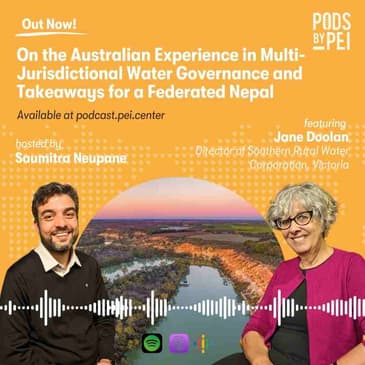
#Ep.070
Nepal's water sector is experiencing significant shifts due to its transition to a federal system, prompting a reevaluation of legal and policy frameworks to clarify roles across government levels. A major proposal under consideration is adopting a river-basin-based framework for improved governance and management. While aimed at enhancing operations and Integrated Water Resource Management, this reform faces challenges. The sector's future hinges on successfully avoiding conflict, forging consensus, and enhancing collaboration among institutions and governments, with river basin offices playing a pivotal role.
In this episode, Saumitra Neupane and Jane Doolan, an Australian water management specialist, on the intricacies of multi-jurisdictional water governance. They discuss Australia's established practices and the parallels between Nepal's shift to federal water governance, focusing on transparent and credible institutional frameworks. Jane's insights cover the development of water regulations, the efficacy of water markets, and sustainable water allocation in Australia. The dialogue also delves into the impacts of climate change on water resources, providing valuable lessons for Nepal as it considers adopting similar strategies in its federal framework. The episode is an enlightening discussion on the importance of stakeholder trust and sustainable practices in water resource management.
Dr. Jane Doolan brings over 25 years of experience in sustainable water resource management, offering policy advice to Australian and state governments on a wide array of issues including water supply and security, national water reform, and river health. Her career features significant roles in intergovernmental policy, especially concerning the Murray–Darling Basin, and in overseeing major water projects. Jane currently serves as a Director of Southern Rural Water Corporation in Victoria, is a Founding member of the Water Policy Group, an Adjunct Professor at the University of Canberra, and chairs various consultative and advisory committees. Her past roles include Environment Commissioner with the Australian Productivity Commission, Commissioner with the National Water Commission, and Deputy Secretary for Water in the Victorian Department of Environment and Primary Industries.
If you liked the episode, hear more from us through our free newsletter services, PEI Substack: Of Policies and Politics, and click here to support us on Patreon!!
[00:00:12] - [Speaker 0]
Namaste and welcome to POTS by PEI, a policy discussion series brought to you by Policy Entrepreneurs Inc. My name is Sonia Jimmy. In today's episode, we have PEI colleague Somethu Nyopane's conversation with Jane Doolan on the Australian experience in multi jurisdictional water governance and takeaways for a federated Nepal. Jane Doolan is currently a director of Southern Rural Water Corporation in Victoria, a founding member of the Water Policy Group, an adjunct professor at the University of Canberra and is the independent chair of several consultative and advisory committees. She has over twenty five years experience in sustainable water resource management, providing policy advice at senior levels to both the Australian and state governments on issues such as urban and rural water supply and security, national water reform, river health, environmental water allocation, catch ment management, and the management of water during drought and climate change.
[00:01:14] - [Speaker 0]
Somithra and Jane discuss Australia's established practices and the parallels between Nepal's shift to federal water governance, focusing on transparent and credible institutional frameworks. Jane's insights cover the development of water regulations, the efficacy of water markets, and sustainable water allocation in Australia. The dialogue also delves into the impacts of climate change on water resources, providing valuable lessons for Nepal as it considers adopting similar strategies in its federal framework. The episode highlights the significance of stakeholder trust and sustainable practices in water resource management. We hope you enjoy the conversation.
[00:01:58] - [Speaker 1]
Well, welcome to the show, Jane. Really delighted to have you here. What brings you to Kathmandu this time?
[00:02:03] - [Speaker 2]
Well, I'm here for the first time, actually, but I'm here for the joint meeting between Australia and Nepal. They have a memorandum of understanding between the two countries on water, and they meet annually. So I'm here for that meeting.
[00:02:16] - [Speaker 1]
Great. I mean, water is an interesting subject in in Nepal. There is a lot of aspirations that have been formulated for water resource development, mostly through hydropower, but you see an increasing trend around irrigation, drinking water, and slightly become a complicated subject. Nepal is has undergone federalism, and water is now part of a multidue restrictional framework. And there are several initiatives that are ongoing to formulate river basin plans, hydropower master plan, irrigation master plan.
[00:02:50] - [Speaker 1]
So a lot is happening around water. And I think this is very timely for us to have experts like you come into the podcast and talk about the Australian experience so that we as Nepali and Nepali policy space can benefit from from that experience. Just to take the conversation forward, maybe begin by talking about the water sector general in Australia and what kind of policies you have, what kind of rules are defined within these policies.
[00:03:17] - [Speaker 2]
Yeah. Sure. And like Nepal, water is fascinating and critical in Australia. Absolutely a critical resource. And politically, a very important issue for management.
[00:03:30] - [Speaker 2]
So we too are a federation. We have six states and two territories, and then we have a national government. But land and water management under our constitution, was brought into effect in nineteen o one, land and water management is a state responsibility quite clearly. The national government's role is one more of facilitation, of funding, of oversight, and they can act in the national interest, particularly in multi jurisdictional basins. So effectively that sets the scene, the roles are clear and each state will then legislate a framework for water management, for entitlements, for planning.
[00:04:10] - [Speaker 2]
Now we went through a period like many other countries. The period between say the late 1880s and about the 1960s, '70s was one where the focus was very much on building infrastructure. Building dams, building waste treatment plants, building irrigation networks and districts. The whole focus was development of the resource because our climate is extremely variable. We have long droughts and and floods.
[00:04:38] - [Speaker 2]
But at the end of that period around the eighties, we started to see a legacy of that investment. And the investment had been by governments, but the the legacy was a lot of environmental issues, a legacy of debt because all of that infrastructure had been paid for by governments with no revenue stream for ongoing maintenance or renewal. And when people really looked at it, the quality, the efficiency of irrigation was poor, very low production value, and the quality of services in regional towns wasn't that good either. So at that point, they basically decided they needed to shift from that building development phase to one that then focused far more on environmental sustainability, getting better economic value to the nation of water management, and aiming for some form of financial sustainability. So we had a big shift.
[00:05:32] - [Speaker 2]
Each state came to this in its own way, but around the early nineteen nineties, they all agreed to cooperate and to set a national water policy agenda. Now as I said, we're a federation. So when you have a national policy, it it isn't one imposed by the national government. It's got to be agreed by all parties. And so in 1994, we had the first COAG water reform agenda agreed to.
[00:05:59] - [Speaker 2]
And then it was extended in 2004 as our National Water Initiative. And it sets up the outcomes, the objectives, the principles, the key areas of water reform that all the states have agreed to implement. They'll implement within their own timeframes to some extent in legislation. But the key directions are set and agreed. And that policy, whilst it's eighteen years old now, is still in force.
[00:06:30] - [Speaker 1]
Hearing what what you had to say to this, I'm imagining that while the nature of problems across Australia, there could be some similarities in the sense that it's a dry area. So droughts are longer and drought is something that is prevalent across the country. But the nature of problems and aspirations of each state could have been very different in all of this. So how how did it really come together? Yeah.
[00:06:52] - [Speaker 2]
You're quite right. If we go to the North, the North has got decent rainfall and it's not developed very greatly at all. If you go to the East Coast, the rain is you know, it's a temperate climate. There's decent rainfall there, but it's highly developed. And then we've got Perth over in the Southwest corner.
[00:07:11] - [Speaker 2]
So definitely areas that share the Murray Darling Basin, highly highly developed. And then areas that are quite undeveloped. So the key thing was to actually craft the policy in ways that would make sense as to whether you were a jurisdiction with little development, so it would help you set the goals and the objective of how that development should occur over time. Or if you were a state that was highly developed and dealing with effects of overdevelopment, it would set the policy about how you would go about doing that. And obviously, these things when you jurisdictional agreements can take a lot of time, and they have to be incentivized in some way as well.
[00:07:54] - [Speaker 2]
So the national government took the role of, if you like, brokering the agreement and incentivizing states to to sign up and to participate. But a key feature of this policy as well and so the policy really there's many aspects to it, but it deals with four key themes, really. It deals with setting up an appropriate water allocation, water planning framework, improving environmental management, moving to cost reflective user pays pricing, and then institutional reform. And it's underpinned by two key, if you like, agreements and investments in better knowledge to underpin each of those reforms and a real commitment to community and stakeholder engagement in every element of it. So that's sort of a summary of it, if you like.
[00:08:44] - [Speaker 2]
But it also had every three years, there is an assessment by an independent body of how the states are actually implementing their agreement. And that's been a focus also that has helped with the longevity. So you might have the federal government overseeing, incentivizing, perhaps providing some finance. But every three years, there's an independent report on whether the state is actually doing it and how well they're doing it. And that has helped a great deal, believe, in making sure the policy has longevity.
[00:09:17] - [Speaker 1]
So I'm assuming the policy also talks about sticks and carrots?
[00:09:22] - [Speaker 2]
No. It doesn't. The first phase the first phase of the policy, the February 1994 to 02/2004, its implementation was linked to federal funding. So a state was assessed and if they were found to be wanting, there could be a penalty there in terms of less funding made available. In 2004 though, that changed.
[00:09:48] - [Speaker 2]
And there there's there was more carrots and no sticks.
[00:09:55] - [Speaker 1]
Because Nepal is is now a federal country and then there is a lot of expectation for the role of provinces, your equivalence of states. Yeah. It would be really nice to hear about how that national water policy formulation was taken by states. And then what kind of directions the states have pursued to kind of implement the the formulations within these policies in the sense that do you observe states have broadly have very coherent norms around how they are to manage water or and what kind of institutions have been established by states? What kind of legal frameworks have been established and being enforced?
[00:10:34] - [Speaker 2]
Yes. So from our perspective, our states were well and truly in place before federation. And federation was actually already in negotiation between states to get to the point of of being a federation. So in terms of water policy, the states in the Murray Darling Basin are quite used to working with each other. They don't always agree, but they're used to working with each other because it is a multi jurisdictional basin.
[00:11:03] - [Speaker 2]
The key thing was to actually bring states outside of that into it and to actually make sure the policy dealt with issues that were relevant to them as well and mostly in the more less developed areas. It wasn't easy. And again, the federal government had to play that role of broker to bring them in. For example, West Australia didn't sign up immediately but came in about six months later, for example. So it's a it's a matter of trying to craft a dynamic whereby it is worth being in than staying out.
[00:11:42] - [Speaker 2]
Because under the constitution, they can quite happily manage their water resources on their own. But I think we are a nation. We do recognize that. And they will actually come to the table in the national interest, particularly if there is some incentive to do so.
[00:12:01] - [Speaker 1]
Excellent. I mean, you mentioned Murray Darling Basin. And whenever there is a conversation around Australia and water, that's something that comes up first thing on everybody's mind. Right? So this is really interesting example.
[00:12:15] - [Speaker 1]
Maybe elaborate on on what that Murray Darling initiative was and how it started, the history behind it because, and I think you'll explain this as you go, but that is a really a really telling example of how an approach changed around multidue restriction or water governance in Australia.
[00:12:36] - [Speaker 2]
Absolutely. It it's it's a very everybody thinks Murray Darling in Australia, and it's good to remind people there are areas outside of it and areas that are not hugely developed, but also need to be managed managed well and and options for new development. So it's important we realize that. But yes, the Murray Darling Basin, it's a fascinating area to work. I've spent a lot of my career either in a state operating in it or now as an authority member.
[00:13:05] - [Speaker 2]
But let's just go back to what it is. It's the biggest basin in surface water basin in Australia. It has four states and two territories, two major river systems that flow into South Australia to the sea. It provides water for more than 2,000,000 people. It is about 70% of Australia's irrigated agricultural production, and it is incredibly important for the environment.
[00:13:32] - [Speaker 2]
We have Ramsar listed wetlands, breeding bird sites, really significant wetland areas in that entire area. And an issue that's becoming far more important in the last ten years is our First Nations people. So there's a there's a a number of First Nations in the basin too.
[00:13:53] - [Speaker 1]
That would need some explanation. Okay. I mean, I I get what First Nations mean, but just for the listeners
[00:14:01] - [Speaker 2]
So it's our indigenous aboriginal populations, and they have been in Australia for forty thousand to sixty thousand years in various parts of Australia. And they operate as individual nation groups. So over time, over that period of thousands of years, each nation group has a a relative area that is associated with them. And they have a very strong relationship with their country.
[00:14:29] - [Speaker 1]
So And the resources.
[00:14:31] - [Speaker 2]
And the resources. Absolutely. A very strong interest in making sure their country is is managed well. And one would have to say since European settlement, that's been greatly ignored until perhaps the last twenty years where first name we're them First Nations or our traditional owner groups depending which state you're in. But the NWI, the National Water Initiative in 02/2004, does have a clause that starts to say they need to be involved in water management on their country.
[00:15:06] - [Speaker 2]
So that's an issue that's coming more into play and will continue to come more into play into the future. Now the major thing, the first time we had an agreement and an agreement with multi jurisdictional governance was around the River Murray, which has New South Wales, Victoria, and South Australia and the federal government involved. And it was 1915. So just a few years after federation when Australia was actually formed. And that is an agreement about sharing the water.
[00:15:35] - [Speaker 2]
So it's an agreement whereby Victoria and New South Wales share all the inflows into the system. But at the South Australian border, they must provide a set range of flows to South Australia. So after that agreement was struck, what we had then was each state went off and under their own legislation allocated that share of water. So you see very different approaches in each of the three states. But the share is set by that agreement.
[00:16:05] - [Speaker 2]
And that agreement also went into what infrastructure would be constructed and managed in a collective manner and what hydrometric information would be collected.
[00:16:17] - [Speaker 1]
Just to stop you here, Jane, for a quick question. So what were the triggers for the agreement? I'm assuming something happened in that basin Yeah. Or where states were maybe conflicted in some some ideas.
[00:16:30] - [Speaker 2]
There there was a a massive drought at Federation. So there's pictures of the River Murray where the River Murray commissioners can step across the river from one side to the other. So with a huge drought and very little infrastructure, I think there was a push to provide and build some dams. But in doing that, you had to settle the water sharing between the states. And in particular, you had to sort of guarantee what share of water would be provided to South Australia as the downstream state.
[00:17:02] - [Speaker 2]
So I think that's what triggered it. It took quite a long time. There's a there's a book which traces the history of inter interstate agreements around the Murray Darling Basin, which is fascinating. But every time we've come to an agreement, it's years in the negotiation. But once they're signed, they generally are settled and we all manage under it.
[00:17:26] - [Speaker 2]
So with that agreement in 1915, each state could go off and do the development. They developed the the dams that they had agreed on. And then we hit that period in the sixties to eighties when we were starting to see the environmental degradation. So they came back together and agreed to broaden the agreement so that they could do more things together. They established a ministerial council, which would be the governing body for the basin.
[00:17:56] - [Speaker 2]
And they set up the Murray Darling Basin Commission. So an agency that would be the agent of those governments, if you like. And they agreed on the funding of that. So we still had the water sharing. We still had the infrastructure.
[00:18:11] - [Speaker 2]
But now we had a ministerial council governing the basin or land and water management. And a Murray Darling Basin Commission, an agent, an agency with staff who could actually do work.
[00:18:23] - [Speaker 1]
And and this individual states were putting in money for Yes.
[00:18:26] - [Speaker 2]
With a depending on what it was, there was any number of cost sharing arrangements.
[00:18:31] - [Speaker 1]
Okay.
[00:18:32] - [Speaker 2]
There's a cost sharing arrangement for infrastructure, for a range of things. But all agreed. Now under that, they actually did some retrospect, amazing work. They dealt with salinity, irrigation salinity and built joint salt interception schemes. They looked at nutrient management after the algal bloom of the 1991.
[00:18:56] - [Speaker 2]
They built fish passage along the River Murray and they started to introduce trading. One of the most significant decisions that council ever made was in the early 1990s, they agreed that they would do a water audit. How much use of water was occurring across the basin? And that showed that at about that time, 1990, the median average flow to the sea was only 27% of the inflows which meant all of the rest was being extracted. So on the basis of that, the ministerial council agreed to cap, it's called the CAP with a capital c, the basin which meant no new diversions could be granted.
[00:19:44] - [Speaker 2]
And they kept it at 93, 94 levels of development. They all agreed to do so and it was a highly significant massive decision. Now on the back of that, every state then had to bring into play how they could meter, monitor, account for their utilization, how they would report back through the ministerial council, how that would be audited and accredited and how they would be able to report to the public. Now the dynamic is one where it's really important to have that transparency and trust in those figures because each state needs to know nobody else is rorting the system. If one state is actually developing and the others aren't, there's a competitive advantage.
[00:20:33] - [Speaker 2]
So the CAP and the institutions that were put in to actually implement the CAP was a huge step forward and each state brought those implementation issues into their own legislation. So they all had to craft their own legislation to implement it. So it was big. Then on the back of that, in 02/2004, they agreed that they would return some water to the environment. The basin's clearly over allocated.
[00:20:59] - [Speaker 2]
And they took what they called the first step where they recovered 500 gigaliters of water for the living Murray.
[00:21:05] - [Speaker 1]
This is this is very interesting.
[00:21:07] - [Speaker 2]
Yeah. It is. So they would recover water. They would recover water by mostly investing in efficiencies in the irrigation sector to, if you like, capture the losses. And they did that and they accrued 500 gigaliters of water as entitlement that was actually then handed to environmental water managers to start utilizing to improve environmental water flows.
[00:21:36] - [Speaker 2]
And so that was kicking along. And again, there was a cost sharing arrangement, an arrangement whereby each state had to find their share of that 500 gigaliters and a cost sharing arrangement and states could perhaps invest in another state and a whole range of rules around that. And then we had the millennium drought. So the millennium droughts started in 1997 and people just thought normal drought, but it kept on going. And then in 02/1967, so virtually seven to eight years into the drought, we had what was the worst year on record.
[00:22:12] - [Speaker 2]
And it was the worst year on record by a third. So a massive shortage, major failure of spring rains, massive shortage on the back of seven years of drought. And 07/08 would have been the worst year on record except we just had six, seven. So this was sort of everybody was really sort of getting extremely concerned about this drought. And we had looked over to Perth on the West Coast, and they had been having, if you like, a series of step downs in in their inflows.
[00:22:47] - [Speaker 2]
And our climate change predictions were a drying climate. So a key question for us was, were we ever gonna come out of this drought or not? Was this the new norm? And if it's the new norm, then basically, you've got a plan for it. So in 06/00/2007, a few things were happening.
[00:23:06] - [Speaker 2]
Adelaide in South Australia had the potential to run out of water in eighteen months or so if those conditions continued. And the lower lakes right at the very end, they were dropping significantly. They're big, they're shallow, they evaporated about 700 gigaliters a week and they were dropping. They dropped to below sea level and parts of it were going acid. So we were in a very severe drought with some significant environmental implications.
[00:23:36] - [Speaker 2]
Had that continued, we were actually looking at the worst case option of letting the sea and changing the nature of that low end. So at that point, that's when the national government stepped in and said, decisions by consensus is too slow. We need a new paradigm. And they changed the governance of the Murray Darling Basin. They brought in a Commonwealth of National Water Act.
[00:24:04] - [Speaker 2]
And whilst much decisions still happened under the agreement by consensus, the Commonwealth minister has responsibility now for setting sustainable diversion limits for the basin.
[00:24:17] - [Speaker 1]
So in sense, there is now a central framework under which Yes. Every state is kind of
[00:24:22] - [Speaker 2]
Yes. Yes.
[00:24:22] - [Speaker 1]
Their water policy and water arrangements
[00:24:24] - [Speaker 2]
are organized. So it's they still have to operate. So this still had to operate knowing that the water shares were there between states and state legislative frameworks were there. But effectively, the states agreed that the Commonwealth could set these diversion limits. And then the Commonwealth devoted $13,000,000,000 to actually then investing in either efficiency or buying entitlements on the market to reduce the consumptive pool and enhance the environmental share.
[00:24:56] - [Speaker 2]
But the shift in governance was one where the Commonwealth on setting the sustainable diversion limits, that minister has the power.
[00:25:11] - [Speaker 3]
Hi there! This is Shia Rana from Policy Entrepreneurs Inc. We hope you're enjoying Pods by PEI. As you know, creating this show takes a lot of time and resources. We rely on the support of our community to keep things going.
[00:25:24] - [Speaker 3]
If you've been enjoying the show and would like to help us out, we'd really appreciate it if you could become a patron on Patreon. Patreon is a platform that allows listeners like you to support creators like us with a small monthly donation. Your support will go a long way in helping us to continue creating high quality content for you. So if you are interested in supporting our show and becoming a part of our community, head on over to Patreon and become a patron today. You can find us at patreon.com/podsbypei.
[00:25:55] - [Speaker 3]
Every little bit helps, and we can't thank you enough for your support. Now let's get back to the episode.
[00:26:10] - [Speaker 1]
And so as of now, there is a version of a basin plan at the Maritalin Basin, and this has been kind of driven by the formulations of of the Commonwealth or the federal government. And then there are arrangements in place, institutional policy at the state level that go into this. There are two points that really struck me around what you said, and this is around water markets and water recovery. Let's begin with water recovery. I think the basin plan's major formulation is around water recovery.
[00:26:41] - [Speaker 1]
This is this is something that we've not even started to think about in Nepal. I mean, we not at a time where we should be thinking, but really as a country who's got so much hydropower resources, water resources in general, To imagine that a nation would have to think about recovering water from existing allocations is surprisingly, but would love to hear more about
[00:27:03] - [Speaker 2]
Yeah.
[00:27:03] - [Speaker 1]
The arrangement.
[00:27:04] - [Speaker 2]
So I think there's a lot of interesting elements around that whole history and where the Murray Darling Basin is right now. But if there's a message to other countries, it is probably don't over allocate. Don't get to the situation where you have taken too much water out of out of the river. So let's talk about the basin plan. So it's done as in why it was done?
[00:27:30] - [Speaker 2]
It was done because we're in the drought and the drought showed we were over allocated. The key element of the basin plan is to set sustainable diversion limits, taking into account the needs of, you know, important key environmental assets and functions. And they set those diversion limits at the catchment level within the basin and at the basin level of overall, the whole Murray Darling Basin. So each catchment will have its own sustainable diversion limit, and it will also produce a downstream so that overall the basin is meant to then be in a sustainable condition. Now when we looked at the current level of development versus what was in the basin plan, there was a gap, twenty seven fifty gigaliters of water gap.
[00:28:18] - [Speaker 2]
So that had to be recovered from the consumptive pool and handed to the environment pool to balance up. Now there was a lot of arguments around, you know, could you do this more efficiently with environmental works? And actually, was that enough? But that's roughly where it landed. So the Commonwealth government, the national government, went about recovering that water from the consumptive pool.
[00:28:45] - [Speaker 2]
Now they did it into three ways, mostly. There was some purchase on the water market, so that's from willing sellers. We have an existing water market in the Murray Darling.
[00:28:55] - [Speaker 1]
We'll we'll touch upon that.
[00:28:57] - [Speaker 2]
We'll touch upon that. Yeah. And the Commonwealth went on to the market and bought. They also invested in irrigation systems to make them far more efficient, to reduce the losses, and to make them modern with a higher level of service for irrigators. And that was done with, you know, cost sharing arrangement with the state and with the irrigators.
[00:29:19] - [Speaker 2]
And then some part of it was also then directly investing with irrigators themselves in on farm savings. So an irrigator would basically be able to go, you know, I'm I'm prepared to give up 50 megaliters. You give me this amount of money. I'll invest in my farm to have a much more efficient on farm approach and hand water back. So to date, of the twenty seven fifty, there's about 2,100 gigaliters already recovered.
[00:29:46] - [Speaker 2]
The rest is subject to significant and ongoing controversy. But you'd have to say about 20% of water has been sorry, of irrigation has moved across. And we have a range of environmental water holders who are managing that 2,100 gigaliters. And we are seeing some really significant environmental benefits.
[00:30:10] - [Speaker 1]
So the salinity is reduced Yep. The environmental flows have Yeah. Improved.
[00:30:15] - [Speaker 2]
Yes. The environment.
[00:30:16] - [Speaker 1]
Health. In
[00:30:19] - [Speaker 2]
they've used it in various ways. So a lot more has gone down to the to the lower lakes. They use it to enhance bird breeding in a number of the big significant bird breeding wetlands. They've used it for to stimulate fish breeding. So it's been a whole range of ways.
[00:30:37] - [Speaker 2]
And there's a there's a whole discipline now of environmental water management. There's a whole range of research that actually underpins it. There's monitoring and evaluation going on now. So it's a very adaptive framework. But they work together across the states actually seamlessly, the environmental water managers, and they try to get the absolute best environmental outcomes they can with the water that they have.
[00:31:01] - [Speaker 1]
Excellent. Let's move to water markets. Yes. It's a very interesting subject in the sense that here in Nepal, we've started to recognize markets, and then we are starting being inducted to electricity markets because we started trading in India. A walk in water markets is very new.
[00:31:19] - [Speaker 1]
How how is it kind of organized in the Australian space? So you had some examples. But what about pricing, the kind of stakeholders, farmers, private sector, governments? And most importantly, I think for water markets to to function, then it has to be based on a set of allocation agreements that had to be in place beforehand. So this was probably referenced to before the basin plan was organized?
[00:31:44] - [Speaker 2]
Absolutely. Absolutely. It it really became important when when the cap was put in in the nineteen nineties. So in the Murray Darling, this is. Because once the cap is put in, there are no new diversions.
[00:32:00] - [Speaker 2]
So if anybody wants to develop, the only way they can develop is to use the water of somebody else. And that really was the drivers for water trading and water markets. Now if we go back, we've had water trading within little irrigation districts informal and informal, you know, since the eighties. But the big advance was in 1998, they attempted an interstate water market in the southern system. Now you're quite right.
[00:32:30] - [Speaker 2]
If you're gonna have a water market, you've gotta have very clear, well defined entitlements that are explicit. You've gotta have good quality monitoring and compliance so that people have real trust. You've gotta have a relatively stable environmental condition so that it doesn't suddenly sort of create an issue where nobody can use water. So there's a whole lot of precursors there which underpin some of the directions in the National Water Initiative that I spoke about. But entitlements, absolutely.
[00:33:01] - [Speaker 2]
Doing a water plan that either sets the caps or sustainable diversion limits is critical. Once they're in place, then development can occur if you allow water trading. To allow water trading, you've got to set the rules. You've got to make sure there are that in setting the rules, the trade rules, the environment will not be impacted nor will third parties, downstream users. So rules have to be set.
[00:33:26] - [Speaker 2]
The rules have to be set cognizant of the system that you're operating in as well. Then the market takes well, there's two elements. You can sell entitlement or you can sell the year's allocation. So, know, shall I go into that?
[00:33:42] - [Speaker 1]
Yeah. I need to clarify a few things for my sake. Sure. Trying to understand here. So for example, if I'm a farmer that I've been irrigating a certain number of hectare of lands, I'm an individual farmer, and I've been drawing water from the basin.
[00:34:00] - [Speaker 1]
Right? So I received an allocation or or I had an entitlement. So what is that entitlement? Does does it say that I get to use water to perpetuity? Is there a time limit set to that entitlement?
[00:34:16] - [Speaker 1]
The second question is, I'm assuming I think you just referenced that earlier, is that that entitlement is that corresponds to the amount of water is actually available. So I might be getting water, but how much water I get depends on what is available in that particular year.
[00:34:34] - [Speaker 2]
That's right. Yeah. So generally speaking, there's two types of entitlements. There's the entitlements in the regulated systems that we have, like the irrigation districts and the dams. One of the first things that we did under the National Water Initiative is to actually introduce statutory under legislation under which there were statutory entitlements.
[00:34:55] - [Speaker 2]
And those entitlements could be open ended, perpetual. But generally speaking, they entitled you to a share of the resource. So you would have an upper limit. I might have an entitlement for 100 megaliters but what I would get in a year would depend very much on what the inflows to that system were. And so we talk about high reliability entitlements and low reliability entitlements because it depends on the system.
[00:35:23] - [Speaker 2]
But just to give you in that six, seven, in Victoria, they have high reliability entitlements. No guarantees of course, but the expectation would have been that you would get a 100% of your entitlement in probably about 95% of use. In that o six, o seven, the high reliability entitlements only got 27 of their allocation. That's all that was in the storage and that's all that they got. And that's understood.
[00:35:51] - [Speaker 2]
And if you're an environmental water manager with that entitlement, then you'll get exactly the same. So we talk about entitlement and then we talk about seasonal allocation. And the seasonal allocation is what you get that year depending on what's happening. So the water market allows you to sell your seasonal allocation, so just this year's water or some portion of this year's water, Or your entitlement, which is that's it forever. Choose.
[00:36:20] - [Speaker 2]
Now the water market has become the Southern Connected System is very big. It's a case study for markets across the world. Since it was introduced, if you like, the pilot for interstate trading was done in '98. The millennium drought really established how important the market was because people could sell their water to horticulture which really needed it. The prices shot up, so it's it's a market.
[00:36:47] - [Speaker 2]
So allocation that year went to a thousand dollars a megaliter just for allocation. But in a wet year or at the end of the season, it can be down at $40 a megaliter. Depends on demand Yeah. The entitlement market has shifted as well. So at the time of when the Basin Plan was brought in at about 2012, your average entitlement was about $2,000 a megaliter.
[00:37:15] - [Speaker 2]
And I think it's doubled now at least on average. But again, it reflects conditions.
[00:37:20] - [Speaker 1]
So is it does the market trading function in a way that states engage in trading with each other and the the allocation to the state then is kind of distributed and there is another market? Or it's just you also have private sector trading, you have farmers trading?
[00:37:36] - [Speaker 2]
The the state shares under the River Murray agreement, that's what the states get. They allocate it under their entitlement frameworks. And then the market allows you to trade between states, between those retail entitlements is what we call them. So the state shares are still the state shares allocated to retail businesses, to irrigators, to urban water authorities, and then the market is about them sort of selling to each other.
[00:38:04] - [Speaker 1]
So do you have the private sector in that market space? For example, maybe a private hydropower developer or of Yeah.
[00:38:11] - [Speaker 2]
But if a hydro we haven't. But if if there was one, they would have to go to the market. They would have to go to the market and buy more water. If somebody wants to build a dam, a small dam, a large dam, whatever, they would have to go to the market and buy the water. The place is kept.
[00:38:29] - [Speaker 2]
It's the only way that you can do it. And so what we have seen as a result of it, if you like, is a whole lot of almond development. Is when when California had its drought, for example, almonds came to the Southern Murray system. And the market water moved from the dairy into almonds and enabled some really significant changes in the agricultural production locations as well as of levels of value. So the market has been huge and very like, it did what it was meant to do.
[00:39:10] - [Speaker 2]
So it was meant to free it up and enable water to move to its highest value economic use. And we have seen that due to the drought, it's done that. The government has used it to purchase water for the environment. What we are now seeing, which is interesting, twenty years on, is some of the social implications of where water has left the districts. Mhmm.
[00:39:34] - [Speaker 2]
And we do have some communities that are very concerned about the social implications where market decisions by individuals have just meant less water is now in their in their community.
[00:39:47] - [Speaker 1]
Very interesting. I'm really intrigued by this because even Nepal's own national water policy that was drafted two years ago talks about putting in place river basin offices and implementing practices like water counting, allocation, auditing. That sounds all nice, but it looks like it's gonna be a complicated process moving forward. But if you were to go and see of how water is being managed, how people use water for what purposes, you see instances of conflict. For example, farmer managed irrigation systems concerned about diversion for hydro use, then you have businesses.
[00:40:25] - [Speaker 1]
There was one example nearby Kathmandu where a private entity was diverting water from a stream for trout farming.
[00:40:34] - [Speaker 2]
Oh, yes.
[00:40:35] - [Speaker 1]
Yeah. Right? And then it was a free diversion. The the water was almost free because nobody was using it. But if you were to imagine that in the future, there's gonna be some value to that water, how is that going to add to the cost of production and all of those?
[00:40:49] - [Speaker 1]
So this whole idea is sounds very interesting. And I think from what you've said, it also promotes efficiency both at on the resource conservation side as well as making sure that you are promoting the right set of use, right set of crops because you don't wanna maybe use crops that are highly intensive or high water intensive requirements because then you would have to pay more for water. So That's right. Really strengthening this linkages between businesses and water use.
[00:41:19] - [Speaker 2]
Yeah. And it it is extremely interesting. And it's been really interesting to see how businesses have adapted and used the market. So for example, just last week, I was touring the Southern Connected System of the Murray Darling and saw a quite a significant dairy farm, if you like. And the dairy farmer leases what can't afford a water entitlement.
[00:41:43] - [Speaker 2]
It's too expensive, but they lease a water entitlement. So they they've got a long term lease and they'll buy on the temporary market. Now that can work, but the temporary market in a drought becomes quite expensive. And the way they manage that risk is that they will carry over water. So it's another thing we can talk about.
[00:42:03] - [Speaker 2]
But they are also making sure that they have two years worth of silage Mhmm. To count for a drought. Mhmm. So the almonds, sort of the almond board, obviously, every business is different. But they tend to operate on the by a third entitlement, high high reliability, lease a third, and then go to the market for the last third.
[00:42:27] - [Speaker 2]
So in a drought, they can shut down production if they need and just go to a survival regime. But it's something that as a government official, I would never think. But the rules are sort of the rules are clear. There's confidence in the market. And I think it's really important that people understand the value of entitlements has increased, but it's because there's trust.
[00:42:49] - [Speaker 2]
There's trust in the institutions. There's trust in the compliance regimes. There's trust in the monitoring, and there's trust in the setup around water accounting. If that trust was to break down and you you didn't have trust in those institutions, you would not get anywhere near the level of investment that we see nor the increase in agricultural production. And I think you mentioned as well that it can drive efficiency.
[00:43:15] - [Speaker 2]
We absolutely have seen that. We absolutely have. So in the middle of the millennium drought with 40% less water, we saw only a 20% reduction in irrigated agricultural production as a result. So yes. Yes to all those things.
[00:43:34] - [Speaker 2]
But so it's been great. But with everything, nothing's ever perfect and it brings its own issues. And the one of the social consequences of water leaving the district is one that is of great concern to some of those communities.
[00:43:50] - [Speaker 1]
Jin, do we have observations around who's giving up entitlements or allocations and who's taking up entitlements and allocation? It's sectoral because I'm assuming Yeah. There are new businesses and new water use coming up. Somebody has to give up existing user entitlement. Any observations
[00:44:07] - [Speaker 2]
on that particular Who's putting it on the market and being prepared?
[00:44:10] - [Speaker 1]
And who's who's taking those?
[00:44:12] - [Speaker 2]
Look, anecdotally, although there is some information, I just don't have it at my fingertips. Quite a lot of our farmers are reaching 70. Okay. And, you know, so there's an aging population. In many cases, the second generation doesn't wanna farm anymore.
[00:44:31] - [Speaker 2]
And so you do seem to see that. So they'll be prepared. It can be their superannuation, frankly. And and some of them actually have kept their water entitlement but sell it on the market, the allocation every year as superannuation or income. We've had consolidation of farming businesses.
[00:44:51] - [Speaker 2]
We've had we've actually got a range of players in the agricultural sector who go in and buy up a range of properties, reconstitute that property in a better environmental sense, invest in some of the water savings, and they will also then use put market on water on the market. In terms of allocation though, what we what we see is interesting. And it's because it's such a big basin and quite diverse and it's connected. We have horticulture, so they need water every year. We have mixed crops, pasture and a range.
[00:45:30] - [Speaker 2]
They can choose to forego a crop if they want to. So what we see with them is depending on the conditions, they'll have a crop. But if it's looking like El Nino or they might choose not to and then they'll put their water on the market and they'll go and buy silage from another place because it's a better business decision. And then we have the annual crops like rice and cotton and they really plant if water is available, in a a wet or whatever year. And so you start to see the market playing.
[00:46:04] - [Speaker 2]
If if you've got a bit of water but you're a rice farmer and it's dry, you put your water on the market because you're not gonna get a crop. The mixed farmers will wait and see there's a bit of a threshold for them. Do they plan a crop or be prepared to buy it from somewhere else and put their water on the market? And then the horticulture needs the water.
[00:46:24] - [Speaker 1]
Yeah. Very interesting. I mean, in the Nepali context, I don't know if this is something that is replicable, should be replicable, given that we have a lot of smallholder farmers Yeah. Than large farmers as in Australia. But the concept itself is very interesting and something that can be explored sectorally just to promote Exactly.
[00:46:41] - [Speaker 1]
Integrated water resources.
[00:46:42] - [Speaker 2]
Think so. And it it becomes so I also work outside the Murray Darling in Southern Victoria. And so we have much smaller systems there, small smaller dams, same entitlement system, and more homogeneous areas. But we will still have a market operating in that. It it won't it won't reach anywhere near the levels of of transactions that we see in the Murray Darling, But it still enables flexibility in that place.
[00:47:12] - [Speaker 2]
Across Australia, we have a number of small markets operating. They'll never reach the scale of the Murray Darling and they shouldn't. It's a reflection of the system it is. But effectively, if you have kept your system and you have entitlements, there's no new development unless you allow trading.
[00:47:32] - [Speaker 1]
Excellent. Just two more things, Jane. What about groundwater? Ah. Yeah.
[00:47:38] - [Speaker 2]
We always forget it, but, yeah, we shouldn't.
[00:47:40] - [Speaker 1]
So there is that conversation here in Nepal as well that we should be using more groundwater Yep. Because building surface infrastructure is quite expensive, and then the paybacks are quite long. And then being in the state of where we are economically, then maybe not the best decisions. And then data is showing that we we have sustainable groundwater sources. How does groundwater allocation work?
[00:48:06] - [Speaker 1]
Is is that allocation within the same allocation and trading scheme that's already in place?
[00:48:12] - [Speaker 2]
Yes. It is. So effectively, we'll have a a groundwater water plan. We'll do exactly the same. Wear all the licenses.
[00:48:20] - [Speaker 2]
How sustainable is that level of take? Put in rules about how to make sure you do have sustainable take. Groundwater tends to be less over allocated. We have had a few aquifers where they are and there has been a little bit of water recovery. But for the most sake, it's it's been about actually setting what is the level of sustainable take out of an aquifer.
[00:48:44] - [Speaker 2]
A lot of our aquifers don't have terribly potable water. So for us, it's often about managing poor groundwater quality. But what we tend to find is that when we do have reasonable groundwater, licensees will use it particularly in drought. So what we tend to find is when the surface water is under stress or the market, that is a high level, people will turn to their groundwater licenses. They'll have both.
[00:49:14] - [Speaker 2]
And so the key thing then is if people are using it in drought, it's actually making sure that we have got good rules that govern sustainable level of take. And there's even experiments in trading in groundwater as well. But again, it's system dependent. It'll never be at a large scale. The trick with groundwater is really understanding the system well enough to set sensible rules.
[00:49:41] - [Speaker 1]
What about climate change? How is climate change the conversation around climate change, how is it driving this idea of peace and planning, allocation, trading? What where is the conversation at? I mean, I understand that the implications would be too much water, too less water, and then the existing allocations kind of really follow what has already been decided. But as you as you foresee climate change, what kind of changes is is the water sector kind of envisioning or thinking about for the future?
[00:50:14] - [Speaker 2]
It it's a really interesting and challenging question for us. Our climate change prediction's pretty dire. For most of Australia, it is a drying climate with more extremes. So more frequent and severe droughts and punctuated by larger floods. I think I think it's it's definitely got resonance amongst water users.
[00:50:36] - [Speaker 2]
Because when we're in the middle of the millennium drought, for example, we could actually describe this is what we're expecting in our worst case 2050 scenario. So many of the decisions that we have made already have been about making those institutions be able to operate under dry conditions. But I think and to get people thinking about it, all of our urban utilities have to do water plans with a range of climate change scenarios. They're investing in climate independent sources of water. So diversifying their supplies, for example.
[00:51:14] - [Speaker 2]
For irrigators, the key thing is being making sure that the information is out there and then they can make their own business decisions and they can use the market. One of the things we introduced was if you've got an allocation, you can sell it, you can use it, or you can carry it over if there's space in the storage for next year. So tools, providing tools to enable more efficient use. But that's all really sensible. But if we look forward even further, we will have to, at some point, in some systems, change our environmental objectives.
[00:51:55] - [Speaker 2]
Because in some systems, under climate change, they will not be feasible to meet. So we'll have to introduce into our water planning ways that those decisions can or systems can be identified as vulnerable and processes put in place to work out, well, what will we do with some of those systems? So for me, one of the next the next version of the National Water Initiative will actually have to extend the water planning provisions to enable over time the outlook for climate change and what do we need to do in some of these systems.
[00:52:35] - [Speaker 1]
Fascinating. I mean, the Australian example, while everything might not be replicable for Nepal, but I think there are really strong messages. And as we're moving towards the close of the conversation, I wanna draw this all to kind of explore what this could mean for Nepal moving forward. Hearing what you had to say, I think Australia has moved to a really high order of water resource management and governance in the sense that you have an established market and there is also trading happening. We are probably just exploring or scratching the early areas of how we should manage water within a federal context where jurisdictions are still not clear but are overlapped within three tiers of government.
[00:53:20] - [Speaker 1]
What do you have to say, for for a country like Nepal based on the early experiences of of water management at states and how that went into a multitude restriction framework. What should be the ideas that Nepali water sector can explore if they are to better manage water in the federal context?
[00:53:40] - [Speaker 2]
I think the first thing is actually getting the roles and responsibilities clear. You can have different models. No one will be correct. But it's gotta be clear. Who's accountable for what?
[00:53:53] - [Speaker 2]
And then you can start to have the conversations about how you all work together. But it's hard to have the conversation about how you all work together if you actually don't know really what everybody's accountable for. So I think very clear roles and responsibilities are are critical first. Once you've got that, you do need to have your legislation at whatever the level is that sets up your entitlement system. It's really important that people understand what entitlement they have and what they can expect and that the river basin authority or the governing agency knows how much of the resource is committed and when that is committed.
[00:54:35] - [Speaker 2]
Know, what it looks like under drought and under flood. So that you've got as a resource manager, you know, a, your resource and then b, where it's going and what is left for the environment and what your issues are going to be. That's almost a base level. If you're not highly committed, terrific. You set a sustainable diversion limit and it means you've got opportunities for development within that.
[00:55:04] - [Speaker 2]
The key then thing is to work through what what would be your rules for assessment of developments within that. If you happen to be highly developed, which it doesn't look like you are, but then you're in the space that Australia for for much of Australia, not all, is in about how do we manage in this highly committed state markets, trading, all of that comes with that. Big thing for me is don't go there. Well, don't get over committed. I'm not saying don't go markets, but don't go to the point where you need to recover water as we have done.
[00:55:39] - [Speaker 2]
It's been very expensive. It's socially disruptive. It's politically difficult. And it cause it's it's really caused a lot of angst amongst a lot of people. What I would consider good resource management is actually to work through your sustainable diversion limit, allocate up to that, and then utilize a market within those sustainable diversion limits.
[00:56:04] - [Speaker 2]
That's what that's what I would recommend.
[00:56:06] - [Speaker 1]
This is even hearing you even in the Australian experience, this is this didn't happen overnight. Right? This is a long No.
[00:56:14] - [Speaker 2]
This is long.
[00:56:15] - [Speaker 1]
This is a long process. Right? And we should be kind of ready to kind of fight through, navigate this process. Hearing I think you mentioned early on in the conversation this idea of building consensus. There was this attempt to to include people, bring them to table, draw consensus.
[00:56:33] - [Speaker 1]
How important is a participatory approach? Clearly, by the Australian example, you you kind of diverted its way and then Yep. The central government had to step in. Even
[00:56:43] - [Speaker 2]
within it though, it's really important. So if if I look back to the early water planning processes, which started in the nineties, for example, The area I know well, Northern Victoria, it's had three iterations of the water plan since then. The first one was about establishing just what the entitlements are and where and what's the environmental share. The second one was about, okay, let's bring the cap into place. And the third one was about how do we manage this in extreme drought.
[00:57:13] - [Speaker 2]
Those water planning processes, they took two to three years. They had 30 stakeholders around the table representing irrigation communities, environmental communities, urban water utilities, all the key stakeholders. They met virtually every six weeks. And they basically trawled through model runs like you wouldn't believe.
[00:57:34] - [Speaker 1]
It was a data driven process.
[00:57:36] - [Speaker 2]
It's data driven process. So they would basically go, if we introduce karaoke, what would it look like? If if we change the DRAT reserve rules, for example, what would it look like? So the model runs would come and basically the assessment would be made of sorry. How does it impact on me, my entitlements, my stakeholders?
[00:57:54] - [Speaker 2]
And that was the process whereby negotiation came. So at the end of it was a water plan. Might not have been agreed by all of those 30 stakeholders, but that had extremely good input and they understood why those recommendations had been made. And so that would be accepted by government as the water plan. Then that almost sets up the drivers for the next one.
[00:58:20] - [Speaker 2]
Issues like drought come in. And so in ten years time, you do the next one. Same process. 30 stakeholders around the table. Maybe in this time, it's a few different people have come into play.
[00:58:30] - [Speaker 2]
But the participatory process is really important. A, it brings the real issues to the table. Mhmm. You know, what are those people dealing with? What do they need to see fixed?
[00:58:43] - [Speaker 2]
It also enables governments to explain why a sustainable level of take's important and what does it mean. And if there is that level of understanding, you actually get far more commitment to the rules once they're in place.
[00:58:58] - [Speaker 1]
Excellent. Just before we end the conversation, Jane, something that's really typical of Nepal is that we we have really good policies on paper. Implementation remains a challenge for for a number of reasons, but as a political economist, I myself have have observed that I think the key thing is about creating really credible institutions with the right authority, the mandate to take things forward. How important do you think is this idea of institutions? You mentioned early on in the conversation also institutions set up at different levels, some as to govern water, some to monitor use, some to facilitate processes, but generally the role of institutions for effective water management.
[00:59:44] - [Speaker 2]
It's it's extremely important. It's extremely important that you have a credible institution that can undertake the plan. So that is the, what is my system? You know, where's the take? The evidence base is critical as a first step.
[01:00:02] - [Speaker 2]
Everybody has to believe the evidence base before you can then look at a range of options or negotiate your way through. So the evident I found in my career that if people challenge the evidence base, you can't even get any further. You know? So having the evidence base there and agreed to is an important first step. So a credible agency that can do that, they need to be able to bring all of the stakeholders together and run a participatory process.
[01:00:29] - [Speaker 2]
So you can have a lovely technical plan, but you really need your main stakeholders in that basin committed to it, understanding understanding what it means for them and their utilization. And then you've gotta be implementing that plan. There has to be compliance. There's gotta be some level of metering of take and and accounting for it so that people actually come to believe their entitlement is how much they can take and they can't take any more than that. So you need those institutions to do a whole range of things and make sure that all of the elements, which is the plan, the implementation, and the compliance and accounting, which are the really critical things, are all done together and in a very transparent way.
[01:01:16] - [Speaker 2]
Because that's the other thing. If it's transparent, you will get stakeholders themselves calling others to account and wanting to see it. Where is the evidence for this? Why is that person not complying? What is happening?
[01:01:30] - [Speaker 2]
That actually helps engender the implementation of the plan.
[01:01:34] - [Speaker 1]
Excellent. Evidence, trust, and transparency. I think we'll take away with that message. And thank you so much, Jane, for coming to the studio and recording this podcast. It was lovely talking to you.
[01:01:45] - [Speaker 2]
And thank you so much. It's been really interesting to be here. Thank you.
[01:01:49] - [Speaker 1]
Thank you.
[01:01:56] - [Speaker 0]
Thanks for listening to PODS by PEI. I hope you enjoyed Sumithra's conversation with Jane Doolan on the Australian experience in jurisdictional water governance and takeaways for a federal Nepal. Today's episode was produced by Nirjin Rai with support from Kushi Hang, Pradesh, Sapkota and from me, Sonia Jimmy. The episode was recorded at PEI studio and was edited by Nirjun Rai and Ritesh Sapkota. Our theme music is courtesy of Rohit Shakya from Jindabad.
[01:02:27] - [Speaker 0]
If you liked today's episode, please subscribe to our podcast. Also, please do us a favor by sharing us on social media and leave a review on Spotify, Apple Podcasts, Google Podcasts, or wherever you listen to the show. For PEI's video related content, please search for policy entrepreneurs on YouTube. To catch the latest from us on Nepal's policy and politics, please follow us on Twitter tweet2pei. That's tweet followed by the number two and PEI.
[01:02:58] - [Speaker 0]
And on Facebook at policypolicyentrepreneursinc. You can also visit pei.center to learn more about us. Thanks once again from me, Sonia. We'll see you soon in our next episode.