
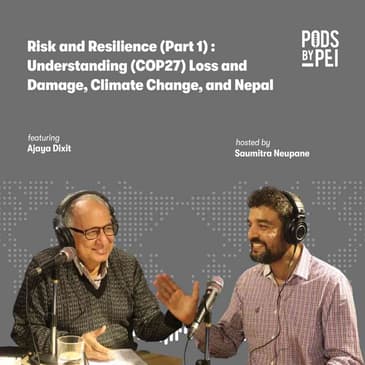
Ep. Co#007
The 2022 United Nations Climate Change Conference, commonly referred to as COP27, took place this November in Egypt. One major achievement of this round of dialogue, which went down to the wire, was to establish a loss and damage fund, particularly for nations vulnerable to the climate crisis. While this may have been “a historic decision,” it raises more questions than answers, especially for countries like Nepal.
In this first episode, Saumitra Neupane, Executive Director of Policy Entrepreneurs Inc, and Ajaya Dixit, a leading voice in Nepal, and internationally, on issues of climate change adaptation, resilience building, and disaster risk management, discuss the outcomes of the recently concluded COP27, including the issue of loss and damage. They follow this up with a wider discussion on the issue of climate change and what it means for countries like Nepal and the Himalayan region.
Mr. Ajaya Dixit, co-founder and advisor of ISET-Nepal is an Ashoka Fellow who has led different projects on climate change adaptation and resilience building, disaster risk management, energy, food security and water governance. He possesses MSc in Engineering from the University of Strathclyde, Glasgow, UK and undergraduate degree in Civil Engineering from Regional Engineering College, Orissa, India. He has directed regional research that examined climate changes impacts on flood, drought and food system adaptation in South Asia. His research focused on exploring the approaches to develop strategies for resilience building against climate change vulnerabilities at sub national scale. He coordinated and edited Nepal’s first national disaster report, which was published in 2010. He is also the lead author of the book “Nepal maa Bipad” (Disasters in Nepal) that was published in 2016. He has published extensively in prestigious journals such as the Economic and Political Weekly. His opinion is highly regarded in the international arena and has been regarded as a climate change adaptation and resilience expert in Nepal and South Asia.
[00:00:10] - [Speaker 0]
Namaste and welcome to PODS by PEI, a policy discussion series brought to you by Policy Entrepreneurs Inc. My name is Chedon Kansakar. In today's episode, the first in a two part series, we have Saumet Rinipane, executive director of policy entrepreneurs, in conversation with Ajay Dixit. Ajay is the cofounder and adviser at the Institute for Social and Environmental Transition, IZET Nepal. He is an Ashoka fellow and a leading voice in Nepal and internationally on issues of climate change adaptation, resilience building, and disaster risk management.
[00:00:46] - [Speaker 0]
In this first episode, Somithir and Ajay discussed the outcomes of the recently concluded COP twenty seven, including the issue of loss and damage. They also cover the issue of climate change and what it means for countries like Nepal and the Himalayan region. We hope you enjoy the conversation.
[00:01:08] - [Speaker 1]
Welcome to the show, Ajay. Really excited about today's conversation.
[00:01:11] - [Speaker 2]
Thank you. Thank you, Somitriji, for having me. I really look forward to this conversation. Well, I
[00:01:16] - [Speaker 1]
was preparing for this conversation, and I realized that I wanted to discuss so many things with you. But because we have so many topics to cover, we will be releasing our recording as two episodes. In the first part, we'll cover the outcomes and achievements of the recently concluded COP27 and slowly ease into the conversation about climate change impact in Nepal and the Himalayan region. In the second part, we will get into a more specific discussion about climate change, its impact on hydropower sector, and the development pathway of the country. Shall we get started?
[00:01:49] - [Speaker 2]
Of course. Looks looks challenging, but let's try.
[00:01:54] - [Speaker 1]
So, Ajay, how do you evaluate COP twenty seven's overall impact on moving the climate agenda forward? How far has this conversation evolved since COP twenty six?
[00:02:05] - [Speaker 2]
Well, I I I came from my place where I live in Balwatar. You know, I took a motorbike, you know, a pothal. And then I was as I was coming and it was a nice warm morning. You know, a little bit cold so I had to have a muffler. And then, of course, there were lots of cars and motorbike, not too much traffic, and, you know, little bit of a pollution.
[00:02:25] - [Speaker 2]
But life was going on, you see. It's just after the rainfall. We just finished out elections. So everything looks nice hunky dory. But up there in the mountains, you see the the global climate, the atmosphere is not what it used to be, say, hundred, hundred fifty years ago.
[00:02:42] - [Speaker 2]
Something else is going on there, and that's what COP twenty six and COP twenty seven become important.
[00:02:48] - [Speaker 1]
But as as with regards to the progress that the COP twenty seven has made, where was the point of departure when we ended COP twenty six?
[00:02:57] - [Speaker 2]
Well, I think we we we need to go back a year. We need to reflect or talk about COP twenty six. Right? COP twenty six was in a very different circumstance, global. And of course, from Nepal's perspective, Alok Sharma was here, the minister.
[00:03:14] - [Speaker 2]
He visited Mustang, and then there was a lot of sort of brouhaha and hype about The UK minister coming, talking about climate change impacts. Nepal's visibility was perhaps a little bit higher than what it was.
[00:03:28] - [Speaker 1]
So was our commitments?
[00:03:29] - [Speaker 2]
Well, I think, you know, our prime minister was there, and he said, you know, we're going to attend a net neutral by 02/1945. And of course, the loss and damage was also something Nepal talked about. But then something drastically changed after COP twenty six. The Ukraine war, the emerging geopolitics, the tension between these big emitters, if you will. And, of course, the assumption was that the COP twenty seven is going to be kind of a no go.
[00:04:02] - [Speaker 2]
You know, there's the international environment is not conducive to getting to a sort of consensus on some of these complex issue. Yet, we see some interesting and perhaps an historic decision regarding loss and damage in in in Egypt.
[00:04:20] - [Speaker 1]
Yeah. This is where where I wanted to expand the conversation more. So this year's COP was heavily about loss and damage. And as you said, while broadly still sitting outside, we did not expect strong commitments, but loss and damage seem to be the primary conversation for COP27, and the delegates had to go to overtime to fetch a deal on loss and damage. Can you talk about what this agenda actually is when it started, and why does it rank so very high as an interest for developing countries?
[00:04:53] - [Speaker 2]
You know, I remember in the mid nineties, that decade when I started to work on climate change, I remember once in Bangladesh, I was in a conference and there was participant from, you know, one of these small island nations in in the Pacific. And, of course, he was very passionate and concerned about the fact that their country might not exist fifty, sixty, seventy, eighty years from now as sea level rise due to due to climate change. And, of course, you know, after being after having just started some look into climate change dimension, You know, I was kind of a little bit sort of, you know, surprised. What the hell is this guy this person is talking about? But then when you go into literature, you find out that this idea of loss and damage, not exactly in that words or in that semantics, but in connection with sea level rise and kind of insurance against that threat, Vanuatu, you know, in 1991.
[00:05:50] - [Speaker 2]
This was even before you and FCCC began, you know, had raised this issue of compensation in in some sense, if you will, you know, because the emission of greenhouse gases, particularly by the rich countries historically, you know, has been one of the major factor that's making climate more erratic. But then subsequently, in some of these, in in most of these conversation, Gloss and Damage didn't figure. You know, it was mostly about mitigation. Even adaptation was a poorly, poorly recognized cousin. It was only after 2000 and perhaps even around 02/2005, 02/1967, adaptation began to get more traction in UNFCC conversation.
[00:06:34] - [Speaker 2]
And then it was in Bali, 02/2007, when the idea of loss and damage found was kind of an entry into the, into the UNFCC process. And then, of course, this has been guided by the fact that the climate disasters are becoming more extreme. They're becoming more frequent. Their magnitude is more than that used to be in the past. So therefore, developing countries, the vulnerable developing countries are unable to adapt to or respond to the kind of climate impact that's being faced.
[00:07:07] - [Speaker 2]
So therefore, that the damage and loss that they face needs to have some kind of support, stewardship, and so on and so forth. But I think in the conversation, the whole idea was on the question of compensation and liability, historical responsibility. Indeed, the UN FCC process did recognize CBD are common but differentiated responsibilities. But this idea of compensation was not known in the UN FCC process, and it went on like that for a long time. And then, of course, in February, you know, it was after COVID.
[00:07:47] - [Speaker 2]
It was perhaps the first physical COVID. President Biden was coming.
[00:07:51] - [Speaker 1]
This was last year in Glasgow.
[00:07:52] - [Speaker 2]
Last year in Glasgow. And, of course, Glasgow was where it all began, you know, when the steam engine, etcetera, the industrial revolution, etcetera. So perhaps there was lots of expectations, you know, of what would happen in Glasgow. But then, you know, they reaffirmed the commitment of 1.5 degrees Celsius, the Paris goal. There was this dialogue of phasing out or phasing down coal, but it didn't happen.
[00:08:18] - [Speaker 2]
It was watered down to phasing I think the terminology was not phasing down, but gradually phasing out, fading out. And, of course, the question of financing. In conversations since since 02/2009, the Copenhagen conference when these countries were expected to pay a $100,000,000,000 that didn't come out. And then, of course, loss and damage was again something that didn't happen in COP twenty six. But subsequently, you know, what triggered was, I think, this devastating flood Pakistan.
[00:08:51] - [Speaker 1]
This is where I wanted to Yeah. Kind of get is in the sense, it almost felt like this issue was at some point of precipice in the sense and it was backed by global events. I was thinking Pakistan as well.
[00:09:02] - [Speaker 2]
Exactly. I mean, if you look at the events, you have rivers drying up, you have heat waves, you have massive wildfires, you have extreme rainfall, you have floods. Then of course, these were going on. You know, you had examples in Europe. You had examples in Africa.
[00:09:20] - [Speaker 2]
You had in China. But I think the Pakistan flood was final nail in the coffin that the magnitude of this disaster was, you know, unprecedented. The rainfall, the floods, the impact, the amount of damage that happened, number of people who were affected. So I think it really emphasized the fact that, hey. Wait a minute.
[00:09:43] - [Speaker 2]
This is something we need to do. And then, of course, there were you know, I do recognize, you know, a lot of people from South Asia, including others, you know, friends and others who've been in this advocacy and arguments for a long, long time demanding that the rich countries pay the For the damages. The, you know, losses and damages. So I think, in that sense, I think this this is an indeed was was historical.
[00:10:11] - [Speaker 1]
Yeah. As you know, that there's been an historic agreement on establishing a loss and damage facility, how do you see this going forward? In a sense, how is it going to be implemented? I, for myself, am not clear as to who's going to put in money, how, and who's going to actually benefit from from this pool of funds.
[00:10:30] - [Speaker 2]
That's
[00:10:30] - [Speaker 1]
What's your impression on this?
[00:10:31] - [Speaker 2]
That's the details questions, isn't it, Sumitra?
[00:10:35] - [Speaker 1]
It is. But your initial impressions of how do you see
[00:10:38] - [Speaker 2]
this You've kind of highlighted it quite well. Yes. The agreement was on fund. If you look at if you again go back to COP twenty seven, Scotland put a little bit of a money, and it was was named stewarding money, you know, sort of a partnership money, not not in that compensation sense. So again, in in COP twenty seven, the language was not on compensation reparation, but it was on agreement to establish a fund.
[00:11:06] - [Speaker 2]
But then what fund, how much, who puts in money, where does the money come from, how it will be dispersed, what will be the criteria, those are the details that need to be worked out. And then I think I think it's going to be a bitter fight as we go on. And then the the next COP is going to be about UAE. I mean, let's not forget, it's it's it's a petrodollar state, you know, that that's going to be the, you know, COP chairman in 02/2023. And then, of course, you know, we can talk about it.
[00:11:39] - [Speaker 2]
We can talk about loss and damage as this historical achievement. But then again, in COP twenty seven, we have a story where, you know, lobbies from, you know, petrol companies, etcetera, were working behind the scene and in watering down the kind of ambitions on 1.5 degrees Celsius.
[00:11:59] - [Speaker 1]
You stole my
[00:12:00] - [Speaker 2]
upcoming question. So I
[00:12:03] - [Speaker 1]
on on loss and damage, I was reading through a few newspapers after COP, and it was dubbed a historic win and abysmal fail in the sense that the demand and focus on loss and damage took precedence over climate change mitigation. Some European countries have candidacies this, and that the focus on curbing fossil fuels, reducing greenhouse gas emissions, bringing down temperature to 1.5 degree thresholds, it really didn't see a lot of attention. How do you see this? Is this a signal that countries are quite content that they cannot come within the threshold of 1.5 degrees and rather pay their way through loss and damage?
[00:12:48] - [Speaker 2]
I hope that's not correct. I don't I I hope that's not the case because regardless of this historical decision to begin begin this provide this fund, we still have to address the emission problem. You know, we can't let emission just go like that. We can't just pump in gas into the atmosphere, and then the weather becoming more erratic, and then becoming more extreme, and then loss of damages increasing, and therefore going on paying for the damages. I think the UNFCC had two legs of negotiation, mitigation and adaptation.
[00:13:24] - [Speaker 2]
And I think the demand was to include loss and damage as the third leg. So I think that's been achieved. So I would hope that the focus would continue to be on all three, on mitigation, on adaptation, on loss and damage. Because we still need to adapt. We still need to find out a way we'll perhaps we'll talk about as we, you know, as we go on.
[00:13:47] - [Speaker 2]
But I thought I hope that's not true, that we have not forgotten 1.5 degree sort of our aspirations and then say, oh, well, you know, it's 1.5 is something that's not achievable, so therefore, let's go on with their ongoing business. I don't let's let's hope that's not that's not the case.
[00:14:02] - [Speaker 1]
Yeah. It's one of the critical for a moment, step back, and look at how that conversation has been evolving. And I see a lot of times for developing countries, while the impact and damages and losses from climate change, is that the focus sometimes feels that they're heavily on climate financing. So it's always that conversation that seems to inform how countries are positioning. So I kind of feel scared.
[00:14:33] - [Speaker 1]
Maybe scared is not the right word, but I have a reservation of how countries are positioning with loss and damage and how this might move the conversation for regressively against climate change mitigation. So
[00:14:45] - [Speaker 2]
You have raised an interesting point, and that's something we really have to be careful. That entire focus on financing perhaps could lead to, you know, our attentions and other important factor being diluted. They focus on mitigation, they focus on decarbonization, they focus on increasing penetration of renewables energies into the system, and then adaptation. You know, if you look at, say, the monsoon of 02/2022, we had floods. We had little bit of landslides.
[00:15:17] - [Speaker 2]
02/2021, October after monsoon was officially declared over, you know, where this extreme rainfall in the West, also in Uttarakhand, and then the weather system moved east and in East Nepal. Unfortunately, the forecasting, the warning was accurate, you know, fairly accurate forecasting in the sense of saying, alright, we're going to get extreme rainfall. Yet, yet, we had damages. We had damages of standing paddy, we had damages of road, and so on and so forth. So therefore, that tells us that tells us that, yes, weather might be extreme, disaster might come, but we need to be prepared for addressing concerns of the farmers.
[00:16:05] - [Speaker 2]
Money is important, but they also need food. They also need to protect their paddy that was almost ready for harvest. How do you do that? How do you do that at scale? Who's responsible?
[00:16:19] - [Speaker 2]
Is the center central state or is the provincial government? Is the local government? How does that ecosystem work? So those are very, very important question, and I think we should not let our attention divert away from this particular challenge.
[00:16:35] - [Speaker 1]
At the heart of this whole conversation is curbing mitigation. Right? How do you address mitigation problems of climate change? I I think this has been a great round of of COP twenty seven, and while feels that they've been important, achievements, especially with loss and damage facility, sure looks, that there are still things to be defined, and it would be interesting to observe how how things unfold in the next COP. But before I let you go on COP twenty seven, as a point of interest for Nepal, were there anything else that Nepal positioned during COP twenty seven, or any topics of interest besides loss and damage that Nepal was pursuing?
[00:17:17] - [Speaker 2]
Well, I think we did talk about the mountain challenges and the mountain agenda, which I think has been something that Nepal has been advocating for a long time. I think it was then the, you know, normal agenda of the UN FCCC processes as a part of least developing country court with often we are part. And then, of course, those who are in the in the conference must have participated in a lot of this, you know, side events and other kind of conversation. But, of course, you know, those are something we can just guess. And maybe those who were in the in the conference can tell us more more about what transpired there.
[00:17:53] - [Speaker 2]
I just wanted to highlight one complete one point on loss and damage. You see, last year, I was involved in preparing the national strategy for loss and damage government of Nepal. What we did was to look at the state of play. We looked at the global politics. We looked at the ways in which loss and damage are assessed, you know, what would be the method.
[00:18:17] - [Speaker 2]
And what I found out, we found out that, yes, it's a important area, serious area, but we still don't have those, you know, systematic methods of assessing. We know what is loss, we know what is damage. We know what is economic loss, what is not non economic loss. But how do you assess it? What systematic method we use to assess that?
[00:18:38] - [Speaker 2]
How do you assess damage that will happen, say, five years from now? Right? So those are very conceptually and operationally difficult challenge that we need to think about.
[00:18:49] - [Speaker 1]
So loss and damage, almost feels that you need a lot of credible data to to make decisions around loss and damages, especially countries would be interested to who are ready to fund would say, where is the data? What is the basis for you to make this decision? Do you think there is enough data or the data ecosystem in the region itself for us to make accurate estimates on loss and damages for any form of future compensation?
[00:19:14] - [Speaker 2]
That's a million dollar question, Sumithra.
[00:19:18] - [Speaker 1]
What would be the answer?
[00:19:19] - [Speaker 2]
Well, answer would be difficult, you know. Let me look at data data architecture in Nepal. You know, if you look at the the the literature, and if you look at the literature, you would find, you know, different sources. You'd find floods and landslides and snake bites and wind, fire, all these hazards causing disaster. And you would find lot of fragmentation in that literature.
[00:19:45] - [Speaker 2]
Last several years, at least we have one portal, the portal that is maintained by the Ministry of Home and with the disaster management authority. At least you have now a coherent systematic platform where you get this data. Alright? But this data system, again, you have the death, fairly accurate. You have those who are injured, fairly accurate, missing.
[00:20:12] - [Speaker 2]
And then you have economic damages in terms of, you know, how much houses are damaged, how much crop is, you know, lost. But then you go to other infrastructure system. You go to hydropower, you go to roads, you go to bridges, you go to agriculture loss. Those damages don't find salience into the data architecture. It is still siloed within respective sector.
[00:20:38] - [Speaker 2]
So there is lot of work that needs to be done. Lot of work that is to be done as to who's collecting the data, at what level, using what methods. How do you ensure that core is? So that's a that's a area for not just climate change, but also for disaster risk reduction.
[00:20:55] - [Speaker 1]
Absolutely.
[00:20:56] - [Speaker 2]
So these two area kind of, you know, coalesce into one. Floods exacerbated by climate change. Extreme events, extreme rainfall that leads to floods. But it's just not the extreme event that leads to flood. It's also the landscape.
[00:21:13] - [Speaker 2]
I'm sure we'll talk about as we go on. But so this is this is something where Nepal really needs to focus on. Focus on that we're doing our homework, we're doing correct assessment what's going on, we build the institution, and we need support, you know. We need support to do that. We need engagement with international actors, other communities.
[00:21:35] - [Speaker 2]
And then, course, we we could talk about attribution, but then maybe
[00:21:38] - [Speaker 1]
as we go For some other time.
[00:21:40] - [Speaker 2]
Maybe. For some other time.
[00:21:41] - [Speaker 1]
Yeah. Excellent. This is a great round off for Coppedrans. Mean, thank you.
[00:21:49] - [Speaker 0]
You have been listening to PODS by PEI. I am Saddon Kansakar, and this is a quick reminder to all of you to do us a favor by sharing us on social media and leave a review on Spotify, Apple Podcasts, and Google Podcasts, or wherever you listen to the show. Now let us get back to the conversation between Samitra and Ajay.
[00:22:11] - [Speaker 1]
Ajay, before we go further in discussing the issues of climate change and what it means for countries like Nepal, what might be of help for some of our listeners who may not be attuned to this topic is if you could shed light on some key concepts and terminologies from the climate change discourse. Meaning and interpretations to word like risk, resilience, adaptation, attribution, etcetera. I'm sure the meanings are much more nuanced than what it is used in common pardons.
[00:22:38] - [Speaker 2]
Thank you for asking that question, Sumitra. You know, I've been working in this climate dynamics maybe for about now, how many? Twenty, twenty five, thirty years. And when I started, I had challenge. I had difficulties.
[00:22:55] - [Speaker 2]
You know, let me start with adaptation. In the nineties, the discourse was Nepal needs to adapt. Nepal needs to adapt climate change. Now, somebody who just started looking into this dynamics, I was intrigued. What does Nepal adapt mean?
[00:23:11] - [Speaker 2]
You know, Nepal is a diverse country. We have Himal, we have mountains, We have valleys. We have Tarai. We have East. We have West.
[00:23:19] - [Speaker 2]
Olang, Chunggola in the East is very different from, you know, Kailali and Kanchanpur. So I was kind of very intrigued, you know, what does that mean? Of course, I had no answers. And, of course, the conversation was also you know, global conversation was perhaps also a little more not nuanced. So as we worked on, we part of this research ecosystem, we tried to find out what does that mean in terms of practical use.
[00:23:45] - [Speaker 2]
What does it mean for a a normal individual, working individual who's not aware of these different terminologies? So we try to conceptualize adaptation as, of course, there is IPCC and other excellent definitions, you know, done by exceptional individuals who have studied, put of these definitions. So we said, In a practical terms, adaptation is about changing your strategy. You have something that you do. You face a stress.
[00:24:18] - [Speaker 2]
You face a shock. That means that the normal approach that we have taken to respond doesn't work. So you have that skill, you have that wherewithal, you have the ability to switch strategy and do well. That's the that's the way we begin to explain that. Now coming back to these terminologies, I talk a lot of with my friends, you know, who are not in the climate business, but educated engineers, doctors, lawyers, others.
[00:24:47] - [Speaker 2]
And I say, do you follow climate change? I say, we do follow, but I think there are people who are working on it. They'll find some answers. I ask them, like, what does WIM mean? You know, with loss and damage, there is this terminology called Warsaw institutional mechanism.
[00:25:04] - [Speaker 2]
So those who are in this discourse would understand it. Although, other one is a Santiago network. People would understand it. But for many, it will be absolutely, you know, what does it mean nobody understand. Similarly with risk and resilience.
[00:25:19] - [Speaker 2]
Alright? What does risk mean? You can define risk technically, potential harm that can happen in the future. And I think COVID has helped us perhaps understand that idea better.
[00:25:33] - [Speaker 1]
Just a small interjection. You mentioned like early nineties beginning with adaptation. Looking at the climate change terminology discourse, it almost feels that that too is evolving these days. Oh, yeah. So from adaptation now, the conversation seems to be heavily around risk and resilience.
[00:25:52] - [Speaker 2]
Indeed. Adaptation was an evolving knowledge. Humans have adapted to climate variability, the natural climate variability. Even if you look at our own landscape, you know, our ancestors have been around for thousands of years, you know, within the limitations. But what does adaptation to anthropogenic climate change mean?
[00:26:13] - [Speaker 2]
Human action induced climate change. Mhmm. We're talking about perhaps much more shorter times timescale. We're not talking about a hundred, two hundred years. So in the nineties, if I remember and when we worked, we thought we had time.
[00:26:27] - [Speaker 2]
We thought we had time to understand what adaptation means, identify its attributes, put systems in place, change policies, etcetera. And then at the end of the day, you know, we'll be able to deal with the, you know, extreme climates that's coming in. Unfortunately, the pace of change has been extremely rapid over the last, you know, five to ten years. The emission has gone up, weathers have become more erratic. Of course, then scientists tell us, you know, WMO and others tell us that, you know, things are becoming more and more more and more critical.
[00:26:59] - [Speaker 2]
But seems to me, you know, some of these conversation some of these conversations have to be simplified. Some of these conversations, I think, have to be communicated well. From jargon, we have to go to day to day language, something that people can connect. Absolutely. You know, that's very important.
[00:27:16] - [Speaker 2]
So why these terminologies like risk and resilience and, you know, greenhouse gas and conference of parties and scenarios and, you know, national adaption plan of action and local Adaptation Plan of Excellence are fine. But we need to expand the conversation. We need to expand the conversation and make it a business of perhaps common men. Because the problem is universal. It's just not the responsibility of the experts.
[00:27:44] - [Speaker 2]
You know, the experts have to be brought into demystifying, if you will, this this this knowledge. It's just not a technical problem. It's a political problem. It's also a cultural problem. It's also about our behavior.
[00:27:59] - [Speaker 2]
That then, you know, makes it really as a a a, you know, you know, serious challenge.
[00:28:04] - [Speaker 1]
If you would take an attempt to demystify current buzzwords around risk and resilience, these two seem to be quite popular around climate change discourse. How would you explain that to a layperson?
[00:28:17] - [Speaker 2]
I'll tell you a story. You know, we're we're working on a on a on a study on the Ganagi Basin. And in Pokhara, we had all these partners from Mustang in a meeting. And then I was trying to explain resilience. And I said, oh, resilience is a capacity to bounce back into your previous state.
[00:28:36] - [Speaker 2]
And there was this teacher, you know, Dhanakumari Gaurbhuza, and she said, sir, that's not right. Coming back to your previous state means to a condition where we have no water, we have no electricity, we have no road. That is not what we think should be coming back to. Then I realized lost in translation. We were not able to communicate, you know, the the the the exact meaning.
[00:29:00] - [Speaker 2]
So I said, well well, I said, well, then resilience would be an inner strength. Inner strength to deal with difficulties in life. It could be at a personal level. It could be at a organization level. It could be at a community level, and then do well.
[00:29:16] - [Speaker 2]
Do better than that we're doing before you face that stress. So that's how I try. For example, things like migration, if you will, you know. We talk about push and pull factors, you know. Migration is fostered by pull and push factors.
[00:29:33] - [Speaker 2]
So we say instead of that, we're going to say, you know, cities are magnets. You know, cities are where everyone wants to come. You get job, you know, you get new opportunities, you get employment. So perhaps avoiding jargons. They might be needed in, you know, academic and other kind of conversations, but at least with common folks avoid those jargons.
[00:29:51] - [Speaker 2]
Find out simple words. Find out local words if you will. Alright? Don't go into some of this, you know, abstract translation. If I could work either word adaptation in Nepali, we call it, you know, for
[00:30:05] - [Speaker 1]
That's a difficult word
[00:30:06] - [Speaker 2]
for me. That's a difficult word, you know. I can't talk with my wife or my other colleagues about, oh, I face the difficulty, so I get. No. It is.
[00:30:15] - [Speaker 2]
Alright. Alright. Or even resilience. You know? Resilience is It might be good in writing, but it doesn't fit into the conversation.
[00:30:26] - [Speaker 2]
Right?
[00:30:26] - [Speaker 1]
Not at all.
[00:30:27] - [Speaker 2]
Not at all. So those are those are the challenges, I think. And the risk is bit complex, you see. I mean, how do you understand what harms that might happen to you in the future? Again, if I look at two years of of COVID, let me, you know, sort of, you know, try my try my try my effort.
[00:30:47] - [Speaker 2]
Let's see. If you have a medical condition, if you have preconditions, if you have not well, you are not washing your hand, you're not putting mask. Right? You're not maintaining basic sanitation, etcetera. And then you go to a crowd in a COVID situation.
[00:31:03] - [Speaker 2]
Of course, you know, you are likely to get contracted by the disease. But if you put mask, if you wash hand, if you avoid crowds, if you do all kind of things that's been told you not to do, then you're kind of safe from safe from that from that exposure. Climate change is hard because so many things are happening. Floods. Floods are extreme event in Mustang.
[00:31:27] - [Speaker 2]
Alright? 02/2021, we had mixed extreme event in Manang and Mustang. Those regions basically get snowfall. This time, that time, there was rainfall, high intensity rainfall. Or we looked at the images and said, wow.
[00:31:43] - [Speaker 2]
Lots of rains and all. But then, you know, two days later, it just goes out of our memory. And then it becomes responsibilities of those individuals who face it. So I think that's a challenge, you see. And that's a challenge of how do you really make it a people's concern.
[00:32:05] - [Speaker 2]
Until it affects you personally, you're not perhaps, you know, as much connected or concerned.
[00:32:11] - [Speaker 1]
So if I'm to oversimplify this, the key takeaway for me, please correct me if I'm wrong, is that, when we're talking about climate change, broadly, a lay understanding would be about extreme events and how that might unfold. While extreme events like rainfall and or slow induced changes like glaciers melting, while it might have its own categorical risks, but really risk and resilience is defined by how you've kind of embedded that particular risk event into a broader system of how society is governed, operated. So things like the policies that you have created, the institutions that you have, the kind of people you have behind these institutions, they really matter to define what risks and resilience shape how we deal with climate change.
[00:33:04] - [Speaker 2]
Thank you. Thank you, Somitra. I think you you kind of really simplified it. Climate change impact doesn't happen just like that. It doesn't happen in one one element of society.
[00:33:14] - [Speaker 2]
Society. It's It's just just not not a people who will be hit. People are hit indeed. If you are in the harm's way, for example, if you are affected by floods, if people live on the flood plain. Why do people live on the flood plain?
[00:33:30] - [Speaker 2]
People don't live on flood plain by choice, or somebody gets hit by landslide. You know, you live on landslide prone areas. Nobody likes to live in landslide prone areas. So there are social and historical and other kind of processes that defines that that that dynamics. Right?
[00:33:50] - [Speaker 2]
But then but then exposure is important, so is the hazard. So in such an exposed position, if you have extreme rainfall, clearly, you know, you're going to be affected. Now that extreme rainfall is not a aberration. We used to have extreme rainfall in past. But the point is that this extreme rainfall, the change in atmospheric energy by greenhouse gases, has changed that dynamics.
[00:34:18] - [Speaker 2]
So therefore, the rainfall is more erratic. And then, of course, you've said, so it's the people who will get affected. It's the infrastructure that we have built that get affected. And then what are the infrastructure? Roads, drinking water, irrigation systems, water supply, health, schools.
[00:34:37] - [Speaker 2]
Right? Communication. They get hit. They get services. And then how do the infrastructures get affected?
[00:34:45] - [Speaker 2]
How have we built them? How have we designed them? How do we maintain them? Do we consider specificity, for example, of a hill slope, its geology, its water dynamics in aligning a road? That becomes important.
[00:35:03] - [Speaker 2]
And then that takes us back to, as you have rightly pointed out, our policies, our norms, our behavior, the way we do engineering, etcetera. So broadly, we can group them into hazard and exposure. Hazard is event. Event like rainfall or event like gloss or event like extreme wind. We had one extreme wind in Barra in two thousand
[00:35:30] - [Speaker 1]
Few years ago.
[00:35:31] - [Speaker 2]
Few years few years ago. So that's that's one. And then then you have this infrastructure that we have built. You have the natural system that we have in place. Now nature gives us services.
[00:35:43] - [Speaker 2]
It gives us water. It gives us air. It gives us other kind of services, and people use that. And then, of course, you have the rules and regulations. And you have managers who manage infrastructure.
[00:35:56] - [Speaker 2]
So it's this composite that determines whether risk is high or vulnerability high, or resilience is lower or accumulated.
[00:36:06] - [Speaker 1]
Excellent. I mean, this is a really fascinating framework, and I want to take this forward and kind of nuance this on the topic of climate change in Nepal. Given your long and continued engagement on the topic, I would like to hear from you about the significance of climate change in Nepal. My point of interest being, as a Nepali, should my interest and concern be limited to what the global narrative is around global warming and the melting of the Himalayas, etcetera, and its related consequences? Or there is more for me as a Nepali to show concern for, given your systemic your framework on what you just described?
[00:36:47] - [Speaker 2]
Well, first of all, I think it's it's a global problem. The problem's genesis or origin is outside our border, outside our territory, outside our sovereign boundary. So it's kind of a is a is a is a is a global common, the global atmosphere which is being subjected to, if we will, different kind of changes, you know, that started, you know, during the industrial revolution, industrial era. That's why in climate conversation, we always talk about 1.5 degree above industrial average. Two degree because industrial average.
[00:37:23] - [Speaker 2]
That's an important point for us to recognize. Because the reference point reference is era which is 150 ago. And that was, of course, a historical, economic, financial, colonial process that was at work. And then, of course, industrial revolution gave us benefits. It it it give humanity benefit.
[00:37:46] - [Speaker 2]
It allowed us to address poverty. It allowed us to get medicines, minimize disease, etcetera and etcetera. But then it also had its externality in the form of the emissions. Perhaps it was not accounted for only in the in the in the in the period. If if it was costed, well, perhaps, you know, we'd be in a different territory.
[00:38:07] - [Speaker 2]
But the fact of the matter is that it's a reality. So therefore, we cannot discount or we cannot forget this global dimension. And there is a huge politics that globally and we talked about it, There you is power behind it. There are interests behind it. At least we don't talk much, but then if you go to the Western society, there are deniers.
[00:38:28] - [Speaker 2]
There are those who says climate change hasn't happened. Alright? And we saw that in The US in the last election. The new administration came, they withdrew from the alright? So therefore, that's a political reality and that still exists.
[00:38:42] - [Speaker 2]
So we need to recognize that. But then but then country like Nepal are in the sort of, you know, front front line of climate impact. Number one, ours is a diverse country. As we talked earlier, we have Himal, we have hills and valleys and Torai. Now, each of them have unique ecosystem.
[00:39:02] - [Speaker 2]
They have unique climate. And then, of course, there is unique social arrangement within this ecosystems ecosystems where we have lived and where we have survived. We could question how we have survived. We have our own limitations. We have our challenge even within our, you know, national boundary.
[00:39:19] - [Speaker 2]
Some of us are doing well, others not doing well. Question of representation, question of social exclusion, so on and so forth. But fact of the matter is the global process, the global phenomena is having an impact. Yeah. And you see that you see that impact say more directly perhaps on snow.
[00:39:37] - [Speaker 2]
Mhmm. You know, you you get snow more more directly. You know, you see that in sea level rise. You can directly relate increasing temperature to sea level rise.
[00:39:48] - [Speaker 1]
Or the melting of the snow.
[00:39:49] - [Speaker 2]
Or the melting of the snow. But when you come to rainfall, it's a little bit dicey. It's it's very hard. Local weather patterns. Yeah.
[00:39:56] - [Speaker 2]
You have local weather patterns. We don't have enough data sets to link it to the global system. Scenarios have limitations. Model have limitations. Temperature wise, we can be more sure.
[00:40:09] - [Speaker 2]
Historical records, model studies, our own experience tells us that temperatures are rising. That's more monotonic. But rainfall is difficult, you know. We can say rainfall is becoming more erratic, that there is a trend, but it's still very difficult to attribute one weather event to climate change.
[00:40:32] - [Speaker 1]
Just coming back to the discussion in Nepal, and I recognize the fact that there is a global phenomenon, and it's not just what Nepal is doing that has impact on climate change. But coming back to our early conversation on risks, you you mentioned institutions, infrastructure, natural ecosystem. What are the critical risk factors do you think that are really exponentially increasing Nepal's exposure to climate change on its impacts? Internal risk factors.
[00:41:06] - [Speaker 2]
I think well, we have an aspiration for development. That's that's fine. We want better health care. We have better education for our kids. We have better commuting, better access to market.
[00:41:18] - [Speaker 2]
Those are fine. Those are something that citizens aspire, and that's the responsibility of the state. But I think the challenge or problem emerges when, you know, we don't recognize the the the specificity of our landscape. For example, if you talk about the hills of Nepal, these are not Rocky Mountains or the Alps. These are geologically young mountain range.
[00:41:42] - [Speaker 2]
These are fragile. So you cannot intervene in this fragility without recognizing the specificity. Let's look at road building, for example. Road are necessary, no doubt about that. But the way we are building roads in the in the in the in the hills, As we call in Nepal, dozeray roads, you know, roads that's essentially designed or aligned by excavator or dozer drivers.
[00:42:09] - [Speaker 2]
Do do not heat to geology. Do not heat to the the the environment. Do not heat to water flow. Do not heat to hydrology. So what do you essentially have is, you know, you dig a track, and the next morning you have a massive rainfall, and that everything comes down.
[00:42:26] - [Speaker 2]
So therefore, both are important.
[00:42:28] - [Speaker 1]
Yeah. This is something that we've also studied. So I would urge our listeners to go and check out PI's website to see the political economy of local roads. This is something that we've tracked ourselves.
[00:42:39] - [Speaker 2]
Yeah. I mean, I've also done a done a study on political economy of roads for 2,022 landslides. And very clearly, we I'm sure your studies does that too, that road building practice has influence on, you know, how landslide have occurred. So the practice of development, how do we align our aspiration for development, the need for development with this emerging risk? You need to begin to again go back to science.
[00:43:07] - [Speaker 2]
We need to understand how climate and the weather pattern is changing. We need to invest in scientific paraphernalia. We need to think about how we design our infrastructure, how we design our roads. We need to go back to our codes, our design assumptions. We need to look at our policies.
[00:43:23] - [Speaker 2]
We need to look at the capacity of individuals. We need to look at capacity of those who manage stuff. So so clearly clearly, Sumithra, there is a there is a case for, you know, doing things differently.
[00:43:36] - [Speaker 1]
Absolutely. I agree, and I I would like to engage on the point that you made that rule of policies and institutions really matter in how, we we make choices around climate change in the reality of climate change. And at this point in time, I I would like to ask you, Ajay, what is the current policy architecture around climate change, and how do you think is is the current structure of policies responding to what you just said on rethinking of how we do development here in Nepal.
[00:44:11] - [Speaker 2]
First of all, let let me take a little bit of a sort of in a reflective perspective. Policymaking is something that government does, and government's policy is meant to provide a guarantee, if you will, that this is what the government is committed to do, a little bit within a bureaucratic framework. But what we're facing is a context that is changing so fast. So on one way, you need to be much more iterative, reflective, looking at what's going on and change the way you do business. That's not that that's a reflection.
[00:44:44] - [Speaker 2]
But other point, you know, in terms of policies, we have plethora of policy. I'm sure, you know, you you you know, done that. We have plethora of policy, and they look good on papers. Thanks to those who have crafted those policies. But how are we doing it in the field?
[00:45:01] - [Speaker 2]
How are we applying, you know, those policy into practice? That, think, is the central point. That's what I think we need to we need to hit and question and, you know, critique and get into more conversation dialogues. I don't think we have done well in terms of implementing policies. I was looking at the the MOFE's website.
[00:45:23] - [Speaker 2]
You know, there are about 29, twenty twenty nine, 30 documents that we have prepared. We've done well. We understand the problem. We know we looked at trace. We looked at vulnerability.
[00:45:33] - [Speaker 2]
We looked at what's going on in, you know, different different areas of Nepal. But perhaps not translated effectively into into into practice. Have we changed the way we build roads, for example? No. Have we really considered the things of flood?
[00:45:50] - [Speaker 2]
To some extent, yes. We have now early warning systems in place where lives have been saved compared to maybe ten years ago. So that's a good news. And this is a partnership between the government agency. There's a partnership between community.
[00:46:06] - [Speaker 2]
There's a partnership with the private sector, telephone service providers, both NTC and the private sector. So this is an innovation and good news, and we've done it. You know, there's something we have to be very proud of, but much more needs to be done. You know, much more needs to be done because we constrict the flow, we narrow the river. River does not have flow, you know, space to flow.
[00:46:29] - [Speaker 2]
And then, of course, you know, when you have extreme rainfall in the watershed and you have constricted flow, you're going to get more floods. Mhmm. And that's what that's what happened in Pakistan. The weather attribution group looked at the events. They said, yes, climate change has exacerbated the extreme events.
[00:46:49] - [Speaker 2]
But but the damage was also exacerbated by what they call outmoded river management mechanism. Outmoded river management system. So therefore so therefore, it's just not the sky that is changing, but I think we also need to look at our own
[00:47:06] - [Speaker 1]
How we respond.
[00:47:06] - [Speaker 2]
How we respond, how we have done, and how we change our way of doing business, way of doing things to suit this emerging reality.
[00:47:19] - [Speaker 1]
And on that note, we come to the end of the first part of my discussion with Ajay.
[00:47:24] - [Speaker 2]
Thank you, Samudra.
[00:47:34] - [Speaker 0]
Thanks for listening to Pods by PEI. I hope you enjoyed the first part of the conversation between Salmitra and Ajay on the topic of COP twenty seven and the issue of loss and damage as well as what climate change means for countries like Nepal and the Himalayan region. Catch the next episode where the two continue to discuss the possibility of Nepal's net zero emission goal, the impact of climate change on Nepal's water, energy, and infrastructural development, and the way forward from the prevalent state of water resource planning and development in Nepal and the South Asian region. Today's episode is part of the conversation. It is part of the series, the present and the future of Nepal's water and energy sectors.
[00:48:14] - [Speaker 0]
It was produced by Nerjin Rai with support from Saurabh Lama and Khushi Hang. The episode was recorded at PEI Studio and edited by Nerjin Rai. Our theme music is courtesy of Rohit Shak Kyo from Zundabad. If you like today's episode, please content, please search for policy entrepreneurs on YouTube. And to catch the latest from us on Nepal's policy and politics, please follow us on Twitter at tweet to PEI.
[00:48:52] - [Speaker 0]
That's tweet followed by the number two and PEI, and on Facebook at Policy Entrepreneurs Inc. You can also visit pei.center to learn more about us. Thanks once again from me to head on, and we'll see you soon in our next episode.