
#Ep.041
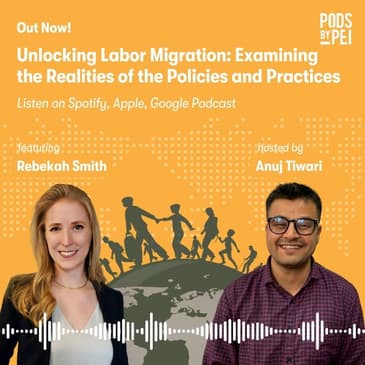
In this enlightening episode of the PEI podcast, we delve into the intricate dynamics of international labor migration. Join our host, Anuj Tiwari, as he engages in a riveting conversation with Rebekah Smith, a renowned expert in labor mobility and public policy. They unpack the multi-layered economic and social impacts of labor migration on the host nations, migrant workers, and countries of origin.
Explore how labor migration policies necessitate careful balancing, addressing the often conflicting consequences for all involved parties. We delve into the tough decisions that inform the design of labor immigration policies, highlighting the integral role of ethics and values beyond mere facts.
Drawing on Rebekah's extensive experience and scholarly publications, we discuss effective migration systems, the global effects of migration on stakeholders, and optimal responses to these challenges. Rebekah, the executive director of Labor Mobility Partnerships, boasts a wealth of experience in addressing market and regulatory challenges obstructing safe and effective labor mobility.
Your support on Patreon allows us to bring these crucial global issues to the forefront. Click here to support us!
[00:00:11] - [Speaker 0]
Namaste and welcome to Pods by PI, a policy discussion series brought to you by Policy Entrepreneur Singh. My name is Ridesh Sapkota. In today's episode, we have PI colleague Anuj's conversation with Rebecca Smith on unlocking labor migration, examining the realities of the policies and practices. Anuj and Rebika discuss the complexities of labor migration policies, considering the perspectives of host countries, the sending countries, and also the migrants. The discussion is based on Rebika's many publications on effective migration systems and draws from her expertise to explore the global impacts of migration on its stakeholders and how they can best respond to it.
[00:00:51] - [Speaker 0]
Revika is the Executive Director of Labour Mobility Partnerships, an organisation that works to address market failures and regulatory barriers that impede safe and effective labor mobility. She has a master's degree in public policy from Harvard Kennedy School and has experience working with institutions helping them build capacity to access effective labor migration. We hope you enjoy the conversation.
[00:01:18] - [Speaker 1]
Welcome to PODS by PER, Rebecca. I appreciate you accommodating the time difference to make this happen. How are you doing today?
[00:01:26] - [Speaker 2]
I'm wonderful. Thank you for having me.
[00:01:30] - [Speaker 1]
Great. Shall we start then?
[00:01:32] - [Speaker 2]
Let's.
[00:01:34] - [Speaker 1]
Let's begin this talk with your interest in labor mobility policy. Could you please tell our audience your interest, how your interest grew in this subject?
[00:01:43] - [Speaker 2]
Yeah, absolutely. So I came from work in international development. And as I studied and worked in the different ways that we tried to help people around the world move out of poverty, I became increasingly frustrated with how little impact I found that I could have. It seems as if the more I studied, the more I realized that we don't actually have good answers on how to help people move out of poverty, especially, you know, within their lifetimes, within a reasonable amount of time. And then I started learning about migration.
[00:02:20] - [Speaker 2]
And I learned about the massive poverty alleviation potential that someone can increase their income by, you know, five to 15 times just by entering the same exact job in another country. So when you chart that sort of gains on a graph against other poverty alleviation interventions that are being funded by foreign aid, you can't even see the other poverty interventions on the graph. There's just absolutely no comparison to the power of migration to really transform the economic opportunity of a family born in a low income country to the other efforts that the development community is currently undertaking. So for me, that was a really compelling reason. And then I got very passionate about trying to expand opportunities for people to work in other jobs abroad as a way of giving their families access to better economic opportunity.
[00:03:23] - [Speaker 2]
And it's also a matter of justice, because by far the most important determinant of your well-being in life is just the country where you were born. So more than your race, more than your gender, more than anything else about you, what is most important to determining the jobs you'll have access to, the skill and education you'll have access to, is just where you're born. And that's a fundamental matter of justice, right? We can't accept a world where the life someone gets to leave, live, is determined only by where they were born. If you think about, there's been entire movements around creating economic opportunity, equal economic opportunity for women and men, for people of all races.
[00:04:13] - [Speaker 2]
But we really haven't focused on this fundamental driver of your well-being. And so that's what I and my organization, Labor Mobility Partnerships, are working on, is to expand access to that economic opportunity to people all around the world.
[00:04:30] - [Speaker 1]
Wonderful. Thank you for sharing. It is indeed excellent the work that you are doing. Moving on, let's discuss migration and the global impacts of labor migration at large while referring to your publications and other relevant resources. But before we get into what is in the policy note that you authored and its implication to sending countries like Nepal perhaps we should begin with a brief background on your research.
[00:04:59] - [Speaker 1]
So can you tell us why you picked this particular research topic and how you went about it?
[00:05:05] - [Speaker 2]
So I work specifically in the policy and practice of migration. So once I realized the powerful potential of migration to unlock that economic opportunity I described, then I started wondering, why aren't we doing more about this? Right? And when you look at the growing youth populations in low income countries, and the aging populations in high income countries, it's clear that there's an opportunity here. Right?
[00:05:37] - [Speaker 2]
That people born in low income countries need jobs, and high income countries need workers. So while migration policy is something that's been stuck for, well, I think as long as any of us can remember, there's really an opportunity to unlock this right now. And so then I started digging into how to unlock migration. How can we create access for people from countries like Nepal, countries like Mexico and Colombia, and many of the other places we work to to work in places like Germany and The US and Canada. And one of the things we've discovered is first that most people, most voters in high income countries are actually not very for or very against migration.
[00:06:26] - [Speaker 2]
What they are is nervous about the way that is currently happening. So you can see that there's a way to actually move the politics of migration by designing technically sound migration models that lead to some of the good outcomes we'll talk about later. So that's one, is we wanted to design technically sound migration systems that can actually speak directly to voter concerns in high income countries. And then the second thing we realized is that there's actually a lot of currently unfilled visas that are blocked by obstacles on the sendings on the pre migration side, like access to skilling and language training and finance. And those are also all things we can solve.
[00:07:08] - [Speaker 2]
So we realized that there was an opportunity to move more people into jobs today without any policy change if we just solved those obstacles. So that's how we've picked some of these topics, is realizing that there is an opportunity to move forward on migration, and wanting to really identify what some of those solutions are.
[00:07:26] - [Speaker 1]
Great. A lot has happened in the world since you published your policy note and other resources. The COVID-nineteen pandemic and the Qatar World Cup are the major events that directly impacted labor mobility especially from the countries in Global South to the Gulf Cooperation Council or GCC in short. We'll discuss your analysis in the in the context of the changes in subsequent actions but before we go any further just to bring everyone on the same page can you please clarify one thing for me In the policy note you mentioned that an effective migration system is where and I quote workers regularly and predictably move through the channels and workers rights are protected through clearly defined and fully implemented terms of migration. Could you please elaborate on these?
[00:08:18] - [Speaker 2]
Absolutely. And yo, in some way, these are probably overly complicated ways of saying very simple things. So what we mean by regularly and predictably is that a substantial number of workers need to be able to move to fill jobs abroad. So you need to be able to see that in practice, workers are actually moving into jobs abroad. And this is important, first, for the system to be fulfilling its intended purpose, that workers are having access to jobs, and employers are getting the workers they need.
[00:08:49] - [Speaker 2]
But it's also important to limit the incentives to migrate irregularly. So I've worked in a number of countries where the migration process is so expensive and lengthy and convoluted that, you know, the logical choice for workers is to migrate irregularly. And that's exactly what we see happening. So the first thing we need in a migration system is to actually create real migration opportunities that are accessible to both migrants and employers. So that's the first bucket.
[00:09:20] - [Speaker 2]
And we know that predictability, so knowing the terms of migration, knowing how long it's going to take, knowing what it's going to cost, is critical for getting employers to engage in the system, and it's also critical to protecting the rights of migrants. And so that maybe leads us to the second point, which is that workers rights need to be clearly defined. So everyone needs to be on the same page as to what rights the workers have access to. The migrant needs to know very well and completely understand upfront the terms and conditions of their migration experience. And then those terms and conditions need to be met in practice.
[00:10:05] - [Speaker 2]
And this is a really low bar in a sense, right? That sounds like something that should be very easily achievable. But what we see happening time and again is the rights might be agreed on, but then they're not what happens in practice. So there might be terms and conditions set for the quality of the contract, right? And is true in almost all migration corridors.
[00:10:27] - [Speaker 2]
But then you see that the contract the migrant signs up front is not actually the one they end up getting when they move into the country, which is something I know that you've seen a lot of in Nepal and neighboring countries in the Gulf context is contract substitution. So that's an example of the terms being defined upfront, but then not met in practice. So the critical second part is everyone needs to agree what the rights and conditions are. The migrant needs to know those terms and accept them prior to migration. And then those terms need to be what actually happens in practice.
[00:11:02] - [Speaker 1]
Thank you for clarifying the concept of an effective migration system. Likewise there is another important notion you've highlighted in your policy note the code technical design of structural elements. You touched a bit on your earlier response but could you please clarify the concept to our listeners and link it with policy making practices in migrant sending countries like Nepal where policy reform still has a massive room for improvement? How might the outcomes of migration system be enhanced by tightening the technical design of these structural elements?
[00:11:37] - [Speaker 2]
Absolutely. And you know, while I'll say that many countries have a lot of room for improvement, Nepal is one of the ones that has a much more developed migration system than many others. So I think it's worth noting that this is a new area of practice across the board. We have a really long way to go in building out effective migration systems in Nepal and everywhere else. So when we look at these sending systems, we try and look at only exactly what is needed for a worker to be able to move into a job abroad.
[00:12:13] - [Speaker 2]
And the reason for that is in order to meet the conditions I mentioned above, that workers are moving regularly and effectively, and through clearly defined and fully implemented terms of migration, you want to really focus only on those outcomes. Otherwise, you end up loading your migration system with a number of additional features that can actually backfire on you. And we've seen this happen a number of times. So we try it to really focus only on the most critical elements to achieve those outcomes. So from looking at from that perspective, the elements we identified are first, have to have a legal framework.
[00:12:51] - [Speaker 2]
Right? There has to be a legal mechanism for a worker to move from one country and fill a job abroad. Secondly, you need the implementing infrastructure for that legal framework. So you've got the policies in place. So there are, there is an allowance for visas to be issued, right?
[00:13:08] - [Speaker 2]
But then there has to be efficient systems actually issuing visas, etc. There might be a requirement for a security clearance. Those security clearances have to be issued regularly and efficiently, right? So anything that you need to actually deliver on the terms of the legal framework. Then, you need employment services.
[00:13:26] - [Speaker 2]
You need a worker to actually be able to find a good job abroad. Ideally, a job that really draws on their skill sets. That deploys the things that they've learned in their past jobs, and brings them into their work in the the country abroad. So now you've created a legal framework. You've helped the worker find a job and move into it.
[00:13:49] - [Speaker 2]
And then you need to underpin that entire system with mechanisms for transparency and protection so that you're mitigating the risks for the worker throughout that entire process. And you also need to build in systems so that this is financed in a sustainable and scalable way. And that's something that we see in almost all migration systems. So I find that when you focus only on those really core elements of a system, what is most important then is to tailor them to your context. So I see a lot of countries working off kind of textbook ideas of migration policy that in many cases doesn't actually meet the needs of their own context or may not be realistic in their own context.
[00:14:33] - [Speaker 2]
So I'll bring one example of a country that I worked in where there was three different departments that were checking the workers' contract. And this took months, it took so many months that receiving countries stopped working with them. But what we discovered was that each of those three departments was stamping the contract, but they were never actually reading it to see, is this a good contract, right? Will this worker be safe? So you really want to focus on the fundamental functions of the system, and not create additional requirements that don't actually increase the protection of the worker.
[00:15:11] - [Speaker 2]
So, you know, in that example, one department actually reading the contract and making sure that it met the requirements of safety would be better than three different departments checking off on it but never reading it, right?
[00:15:24] - [Speaker 1]
Yeah, I mean that's how it is. Now anchoring our conversation to host countries, referring to a few policy papers from the Center for Global Development where you are a non resident fellow these papers highlight that regardless of whether the host country is developed or developing there have been well documented reports highlighting the potential benefits of hosting migrants. These include higher incomes and employment rates for natives, net positive fiscal effects, increased innovation and a more efficient productive economy but despite that host countries especially GCC countries practice placing a higher value on the rights of the natives than non citizens. Why do you think this happens and is it any different than other migrant hosting countries in North America, especially The US and Canada?
[00:16:21] - [Speaker 2]
It's a good question and a very difficult one. It's a difficult dynamic that we see. I think the first thing we have to do is separate the question of allowing people to work in your country, which is what benefits, results in most of the benefits that you outlined, and the question of citizenship. So, if you think about other forms of migration, like tourism and student visas, there's all sorts of ways that you enter a country for a defined period of time that does not create this connection to the idea of citizenship. In the world of work, that becomes much more complicated, especially because people might migrate for years or even decades at a time.
[00:17:10] - [Speaker 2]
So that raises much more of the question of what are the obligations and responsibilities to, of host countries, to the people who are working in their country. And that's not something I can answer at this time. It's an incredibly complicated question that each country answers differently. What I can say is that it is important to recognize that these are two separate decisions. And so recognizing that answering one might not lead necessarily to an automatic answer on the other.
[00:17:44] - [Speaker 2]
Now, when we compare the context of the GCC countries with host countries like The US and Canada, they've basically answered those questions differently. And this leads to what one researcher, Glen Weil, has identified as the openness equality trade off, Which is that there appears to be an inverse relationship between how many people you allow into your country and how integrated they become into the body politic. It seems as if the more people you let into your country, the less comfortable you are integrating them and vice versa. So what we see is that the GCC countries in The US and Canada are effectively on opposite ends of this spectrum. That the GCC lets in many people as a percentage of their population but affords them very few rights.
[00:18:41] - [Speaker 2]
Whereas countries like The US and Canada as a percentage of their population lets in far fewer people. But it integrates them into their, their body politic, into their their communities. And I think it's a, that trade off is one that we as a migration community have not necessarily reckoned with and it's incredibly difficult. It may it raises a number of deep ethical questions, but I think it's one that we need to see if we can can we find a way to break that trade off, to break that relationship, and let more people move but also on better terms and conditions. So I think that is an open area for much deeper work.
[00:19:25] - [Speaker 1]
Absolutely. I agree. So connecting to whatever you said, there was an article in the Guardian about how the situation in Qatar has not changed for the benefits of migrant workers despite on paper policy changes before and during the FIFA World Cup twenty twenty two. The structural elements you highlighted in the policy notes have not changed in the country. How does policy change in the host countries impact migrant workers on their willingness to travel?
[00:19:59] - [Speaker 1]
How could sending countries assert if not by requesting the host country to abide by the changed rules?
[00:20:06] - [Speaker 2]
It's a great question and I think we have to go back to the fundamental motives and incentives here. If you're a worker born, let's say in Afghanistan, your incentive to find a job abroad, including in countries in this EGCC, is incredibly high, right? Think about what you would do to increase your income by anywhere from 400% to 800%. Right? There's a lot that any of us would put up with for that.
[00:20:36] - [Speaker 2]
Right? So the workers incentive to work abroad is incredibly strong, and that weakens their negotiating power because right now the GCC is allowing many workers to come and most other countries aren't. So other doors are effectively closed to you. Whereas the GCC provides this opportunity despite the fact that it comes with severe trade offs. Despite the fact that you know that there's going to be a number of risks you're facing.
[00:21:11] - [Speaker 2]
And that's true as well for the sending country governments. That their negotiating power is limited because there aren't other options. So to me, I think the most powerful lever to achieve this change, and it's not exactly a helpful answer, is we have to open migration doors to other countries. So the way that we're going to improve conditions for migrant workers and the way that we're going to improve the negotiating power of sending countries like Nepal is to open access to countries like Canada and The US and countries in Europe. And we've actually seen this happen.
[00:21:48] - [Speaker 2]
So there's been strong migration of nurses to Saudi Arabia for a very long time. And what we're starting to see happen is that Saudi Arabia is actually having to increase the wages and the rights of those nurses because countries like Canada and The US and Australia are trying to recruit them. So the nurses that are coming into Saudi Arabia after a few years are actually being recruited to these other countries. And as a result, Saudi Arabia and the employers there are having to actually increase wages and terms. I think this is a foreshadowing of what we're going to start seeing across the board, though I think it's going to take a longer time.
[00:22:33] - [Speaker 2]
So as we see aging set in, in countries like The US, like Germany, and they start more actively, as they already have begun, to recruit workers from abroad, I think then we'll create competition for the workers that are currently going to the GCC. And when we get there, we will have much better negotiating power. But that's, it's a long term theory of change. It's not an easy answer. But I think over time, that's how we're going to see this dynamic change.
[00:23:04] - [Speaker 1]
I couldn't agree with you more. I mean, I wish that happened soon where there is a competition between hosting migrants and then migrant workers and sending countries negotiating power increases. So let's shift our focus on sending countries. So one of the lab studies you authored back in 2020 titled why labor mobility highlights a number of factors of how facilitating labor mobility offers a powerful development tool through remittance and skill accumulation yet the sending countries don't actively encourage workers to seek foreign employment. Could you please elaborate on this phenomenon?
[00:23:48] - [Speaker 2]
It's a really interesting one and you know it's one that I see played out in the development community as well, that migration is viewed as a niche topic rather than a fundamental avenue to transformative poverty alleviation. I think there's a few reasons for this. And I think the first and fundamental one is that both by sending country governments and by the development community, migration is viewed as signaling a failure of development. So when people go abroad to seek a better life, this is viewed as reflecting some sort of failure on the part of the sending government to provide that life at home. But this just isn't supported by the facts, and I think we need to fundamentally change that understanding.
[00:24:42] - [Speaker 2]
There is great research by Michael Clemens, who's the preeminent scholar in migration and development, showing that up to approximately $10,000 per capita GDP, migration actually increases with development. And that's because as people have access to more disposable income, they make investments in their future. Right? And one of the best investments they can make in their future is migration, is finding a job abroad. So as people have access to more money, they actually are more inclined to seek employment abroad.
[00:25:19] - [Speaker 2]
And I think, you know, so we have to change this understanding that migration reflects a failure of the home country to create a good life at home. Because ultimately if the sending country government is successful in their efforts at economic development, we should actually see more people migrating. That's a sign of success because they have more options now. I think part of the problem is that we tend to only think about well-being and poverty alleviation within the context of a specific place. So if you think about even one of the key ways we measure poverty and well-being, GDP per capita, is actually looking at the well-being within one specific country.
[00:26:05] - [Speaker 2]
So if you're a migrant and you leave, and you increase your income by 10 times, that's actually not captured in GDP per capita. So that's not captured as a measure of success for that country, even though you, as a citizen of that country, are doing far better than you were before. So I think we also need to think about how do we measure success? How do we look at the well-being of the people who are born in a given place rather than just the people who are currently living in a specific country? And then outside of those fundamental differences in how we think about development, I think there's a few other reasons that we haven't seen as much advocacy from sending country governments trying to actually create channels for migration.
[00:26:49] - [Speaker 2]
One is concerns around what's called brain drain, or the migration of needed workers from a home country. So the traditional example is doctors and nurses finding jobs abroad, and then there not being enough workers to provide adequate health care at home. This is again something that actually has it's a very common narrative, but what we actually see when you look at the facts is not brain drain, but rather brain gain. And what that means is migration significantly increases the return on investment in a skill set. Right?
[00:27:22] - [Speaker 2]
So if I, as a nurse, have the opportunity to migrate, meaning that I can increase my income by five, ten times, I'm much more likely to be interested in training as a nurse. Right? And what we've seen in countries that do have strong migration outflows like The Philippines is that because of that dynamic I've described, there are actually more nurses in The Philippines today because of migration than there would have been if those doors were closed. So more people trained as nurses, many of them migrated but many didn't. And so there's actually more nurses even at home.
[00:28:00] - [Speaker 2]
So brain drain is a concern that's been frequently repeated but is actually something we can move past. It's also something we know how to design against with models like global skills partnerships. And then lastly, I think there are very valid concerns around risks of worker abuses and violations of their rights while abroad. And this is where I think there's a lot more work to be done on finding mechanisms that can mitigate the risks to the workers. So I think that one is a very valid concern of will our people be safe?
[00:28:35] - [Speaker 2]
Will they be protected while abroad? And I think that's an area where there's a lot more work yet to be done.
[00:28:40] - [Speaker 1]
Well, thank you. So you answered my follow-up questions as well. So I was actually referring I was going to refer another paper, Labor Mobility Helps Foreign Workers and Their Families Escape Poverty and then you quoted Michael Clemens and then you basically answered that question. So thank you very much. So now let's take a closer look at some of the prevalent laws around the globe from migrant workers' perspective The Nepalese government's decision to prohibit individuals from seeking foreign employment in the domestic category or the ban on labor unions in GCC countries likewise the Philippine government as you just mentioned forvade nurses from traveling during the pandemic citing their importance to the country's effort to combat the COVID-nineteen surge.
[00:29:36] - [Speaker 1]
From a legal standpoint it does restrict citizens freedom of movement while from the sending country's perspective it makes no sense to send workers abroad when there are problems at home and from the host country's perspective if they could not take the workers during times of high demand why should they care about hiring them in the future? In light of these circumstances and referring to academic studies on the triple win through labor mobility in which workers have an opportunity to improve their incomes, employers get access to much needed workers and receiving and sending countries both see economic gains. What action can the migrant workers take to seek recourse here?
[00:30:21] - [Speaker 2]
Yeah, that's an interesting question. And I'll start by flagging that I am not a lawyer and so the legality of it is quite tricky and not something I know that I can answer. What I will say is we haven't seen these bans work well in practice. What happens is exactly what I talked about earlier, that if you block someone's access to a job overseas legally, we end up seeing that they just migrate illegally through increasingly dangerous pathways. So, for example, the government of Ethiopia implemented a similar ban on domestic workers moving to The UAE.
[00:31:06] - [Speaker 2]
And what we ended up seeing was that over the course of a few years, the population of Ethiopian workers in the GCC irregularly grew dramatically. And we've seen this happen time and again, that when you implement a ban, that simply creates or that simply blocks access to the safer path way and moves people into much more dangerous irregular pathways. So, I mean, I think what we know is that they haven't really accomplished the descending country's goals. And I guess I would refer back to my earlier points that this is where I think a more successful route would be to try and create open, better competing migration avenues. So rather than closing one, though risky, at least legal avenue to migration, opening up more and better legal avenues.
[00:32:02] - [Speaker 2]
And this is something that I've seen more and more sending countries focusing on, is how do we diversify our flows so that you're not just having to accept the terms and conditions offered by, for example, GCC countries. So I think that's all I have to offer at the moment. This is a very tricky question. But I think again, unfortunately, we really go back to those macro dynamics that play out over the course of years, but aren't necessarily that satisfying for workers who want redress now.
[00:32:34] - [Speaker 1]
So you talked about other mechanisms. And then coming back to your policy note, you put forth the case of South Korea's employment permit system EPS in short as a successful case where governments are both sending and host countries manage the entire migration process. I understand the policy change has to have a lot to do with the geography culture and politics of the implementing agencies but given the success of the system why do you think it is not pushed to the extent it should be for the benefits of host countries sending countries, and ultimately of migrant workers.
[00:33:12] - [Speaker 2]
You know, the EPS is a really unique system. It is, as your listeners might be familiar with, it's a government to government system, meaning that on both sides, it is government agencies doing the identification and testing and placement of the workers. That has worked very well in the Korean context, and I know they've invested a lot in building up that capacity. I also think it's important to note that that model may not be relevant everywhere. It really depends on having strong public employment services in both countries.
[00:33:50] - [Speaker 2]
And to be honest, it can be a quite expensive system. Because it does rely on, well, quite expensive government services. I think there's also concerns that it might not be as demand driven as when you more fully incorporate the private sector into the process. So while that system has been extraordinarily successful in achieving results, especially in improving the protection of workers and driving down the costs that are paid by workers, I think there's also trade offs to be aware of. And I think that this, to some extent, may be part of the reason other countries haven't adopted it, both because it may not actually be relevant or feasible in their context, And at the same time, that takes a massive effort of government will and government dedication to build that system from the receiving government side, and then to go to every single sending country and develop out the infrastructure and capacity with, in partnership with them.
[00:34:57] - [Speaker 2]
So it's a really good system. It's one I think we should explore replicating in other places. But at the same time, I also, I go back to my earlier point, that what is most important is to focus on the functions and outcomes of the migration system, and design one that is relevant to your context and your corridor.
[00:35:29] - [Speaker 3]
You're listening to Pods by PEI. We just wanted to take a brief moment here to thank you, our listeners, for your amazing support. It truly means the world to us. And since you have been listening to us for so long, now we want to hear from you. Send us questions that you've had on your minds and topics you want to see us cover in the future.
[00:35:48] - [Speaker 3]
You can reach out to us on our email at info@PEI.center or leave us a message on any of our social medias. So thank you again for your support and for listening to PODS by PEI. We are looking forward to hearing from you.
[00:36:09] - [Speaker 1]
So as conversations are centered around policies having implications for all the stakeholders in labor migration how can policy related to global labor mobility be designed to promote economic growth, social welfare and sustainable development while also ensuring that the rights and dignity of migrant workers are respected and protected. You've answered few of those but could you please touch upon this year?
[00:36:40] - [Speaker 2]
Well that is the million dollar question, isn't it? That is the fundamental question that all of us have to be answering as we move into the future. A few thoughts. One is, to me, migration fundamentally, at its core does promote economic growth, social welfare, and sustainable development. The poverty alleviation that is achieved, the well-being of the migrant workers and their families, the increases in income both directly to the worker and through remittances.
[00:37:13] - [Speaker 2]
These are all fundamentally developments at their core. I think where we have a lot more work to do is ensuring that the rights and dignities of the workers are protected. I think the path forward is truly understanding the needs and motivations of each actor at the table. So really taking seriously the needs of the migrants themselves and their families, of the employers engaging in the system, of both countries' governments, as well as the actors, the intermediaries who are helping navigate the process. Where we're going to find sustainable development is at the nexus of the needs of each of those actors.
[00:38:01] - [Speaker 2]
So the needs of sending governments to take care not only of their people who are migrating abroad, but the people left behind. Right? So that's where you start looking at things like global skills partnerships and investing in skilling that benefits both the migrant workers, but also workers who stay behind in the home country. Taking very seriously what it is that is important to the migrant workers about their migration experience. And I find that there is a lot of conjecture around that.
[00:38:34] - [Speaker 2]
There's a lot of very high level thinking. But what we frequently don't do is just ask the migrant workers themselves, what does a good migration experience look like to you? And build that into the design of the migrant systems. So I think, you know, this is a very big question. And I think the way that we're going to answer it is by really understanding deeply from each actor within each context what success looks like.
[00:38:58] - [Speaker 1]
Right. My other question is also related to my earlier question. So the economic benefits of labor migration principally depend on the wage difference between sending and host countries but there are social costs attached to it and largely they go unaddressed. For instance the social cost depicted in the movie Roma where the protagonist a domestic worker experiences alienation as she cannot have her own family and cannot fully participate in the life of the family she serves. She loses her sense of self by devoting all her time to serving their needs similar to construction workers who work on massive projects without personal ownership.
[00:39:49] - [Speaker 1]
So this is a common fate for low skilled migrant workers often portrayed as expendables who have limited options to improve their societal status. While labor mobility has benefits, there is a need to create a supportive environment that enables these workers to benefit from their hard work in their lifetime. Do you consider this to be a policy issue that falls under the scope of effective migration governance?
[00:40:18] - [Speaker 2]
Yeah, it's a great question and an important one. The first answer to this, I think, is that we have a tendency to treat migration as either all good or all bad, When really, it's nuanced, right? And it is full of benefits and risks. And people who migrate might build a much better life for themselves and their families, but at the same time experience this alienation, these risks that you're describing. And I think the first thing is recognizing that both can be true at once and migration is not all good or all bad is critical.
[00:41:01] - [Speaker 2]
And I love your recommendation of the movie Roma. And if I can, I'll add my own recommendation, which is a book written by Jason DeParle, which is called A Good Provider is One Who Leaves. And it describes over several decades the experience of a Filipino family and their experience of migration. And within this Filipino family of say 20, I think about 16 migrate. And you see from their migration experiences the full range of potential.
[00:41:29] - [Speaker 2]
Some have terrible experiences and lose arms and end up returning home and experience really the full risk of migration. Others end up as permanent citizens in The US building a new life for themselves and their family, and even they experience several of these risks and downsides that you note. So what I love about that book is it depicts migration in its full nuance. And what is most important to me is that we need to center the agency of migrant workers and their families. So all of us in life get to take risks, take chances, to accept trade offs, right?
[00:42:06] - [Speaker 2]
But I find that in the discourse around migration, we somehow exclude that decision making power from the migrant workers and their families. So to me, the first step is making sure that when people are making the decision to migrate, they really understand that this might be their experience. And then they get to decide, is it worth it to them? And I think that that is a fundamental part of being human, is having that agency to decide for yourself what risks you take on. But then, moving kind of to your next question of policy, I do also think there are things that we can do from a policy perspective that that will mitigate this risk, and especially give migrant workers the option, as you say, to improve their social status.
[00:42:51] - [Speaker 2]
So what most visas don't currently allow for is career progression. So I think what we need to start thinking about is how to design visas that don't just take a snapshot of you when you enter the country and keep you stuck there forever, but actually give you an opportunity to learn and grow like any other worker has access to. LAMP is actually currently working on design of a global skills partnership doing exactly that. So moving workers through student visas, having trained in the care sector prior to migration, moving through a student visa, and then after two more years of training, having access both to a permanent migration pathway and to career progression. So I think that one of the things we can do is really unlock that access, that opportunity to progress, to grow and advance like all of us have access to, and build that into our visa systems, which is something that at the moment is really completely missing.
[00:43:54] - [Speaker 1]
Wonderful. So as we near the end of this episode, I'd like to take a few moments to get your thoughts on the developing themes in labor migration research. Maybe you could talk about your current research project as you just did and share some of the interesting things you've found so far.
[00:44:15] - [Speaker 2]
Yeah, well we so what LAMP does is rather than conduct research, we actually run demonstration projects that actually test different aspects of what we've talked about here today in practice. So for example, right now we are working with actors in El Salvador to train workers to work on cruise ships. And we are working with a training agency called Aquila Center for Cruise Excellence, who's training the workers both in what life is like on a cruise ship and what skills are needed, as well as in English that they can use within those jobs, and then connecting directly with the cruise ship industry to employ those workers. Now that work is actually currently undergoing, and we hope to start seeing the first placement soon. But that we're designing a number of projects like that.
[00:45:08] - [Speaker 2]
I also mentioned our work on a global skills partnership that's actively testing this idea not only of skill training that benefits both countries, listening side and the receiving side, but also testing out this idea of career progression. So what we're actually doing is designing systems that explicitly speak to or test some of these different aspects that I've described today are needed for the future of migration. And I guess all what I can say for now is stay tuned for the results. What we'll do is feed those back out into the policy world as we actually see in real life and in real time how those systems work.
[00:45:46] - [Speaker 1]
Yep. Looking forward to it. And finally, do you have any messages you'd want to share with our listeners?
[00:45:54] - [Speaker 2]
I think what I would share is that I firmly believe that migration will be one of the defining issues of this century. That the prosperity of those of us born in high income countries and those of us born in low income countries is inextricably linked. That the ability of workers to easily move across countries and fill needed jobs will be the key to unlocking a shared future of prosperity for all of us. So I'm so grateful to you for having me today to talk about these important issues. And I hope your listeners continuing to engage on this issue, that they themselves start working on the solutions to some of what we've talked about, and that we can keep as a community finding the way forward.
[00:46:42] - [Speaker 1]
And that brings us to the end of today's episode. Rebecca, thank you so much once again for providing us with your time and your wonderful insights. It was really appreciated.
[00:46:53] - [Speaker 2]
Thank you so much. I very much enjoyed being here with you. And I look forward to continuing to follow your important work.
[00:47:00] - [Speaker 1]
And thank you to our listeners. Goodbye. We'll see you next time for another episode of Pods by PEI.
[00:47:07] - [Speaker 0]
Thanks for listening to Pods by PEI. I hope you enjoyed Anuj and Rebika's conversation on unlocking labor migration, examining the realities of policies and practices. Today's episode was produced by Nirzanraai with support from Kishihang, Saurabh Lama, Saron Kunshakar and me, Ritesh Sapkuta. The episode was recorded at BI Studio and was edited by Nirajan Rai. Sound, design and mixing done by me, Ritesh Sapkuta.
[00:47:32] - [Speaker 0]
Our theme music is courtesy of Rohit Sake from Jindabad. If you liked today's episode, please subscribe to our podcast. Also, please do us a favor by sharing us on social media and leave a review on Spotify, Apple Podcast, Google Podcast, or wherever you listen to the show. For PI's video related content, please search for policy entrepreneurs on YouTube. To catch the latest from us on Nepal's policy and politics, please follow us on Twitter tweet2pei that's tweet followed by the number two and PEI and on Facebook at PolicyEntrepreneursin.
[00:48:05] - [Speaker 0]
You can also visit pi.center to learn more about us. Thanks once again from me Ritesh. We'll see you soon in our next episode.