
ABOUT THE EPISODE
#Ep.056
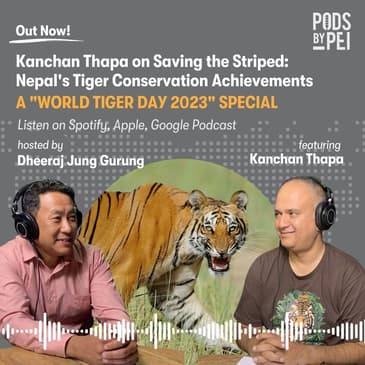
World Tiger Day 2022 was a special day for Nepal. The country announced that it had raised its tiger population to a solid 355, making it the frontrunner in tiger conservation in the world. Conservationists and big-cat enthusiasts worldwide were enthralled as the endangered feline population tripled from when it was last rounded up in 2009. In this episode, PEI colleague Dheeraj Gurung sits with Kanchan Thapa to celebrate Nepal's remarkable achievements in tiger conservation. They delve into the past anxiety surrounding the depleting tiger population and explore the conservation efforts that turned the tables, including the Terai Arc Landscape. They also discuss the challenges ahead as the wildcats grow in limited terrains. Kanchan Thapa is an environmentalist turned wildlife biologist. He is the Head of Wildlife Programs at WWF Nepal. His contributions to Nepal’s tiger conservation efforts have been crucial and include designing Nepal’s first tiger monitoring protocol in 2008 and undertaking the country’s first non-invasive genetic survey of tiger populations.
[00:00:06] - [Speaker 0]
Tigers. Tigers. Tigers. Tigers. Nepal recently after tiger population like
[00:00:15] - [Speaker 1]
Making a remarkable comeback here in Nepal. One of Asia's poorest countries has brought rhinos and tigers back from the brink of extinction, almost doubling their populations in just fifteen years. Namaste and welcome to Pods by PI, a policy discussion series brought to you by Policy Entrepreneur Singh. My name is Ridesh Sapkota. In today's episode, PI colleague Dheeraj Gurum is joined by Kansan Thapa for a conversation on saving the strike in Nepal, a World Tiger Day twenty twenty three special.
[00:00:56] - [Speaker 1]
Kansan is an environmentalist turned wildlife biologist. He is the head of wildlife programs at the WWF Nepal. His contributions to Nepal's tiger conservation efforts have been crucial and include designing Nepal's first tiger monitoring protocol in 2008 and undertaking the country's first non invasive genetic survey of tiger populations. Leaders and concerns celebrate Nepal's remarkable achievements in tiger conservation. They delve into the past anxiety surrounding the depleting tiger population and explore the conservation efforts that turn the tables, one of which is Tarai Ark landscape.
[00:01:36] - [Speaker 1]
They also discuss what challenges lay ahead as the wildcats grow in limited terrains. We hope you enjoy the conversation.
[00:01:52] - [Speaker 2]
Namaste. This is Dheeraj Gurum.
[00:01:54] - [Speaker 3]
Hi. This is Kanchan Thapa.
[00:01:56] - [Speaker 2]
Welcome to the show, Kanchan. It's a pleasure to have you here. How are doing today?
[00:02:00] - [Speaker 3]
I'm doing good. Thanks for the invitation.
[00:02:03] - [Speaker 2]
Great. So let's begin. Right? Yeah. So today we're here to celebrate Nepal's achievements in tiger conservation.
[00:02:11] - [Speaker 2]
And as we know, World Tiger Day last year was very special for Nepal. The country announced that it had raised its tiger population to a solid three fifty five, making it the front runner in tiger conservation in the world, right? So when this announcement came about after decade long conservation efforts, conservationists and big cat enthusiasts worldwide were enthralled. But this joy of this achievement may have been lost upon the general population, perhaps many of whom may not be able to recall why this feat was so significant. So so, Kanchan, to set the tone of our conversation today, can you elaborate on this achievement?
[00:02:54] - [Speaker 2]
How was the condition of tigers when we first committed to their conservation back in 02/2009?
[00:03:01] - [Speaker 3]
Yeah. Thank you, Dheeraj. So first of all, let me begin. This achievement has been indeed a very historic moment for Nepal Mhmm. For South Asia, and for all the rich countries in the world.
[00:03:13] - [Speaker 3]
So back in 02/2009, the government of Nepal make a historic commitment to the global goals of doubling the tiger number in the wild. And Nepal has been also the signatory to it as well. And since then, our journey took almost like ten years to achieve this historical accomplishment. Mhmm. So having said that, in terms of the number, so back in 2009 when we did a nationwide survey, so we had 121 wild tigers in our national park and its surrounding areas.
[00:03:49] - [Speaker 3]
So when we did our fourth national survey, we estimated around 355. So that's nearly not a double, but almost tripling the tiger population.
[00:04:00] - [Speaker 2]
True, true, yes.
[00:04:01] - [Speaker 3]
So that means it's a huge achievement, as I said, to the country, to the people, and to the entire conservation fraternities and including the world leaders as well because they were the one who are driving for the TX2Gold across the world. So back in 02/2009, when I recall back, it was a little bit different scenario. Rhino poaching was at the highest within the country. And we have less information about how our tiger were doing across this space, across the country, in our national park and in the surrounding areas. Because our monitoring system was not, you know, very refined, not so much robust during that time.
[00:04:48] - [Speaker 3]
And we actually don't know what was the real baseline of our tiger population within our national park, so that was the situation. And the country just moved from modest insurgency during that time, and there was a kind of a, you know, like avoid situation, even though we are doing really good at the conservation across the field level. But in terms of the number, in terms of what should be our strategy during that time, was kind of fluctuating during that time. And even within the region, if you see in India, two national parks, Iskar National Park and the Panna Tiger Reserve, the government declared that there was no tiger in those national park
[00:05:30] - [Speaker 2]
as well. Oh, really? Okay. So
[00:05:32] - [Speaker 3]
India was also struggling during that time because two of their tiger reserve were devoid of the tigers as well. So the effort on the tiger conservation were mounting up across its ranging countries. So during the 02/1989, the world leaders came up. So they made a global alliance called the Global Tiger Initiative. And in within Nepal as well, since we are doing, you know, like, as I mentioned already, there was a lot of gap we need to fulfill in order to make a significant stride in the tiger conservation as well.
[00:06:08] - [Speaker 3]
So in 02/2009, the world leader came, so Nepal also joined in there, and so they made a commitment, we need to do something on the tigers. And then they come up with the global tiger strategy as to one of the major goal was to doubling the tiger number. So this was a kind of a situation during that time and it was a government effort to bring all this, talking about the Nepal itself, so it was a government effort to bring all the stakeholders at the one place. So this is our effort we need to complete in next ten years. So it was a concerted effort which were fulfilled by every stakeholders within the country and we got the result.
[00:06:48] - [Speaker 3]
So over the years, we saw a lot of recovery in tiger population within area where it was very much stressed and stable in those areas where the tiger population was already high.
[00:07:00] - [Speaker 2]
Okay. All right. So now let me take you further back in the timeline. What were the different threats that led to this dismal state of tigers in Nepal? And what were the key drivers for the conservation initiative?
[00:07:15] - [Speaker 3]
Like human being Mhmm. The wildlife also need very basic things. They don't don't need very much fancy stuff. Okay. Too informal at this moment.
[00:07:26] - [Speaker 3]
Mhmm. So they need water. It's a very much basic thing. Second, they need a food. Everybody needs food.
[00:07:35] - [Speaker 3]
And next they need is a cover, is a habitat, the home for them. So these are the three basic things the wildlife need and also the tiger need these basic these three basic things. But at the recent times, the protection has become a a major ingredient to what the wildlife need. That means they need a protection because the human threat has escalated over the period of a time because the demand for the wildlife product has so much escalated over the time. So the protection has become much more a key ingredients to the survival of the wildlife and including the tiger as well.
[00:08:12] - [Speaker 3]
So if you talk about the tigers, this basic thing is reflected in the habitat loss and degradation. So over the period of a time, we have seen a lot of loss in tiger habitat. That means, like, there's a lot of land use change that's happening in the landscape, which was originally the habitat for the wildlife. So this has also, you know, like, created a small space for the wildlife, and the larger habitat has been converted into other land use. That means the agriculture
[00:08:43] - [Speaker 2]
Yes. Yes.
[00:08:43] - [Speaker 3]
Going to the settlement area and all those. So it has become it's it's still going on. Maybe in Nepal it's less, but if you see other range countries across the region, the habitat loss has been the major issue. If you see the Southeast Asia, the land conversion into the palm field and all the, know, for the timber and all those. So there has been a lot of land use change, so it has led to the habitat loss and degradation.
[00:09:09] - [Speaker 3]
And also the quality of the habitat. What we have seen the habitat twenty years ago is not the same as we see today now if you go to the national park because we have been there for a longer time. So we can see the gradual, there has been a lot of changes in the habitat as well in terms of the quality. Maybe in the quantity, the cover has increased, but the quality wise, it's not so same as it was before. So there might be a lot of factors that come in play a role in the degradation part.
[00:09:40] - [Speaker 3]
That would be a from ecological point of view, you can see lot of invasion of the invasive species that you can see in the tiger. Lantana problem is there. Mycenae problem is there. So these are actually replacing natural habitat at the very core area where it was supposed to be a high density area for the tiger as well. So that has also been creating a few, you know, the habitat degradation problem.
[00:10:07] - [Speaker 3]
The second problem, which is very much pertinent issue that keeps on popping up, is poaching issue. Okay. And it's a twenty four seven issue. It's not like you control a poaching for a few months, and there will not be a poaching after the one month. It's not that.
[00:10:24] - [Speaker 3]
So it needs a twenty four seven protection for the tiger habitat. So tiger poaching has been one of the most significant threat we have been seeing over the period of our time. So we have to be a constant vigilant for addressing this poaching problem. So poaching means because there has been a lot of a demand for the tiger products. You can see the tiger skin.
[00:10:49] - [Speaker 3]
Every part of the tiger is used. So whenever the tiger is poached, the poacher take away everything. And we have less information. We get the first hand regarding that if there is a poaching of the tigers because body size in comparison to other big mammals like rhino and elephant. Tiger, since every part is used, so until and unless the law enforcement agency sees something and they see a tiger skin and when we relate back to our database, oh, our tiger has been pushed.
[00:11:21] - [Speaker 3]
So yeah, so approaching is major problem. And also the third issue is the trade issue as well, because Nepal is a transit between two large nation, especially China and India in the South. And India become a major supplier of the tiger. Really? Yeah.
[00:11:38] - [Speaker 3]
So Nepal has a transit point. From India, it comes to Nepal and from here either goes to China or other countries in Southeast Asia like Cambodia, Vietnam. So there's a major demand for the Tiger products.
[00:11:50] - [Speaker 2]
Okay. So, yeah, you mentioned a bit about poaching as one of the significant threats, and I would like to go further into this, right? So, for an example, a while back, I read an article about local alkali spirits that were made out of tiger bones, and you mentioned that every part of the tiger is being used. So people believe that this portion made you strong as a tiger, right? So can you describe what the market looks for products, these types of tiger products?
[00:12:22] - [Speaker 2]
Who are the poachers and what demand are they servicing?
[00:12:26] - [Speaker 3]
So as I mentioned, like, few of our tigers has been poached and they went into the into the tiger trade. So majority of the tigers is also from the India as well. Nepal has a transit point. And we have been making an effort to disrupt this trade route as well. So we have been working a lot with the law enforcement agencies so as to curb the illegal wildlife crime, especially the trade aspect as well, as I talked already about the poaching.
[00:12:56] - [Speaker 3]
So as per the expert, what they acknowledge is, so there are different layer in the tiger trade. So the main poacher who does all the, you know, the
[00:13:07] - [Speaker 2]
Okay.
[00:13:08] - [Speaker 3]
The killing. Killing and all those, take advantage of the, you know, the local people. I would not say all are involved. Few of them has been involved. And they make advantage of their, you know, the economic situation, the financial situation and all those, making a very lucrative
[00:13:24] - [Speaker 2]
Market. Yeah.
[00:13:25] - [Speaker 3]
Market. If they portion, like, they will get a lot of money out of it. And and so mainly, poachers has been of those, and they sell us not sell, but it's a middleman who are, you know, like reaching out to all these poachers at the local level to make a tiger kill. And and I think they sell it to the international market. And normally, have been able to nab the poacher at the local level, to some extent at the middleman.
[00:13:58] - [Speaker 3]
Very hard, but at the higher level, it's beyond the country. So there has been a lot of work that has been going on, you know, to disrupt the the trade at all the level. But in Nepal, it's the Okay. First
[00:14:12] - [Speaker 2]
This is more like an international
[00:14:13] - [Speaker 3]
Yeah. It's it's organized crime. Right. So what they the wildlife poaching is also the trade. It's all the organized crime.
[00:14:20] - [Speaker 3]
It's not one group of people maybe involved in the poaching, but the trade, it takes a lot of has to pass all of those the level. So, yeah.
[00:14:29] - [Speaker 2]
Right. So, Kanchan, that's a very fascinating insight into the rather obscure world of tiger poaching, right? So before discussing the conservation efforts, though, let's get to know tigers a little bit more. So as we all know, tigers are one of the most well known animals in the world, But for many of us, what we know is perhaps just limited to the foreign skin, right? You know, the iconic black on orange stripes and impressive predatory fangs.
[00:14:58] - [Speaker 2]
So I thought, given that you have devoted a significant portion of your research to these majestic animals, maybe you can share the lesser known traits of the tiger, especially in terms of their temperaments, needs, and even quirks that guide strategies for their conservation.
[00:15:17] - [Speaker 3]
So as I mentioned, tiger is, you know, is yet another animal which you see in the jungle. And in comparison to the habitat, you see a lot of trees around. You don't see that much of a wildlife So around as if you talk a tiger in particular, so it's a elusive animal, very hard to see in the wild, unlike in few other areas in India where the habitat is completely different, the tiger sighting is also good in comparison to in this part of the world, especially our area is much more floodplain habitat, and where there you see a lot of underground growth as well. You can see the grass grown as high as the the first story building. Height of the grassland and yeah.
[00:16:04] - [Speaker 3]
You are searching for the tigers in such a huge grassland. So that means that every time you go to the field, you are actually searching for the tigers and you don't see. But at the end of the day, when you finish the survey and you analyze your data, you see that area is the highest density for the tigers in the world. So that's really fascinating. So elusive nymphs is one of the criteria which also define the tiger majesty in the jungle as well.
[00:16:30] - [Speaker 3]
So that's what I feel like. And secondly, there are few other stuff. You know, the general people has a perception is we have a nine species of subspecies of a tigers in the world. And in Nepal, India, Bhutan, and a part of the Myanmar, so we have a Royal Bengal tigers. And the rest of the I would say, three three of the subspecies is already gone, Gaspian, Javan, and the Bali tigers.
[00:16:58] - [Speaker 3]
And now there is a six subspecies that are distributed across the 13 range countries. And in Nepal, India, Bhutan is the three countries where we have common tigers. And 70% of the tigers lives in India.
[00:17:11] - [Speaker 2]
Okay. Right.
[00:17:13] - [Speaker 3]
I mean, the world tiger population is around, like, 4,000 plus, and 70% of those tiger population lives in India only. Okay. So India is the one which drives the global tiger conservation work as well. So so that's also one of the important asset many people don't know.
[00:17:32] - [Speaker 2]
Among among all these tigers, which which is the largest? I think, is it the Royal Bodhana?
[00:17:36] - [Speaker 3]
No. The largest is the Siberian tiger. Okay. So more tiger because they live in such a cold condition, their fur is a little bit thick, so that's why you see much more fluffy. Okay.
[00:17:45] - [Speaker 3]
And in terms of, I think, length as well, it's a little bit larger than the Royal Bengal Tiger as well. And the smallest one is a Sumatran Tiger that you find in Indonesia. And other tigers are in between those two. So so second largest is Bengal Tigers. Even though if you see in the wild, you'll get amazed with the size of the animal because it's like 250 k z beasts actually standing in front of Wow.
[00:18:12] - [Speaker 3]
It's really like so it's really huge if you see in the wild. Yeah. Even if you see in the zoo, like, if you go near to the to the the animal itself, it says such a huge in terms of the volume as well, in terms of the length as well. And one interesting fact is every tiger is different. You can actually identify yourself if you have photographs.
[00:18:35] - [Speaker 3]
You can individually identify each each of the single individuals. And so that's the reason why we can able to count the tigers in the world from the photographs. So it's like our thumbnail and in the thumbprint. So every human being thumbprint is different. So every tiger stripe pattern is different.
[00:18:54] - [Speaker 3]
So that's why, every cat species you can individually identify. It is a unique stripe pattern in their body.
[00:19:03] - [Speaker 2]
So yeah, there's also the fact they need a very large area to roam around, play density and all that?
[00:19:09] - [Speaker 3]
Yeah. Normally, it's like let's correlate with the human. Mhmm. If you have to feed your family, and if you don't get a job nearby, you have to, you know, stroll around at the different areas, go around, right? So it takes a large area to find the job as well.
[00:19:29] - [Speaker 3]
Same with the tigers. So they need to feed the animal. If there is no food, they have to travel a long distance. And the area covered by them is very large if the prey density is really low. So that's how it relate with the tiger as well.
[00:19:43] - [Speaker 3]
In some area, within national park area, normally you have a very good prey population, so that dictates their space use as well. You have a really good food, water availability is really high, then they don't have to fetch to a larger distance to get their food, so they can get within the smaller area. That's why their home range is so small. But in the area where the prey population, prey density is so low, so they have to, you know, travel a long distance to make a kill, to make a, like, to get the food, and that's why the area covered during that time is so large, and that's why their home range is so large. So depending upon the area, depending upon the prey availability, and even the environmental condition, let's say, the water availability.
[00:20:32] - [Speaker 3]
So these all dictates the tiger home range, their territory and all those.
[00:20:38] - [Speaker 2]
Great. So you just mentioned that most wildlife need large scale mobility to preserve genetic variety and avoid vulnerabilities and illness caused by inbreeding as well. So the tiger population in Nepal had the facilities to make these long journeys into the jungles of India until the 1960s, so when the East West Highway was constructed, which not only blocked the Tarai Corridor for tigers, but also invited massive human influx. So I think this is where the Arc landscape comes in. You being a part of this as well.
[00:21:14] - [Speaker 2]
The Tarai Arc landscape project tacked this problem by focusing on the diasporic need of tigers. Eventually, the project became one of the reasons for Nepal's success in tiger conservation as well. So, Kanchan, as one of the key members behind this project, can you elaborate on what the Tara Arc Landscape is and share some of its primary focuses?
[00:21:38] - [Speaker 3]
Yeah. Thank you. I'm so glad that you mentioned Tara Arc Landscape in our discussion. Many people don't know about the landscape apart from the people working in the conservation world. It's a transboundary landscape between Nepal and India, covering almost like 50,000 square kilometer of the area.
[00:21:59] - [Speaker 3]
So if you see the orientation, it begins from Almaty River in the East. So it covers all the area from Bhagmaty in our within our border from to Mahakali, but it extends all the way to the the entire Tarahat landscape. It extend to Yamuna River Okay. In the in India in the West. So basically, idea is the landscape was designed based on tiger ecology.
[00:22:26] - [Speaker 3]
So it was envisioned back in 02/2001, so we are almost like working twenty two years in this landscape. We started a tiger conservation at at the very specific ecosystem or within the national park area. You know, we need to even we are doing the same thing. Our scale of intervention at the very fine scale is ecosystem level at the very specific habitat area. We are trying to manage the tiger.
[00:22:55] - [Speaker 3]
But if you you mentioned about the area of the land it needs, so national park boundary is not enough because Sure. They have to travel a longer distance. And also for survival of the tiger within the core area, there needs to be a mix of a population between the core area as well. So in that case, we need to work at the landscape level. So if you see the Tarahat landscape, there are five national parks which are spatially segregated, but these are connected by the forest block.
[00:23:25] - [Speaker 3]
So with this project, what we are trying to do is we are trying to connect five national parks within Nepal with the 11 national parks in India. So there is a kind of a connection between these national parks. The connection varies from, you know, the width of the connection, maybe from one to two kilometer to the hundreds of kilometers. So so we identify these are the corridor areas. So idea is the tiger from Persia National Park which is on the Extreme East can go to Suklafata National Park within Nepal which is located in the West Of Nepal.
[00:24:04] - [Speaker 3]
Or even though the tiger from Porsa can go all the way to Rajatji National Park on the side of the Yamuna River. So we are trying to create this habitat as a highway for the tiger movement, the tiger dispersal. So the Therak Landscape is all about the tiger conservation across this meta population of the national park spread across this landscape. And since it's a human dominated landscape as well, so there has been a lot of stake from the local people as well. So their contribution is immense, as well as the landscape approach conservation is also trying to give a maximum benefit to the local people living around as well.
[00:24:46] - [Speaker 3]
So basically it's a tiger landscape, but trying to maintain the persistence of a tiger across the landscape one, maintain the ecological integrity as well because lot of ecosystem services you are getting from the landscape as well. And third is to have a balance approach to ecosystem conservation across the landscape itself, benefiting to the local people as well.
[00:25:15] - [Speaker 2]
Very good. Very good. So I think even the name, the Tarai Art Landscape, do you want to elaborate on that as well?
[00:25:21] - [Speaker 3]
Yeah. During 02/2001, when we designed this landscape so I one one thing I forgot to mention. So as I mentioned, this was based on Tarai dispersal model. So scientists collected almost thirty years of data to design this landscape. So it's a tiger landscape in particular, but as I may I said, like, the benefit has so much cross cutting across the wide range of the the ecosystem benefit which the people can get out of it.
[00:25:50] - [Speaker 3]
And the name designation was a little bit interesting. So when we were designing this, not me, I would say in particular, so the group of scientists were taking a lead on designing this landscape. So they were trying to come up with a name after it. Since the landscape is at the lowland area, so the Tarai Arc landscape was actually like it it it forms a kind of a arc, but the indigenous people live there is mainly the Tharu people. So even though there are other 10 indigenous people that lives in this landscape, the Tharu people wears a kind of indigenous necklace, where each bead is identify has been identified as a protected areas.
[00:26:33] - [Speaker 3]
Okay. And the string which connect this is the forest, you know, the the the forest block, and that's how and it kind of forms the the arc, you know, and that's how they came up with the tariq landscape. So East Bead is a protected area, and the the line is a forest connectivity, and it's won by the the Tharu people, so which is the major indigenous people that has been living up there. That's how it came. And so in the previous picture with the Tarak landscape portfolio, you'll see a lot of Tharu people wearing those beads, but it has a special meaning as to how those landscape was designed.
[00:27:11] - [Speaker 2]
Wow. That's that's very fascinating. Yeah. So, yeah, Kanchan, the Taraarc landscape covers a vast area, as you mentioned, starting from Bhagmaty in the East in Nepal down to the Yamuna River in India. So the area includes multiple extensive forests, wetlands, and agricultural lands as well.
[00:27:30] - [Speaker 2]
So in this day and age, very few are lucky enough to experience the wildlife in the kind of depth and proximity that you did as a part of this project, right? So on the lighter side of things, could you share what your experience was like out in the wild? Do you have fond memories from when you were out in the field or perhaps some lived stories of thrilling encounters as you work with one of the apex predators of nature?
[00:28:00] - [Speaker 3]
Yeah. That's a very interesting question. So having said that, as I mentioned, a tiger is a very elusive animal. It's very difficult to see in the wild. And we as a researcher, like I almost spend much of my career, even today, like I spend most of the time in the field as well, but a little bit safe from the research to much more into the conservation aspect.
[00:28:25] - [Speaker 3]
Whenever I go to the field and we will get very excited to go to the field because most of the time, as for me, like, I'm working in Kathmandu, and it's really excite me to go into the field. And normally, go there, and our first aspiration in the field was to see the tigers. But normally, sometimes you see, it's like sometimes most of the time, you don't see. So when I was doing my research, I think whenever I go to the field, I first pray to the god, please don't let me encounter with the tigers. Even
[00:29:00] - [Speaker 2]
though you're working with them.
[00:29:01] - [Speaker 3]
Even the tiger. Because that will, you know, like, will change my day a lot. Okay. Because we are also afraid of the Definitely. Definitely.
[00:29:10] - [Speaker 3]
In the wild. So so yeah, there are a few moment I I I can share right now. So we were in the we are I think we are doing some work, field work. So we were because normally we use a domestic elephant back for especially for the traveling across the, you know, when we have to go through the grassland area. So the walking is not possible.
[00:29:32] - [Speaker 3]
It's very dangerous. So two of my my friends, we are on the elephant back. So he was facing on the one side. I was facing on the other side. And we are just talking, and when we are just passing through the grassland.
[00:29:46] - [Speaker 3]
And I was talking on this side, and he was he was not talking with me. He was just listening to me. But he was he has seen the tigers on the other And I said, Kanchan, there's a tiger. And and when I turned around, I couldn't see the tigers. Okay.
[00:30:00] - [Speaker 3]
So what I wanted to say is that you you have to be very lucky to see the tigers in So the I was in the same elephant, and he was facing on the northern side, I was facing southern side. He saw the tiger, I didn't. So what I want to mention is you have to be very lucky in the wild to see the tigers. And the second time, normally, you know, like, we have a lot of a workshop in the field. So many people come, so we talk about a different, about our work in a very, you know, like natural condition and all.
[00:30:30] - [Speaker 3]
So we we used to have a field work. I'm in the field visit after our workshop and all those. So we were in India, Sariska Tiger Reserve, so it's on the outskirt of the Delhi. And so we went there. So I think there was like fifty, sixty people in, you know, almost like a 10 Jeep safaris.
[00:30:50] - [Speaker 3]
And as I mentioned, the Sariska Tiger Reserve was once devoid of the Tiger. The India government make a lot of investment and there was a lot of recovery of the tiger after they translocate tigers in those area. So they were all radio collared and with the radio collared you will normally will find the recent location where the tiger is. So we went there, and I was with my DSLR camera, and my eye was on the eyepiece of the of the camera. So we then we suddenly saw the tigers in front of the road.
[00:31:23] - [Speaker 3]
Right? And we are all busy and I was busy taking the photographs. I took fantastic photographs, but at the end, I couldn't see the tigers with my bare eyes, you know, like, only on the so sometimes I feel like I I got a chance to see the tigers in the wild at a such a close distance, but I was busy with my
[00:31:43] - [Speaker 2]
But only through the lenses.
[00:31:44] - [Speaker 3]
True. Only through the lenses. So that's really, you know, sometimes, oh, I would have seen the tigers with my bare eyes. So it's I'm still struggling these days to see the tigers, full grown tiger in front of you. So so those were the two moment I recall mostly.
[00:32:00] - [Speaker 2]
Right. So that's fascinating. So you definitely love what you do, Kansan, and I share this enthusiasm with you as well. Personally for me, I grew up listening to many stories and even legends of magical encounters of these magnificent beasts. So I read about the jungle and wildlife from authors like Jim Corbett and Kenneth Anderson.
[00:32:22] - [Speaker 2]
I'm sure you've heard of them as well, right? So this passion of mine stayed with me, and I'm known to be somewhat of a storyteller among family, friends, and especially my students when I was teaching back in St. J. V. So what about you, Kanchan?
[00:32:36] - [Speaker 2]
What inspired you to get involved in studying and conserving wildlife?
[00:32:42] - [Speaker 3]
Yeah. Normally, you know, in our Nepalese I've not said the culture, but in your grown up phase, your dad and mom often tells you, you have to be either a doctor or engineer,
[00:32:54] - [Speaker 2]
you know.
[00:32:54] - [Speaker 3]
Those are two figures I always hear from my dad and And my when I completed my 10 plus two, so that's that's the phase where where you, you know, really strike to your what you want to become in the near future. So after I completed my 10 plus two, and my dad wants to me for me to become a doctor. I said, I can't become a doctor. So during that time, environmental science was really a hot topic.
[00:33:21] - [Speaker 2]
K. You know,
[00:33:22] - [Speaker 3]
like, not many people were studying, and so the Kathmandu University has a environment science program. And that really, you know, like, what I would say, like, attracted me. And so normally within the environment science, you have a brown sector and you have a green sector. So brown sector means you have basically working into the pollution and all those, and the green sector is a natural resource management sector. So we were studying our undergrad at Kashmir University, and normally, you know, within the college, you have a field trips and all those.
[00:33:57] - [Speaker 3]
So we had a chance to go to Chitwan National Park during that time. So that was the first time I saw a rhino in the wild. So during that time, I didn't believe, like, I will pursue my career in the wildlife conservation. But somehow, you know, like, the natural setting and all those, that that was kind of attracting me to work, especially not in the wildlife conservation in particular, but on the natural resource management side as well. So when I completed my bachelor, so I was not much more inclined into the green sectors.
[00:34:29] - [Speaker 3]
And then for my master's, and I applied for for doing a natural resource management, and that's how it started, I would say, a stepping stone into what I'm doing today. So my master's was much more focused on the forestry aspect as well, and that's how I got into the green sectors. So after completing my masters in the EIT Bangkok, so when I came back, you know, next experience is get a job, you know, like, kind of stuff. And then I was looking for a job, then I see I know I I have to do on something on the green sector, so then I applied for a job in WWF where I'm still doing my work today. And they gave me a kind of option to either work in the research part or into the management part.
[00:35:18] - [Speaker 3]
And research the was really exciting because, you know, you got they said, like, oh, you got to work on tigers and all those. So I don't know. Instant moment, it attracted me. So I had my background on that, but the wildlife conservation was a little bit new for me during that time. So it's really in a passion to learn for the new things as well, maybe something that attracted me.
[00:35:41] - [Speaker 3]
And the opportunity provided by WWF was a crucial part during that time. So the first work assignment they gave me was go to Berdia National Park and monitor the wild rhino in the I mean the translocated rhino in the wild. So it was interesting. So I straight
[00:35:59] - [Speaker 2]
You started off with rhinos then.
[00:36:00] - [Speaker 3]
Yeah. Started with the rhinos in Bardia, and straight going into the jungle was a really a a kind of a different experience. Before you go as a tourist, but there you are going to do your work. So and I didn't have so much of a back then experience in the field. I So really gained a lot of a field experience on the and during that time, you know, like I had a free hand to either work in the different especially I was working in the Tarai area.
[00:36:27] - [Speaker 3]
So I had an opportunity to work in the different species and the tiger really fascinated me during that time. There was a kind of a void at the later phase was to not many people were working on that. I mean the expert actually working on the tiger concept. And in due course of a time you're working not only on the research aspect but different aspect that really get into the same that's the tiger conservation. So that's how a different, I would say, a stepping stone into this wildlife conservation arena over the period of a time.
[00:37:09] - [Speaker 1]
Hi there. This is Ridesh Sapkota from Policy Entrepreneurs Inc. You have been listening to Pods by PEI. If you enjoy PEI's content and would like to hear more from our team, we have good news for you. We are thrilled to introduce you to our free newsletter services, PEI Substack of Policies and Politics.
[00:37:30] - [Speaker 1]
PI Substack draws from the PI's in house expertise and experience in policy research and reform initiatives to present through pieces on, but not limited to policy, politics, economies, development, energy, and climate. Subscribe now to PI Substack at policyantra. Substack dot com or through the link in description to receive weekly newsletter, issue coverages, event updates, and full access to our recent publications. Now let's get back to the
[00:38:09] - [Speaker 2]
landscape again. Okay? So the Toraii Ark landscape hosts vast wildlife and wilderness, as you mentioned. However, nearly 7,000,000 people also are living within its territories. So moving on, I want to pick up the aspect of the local community and stakeholders for a bit.
[00:38:28] - [Speaker 2]
Multiple WWF reports have cited community involvements as one of the significant contributors to the success of the project, right? So of course, local stakeholders are essential in managing the consumption of natural resources, but they can also be a force of defense against wildlife poaching. So can you elaborate on why the locals were a dynamic asset to the project? Maybe you can also share some examples of community feedback that helped the project.
[00:38:58] - [Speaker 3]
Yeah. First of all, we had the national census, human population census, so increased from 7.5 to 8,500,000.
[00:39:08] - [Speaker 2]
Oh, really? Okay.
[00:39:09] - [Speaker 3]
So what I want to relate is, it's a human dominated landscape. And I think 90% of the people live within the 100 meter from the forest age. You know? So you can see the interface between the forest and the settlement or the agriculture land is high within within the Tarahi area. And so what that also mean is community are one of the important stakeholders in the landscape.
[00:39:41] - [Speaker 3]
So they are also contributing to the conservation in the first place, and they are the one who will be getting the benefit. They know about it within the, like, example, realizing this scenario, this context, the government has set aside a buffer zone across the national park. So buffer zone are are those area which include the community which have their direct stake to the natural resource in their surrounding. So they have been well identified by the government, and they will get all the benefit they need if they really do a good conservation in their particular area. So they have been getting, like, example, whatever the revenue the national park generate from the park entry fee, 30 to 50% channel back to the the community.
[00:40:33] - [Speaker 3]
And they can use whatever money they get from the government for the benefit of the society within the buffer zone area. So they can do that. So not only in the buffer zone, I would also say in the corridor area or in an area community living along the forest fringe. The government has also, you know, like has a community forestry program as well, where the forest has been handed over to the community for the management. And they have been getting a benefit by the good conservation they have done in their community forestry.
[00:41:06] - [Speaker 3]
So they are getting a benefit out of it. So the first of all, the government has recognized that as well. But on on the flip side as well, so there has been a few negative interaction as well, especially like for example, the human tiger conflict or the human wildlife conflict in general. So in some area, you know, which has identified as a very hotspot for the human wildlife conflict, So there has been interaction between people and the the park authority or the the community or the authorities and so on. But, you know, the resource has been so much so limited.
[00:41:45] - [Speaker 3]
So the government is trying their level best so that resource get channelized to those needy people, especially, you know, the victim families and all those which are affected by the wildlife. And also they are trying their best to mitigate the problem out of the human tiger conflict as well. So maybe in those area where the conflict is really high, at some point of time, maybe the tolerance of the people with the wildlife might be very less. But you can see that because the people have been living with the wildlife since a very long So it's not like that at the recent time, the tolerance level has gone down. It's not so, no.
[00:42:26] - [Speaker 3]
Because the conservation has been really good and they are getting a benefit out of it as well. So what we are trying to do is we have been trying to very much proactive in the management of these negative interactions so that the people tolerance will get improved day by day as well. Proactive in the sense with respect to management of the human wildlife conflict, and also proactive with respect to, you know, trying to have a very conducive policy in place as well, and also proactive in the sense, I have to, we are very proactive rescuing certain, any adversity we can find across the landscape, trying to mitigate that in time. So those kind of very proactive measures the government has also, you know, taken in place. So overall idea is to have a kind of a very good tolerance level among the communities so that the relationship between the wildlife and the communities is much conducive, so it's beneficial to them and also to the species itself.
[00:43:23] - [Speaker 3]
Species itself in the sense their habitat get improved and with the community because they are getting the benefit out of it because the tourists are visiting their place, the local tourism has also flourished, so their financial condition has also gone up in these areas. As you can see in the field these days, homestay has become one of the important, I would say, the business for growing the local economy as well. So one of the precaution for this is increase in the wildlife in the surrounding area where the people come and see those wildlife.
[00:43:56] - [Speaker 2]
So yeah, yeah, definitely the project benefited from embracing local views and participation as you just said. So but I'm sure the project opened up many socio economic opportunities for the locals too, as you said. So can you add on how the locals are benefited from the conservation program?
[00:44:14] - [Speaker 3]
As I mentioned, I told you about buffer zone program and the community forest ry program as well. So in both the cases, especially in the buffer zone, you are getting whatever the revenue generated by each individual park. So they get the benefit out of it. Example, can see Soura. Okay.
[00:44:33] - [Speaker 3]
So there has been, you know, it's such a boom in the local economy as well. So people had benefited as well. They get a job and you know, like doing their business and all those. And even in the rural setting in other areas as well, the homestay program has so much florist and and the people are getting a direct benefit out of it. So we did one study in Bakke National Park last year and trying to because Bakke is our youngest national park in the country and which was also one of the conducive policy step forwarded by the government of Nepal when we had this TX2 goal.
[00:45:12] - [Speaker 3]
So that national park was developed. And over the last fifteen years or so, what are we asked the local people over there, what benefit do we have seen by establishment of our national park in their surrounding area? And they said, we have a very clean year. The forest has gone up. So I can see the spring coming out of the, you know, the the degraded forest area, which was where before there was no water sources over there.
[00:45:42] - [Speaker 3]
So water availability has improved. And this really said like, you know, having a very good forest cover and the wildlife in place, so that has a direct benefit to the local people, not only in terms of the economic benefit, but also ecological benefit as well, and overall the environmental services it gives to the local people. That's also most of the important thing.
[00:46:07] - [Speaker 2]
Great. So, Kanchan, now we've talked about tiger conservation efforts and Nepal's achievement, right? But to really complement this feat from the perspective of the environment, and also for a country in a global arena where the conservation of endangered animals is institutionalized and often rewarded. What does this achievement actually mean for Nepal?
[00:46:34] - [Speaker 3]
So as I mentioned, so the stride we have taken in tiger population success has a lot of significance at the global level as well. So I mentioned about TX2 gold, so that's doubling the tiger number. So that has been in Saint Petersburg back in 2010. Right. In Russia.
[00:46:55] - [Speaker 3]
So there was a global conference where the global leader plays for doubling the tiger number, so that was a target set. So individual country trickle down to individual range countries. And then so we achieved that. So we are almost tripling the tiger number. So that was a really good aspect.
[00:47:16] - [Speaker 3]
And and also we had a, you know, like, what I'm now, not only the tiger range countries, but also the other species of concern at the very global level, like for example, in Africa, jaguar in South America. So they are also taking, you know, the conservation success that we are having and trying to replicate in their own scenario, you know, these best management practices as to how to recover the tiger from the brink of extinction. That was a really good message which Nepal has shown to the global conservation with this tiger success.
[00:47:54] - [Speaker 2]
Nice. So basically, our achievement has been an inspiration to other countries.
[00:47:59] - [Speaker 3]
Yeah, definitely.
[00:48:01] - [Speaker 2]
So, yeah. So certainly, tripling the population of tigers, a species whose numbers sank through the twentieth centuries, is definitely a joyous feat. Right? But this is not the happily ever after ending that we actually look for. So especially given how the natural habitat these beasts once trod on is no longer as vast as it used to be.
[00:48:23] - [Speaker 2]
So furthermore, they now share territory with humans and their ways of life. Both tigers and humans can be equally volatile and threatening to each other. So in the year after the declaration of success in last year's World Tiger Day, issues of conflicts between wildlife and people arose. It's quite evident probably years before that as well. So now with this question, I'm curious to know some of the confrontations that have come up since the tiger population increased in these limited and shared territories.
[00:49:00] - [Speaker 3]
So, yeah, that's a really good question. Ever since we had a new number on tigers on Global Tiger Day, July, so the narrative of tiger conservation, you know, changed overnight. Mhmm. Just like one month ago, before July 29, we are just talking about the tiger recovery, tiger recovery, you know, like, we need whether we can achieve the the doubling of the tiger number or not. After July 29, there was a completely, you know, change with the kind of a tiger conservation strategy we need to have.
[00:49:39] - [Speaker 3]
So definitely, yeah, with the increase in tiger number, so during the same time, there has been a lot of increase in human tiger conflict in certain areas within the landscape. So that really drive the what kind of a strategy we need to have in the next ten years, let's say. So that was from conservation to management of our existing tiger population so that the negative interaction with the with the communities lessen over the period of a time. This is my personal view. And also, like, it's not a tiger conflict was not there previously.
[00:50:19] - [Speaker 3]
Yeah. Definitely over the period of a time, so it has increased. So tiger I mean, the tiger conflict was there ever since, you know, there has been an influx of the people, wide range of a migration after, you know, like, the Tara area was declared malaria free
[00:50:37] - [Speaker 2]
Yeah.
[00:50:38] - [Speaker 3]
Zone back in fifties, sixties. Yeah. So ever since we have been seeing a lot of conflict over the period of a time. We have done with our limited resource. The government has been doing a lot of management of the conflict because they are the one which has a front doing all those management in the field itself.
[00:50:57] - [Speaker 3]
We are just supporting the government in doing so. The kind of work we have been doing, and that really was not reflected so much after the July 29 narrative on the tiger conservation effort. Most of them had portrayed like we have done nothing on the tiger conflict management side as well. It's not so, but we have been doing that. Maybe at the scale we need to do has not been so much, So I just wanted to highlight that as well.
[00:51:24] - [Speaker 3]
So yeah, mean, the conflict has gone up. So one of the major driving factor has been increase in tiger population in our landscape as well. But on the other side of the story is also there is opportunity as well. Like for example, as you mentioned about the Jim Corvette Tiger Reserve in India, we have three fifty five tigers in Nepal. In Jim Corvette National Park, there are more than 300 tigers.
[00:51:50] - [Speaker 3]
Okay. So density of the tiger is so high in that particular area. So that particular area can hold the habitat condition, you know, the all the ecological requirement are fulfilled by the national park at the very large level. So they can hold a large tiger population within the small land of area as well. So if you try to equate to our national park as well, if you do a really good management within the core area as well, we can hold a large number of our tigers as well.
[00:52:22] - [Speaker 3]
So what we also need to do apart from managing the tiger conflict in our landscape, we really need to improve the quality of our habitat as well so that tiger can foster really well within our national park and they don't have to come out to get the resources from the human from the human interface as well. Normally, happen is most of the conflict we have seen is within the forest itself. It's not like tiger coming out and killing the people or injuring the people. It's not that. It's actually like people are going inside the forest and somehow they have an encounter with the tigers and either injury or in a very serious case that has been unfortunate event.
[00:53:05] - [Speaker 3]
So the death of the people as well we have encountered. What I wanted to say is there should be a balanced approach with the management. Maybe at the moment, our priorities would be on achieving a human tiger coexistence in the first place. But to achieve that as well, we need to focus on the core area as well. Right?
[00:53:24] - [Speaker 3]
So have to have a very good management of the core habitat in place as well, so they don't have to come out for for their basic requirement.
[00:53:35] - [Speaker 2]
That's very insightful. Yes. And we were discussing the disproportion of wildlife population to habitat. So it made me think of the other wild counterparts to tigers, like leopards, rhinos, elephants, sloth bears, hyenas as well, whose existence might be competitive or under threat from tigers also, right? So balancing forest ecosystems was a primary objective when the tiger conservation effort was undertaken, I'm sure.
[00:54:05] - [Speaker 2]
Are we seeing the same results in restoring the balance that we actually hope for?
[00:54:10] - [Speaker 3]
We normally take large mammals as an indicator species for our ecosystem health. For example, tiger itself is a indicator species, so it's a top of the food chain as well. So if you have a really good tiger population in place, so you have that means there are really good food availability in that particular ecosystem. So if you have a really good population of tigers in place, that means your ecosystem is really healthy.
[00:54:44] - [Speaker 2]
Okay.
[00:54:44] - [Speaker 3]
That also in one way, we can define whether there's a balance kind of element within the ecosystem or not. Second, yeah, it's a natural process as well. So the nature takes its own course as well. Yeah, definitely there will be some change in the distribution pattern of the species in particular, interspecies or the intraspecies, you know, yeah, there will be, there will a kind of a competition as well. Like for example, let's say tiger and the leopard.
[00:55:13] - [Speaker 3]
So both are top carnivore in our ecosystem, in our landscape as well, in the Tarai area. But they know how to live with each other, you know, like so tiger are very much, you know, concentrated in the core area, so they will push the leopard to the fringe area so they live within the maybe about in general I would say so within the core area tiger population will be high, along the fringe area the leopard population is high, So normally you see, you know, across the fringe area you often encounter with the leopard. So if you go to the Tarai and you ask with the people, it's a leopard conflict that is more coming up than the tiger population. So one of the reason could be, you know, like increase in tiger population may be pushing much more leopard to the, you know, the much more suboptimal or the fringe area. So that's why they encounter more with us.
[00:56:07] - [Speaker 3]
So that's why along the villages you see, oh, there's a lot of leopard that's taking away my livestock and all those. So that's the kind of usual cases we have been hearing from the field. And also tiger tins, maybe the leopard, you know, they use a much more suboptimal habitat and within area where the you see a very good jungle, but maybe, you know, the tiger presence is very much less, but you you often find a lot of a leopard in those area because maybe a tiger population somehow kind of have an interaction with those leopards. In some area like in Chitwan it said that tiger hunt by day maybe the leopard hunt by the day, so that's why they are changing their shifting their activity pattern as well. So that's why they kind of, you know, live in those competitive environment.
[00:56:55] - [Speaker 3]
So depending upon the area condition, the animal change their behavior accordingly. So that's the situation. And the rhino tiger, they share the same habitat but it's a carnivore versus the herbivore.
[00:57:09] - [Speaker 2]
They keep the distance.
[00:57:11] - [Speaker 3]
Not the distance as well. So they share a habitat as well, but their requirement is different. So maybe the calf of the young calf is rhino is also the food for tiger as well sometimes, we have seen in the field. So yeah, so whatever success we have been getting in the tiger conservation has also reflected to the rhino conservation as well because they share the same habitat and the success we have been getting in rhino conservation can also be related to the, you know, the effort we have been spending on the tiger conservation effort So as well and vice
[00:57:46] - [Speaker 2]
it's both ways, right? So in light of all these observations, moving forward with Nepal's tiger conservation efforts, What do you think might be some upcoming challenges, and how do you think we can best tackle them?
[00:58:01] - [Speaker 3]
So I would again say, I will I'm stressing this. Tiger needs the three basic stuff: water, habitat, and the food. So and one thing, the the protection as well in the recent times. So if you can ensure all this thing, it's a boon for the tigers. So but getting the basic thing is a huge challenges for us as well.
[00:58:25] - [Speaker 3]
So normally people believes like if you spend 100 rupees today, so you'll have a management for for, you know, the lifelong it's not that. So you need to spend the resources each and every day to sustain these. So you have to have to spend the resources on this. So what we are doing is a basic thing. So we need to ensure that food availability is there.
[00:58:51] - [Speaker 3]
For that, we need to have a very good management of the core core habitat. Spend I think we have a such a large grassland, which needs to be managed on a regular basis. On every year, we have to manage that. It costs the money. So we have to fuel that as well.
[00:59:08] - [Speaker 3]
So water needs to be there, so water availability needs to be there, especially during the dry season. When there will be no water, they will come in contact with the people and the conflict starts, yeah, so we need to have a very good core habitat management in place as well. So that's the basic requirement we have to be in place. And also the ongoing, you know, many people are talking about the climate change and all those. So that has also effect on the resource availability as well.
[00:59:34] - [Speaker 3]
That needs to be considered as well. That's why the Department of a National Park has their new strategy and that's focusing on the climate smart management strategy as well. And the other thing is the poaching control. That's 20 fourseven work that have to be done. We have now a population of three fifty five, so managing a three fifty five pollution is also a huge task.
[00:59:56] - [Speaker 3]
That amount of resources needs to be spent in order to have a, you know, to manage the existing population. So that's a huge challenge in the coming days. As I mentioned about the poaching and the trade issue as well. So
[01:00:09] - [Speaker 2]
We need to
[01:00:09] - [Speaker 3]
check that. Yeah, we need to check or to disrupt those. Transition. Trade route as well. With a good enforcement in place.
[01:00:16] - [Speaker 3]
And next thing is like Nepal is now transitioning into the developing countries, right?
[01:00:22] - [Speaker 2]
Yeah.
[01:00:23] - [Speaker 3]
I think. Yeah. So that means we'll have more much more infrastructure, know, much more dams, roads, irrigation, and those are all smacking through your national park, your, you know, critical habitat, your corridors and all those. So with the great effort from the from the government and and with all the conservation partners including the WLO has been the major lead on this as well helping the government develop this infrastructure guideline as well whenever especially the linear infrastructure that goes through the corridor or any forested area or any critical habitat or the national park corridor area. So we need to have either underpass or the overpass.
[01:01:03] - [Speaker 3]
Poor infrastructure issues is a biggest you know, design and all those will have a major repercussion on the wildlife habitat. So that needs to be ensured that, you know, the good mitigation measures in place. So that's kind of a challenges we have coming up. Water is a major issue. Like most of our national park passes through the major river system and pollution and, you know, the the quality, water quality along with I mean, the overall river health, that that will be a major issue that needs to be tackled in the coming days because lots of built up area is coming up, settlement area is getting expanding, and, you know, like big factories and are coming across the river edges and which will have a which will pollute our river for sure.
[01:01:52] - [Speaker 3]
And that will have a major repercussion to the wildlife along the lowland areas, which are directly dependent on the on those water sources. So those are the major threats we need to tackle in the coming days.
[01:02:05] - [Speaker 2]
You mentioned the underpass, I think, on the highways. Does this actually work?
[01:02:10] - [Speaker 3]
Yeah. First underpass was developed along, maybe you have seen or not, so along the Mungling Narangat stretch. So there are four underpasses. So what we have done is, so the World Bank has built those. Actually, Nepal government has built those with the support from World Bank.
[01:02:30] - [Speaker 3]
So in their design, they have built four underpasses. And what we have done is we did a survey across the underpass. Put on some camera trap and trying to capture the wildlife photographs. And yeah, we have seen a lot of use by the mesa wildlife, including leopard tiger, haven't found till now, but yeah, the size, dimension is as that's beneficial to the to all the wildlife and the they are using it as well.
[01:02:56] - [Speaker 2]
Okay. So are they will they be using that in other areas?
[01:02:59] - [Speaker 3]
Yeah, that's why the with the guideline in place which was directed from the the government of Nepal and now the most most of the donor funded, they have their own guy, I mean, the environment safeguard in place and they are trying to have a, you know, whenever the they are expanding the road, actually the East West Highway. Yeah. So they are doing the underpass wherever it's feasible with the extensive study they have done. So they have built this biodiversity plan they have in place and along with with those plans, so they have identified which area they needs to have underpass. So they are building that as well.
[01:03:39] - [Speaker 2]
So yeah, Ghansham, excellent. So before we end today's conversation, is there anything else you want to share with our audience?
[01:03:47] - [Speaker 3]
I think most of the thing I've already said. So I think one of the, especially for us, managing a human tiger conflict is a major priority for us, for the government and for us as well. So we are trying our level best to manage the existing tiger population within their core habitat and try to minimize the conflict. It's for sure we cannot avoid the conflict 100%. Yeah, we will not able to do that, but manage to the extent possible with our proactive measures.
[01:04:23] - [Speaker 3]
So what we are telling these days is tiger it's very difficult for us because us to chase the behavior of the tiger in the wild. It's very unpredictable, their behavior. But the so far, the cases we have seen is most of the most of the conflict happened inside the forest where the people has actually ventured into the forest and and then where the conflict really happened. So if we can change our own behavior at this moment so we can somehow decrease the level of a conflict over the period of a time. So for WWF as well, what we have strategized in most of our conflict mitigation disease to have a behavior change communication as a core of the of the human tiger conflict management.
[01:05:16] - [Speaker 3]
So that, you know, over the period of a time, with every work we do, that also will change the behavior, the way the people behave in implementing any activities in this human tiger interface. For example, if I'm doing an early warning system, I want people to to have such a behavior that whenever they see a tiger, they will not forget to turn on the siren, you know. Like, that's a kind of a change in the behavior to to be very spontaneous. It's not like the, okay, I will I have seen the tiger. I'm right now a little bit busy.
[01:05:58] - [Speaker 3]
I'll turn off my siren after one hour, after I completed my meeting. It's not like that. So we want to have a a behavioral change communication as a core in our tiger conflict management in the field.
[01:06:14] - [Speaker 2]
Anyways. Okay. Alright. Thank you so much, Kanchan, for joining us here today at PODS. That was a wonderful conversation, very insightful to the fascinating world of tigers.
[01:06:27] - [Speaker 2]
And we wish you all the best in all your future endeavors. Thank you so much.
[01:06:32] - [Speaker 3]
Yeah. Thank you. Thank you for inviting me. And so it is a great privilege to talk something about the tiger, its habitat, and the conservation initiative we have been doing in the field. Yeah.
[01:06:44] - [Speaker 3]
Great to be here. Thank you for the invitation.
[01:06:46] - [Speaker 2]
Alright. Thank you so much.
[01:06:47] - [Speaker 3]
Thank you.
[01:06:55] - [Speaker 1]
Thanks for listening to Pause by PEI. I hope you enjoyed Dheeraj's conversation with Concern on Saving the Striped in Nepal. A World Tiger Day twenty twenty three Special. Today's episode was produced by Krissy Hang with support from Nirajan Rai, Sonae Ajimi, and me, Ridesh Sapkota. The episode was recorded and edited by Ridesh Sapkota.
[01:07:16] - [Speaker 1]
Our theme music is courtesy of Rohit Sake from Jindabad. If you liked today's episode, please subscribe to our podcast. Also, please do us a favor by sharing us on social media and leaving a review on Spotify, Apple Podcast, Google Podcast, or wherever you listen to the show. For PEI's video related content, please search for policy entrepreneurs on YouTube. To catch the latest from us on Nepal's policy and politics, please follow us on Twitter tweet2pei and on Facebook policyentrepreneursinc.
[01:07:50] - [Speaker 1]
You can also visit pei.center to learn more about us. Thanks once again from me, Ritesh. We'll see you soon in our next episode.