
Designing for Tomorrow: Alex Shrestha on Sustainable Architecture in Kathmandu and Beyond | PODS by PEI
#Ep.087
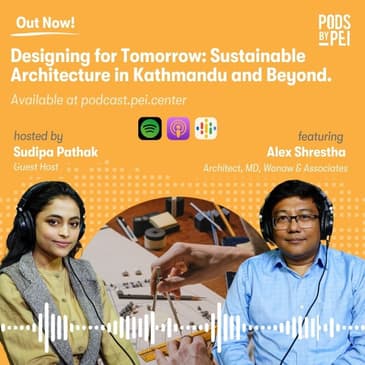
Alex Shrestha represents a generation of architects and urban planners creating a positive impact across the Nepali landscape. As managing director at Wonaw & Associates, he focuses on beautiful, functional and sustainable architecture. Alex’s creations have earned national and international distinctions in being among the top 4 resorts in Asia and is recognized by the Society of Nepalese Architects with the Architectural Excellence Award 2021. His most critically acclaimed creation is the environment friendly resorts Pavilions Himalayas Resort, Pokhara where he incorporated sustainability and energy saving features in hospitality.
Sudipa and Alex discuss the niche and nascent idea of sustainable architecture. They navigate the role of architecture in promoting sustainability and the factors influencing its adoption in Nepal, including societal values and economic considerations. They explore the evolution of architectural preferences in Kathmandu, focusing on how major events like the 2015 earthquake have influenced social aspirations in architecture. They end with a dialogue on innovative building technologies and policy strategies in shaping sustainable architectural practices.
If you liked the episode, hear more from us through our free newsletter services, PEI Substack: Of Policies and Politics, and click here to support us on Patreon!!
[00:00:00] Namaste and welcome to PODS by PEI, a policy discussion series brought to you by Policy Entrepreneurs Inc.
[00:00:18] I am Kushi Hang and in today's episode we have guest host to the Babataq in conversation
[00:00:23] with architect Alex Trešta on designing tomorrow navigating sustainable architecture in Kathmandu and beyond.
[00:00:30] Alex Trešta represents a generation of architects and urban planners creating a positive impact across the Nepali landscape.
[00:00:37] As managing director at Wona and associates he focuses on beautiful, functional and sustainable architecture.
[00:00:43] Alex's creations have earned national and international distinctions in being among the top four resorts in Asia
[00:00:49] and is recognized by the Society of Nepalese Architects with the Architectural Excellence Award 2021.
[00:00:55] His most critically acclaimed creation is the Environment Friendly Resorts Pavilion Himalayas Resort, Pokhara,
[00:01:01] where he incorporated sustainability and energy saving features in hospitality.
[00:01:07] So Deepa and Alex discuss the niche and nascent idea of sustainable architecture,
[00:01:11] the navigate the role of architecture in promoting sustainability and the factors influencing its adoption in Nepal,
[00:01:17] including societal values and economic considerations.
[00:01:21] They explore the evolution of architectural preferences in Kathmandu, focusing on how major events like the 2015 earthquake
[00:01:29] have influenced social aspirations in architecture.
[00:01:31] They end with a dialogue on innovative building technologies and policy strategies in shaping sustainable architecture of practices.
[00:01:39] We hope you enjoy the conversation.
[00:01:41] Namaste, I am Sudeepa Patak.
[00:01:45] Namaste, I am Alex Trešta.
[00:01:48] Welcome to Pods by PEI.
[00:01:50] Let's start this conversation exploring what pulled you into pursuing sustainable architecture.
[00:01:56] How did your journey as an architect reached the niche and nascent spare of the sustainability?
[00:02:02] I have always been a nature person.
[00:02:06] I have grown around nature and nature is a very important aspect of my life as I grew up,
[00:02:13] and it is very important to me today.
[00:02:16] And hence, I wanted to practice what I believe.
[00:02:19] Also sustainable architecture integrates environment friendly design principles to create buildings that minimize ecological footprint while maximizing energy efficiency and occupant comfort.
[00:02:32] So this approach resonates with me because it addresses pressing global challenges like climate change and resource depletion.
[00:02:40] So yeah, the idea of creating buildings that harmonize with their surroundings, utilize renewable resources and reduce waste aligns with personal values.
[00:02:50] And hence this is how I got into sustainable designs.
[00:02:53] So when we think of sustainability, we often associate it with the behavioural aspects of our lives and focus on the practices.
[00:03:01] How do you think our space in architecture play a role in sustainability?
[00:03:06] It has a direct and very intricate relationship for sure.
[00:03:11] Things like passive design strategies, where overhangs or solar, wind, water, small things that you do to within the design of a building
[00:03:24] has a very big impact on the space that we are creating.
[00:03:29] Also energy efficient systems like perhaps LED lights or all the new technologies that we have in terms of water management and waste, water management and so on
[00:03:43] has also a direct impact in how you use these elements as well as the cost savings that you can achieve by using these.
[00:03:55] Material selections for instance, by using materials that are locally sourced and locally found within your local area as compared to getting something that's imported from thousands of miles away.
[00:04:07] That will have an impact on the design as well as the cost, as well as the carbon footprint of the house or whatever that you are trying to construct.
[00:04:19] Similarly water conservation, if you are able to have rainwater harvesting, gridwater harvesting as well as blackwater reuse.
[00:04:27] This will have a substantial positive impact on your building as well as the environment.
[00:04:34] Also green spaces and urban design is also something very important when you talk about a city or a town where having innovative ideas will make the life of the people living there also nice as well as it will reduce the temperature of the place
[00:04:55] and it will again have a positive impact on the lifestyle of its people.
[00:05:00] So yes, all these things have a very important role in the space and architecture of sustainability.
[00:05:07] Great, you very nicely summarized how we can opt for actually we are in the position to choose the material as well as how we are going to execute or operate the system that we have created the housing system.
[00:05:23] Now let's move towards traditionally built with a great deal of art and craft involved.
[00:05:28] We can talk about pagoda style, our vernacular houses. They are a very rare site these days.
[00:05:35] Even the ones that we can locate are in poor shape. Whenever I land in Kathmandu, I see the eye-soring view of RCC houses with the blue red corrugated sheets on the top.
[00:05:47] What do you think of this change over the decades from the population in flux during the insurgency to the 2015 earthquake? How have you seen the value evolve?
[00:05:57] Right, so it's definitely very evident, no doubt about it not only in urban areas but all over Nepal even in remote parts of Nepal from the Himalayas to the Far East and West.
[00:06:10] This is very much evident and there are many, many reasons for that to have happened.
[00:06:18] So some of the significant changes that you mentioned in the past decades are influenced by various factors such as population growth, urbanization, even natural disasters and political instability as well as socio-economic developments that have happened.
[00:06:35] Talking about population growth and urbanization, there is a migratory trend of people moving from the rural areas to the urban areas for various reasons, for the employment, for better lifestyles and so on.
[00:06:48] You can see that has outpaced the development of infrastructural efforts, hence you have this half buildings as you mentioned everywhere.
[00:06:57] We have not been able to keep in pace with this population and urbanization growth. The infrastructure development in terms of road, electricity, water has also not been able to keep in pace over these years.
[00:07:11] Having said that even cultural heritage preservation efforts have also been difficult to do that simply because in the instance of Kathmandu apart from the core world-hages sites, I mean one step out of it then it feels like you are in a concrete jungle simply because it is so difficult to the pressures of a CBD to maintain Kathmandu Valley as a heritage site and also to maintain it as an economic hub.
[00:07:40] And of course the socio-economic changes with improved economic and purchasing capacity of people, they have more access to money if I may say so.
[00:07:51] And of course the aspirations has also changed.
[00:07:54] So all these have evolved in response to various internal and external forces undergoing transformation in its physical, social, economic and environmental dimensions.
[00:08:06] So maybe you also want to elaborate on how the architectural scene of Kathmandu, do they maintain the sustainability standard you mentioned earlier, the modern trend of building RCC houses that we can see in Kathmandu, especially in terms of energy efficiency which is a big target for Nepal's climate commitments.
[00:08:27] I think in my professional practice, I have gone in this direction of practicing sustainable design more out of compulsion in the past years because as you know in the past decade or so we had issues with everything such as electricity, water, drainage.
[00:08:51] So I mean we had almost 18 hours of no lights a day, water even now very scarce to have good running water supplied by the government that's running 24 hours.
[00:09:03] And so in that sense I have gone into this direction of sustainable design so that I can still have a comfortable living space within all these constraints if I may say so.
[00:09:16] But now in Kathmandu I still feel that we are still at an infancy as far as sustainable design and practices are concerned.
[00:09:24] But it's good to see that it's now being talked about in various platforms from colleges to policy level and so on and there's a lot to be achieved in this area.
[00:09:36] Yeah, for sure. Those are very interesting observations Alex and I think these changes reflect the people's evolving perspectives and aspirations too.
[00:09:46] So let's discuss that for a bit in Nepal architectural choices are saturated with social values based on your observations what design preferences are popular in Nepal and is sustainability of priority in this preferences.
[00:10:01] Depending on the geographical location of Nepal the access to various building technologies and materials as well as the socio economic status of the people living in the area it varies.
[00:10:17] In the past for fathers have developed the architectural style so that they could live in harmony with nature.
[00:10:26] So in that sense we are not doing anything new I mean if you look at any settlements anywhere in Nepal from the material choices to thickness of the walls to natural materials which provide insulation in the heat as well as the cold.
[00:10:42] They had experimented with this over time and they got it right.
[00:10:46] And now as they say the neighbors gardens always greener with the influx of modern technologies which we haven't really understood well like concrete for instance.
[00:10:59] We try to implement it and they have its own negative aspects and they would not be best suited for perhaps the environment and the condition that we want them to fit in.
[00:11:12] So it is very important to have that balance where you are able to use these new technologies materials as well as try to reflect the local architectural cultural style into the spaces that we design.
[00:11:28] So I think that is very important for people to understand and that would eventually lead to healthier lifestyle, more comfortable spaces and will benefit the whole population in large.
[00:11:42] As we try to understand a people's disease and making process we would be remiss not to talk about the cost relating to sustainable options.
[00:11:52] So in your opinion do you think cost is playing a big role in people's preference for sustainable alternatives or maybe you can also talk about your experience in building some infrastructure adopting the energy efficiency.
[00:12:06] What do you think are the major challenges in building energy efficient houses in Nepal?
[00:12:11] Indeed cost is a significant role and it influences people's preference for sustainable alternatives for sure including energy efficient buildings with things like initial investments, the perception that people think that it is a huge investment burden to them.
[00:12:33] No doubt it adds to the cost of the initial investment for sure but really it depends on what items you want to check or include into this sustainable design.
[00:12:45] So the more boxes you clear check obviously it adds to the bill but having said that this is where the designers need to be clever and try to integrate as much sustainable measures as possible trying to also adapt locally so that the cost goes down.
[00:13:03] So you don't have to import everything from abroad for instance they might be some local ways to getting the same results.
[00:13:10] Also the lack of awareness and education is also a big part as I mentioned in the past it was done tried and tested and was working but now we are dealing with new materials, new technologies and it has not really been tested and made aware in that light I guess.
[00:13:30] So awareness and education is also very important so that people know the pros and cons of using adopting all these technologies.
[00:13:41] Limited access to finance is also a very important point because obviously they have a limited budget and they might not be able to achieve all these or include all these sustainable measures into their designs.
[00:13:56] In rural areas for sure the supply chain constraint is also a problem.
[00:14:01] Kathmandu being the capital city of course we as architects and designers and engineers we have access knowledge and the means to also acquire these technologies
[00:14:13] and also the professional manpower that is required to adopt it into designs but in the rural areas you have to be very careful.
[00:14:22] You don't want to go overboard because sometimes you might be able to implement it but the operations, the maintenance is always an issue and if you go back and check it in a few years maybe it's redundant so you don't want to do that.
[00:14:36] So yeah the supply chain is definitely a constraint.
[00:14:40] Kathmandu has always been the center of innovations in that sense but the main effect of sustainable design needs to spread throughout the country.
[00:14:51] Also the regulatory and the policy framework is also very important in terms of building codes, standards, incentives, taxes so that initiatives can be taken by the government to encourage sustainable designs.
[00:15:06] And cultural and socio economic factors also very important.
[00:15:10] People's aspirations as you mentioned people have they want to be better than the neighbor and they want to have a concrete house it has to their social status and depending on the area in Nepal so things like that and it kind of perceives that they have better social status or they are wealthier.
[00:15:34] And so on as compared to having a traditional house which is very much more sustainable.
[00:15:40] So all these things it affects sustainable designs and addressing these challenges require a multifaceted approach I feel that involves raising awareness providing technical assistance, improving access to finance especially in the rural areas.
[00:15:57] Strengthening regulatory framework, fostering partnership between government agencies, NGOs, financial institutions and the private sector.
[00:16:07] So I have been practicing sustainable designs on my own level for the past decade or so.
[00:16:17] As I mentioned more out of compulsion because in order for me to provide all the facilities that I want to to my clients for their businesses, I had to have a system which is working.
[00:16:32] So projects you know it could be a residence it could be a hotel it could be a commercial enterprise or a bank we can definitely integrate the sustainable design practices in all these.
[00:16:46] All these various types of projects and it may vary as per the geographical locations I mean the same solution which I do for a project in the south in Chitwan may not be applicable in the Himalayas and so on.
[00:17:03] So one nice project that had designed back in 2013 was a project called the Pavilion Himalayas which is in Pokra.
[00:17:13] So it is in a rural part of Pokra it is almost 20 minutes drive from central Pokra and you have to go through a bumpy road and you have to cross a river at the time to get to it.
[00:17:26] And it's a very rural setting and when you think of Pokra we think of the lake or we think of the majestic Himalayas.
[00:17:35] But this site it had none of these you know it was difficult to get to it was a rural area you could you don't see the lake from there and you just see a small little Himalay if you're lucky enough on a clear day.
[00:17:48] So definitely not the cliche destination point for Pokra at least in terms of touristy value but and here as you can expect no good electrical lies, no water supply, no drainage and so forth.
[00:18:04] So here I wanted to design something nice a resort has but the brief given to me by my client and it's a small eco resort and nevertheless it has a lot of sustainable features into it.
[00:18:19] I mainly generalize it into three categories in terms of energy food and water really those three things.
[00:18:28] So in terms of energy we produce our own electricity. We have a 60 KV system which provides all the lighting, all the electrical needs for the resort except for the big heavy machines like the sauna and pumps for the swimming pool.
[00:18:45] It has very efficient solar to make hot water and it also has something called a heat pump which transfers the heat of the air into the water.
[00:18:57] So a hybrid system of solar as well as heat pump is used to heat the water that is necessary for for bathing for the guests and so on, which is a very efficient system.
[00:19:08] We also have to have a rain water system where all these villas have underground tanks and if it rains all the water is filtered and collected and it is used for all the purpose within the resort itself from drinking to washing to so on.
[00:19:23] The waste soapy water which we call grey water is also recycled by natural filtration system using plants and sand filtration and it is used for flushing their toilet.
[00:19:37] The waste from the toilet which we refer to as black water goes down and this is a farm setting so we also have animal manure.
[00:19:47] So human sewage as well as animal manure goes to a tank and there we create methane gas which goes directly into the kitchen and is used to cook the food for the guests itself.
[00:19:58] And the last residue comes out as fertilizer which is used to grow the plants throughout the year.
[00:20:06] So that brings me to the food so this senses a farm setting, we have rice, quen with and so on and fruit vegetables as well as dairy products and milk and so on which is produced within the resort itself.
[00:20:20] So in terms of energy, water and food we are as independent as we can could be at that time.
[00:20:27] And also the architecture is very beautiful so you do not feel like it's a compromise staying there.
[00:20:34] For the operators what this means is lower operation cost in the long run.
[00:20:40] Also this is a movement which is catching on and people prefer to stay in places like this.
[00:20:47] They do their research beforehand and they prefer to stay in places like this.
[00:20:52] And within the first few months of its opening we've got people from all over the world writing about it, talking about it, awarding it in various platforms.
[00:21:02] So I feel that this is the way to go forward and in my own way I'm trying to also use this example to other investors to see all the advantages of going sustainable.
[00:21:15] So do you want to talk about cost side in terms of long-term operation and initial investment?
[00:21:23] So for an average it would definitely add to the cost of a project for sure.
[00:21:29] As I mentioned depending on what sustainable measures you want.
[00:21:33] There are certain things which are very simple like passive design as we say which is if it's in hot climate, you know to have a larger overhangs
[00:21:43] or to have windows placed in certain places to encourage natural ventilations or using cavity walls or the material selections which would help in keeping the structure cool during summer and warm during winter.
[00:22:01] As I mentioned all these water technologies, all these things would definitely reduce your operation cost.
[00:22:08] For instance I finished one house nearby in Kathmandu a few years ago and to build that house we had to buy water because there was no water source.
[00:22:19] And now they have excess water throughout the year from Renoir harvesting. They produce their own electricity so they don't have any line from the electrical company.
[00:22:33] And in that sense they don't have to pay anything for the future except their operating cost.
[00:22:39] So if you have the budget to use all these technologies to incorporate technology which come from outside Nepal for sure that's a cost added to your initial investment but nevertheless the future cost would be very minimum.
[00:22:54] But if I'm doing something in a very remote area we try to use local technologies as much as possible which is low tech but still would give you decent performance.
[00:23:07] For instance using materials like Adobe or stone which is found in that area or wood or recycled wood, various technologies which have been developed over time in that particular zone.
[00:23:21] So this would also add to a better lifestyle let's say.
[00:23:25] Moving forward I wanted to touch upon Nepal's NDC and how household emissions are a big part of it.
[00:23:32] One of the common ingredients of architecture in Kathmandu right now is cement.
[00:23:37] Cement has an approximate foreign investment of $420 million and the production has tripled since the earthquake.
[00:23:45] Such investments can be a great liability for a country like ours in terms of contribution.
[00:23:51] How significant of a role can of refocus on architecture play for Nepal in meeting its NDC goals?
[00:23:59] So refocusing architecture Nepal towards more sustainable practice could indeed play a significant role in helping the country meet its NDC goals particularly in reducing household emissions and mitigating the environmental impact of cement production.
[00:24:17] So by embracing green building practices investing in sustainable architecture through promoting energy efficient buildings, encouraging sustainable urban development as well as enhancing resilience to climate change.
[00:24:33] Building local capacity and resilience as well as will definitely align with global climate goals.
[00:24:43] So by these measures I feel that Nepal can be a more resilient, equitable as well as an environment friendly sustainable future.
[00:24:54] You summarized few very important points on that and I also wanted to know your opinion on how the state showed up for this cause both in terms of policies but also leading by the example.
[00:25:09] So I feel that the state can play a crucial role in promoting sustainable materials and design in architecture by implementing policies regulation, having incentives for those who follow sustainable practices as well as educational incentives that encourage builders as well as designers and homeowners to prioritize sustainability.
[00:25:37] So I think first they should help start the discussion and develop and enforce building codes because as I mentioned I started the sustainable practice on my own will and my own interest but we cannot do this in mass unless you know the government actually has building codes and in a way enforces people to go in that direction.
[00:26:02] The state can also offer financial incentives because people who do not want to go in this direction will see economical win or to go in this direction.
[00:26:14] So financial incentives are very important as well as subsidies on materials perhaps grants or even tax breaks those will all encourage the general mass to move in that direction.
[00:26:25] Also promoting education and training because one thing is to of course I'll share the masses in one direction but if they are not enough technicians available to help then that's also an issue so we need to promote education as well as training from you know from high school level all the way to technical level as well.
[00:26:46] Also I feel that the government can help in facilitating research and development because whatever has been developed in the western world may not be applicable in ours in the type of topography and the type of socio economic conditions that we have to implement these in.
[00:27:01] So in the past as we discuss a lot of solutions has already been has come out by our ancestors through their architecture and through their lifestyle so we need to try to integrate them and do research so that we can you know have a set of sources on how people can put in all these sustainable measures at the lowest cost in the specific geographical environment.
[00:27:28] Also the government should also lead by examples I feel there are a lot of buildings that are built by the government and most of them are not really sustainable so if they can also lead by examples have all these sustainable measures in their buildings itself then people can actually see it and witnesses for themselves just like the pavilions and then they are more convinced that this is a good idea and it will have this is this savings and it will be a good idea.
[00:27:58] It will help them to have a better lifestyle and lastly they should also I feel foster collaboration and partnerships within all the stakeholders within this field.
[00:28:11] So I have personally I have encountered many experiences where people want to know about these new building materials and technologies like rammed earth buildings hollow cement blocks and green bricks etc.
[00:28:26] So as an architect what do you have to say about these new trends in the market?
[00:28:33] So you will be quite surprised this ram that you mentioned it's been around in Nepal for thousands of years actually so I'm working in a project in Upper Mustang and as you may know that here is almost 4,500 meters in elevation cut off from the rest of the world in that sense in terms of the environment.
[00:28:55] So I have been able to build almost 6, 7 story buildings and palaces by just using what's around them which is basically earth mud soil and stone and wood that they can find.
[00:29:16] Rammed earth has definitely been used in various places in Nepal even in the southern part in the Theray mud houses are very common and unfortunately these slowly being lost this technology but I'm glad to say that it's again coming back into the shouldn't say mainstream but it's definitely catching the attention a lot of people.
[00:29:41] So I feel like these new technologies are very exciting and we should definitely incorporate this there's a gentleman who is actually doing lot of building constructions using hemp as well.
[00:29:56] So this is a natural material which is found abundantly in Nepal and by mixing it with certain elements like limestone he's able to build a very insulated house at a very low cost.
[00:30:08] So this is I think definitely very important and trying to use basic materials which are found within the locality which the people familiar with low tech would definitely help also reduce the initial cost of the project or should definitely be implemented within the design having said that in extreme climates and if the project has budgets.
[00:30:34] There are also new technologies which come from the west for instance in relation to double glazed windows underflow heating or radiators and so on so that can also be integrated within the project which will help the efficiency of that structure.
[00:30:51] So what's the situation in other up and coming cities in Nepal besides Kathmandu are there anything that we can be on the lookout for?
[00:30:59] So around the world in a global scene there are lot of very interesting things happening so there are a lot of agencies such as lead which is principally green building certification program which is recognized globally and it provides a framework for evaluating and certifying sustainable performance of buildings based on criteria such as energy efficiency water conservation material selection and
[00:31:27] indoor environment quality. So there's one thing me using all these technologies and claiming that it is eco friendly but it's definitely nights to have a proper certification agencies which actually certify that I have been able to achieve whatever results that I sought out to achieve.
[00:31:49] There's something called the building energy efficiency standard especially in the European Union which also sets out minimum energy performance requirements for new and existing buildings as well as requirement for certifications and inspections.
[00:32:07] For urban greening and biodeiversity policies cities around the world are implementing policies and programs to enhance the urban green spaces protect the biodiversity and promote ecological resilience.
[00:32:23] So for instance in Singapore they have been able to implement a comprehensive urban greening strategy that includes initiatives such as green roofs vertical gardens and parks to improve the city's livability and environmental sustainability.
[00:32:41] Something called the transit oriented development basically it's an approach that promotes compact mixed use development around public transportation hubs to reduce car dependency and this obviously reduces traffic congestion and greenhouse gas emissions and cities like Portland Oregon and Brazil have successfully implemented these to the policies.
[00:33:11] So it's a bit more walkable bikeable and transit accessible communities. So yeah there are definitely a lot of practices successful stories from all over the world another one is the incentive for sustainable development where financial incentives grants or tax breaks are given developers builders and homeowners to invest in sustainable development projects.
[00:33:36] So for example in Vancouver this has been successfully run to provide density bonuses and expedited green permit for green billing projects that exceeds a certain standard you know definitely to encourage so by studying and adapting these best practices and policies.
[00:33:58] Definitely can develop tailored strategies and initiatives to promote sustainable architecture in Nepal.
[00:34:07] Thank you for your invaluable time in providing us with a great insights Alex thank you for being here.
[00:34:13] Thank you very much for having me here and delighted to talk about this very very important issue unsustainable living which is affecting all of our lifestyle and we hope that awareness is increased through program like yours. Thank you very much.
[00:34:32] Thanks for listening to Boz by B.I. I hope you enjoyed Sudibaz conversation with Alex on designing for tomorrow navigating sustainable architecture in Kathmandu and beyond today's episode was produced by me Kushihang with support from Nierjandrai and Ridesh Sapkota.
[00:34:50] The episode was recorded at PI studio and was edited by Ridesh Sapkota. Our theme music is courtesy of Rohit Shakyar from Zindaba.
[00:34:58] If you liked today's episode please subscribe to our podcast also please do us a favor by sharing us on social media and leaving a review on Spotify Apple Podcasts Google Podcasts or wherever you listen to the show.
[00:35:10] For PI's video related content please search for policy entrepreneurs on YouTube. To catch the latest from us on Nepal's policy and politics please follow us on Twitter at tweet to PI as T.W.E.E.T followed by the number 2 MPEI and on Facebook at policy entrepreneurs Inc.