
Ep#074
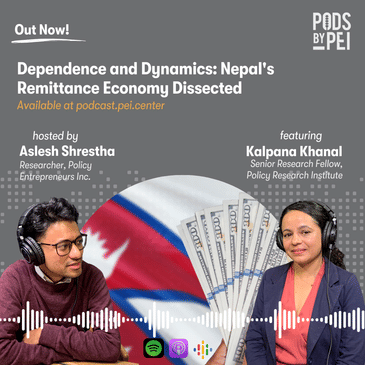
In this episode, PEI colleague Aslesh Shrestha sits with Kalpana Khanal to discuss Nepal's heavy reliance on remittances, analyzing their pivotal role in driving economic growth while also scrutinizing the associated risks and vulnerabilities. Exploring the historical trajectory of this dependency, they uncover the factors behind the reliance and examine their impact across sectors ranging from the macroeconomy to households and sector-specific consequences.
Kalpana Khanal is an economist specializing in public policy, international finance, money and banking, development economics, and institutional economics. She currently serves as a Senior Research Fellow (SRF) and Head of the Center for Economic and Infrastructure Development Policy at the Policy Research Institute (PRI) in Nepal. She obtained her Ph.D. and MA degrees in Economics from the University of Missouri Kansas City (UMKC), USA. Her research focuses on the comprehensive analysis of economic policy issues at a broader level.
If you liked the episode, hear more from us through our free newsletter services, PEI Substack: Of Policies and Politics, and click here to support us on Patreon!!
[00:00:01] Namaste and welcome to Parts by PEI, a Policy Discussion Series brought to you by Policy Entrepreneurs Inc. My name is Lnia Jimmy. In today's episode we have PEI colleague, a Slay Shrestre in conversation with Kolbanakana,
[00:00:23] on Dependence and Dynamics, Nepals Remittance Economy Dissected. Kolbanak is an economist specializing in public policy, international finance, money and banking development economies and institutional economics. She currently serves as a Senior Research Fellow and Head of the Centre for Economic and Infrastructure Development Policy
[00:00:45] at the Policy Research Institute in Nepal. She obtained her PhD in MA degrees in economics from the University of Missouri Cancer City, USA. Her research focuses on the comprehensive analysis of economic policy issues at a broader level. In this episode,
[00:01:03] the discussion navigates Nepal's heavy reliance on remittances, analyzing their pivotal role in driving economic growth while also scrutinizing the associated risks and vulnerabilities. Exploring the historical trajectory of this dependency, they uncover the factors behind the reliance and examine their impact across sectors ranging from
[00:01:25] the macro economy to households and sectors specific consequences. We hope you enjoy the conversation. Namaste, I'm Oslay Shrestre. Namaste, I'm Kolbanakana. Welcome to Parts by PEI, Kolbanakana. Thank you Oslay's. To a set this stage, let me start the conversation with a statistic from the World Economic Forum
[00:01:48] an estimated $626 billion has flown into the low and middle income countries in 2022. And it is estimated to rise further. This kind of gives us an idea that more and more low middle income countries are becoming dependent on remittances as it has exceeded the official development
[00:02:12] or system flows and also it is projected to exceed the FDI flows in 2023. So given that remittances on a micro level is important for households, specifically in a country like Nepal, aware significant population is still living in poverty but I would like to focus the conversation
[00:02:34] mainly on the macro aspects of remittances. So for a country like Nepal, what kind of macro impacts does remittances have? So all of us know that Nepal is dependent on remittance, right? And right now
[00:02:50] the share of remittance in our GDP is almost one third, one fourth I guess. And this does not include remittance from India and also it does not include remittance from informal sources such as Mundi, similarly remittance has emerged as the largest source of foreign exchange earnings.
[00:03:13] Remittance has been maintaining the balance of payment surplus except during the pandemic years and also remittance has helped Nepal breeze the resource gap. And when it comes to government revenue, remittance finance imports they are the biggest source of government tax revenue.
[00:03:35] And also historically if we look back, remittances have helped Nepal observe external economic stocks and also if you look at the economic survey to 2223 data, you see that 15.1% of the population is below the poverty line and most of them live in rural areas and the main
[00:03:59] contributor to reduction in poverty is remittance. So remittance has significant positive impact in our macro economy and our economy is dependent on remittance. Definitely so as we see the macro economic impacts you've also pointed out that Nepal has become dependent on remittances.
[00:04:23] We've seen a stable inflow of remittances for the past two decades due to which like you said imports have been financed mainly because of the remittance inflow but we are seeing significant dependency on an external source of income. So how does this dependency create risks or adverse impacts
[00:04:44] on the economy? So in the short run you pointed out that because of remittance, consumerism has gone up and also this has led to rising imports and also because of that our currency valuation
[00:05:01] exchange rate has gone up and this has led to symptoms like dodge disease and this may have some adverse impact on exports but we see that there are some positive effects for some households, but for some other households it may have some adverse impacts especially families at the
[00:05:25] margins because of lack of assets because of some cast relations gender or their ethnicity they cannot enter into the migration chains or it may be difficult for them to enter and sometimes the migration circuits can be improper racing because of their exploitative nature, the recruitment
[00:05:48] processes are tough and sometimes workers lose their jobs or their employment contracts. Primotually they can have some health impacts, low pays we can see that in some of our Nepali workers who are in the middle east and also as the share of remittance in our GDP is
[00:06:12] increasing the role of the state in providing public services and social provisioning is also declining so that's also adverse impact. But we've also heard about the capital which is coming in going into the wrong sectors as we say on productive sectors can you elaborate a bit on that?
[00:06:33] Yeah right now consumption is the main thing but if we look at consumption, if we look at the history of Nepali people or our economy where historically relatively poor and people did not have enough
[00:06:48] to eat people did not have enough to wear and their basic needs were not met so if some of the income is going to consumption I don't see it as a negative thing because sometimes certain
[00:07:02] level of consumption also helps the economy and also the decline in poverty is the indicator that some consumption is necessary at the initial stage but now that poverty has significantly declined it's about time to direct the remittance to productive sectors. These are some very interesting
[00:07:25] observations you've made but I am curious about how Nepal has reached this stage where we depend on remittance inflow for most of our imports and well like we've seen in the past few years
[00:07:41] we've struggled when the remittance is low so how have we reached this stage? We have to contextualize ourselves right migration and remittance flows are not new phenomena and all of us know that
[00:07:57] traditionally we used to have laureates who migrated to India or Pakistan and they sent money home and the families that had one of their members working outside Nepal had relatively stable income
[00:08:13] and were better off but if we look at the recent history if we look over the past four years it's not just Nepal a global trend has emerged within the international community and a new paradigm has
[00:08:29] evolved and this new paradigm has two areas of migration and development linked together and this new nexus is called migration development nexus and in this new form of development the government institutions, international financial organizations and geos and the private sector
[00:08:50] actors have become interested in migration and remittance and their potential for poverty reduction and development so all of the interest of these organizations have been channeled towards remittance as a source for poverty elevation or development so that's the recent change
[00:09:12] and because Nepal is not that far away from this global trend and global discourse of development it happens slowly through various policies or the new trend that I mentioned right it comes with a variety of institutions and these institutions become involved in activities linking migration
[00:09:32] and remittance is to development and also new institutions are formed new policies have been prescribed all of these the whole ecosystem and the trend led to this dependence because the main
[00:09:47] motto of these trend is leveraging remittance for development so I will continue on that so when it comes to popular perceptions of out migration like currently the one you pointed out is about the migration
[00:10:06] development nexus which shows like any developing country has to pass through this phase of development where people migrate and earn money and send them back because of the higher wage rates in other
[00:10:19] countries and there is kind of a free flow of labor into countries facilitating that one narrative could be that the other narrative could be that of a failing state where the state is failing to provide for
[00:10:33] its citizens and hence the citizens have to take matters into their own hands and go to other countries and fend for themselves so which narrative do you side by a I wouldn't take side but
[00:10:47] let me continue like you know what I mentioned earlier right so this new trend the migration development nexus so the novelty of this nexus or this new development trend is that migration and remittances have gained popularity as an instrument to finance development and reduce poverty so that's
[00:11:09] the main narrative but some of the studies have challenged the underlying narrative for example one of the studies conducted in Mexico argued that increasing migration rate and remittance flow increased levels of dependency in three ways so the first is migrant communities move away from their
[00:11:33] based subsistence agriculture and second increased demand for consumer goods so we have also seen rising consumerism in Nepal right so the rising demand for consumer goods increase conspicuous consumption so that means people buying imported items luxury goods and this has been
[00:11:53] leekasing the hard earn income to foreign countries in the form of imports so we're losing for any exchange and the third one remittance flows intensifying local inequality that has been observed so it has been argued that this high cost of international migration actually we see that in
[00:12:15] Nepal as well so people because of various inefficiencies in the migration chain people are the workers and of spending a lot so migration is not easily accessible to everyone especially not for the
[00:12:32] people in the margins so because of all these there is a form of increased level of dependency and also government often tend to fall back on remittance flows for microeconomic stability that magnifies the level of dependency so based on experiences of all the developing
[00:12:55] country as well as all of these applies in Nepal as well but you did point out about certain public moral hazards that come into place when people migrate and most of the families are then taken care of by the one that has migrated rather than the government.
[00:13:16] Right so what I was trying to see is that usually the state has a role to play to provide let's say health education care the basic social security needs of the people but with increase
[00:13:30] the migration the public sphere is receding like the size of the government in terms of providing service to the people is declining and heavy reliance over reliance on the private regenerated remittance is increasing right now everyone is relying on that one income that
[00:13:50] family is receiving so even the state is moving its responsibilities to the people so this can be alarming because the state has a role to play even in capitalist developed economies like the United States the state provides basic education health care and it takes care of its old
[00:14:14] differently able people and we see that slowly declining in the developing world and people are looking up to remittance flows for those purposes as well so this has been called as a public moral
[00:14:30] hazard in the literature so given that you've pointed out that there is possibility of public moral hazard that when the government steps away from their responsibilities the labor workers have to fend off for themselves and their families but is there a choice for the government
[00:14:49] of taking a matter into their own hands and not allowing people to migrate and keeping them in the country and utilizing their labor specifically when the international system is facilitating migration in an easier manner with the financial systems and policies
[00:15:08] becoming more relaxed for labor migration that's a tough one as well so right now curving migration would be counter intuitive for Nepal especially in the short run because as we know Nepal economy relies on foreign assistance even to conduct our budgeted projects and also as we are discussing
[00:15:31] second wave of reforms in our economy we are talking about building an economy that encourages inflow of foreign direct investments so this is our domestic context whereas in the contemporary international financial system remittance has been seen as an asset that can be
[00:15:50] secretized and can be used as collateral for loans in international capital markets so that train has already emerged in the international financial system so actually we can utilize future remittance flow as an asset to get loans from international market as we graduate from LDC
[00:16:13] this could be a possibility for us so there is some room that we can benefit from that but depends on how we do our economic diplomacy, how we manage, how we put things together and also in the international context remittance are also used as guarantees for foreign debt
[00:16:34] and international rating agencies rank credit worthiness of a country almost at the same level as that of oil exporters and some of the countries such as Brazil, El Salvador, Honduras, Jamaica etc they have offered bonds backed by remittance from United States and even in the
[00:16:54] case of Nepal the government once issued diaspora bond in 2010 I believe to raise funds for infrastructure development I don't know how successful it was but this could be done in future as we are talking about the use infrastructure development in Nepal green and sustainable infrastructure development
[00:17:15] in Nepal so this could be a future possibility so we don't want to rule that out and also in the current context institutions such as the World Bank, the UK Department of International Development International Organization for Migration etc the leaders in bringing this notion or contemporary
[00:17:37] reforms or discourses in international financial system and the direction of development is like the financialization of development and remittance can be used as an asset that can be secretized so I don't see dependence on remittance going away anytime soon we just have to think
[00:18:00] how Nepal can benefit from this ongoing development so that means more and more burden on the migrant labor in the foreseeable future yeah having said that in the short run I don't see that
[00:18:16] going away anytime soon but we have to start planning for the future right now so this could be the short term plan and it could be midterm plan as well but in the long run creating employment
[00:18:29] at home can have no alternatives so we have to work towards making our economy grow so that more jobs can be created at home so that our use do not have to migrate or majority of our use do not
[00:18:45] have to migrate. Hi there this is Kushif and Policy Entrepreneurs Inc we hope you're enjoying by PI as you know creating the show takes a lot of time and resources and we rely on the
[00:19:02] support of our community to keep things going. If you've been enjoying the show and would like to help us out would really appreciate it if you could become a patron on patreon. Patreon is a
[00:19:13] platform that allows listeners like you to support creators like us with a small monthly donation her support will go a long way in helping us to continue creating high quality content for you so if you're interested in supporting our show and becoming a part of our community
[00:19:29] hit on over to patreon and become a patron today. You can find us at patreon.com slash podsbypea every little bit helps and we can't thank you now for your support. Now let's get back to
[00:19:42] the episode. So now that we've discussed the majority of the macro aspects and some of your findings from your papers I'd like to bring the conversation to one interesting concept you pointed out in your paper that is of the transnational household. So could you briefly elaborate what
[00:20:06] the transnational household is and what are the impacts of these households in a country like Nepal and how does the transnational household change the social fabric of communities? I would like to first contextualize how this happened. As we are aware since the 80s during the
[00:20:28] tature and Reagan era's liberalization and deregulation was the main mantra and as most of us are aware the mandate of globalization was free flow of capital as well as labor and there was also term as liberalization through liberalization and deregulation so the policy reforms that took
[00:20:50] place during that era made mobility of capital relatively easier but labor mobility across national boundaries still continues to be highly regulated it's not that easy. Capital flow is relatively easy but labor flow is not easy so let's this context right and in my research I refer to
[00:21:12] this economic anthropologist Carl Pollyani and I go back to his 1944 book the great transformation where he calls land, labor and capital. Fickchish is commodities and as we are aware commodity is
[00:21:28] something that is produced to be sold in the market but land, labor and capital we do not produce them but now land, labor and capital are sold in the market so based on Pollyani in terms labor
[00:21:41] can be called a fickchish he has commodity because it was not produced to be sold in the market but now we do in the forms of migrant workers. So migrant receiving countries still restrict the duration
[00:21:53] of paid work and residence visas for all looped occupations and it's relatively hard for the workers so these has led to the emergence of global household in or the concept of transnational household
[00:22:08] so what this means is that one person migrates let's say male or female in the family but they have family members those are left behind in the home country and in the host country now they have a
[00:22:23] new migrant household maybe there's one person or they have some friends together and if we are talking about care work female workers or male worker migrating to provide care work domestic health the household receiving those services so you have you know migrant worker the family left behind
[00:22:42] the household that's receiving the services right the workers that are providing care work so all these dynamics that are interdependent with each other so whole these is like a ecosystem termed as transnational household and the labor migration is supported by this concept of transnational
[00:23:01] household but the transnational household breaks when the migrated worker can actually settle for example if labor migration to Australia or United States they provide green card or permanent residency and give option to workers and most of these are skill workers and the relatively
[00:23:20] lower skill workers do not have these options so that's why you see migrants going to middle east or other countries send home money like the most of the remittance we see these from the on skill
[00:23:33] workers whereas the migrants who go to US are Australia the developed world they tend to settle there after sometimes and once it's settled there's not this transnational household like the immediate families there so this stop sending money so this whole concept is centered around the idea of
[00:23:54] temporary and a temporary migration once it's a permanent migration then remittance flow stops so that's how we have to understand this idea like you know a remittance relying on transnational household which again is centered around the concept of temporary in this like you've said basically
[00:24:14] the families which are affected let's say temporarily because one family member has migrated to provide for them so what kind of social impacts does that bring or what kind of impacts does it have on
[00:24:29] the social fabric of communities which have a majority of families which have at least a member that have migrated you know we can see that as a family is migrate because of this idea transnational household the family is not together it can have especially if the mother migrates
[00:24:49] there is a care deficit meaning the older member of the family will have to look after the youngers and when the father migrates usually the mother is the one who's looking after the kids
[00:25:01] and studies have shown that children who are raised by both parents do well in terms of discipline or education and also because the husband wife children are not together this can bring lots of
[00:25:14] emotional, social issues and we often see that in our society as well because you want family to be together and most of these host countries usually do not allow the whole and can have implication
[00:25:29] in terms of care deficit and also there could be many other impacts in other sector like labor deficiency in the sending country so I will stick to the labor deficiency part and let's talk about
[00:25:44] the labor market in Nepal so how is the continuous exodus of unskilled labor impacted the labor heavy sectors of construction manufacturing and agriculture sector in Nepal? So as we see you know we have some studies mentioned the population
[00:26:06] different but we haven't been able to utilize that and especially now that Nepal needs to do a lot in the infrastructure sector what as we migrate our young population to Middle East we are bringing
[00:26:21] workers from the neighboring countries to do our construction work as well as our agricultural works so this has a huge impact and also this increases informalization of the economy especially when workers from the neighboring countries like India come and many of the payments happens
[00:26:42] to informal channels. Okay so specifically I will talk about one sector which is the agricultural sector because Nepal has been dependent on agriculture as far as we know and in your people you've talked about certain impacts of out migration on the agricultural sector which is specifically
[00:27:00] because of rural gentrification and there is also the deactivation of agricultural land as we say and eventually the land which was used for farming becomes an asset which not an asset let's say
[00:27:17] becomes a speculative instrument right so can you elaborate on how this has been going on in in the context of Nepal? Sure so first of all when people in the rural areas who traditionally
[00:27:30] relied on agriculture leave for overseas work the area well land that they use for cultivation of crops becomes more available and sometimes these attracts the landless laborers and they become seer cropers and this phenomena could be called repise and titiation so meaning people who didn't
[00:27:53] have land are now the peasants or farmers so this is one phenomena but when the migrants return right so one of the forms of investment for the migrant worker is investing on land real state
[00:28:08] so the returning migrants they engage in buying land as an asset to hold and they do this for a speculative purpose or as an investment and these buyers who bought the land for a speculative
[00:28:21] purpose they keep the land on cultivated and thereby this land is rapidly converted to follow land and these restricts this also restricts the landless to the land right and reduces the demand for agricultural labor because the landless people who used to work as seer
[00:28:43] cropers they no longer has access to land and these further suppresses of rural gentrification meaning the landless people who were seer cropers now don't have access to land then they have to move out of the rural areas and eventually these people have to move to urban areas so
[00:29:01] encourages urbanization and people start looking for off-farm works and this eventually leads to deactivation of agricultural lands and many of the researchers have seen these patterns emerging in rural Nepal so can this be linked to our import dependency in agricultural products at the moment
[00:29:26] this definitely has some impact because many of the studies and even in the news we have heard or read that you know the monkeys are taking over agricultural farms right meaning the forest is expanding to the agricultural lands meaning people are not taking there are not enough people
[00:29:47] to take care of the land right so when people cannot grow for subsistence they have to rely on market and again when people have to depend on the market to buy their basic needs they are
[00:30:03] utilizing the money from remittance to do this so we see these break-ares subsistence agriculture which is not a good thing in the long run so we definitely see an interesting chain of events that have unfolded in the context of Nepal but another interesting or let's say another cautionary
[00:30:26] scenario we have to look at is about the demand for certain professional services in labor demanding countries that can lead to over supply of labor in countries like Nepal especially I'll take a case of a nursing services so because of certain demands in countries like Australia or Canada
[00:30:47] or the United Kingdom for nursing services we can see that there's been an over supply of nurses in Nepal and because only limited nurses get to migrate to those countries because of an
[00:30:59] over supply in the labor market in Nepal the nurses seem to be heavily exploited in terms of working hours in terms of the money they receive so what can the government do to minimize or mitigate
[00:31:17] these kind of scenarios? Okay good question. So let me contextualize this in terms of global care chains we already talked about transnational household and one of the impact I mentioned
[00:31:31] is care deficit so and because of the care deficit this has led to global care chains and let me explain what that is. So in the higher income countries like the Western world women are going out
[00:31:48] to the job market and because of that care deficit has been created and these have generated demand for care work that has increasingly been supplied by immigrant women from lower income countries.
[00:32:02] So in United States most of the nannies are from the Latin American countries and if you see in Philippines or countries like that the nannies are from India or in Israel some of the domestic
[00:32:18] work or the nannies are the eskere workers from countries like Nepal, Bangladesh. So this has led to the global care chains you specifically talked about nursing but here I take nursing as a care work
[00:32:33] because most of those nurses from Nepal go to Australia or UK are engaged in care work including eskere sometimes nursing home they work for ising population right and we have to understand that these care workers or in general migrant workers are racialized right gendered especially in
[00:32:54] care it's female so gendered and often from poorer reasons including rural communities and they take on care labor while these care workers are providing care work in the relatively developed world they are transferring their own family and community responsibilities to
[00:33:17] other even poorer caregivers so when a female from Nepal migrants to let's say Philippines or Israel to provide care to the families is there who's taking care of her children maybe someone from rural
[00:33:33] Nepal right so this is this safety and responsibility is from the world he to the poor to the poor you see you see this global care chain so it extends from United States the global north to
[00:33:48] the global south and this has been organized as a result of crisis that neither the states of origin nor of the destination have been able to solve meaning like the countries that demand
[00:34:02] care work and the supplies because it's a chain so the result is a huge care gap from research to poorer families from the global north to the global south and again in between these
[00:34:19] care ethics has been compromised and this again let's switch to a this in remittance driven international development paradigm so it has created new vulnerabilities and female digestion of migration has contributed to changing family dynamics and non immigrant woman
[00:34:42] have been involved in family care household allocation of resources and some of the impacts include emotional stress and migrant mothers caregivers children in transnational families aging population in transnational families taking everything into consideration what you've said
[00:35:06] what we've discussed we know that Nepal will be for the foreseeable future dependent on in terms of migrants so in Nepal the Nepal government manage this migration for the betterment of the workers and their families so some of the existing problems includes like the
[00:35:27] departure system in Nepal migrant workers are not provided orientation before they leave the laws are delidally you know and we don't provide enough skills to the workers before they leave so they are getting like mineral payments and also access to communication network is poor so enhancing
[00:35:48] skills to the workers before they leave and being aware that this international migration chain has created vulnerabilities and this exploitation and through economic and labor diplomacy we have to ensure that our workers are situated in countries with strong labor laws and also we have to
[00:36:09] minimize human trafficking if we can ensure that people can migrate because they want to and not because they have to that will be a big progress but like we've discussed about the transnational household we've said that there are certain social issues these families face so
[00:36:29] is the government aware about these things and do you think they have certain policies that cater to transnational households specifically? I'm not very aware if there are specific policies for the families that are left behind I know the government has some policies for the
[00:36:47] returning migrants but I'm not sure if they have any policy for the left behind household I know that especially in the banking financial sector the return on remittance is 1% higher the interest
[00:37:02] is higher I don't know if you can that as a policy but I haven't seen anything like that but you know that's something to consider policy makers so what do you think would be a good policy or
[00:37:16] good start for government focusing on these households? Right now it's very segregated like even our data keeping system how systematic it is so maybe formalizing and making sure and keeping records of who's going what's happening but the thing is right now migration is
[00:37:41] not because people want to but because people have to meaning all these happens in very it's a tough process right it's a very taxing process for the immigrant workers and most of the on-skilled workers who migrate are at the bottom tier of the economy even though they are
[00:38:04] helping the economy they come from marginalized family rural areas right and is a expensive process at least if the government can formalize the process and ethical recruitment and punish the human traffickers and also ensure that the migrant workers like the collateral you know especially
[00:38:29] some of the workers lose their only piece of land as collateral sometimes so if the government can facilitate that that would be great and also another thing is we are losing so many workers in
[00:38:41] the middle east because of the stringent working conditions at least if we can take care of the families of the workers who we have already lost that would be a good step in the right direction
[00:38:58] definitely I have a one more question for you and the conversation but this is a difficult one I would say so I'll get the nebali government leverage the ever increasing remittance inflow for more than
[00:39:12] those imports or loan repayment so you know we are in the words of LDC graduate and right now and with LDC graduation one of the criteria for the graduation was the economic vulnerability index even though this index does not capture vulnerability such as dependence on remittance and other
[00:39:35] structural volatility so dependence on remittance over dependence on remittance for macro economy can make a country of volatile two external socks especially if we look back during the COVID era the remittance declined and for a brief period of time our balance of payment was negative like
[00:39:56] really bad so what we could do is we need to diversify our source of foreign extremes and this can happen if we can increase our export base how can we do that by utilizing our population dividend domestically right in the industrial sector and even if we look into
[00:40:20] our data like the structure of our economy we see that the service sector right now occupies a higher share of the GDP and service sector from tourism to ICT information and communication
[00:40:35] and some of the ICT related jobs can be done with minimal skills so we could train some of these on-skilled workers so our vocational education system could be improved so that we can
[00:40:50] enhance the skill of our workers and try to retain them at home or even if they migrate if they have some skills they'll earn more so that's one and another is you know we have this job guarantee programs can extend the job guarantee programs to infrastructure sector
[00:41:12] clean energy because we are moving into energy transition so this hydraulic obesity project through our vocational education system we can train existing work or a returning migrants and engage them in you know like the jobs for the future will be in the infrastructure sector
[00:41:32] ICT sector energy transition and also in high value agriculture sector like incentive rising and driving our policy like subsidies through government incentives to create more employment at home so that they can engage the youth or our population dividend
[00:41:55] so definitely channeling these inflows from remdances to the specific sectors you've mentioned would be the right way to go thank you for ending on the wonderful note I've enjoyed the conversation and like to thank you from P.A.
[00:42:10] Thank you as least for having me it's wonderful talking to you thank you thanks for listening to parts by P.A. I hope you enjoyed our delicious conversation with Kalpana on dependence and dynamics the ball remittance economy dissected today's episode was
[00:42:35] produced by Naging Rye with support from Kushihang, Redish, Sapkota and me, Sonia Jimmy the episode was reported at P.A.I. Studio and was edited by Redish Sapkota and Naging Rye I think music is courtesy of Rohit Shakya from Jindabad if you like today's episode
[00:42:53] please subscribe to our podcast also please do us a favor by sharing us on social media and leave a review on Spotify, Apple Podcast, Google Podcast or wherever you listen to the show
[00:43:06] for P.A.I. is video related content please search for policy entrepreneurs on YouTube to catch the latest from us on the Bals policy and politics please follow us on Twitter at tweet to P.A.I
[00:43:19] that's tweet followed by the number two N.P.E.I and on Facebook at policy entrepreneurs' you can also visit P.A.I. Center to learn more about us thanks once again for me Sonia we'll see you soon in our next episode