
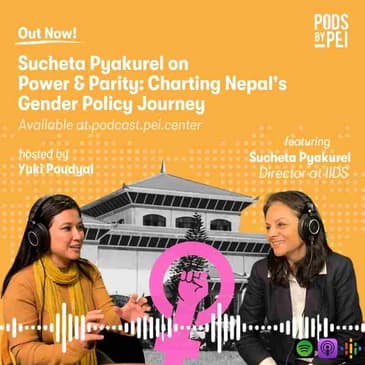
#Ep.072
Despite once being gripped by patriarchy, Nepali society has come a long way in terms of gender equality and equity, and gender policy efforts have played an undeniable role in reshaping the reality of women in Nepal. Today, women’s representation and participation is incentivized in different development sectors, including education, health, workforce, and politics. However, the strides of progress are still enervated by inefficient implementation, which poses questions about the vitality of gender policies.
In this episode, guest host Yuki Poudyal sits with Sucheta Pyakurel to explore Nepal’s policy landscape with Gendered Lenses. They begin by elucidating the case for gender equality and its vital connection to responsive policies and budgeting in patriarchal societies like Nepal. Tracing Nepal's history of gender policies, Sucheta shares pivotal reforms that have significantly narrowed the gender gap while also critically examining the formal and informal hindrances. The two discuss crucial gender policy events and debates to extract observations on the efficiency of such policies and recommend changes.
Sucheta Pyakuryal is the Director of the Center for Governance at the Institute of Integrated Development Studies (IIDS). She teaches Gender in Politics/Policymaking for the Masters and PhD programs at Tribhuvan University and is a visiting faculty of Kathmandu University’s Masters in Public Policy and Management program. An alumna of the Regional Center for Strategic Studies of South Asia, her work focuses on studying democratic development and good governance in the region.
Yuki is currently the co-founder of the Nepal Institute of Study Abroad and has experience working across a myriad of sectors, from non-profits to innovative start-ups as a consultant, strategist, and leader. She completed her Masters in Development Practices and International Business from Tufts University.
If you liked the episode, hear more from us through our free newsletter services, PEI Substack: Of Policies and Politics, and click here to support us on Patreon!!
[00:00:01] The first day in the world, the first day in the world, the first day in the world. Now, I am welcome to Pods by PEI, a policy discussion series brought to you by Policy Entrepreneurs Inc. My name is Kushian.
[00:00:17] In today's episode we have guest host U.G. Podils Conversation with Sucheta Pyakurel on Power and Parity, charting Nepals Gender Policy Journey. Sucheteta Pyakurel is the director of the Center for Governance at the Institute of Integrated Development Studies.
[00:00:35] She teaches Gender in Politics and Policy Making for the Masters and PhD programs at Tribune University, and is a visiting faculty of Kathmandu University's Masters in Public Policy and Management Program. An alumna of the Regional Center for Strategic Studies of South Asia,
[00:00:51] her work focuses on the study of democratic development and good governance in the region. U.K. is currently the co-founder of the Nepal Institute of Study abroad and has experienced working across a million of sectors from non-profits innovative startups as a consultant, strategist and leader.
[00:01:09] She completed her master's in development practices and international business from Sof's University. In this episode, U.K. and Sucheta explore Nepal's policy landscape with Gender Lenses, the begin by illucidating the case for Gender Equality and its vital connection to responsive policies and budgeting in P.T.R.E.
[00:01:29] with societies like Nepal. Chasing the policy history of Gender policies, Sucheteta shares pivotal reforms that have significantly narrowed the gap while also critically examining the formal and informal factors that hinders implementation of these policies.
[00:01:44] The two then discuss crucial gender policy events and debates to extract observations on the efficiency of such policies and recommend changes. We hope you enjoy the conversation. Thank you Sucheteta for being here and welcome to our podcast, Ritril, to have you here. Thank you for having me.
[00:02:05] It's great. Sucheteta, let's just start with the basics while we're talking about gender equality. Everyone has their own notion of what it is so that we can all be in the same plane. Why don't you start with explaining us what gender equality means to you?
[00:02:21] How that's connected to gender responsive policies and budgeting? The gender equality is if you trace it back to what it means, what it should mean. I guess we'll have to go back to the fundamentals of political philosophy where one is taught that one is born free
[00:02:41] and one is born with three sets of rights, right? To life liberty and property. So one is born absolutely incompletely free and equal. So right to life liberty and property in an equal manner, right?
[00:02:53] So going by that particular tenant, one needs to assume that we're all equal regardless of who we are, whether we are a man or a woman or whatever, right? A child. So with that pretext, gender equality should have been a norm from the get go, but it wasn't.
[00:03:14] It's not being. So I guess to kind of have the kind of political system that we envision, the kind of egalitarian system that we envision. One thing that is a must is gender equality.
[00:03:27] I mean that is the starting point everybody has to be equal and the fact that it's not. And that's a problem that becomes a problem. And so that's the reason why we talk about gender equality. So regardless of who we are, what our gender is, we're absolutely equal.
[00:03:42] That is the basic prerequisite to our democratic governance. You cannot have democratic governance without that particular prerequisite, that we're all equal, that we're all born equal, right? So that's the reason why we talk about gender equality.
[00:03:55] And the fact that there is a lot of gender inequality in society such as ours, very patriarchal traditional field societies, that becomes an issue, especially in regards to political evolution. So that's the reason why the issue of gender equality is pushed forth,
[00:04:11] just to be talked about, just to kind of smooth the planes, just to kind of level the plane field. And so that is gender equality for anybody for all of us. Now moving to your second portion of the question, why gender equality, especially in regards to policymaking process,
[00:04:30] in regards to gender response, a budgeting, we call it GRB. So because we're all born equal, because we're all citizens, because we're all voters, and because we should have an equal claim to the political pie, and that's the state. And when that does not happen, that becomes problematic.
[00:04:47] And so in order for all of us to have equal access to the government, to various incentives that the government provides, it is very, very important to have equal access, regardless of one's gender. And so that's the reason why gender equality is extremely important,
[00:05:03] while making policies, while implementing administering policies, gender equality is a must at every stage. So that's the reason why gender equality is a major fact. It's a big fact, a very important fact in policymaking process. Now moving on to gender responsive budgeting.
[00:05:19] So budgeting, it's a fiscal policy of the state, right? Budget is a policy, it's a fiscal policy. And money is power. Money is where the cloud is, it's where the pressure is, where the power is. And the majority of the time what has happened in the past,
[00:05:35] and what typically tends to happen, is that the money is allocated to or for cotton code policies that have a lot of interest from particular pressure groups, interest groups, those that actually have sociopolitical cultural cloud, religious cloud at times. And majority of the times, those are not women.
[00:05:57] And so that's the reason why it's very important that we allocate funds for women, for women's development because 51% of the total population are women, right? And so if you want a holistic development, if you want like the state to be uplifted in a holistic manner,
[00:06:13] you cannot afford to leave behind that 51%. And so that's the reason why gender-based or gender-responsive budgeting is very, very important to gender equality. So I hope I've answered all three of your questions. So it's really, it's a follow-up on that.
[00:06:28] So as we talk about how status created spaces for these women, let's talk about the brief history of the evolution of gender policy. And as you answer this, you can go over some of the historical landmark policies. Maybe you can talk over policies in our country
[00:06:44] that you think have enabled us to bridge that gap between what we used to have and what we didn't, a decade or two years ago. So I guess when we're talking about policies,
[00:06:54] I think it's very important to talk about the political environment surrounding the advent of those policies. And so if you are to trace back, if you focus on the Nepali context, I guess one cannot help but remember the times of yoga Maya,
[00:07:11] yoga Maya and yoga and yoga and yoga and yoga and yoga and yoga, and she, I think she died in 1940, 1941 42 from Lama mistaken, but I may be completely wrong with the dates, and the first half of the 40s.
[00:07:21] So that was I guess one of the most important landmarks where women came together and defy the system, and pushed for a way to start with gender-friendly policies. And shortly thereafter, they were talks about opening women's schools and colleges in Kathmandu.
[00:07:39] And so here's stories about how Manga Devi is saying along with Sana Prada, and another sad number than another, I think they went up to partnership, asking him to open a school for women.
[00:07:50] And that was how the first girls who in Nepal was opened as Padma Kanyah school. And likewise shortly thereafter, women's colleges were open like one college. Padma Kanyah was open. And so it started this gender-friendly policies, you know, the process of gender-friendly policies.
[00:08:09] And then fast forward to the 90s, you had the 1990s movement where a lot of women, they came up to the fore and they were fighting for the cause of democracy. You know, some of the names come forth,
[00:08:21] you know, we just tend to remember Shalajadri and Sana Prada and Manga Devi, they didn't portray themselves as feminists. I remember distinctly, I mean, I was growing up at that time, and I remember how Shalajadri very specifically said that she is not a feminist,
[00:08:38] but I guess what the leaders, the female leaders at that time, what they were not realizing was how they were like, you know, what they were doing, how their actions were very, very feminist. And so I guess because feminism had that stigma,
[00:08:50] that the word feminist had that stigma at that time. And so majority of the women leaders, they were not willing to associate themselves with that particular word. And maybe that's the reason why, but you know what they did was very feminist,
[00:09:02] feminineistic, so Sana Prada and Manga Devi being in. And Shalajadri. And so these are the women that come to mind that actually pushed for gender-friendly policies. So you had co-tosystem, the first co-tosystem in 1990, and later on, and of course you had, you know, Beijing platform for action in 1995,
[00:09:22] which kind of really really pushed gender-friendly policies from the international level. And so with Hillary Clinton saying women's rights are human rights. So that kind of started the conversation about how women's rights is, it's something that needs to be discussed more about how women's
[00:09:39] policies need to come up to the fore. So that was happening. And in 2001, 2002 I think there was a landmark decision about how unmarried daughters can and should have access to parental property. And from that moment onward, one after the other cases that came that actually started
[00:09:59] giving more and more access to things like citizenship and property and so on. So the discourses have been going on and full of less since that time. And it's not stopped till now. So we are evolving, of course, where we're working every day,
[00:10:16] working very hard to make sure that women are at the same level as men. The work continues but there are a lot of policies that have actually turned into law. And there is an overarching national policy now as director principles
[00:10:31] as one of the director principles, Jesse, gender empowerment and social inclusion policy that basically touches upon major bureaus and their functioning and so on and so forth. So a lot has happened since then but very shortly it just tried to trace the evolution of policy making process generally,
[00:10:48] policy making process in the past. That's great. Thank you very much. So moving on, the purpose of gender policy interventions are to address problems or lack of opportunities and resources that arise from one gender. However, the route to policy from policies to impact isn't that simplistic
[00:11:11] and there are many nuances that dilute policy level efforts. What do you see are some of the more important policies that have struggled to find traction in the real world? What are the different forms of hindrances in the way of proper limitations of gender policies?
[00:11:30] Okay, there are a lot of instances I don't know if I can, or all of them I don't know if I can remember all of them but some of the policies that come to mind. I mean, the citizenship act, it's already been that it's been promulgated
[00:11:42] however as far as administration's concerns, as far as implementation's concern. There are a lot of hiccups that are still being felt, especially by women. I remember in a student of mine talking to me about how her son is interested in getting his citizenship through her,
[00:11:57] but the state won't allow it. Because the state wants either the father completely absent from the picture or the father already passed me dead. So there are a lot of societal hindrances that basically, maybe it's because of the social culture residue
[00:12:13] that you see such hiccups so that another thing, another issue that I was talking about with somebody, the other day was recently this act against Acidatech. Survivors, that has been passed but what their concern was that this could have been a policy or an act against anybody
[00:12:37] that tries to use burn violence against women. But it just became an act for Acid survive as not for victims or survivors of burn violence. So these are some of the things that make policy implementation, policy administration very complicated. Other things that I can think of,
[00:13:01] you have a system of course, you have good system in the parliament, you have good system in the federal parliament, you have good system in the state parliament, in the local government, local level. Most of the time what you see and this mean not sound too optimistic,
[00:13:15] but you do see a lot of tokenism going on. And then of course we saw in the last election how the mandatory, you know, one of the mere or the vice-mir, or the deputy mayor. I don't want one has to be of the,
[00:13:32] you know, one of the two changes right? So what we saw was we saw this unholy alliances between the parties among parties and that completely through the women off. And so this election we ended up not getting majority of the seats, so the ratio is kind of declined.
[00:13:50] Number one, number two, I mean we talk and there are a lot of narratives that are out there that are not quite correct. So when we talk about women's representation in the public administration, in public sector, especially in public service works,
[00:14:05] where do the 33% of the women, you know, they come from the quota system? Well, that's not wrong, it's 33% of the 45%. Right? So it's like 45% of the total quota of which 33% of that quota goes to women. So it amounts to around 15, 16% or more than that.
[00:14:24] And so these are the narratives that are out there. So despite laws, these are the cleavages that we need to kind of iron out and make it more equal, more leveled. And again, as far as, I mean even the quota system,
[00:14:39] we have quota in place, but what we've seen is maybe because of the socio-political perspective or socio-cultural perspective, a lot of women who are talented, a lot of women who are deserving, they kind of, you know, what we've seen through research is they do shun
[00:14:57] being seen as somebody who's come in from the quota system, using the quota system as opposed to the free competition. And so there's that stigma attached to the entire quota system also. And it makes this issue more clear. So yeah, it's one thing to make policies.
[00:15:15] It's one thing to kind of, especially when the government is centralised very easy to make policies here in a centralised government, but then taking it to the hinterland, taking it to the periphery and implementing it, it's going to be, and it has always been a major major challenge
[00:15:29] just because of the socio-cultural flavor that we have around, I mean, around about. I'm going to be backing off of that. Let's talk about all these resistance against gender policies. Another common health practice is regarding how gender policies are sort of competing with development goals in itself,
[00:15:52] and this is especially prevalent when resources are scarce and projects are urgent, like most of the things I'm in about. How do you approach this perception and how can practice nurse best deal with this? It's really interesting how you frame that question,
[00:16:08] because I think it's precisely because of that, that we need gender equality, gender parity in policy making process. See what happens is in public sector, there's always this fiscal crunch that is there, I mean, our tax collection system is not too robust,
[00:16:23] and so we always have this fiscal crunch. So we don't have money, and we really cannot afford to go wrong while making policies, because we don't have the money, and we have to do with whatever we have, but we cannot afford to go wrong.
[00:16:35] And so we come up with policies. Majority of the time what we do, what we've been doing so far, has been importing policies from outside. They've been good and good. I don't like using the word donors, but development partners, let's put it that way.
[00:16:49] Who are keen that we adopt a certain policy, and then they encourage us, and of course there's money attached to it, and we do it. But now that we're developing as a viable state, we have to come up with our own policies,
[00:17:01] because the people are getting more aware, they're questioning, they're getting more accountable. They're making the government more accountable. So we do have to make our own policies and make our own policies implement them, and deliver results. But because of this fiscal crunch, we cannot afford to go wrong.
[00:17:19] And so, for example, I was just reading this policy about some development agency where they went into one of the villages in India, and they wanted to do a vaccination day. They wanted to allocate a vaccination day, and they chose up Tuesday. But Tuesday apparently was the day
[00:17:37] where the village women would go to some hardbazaar to sell their produce and things like that. And so that was like a major failure. And the reason why that happened was because women were not consulted. They were not involved. And so if you do not involve women,
[00:17:54] so any policy see 51% of the population is women. And so for any policy that gets churned out of the system, it has to cater to 51% of the stakeholders. And if you do not get them on board, if you do not ask them questions,
[00:18:09] if you do not tell them whether this particular policy is feasible or not, how are you to know whether that policy is going to be a success or be a failure? So in order to avoid failures, in order to avoid waste,
[00:18:23] in order to make sure that the policies that we churn out are good policies that are not going to waste the state coffers, the money of the state. We have to make sure that all the stakeholders, holders, all the parties involved,
[00:18:35] all the parties that basically will get impacted by the policies. They have to get consulted. They have to be brought onboard. They have to be asked questions. And they have to give input while making those policies. And if that does not happen,
[00:18:49] the majority of the time it does not. And that's the reason why development fails. That's the reason why development projects fail because majority of the stakeholders are not consulted. And so for that very precise reason, women need to be consulted, they need to be onboard while making policies.
[00:19:07] And our take is that well-chained policies are soft, kind of policy. It's like, you know, it's not one of those very, if I may say, so sexy policy. Because, you know, Monday and soft policy is very ordinary policies.
[00:19:22] And we just do it because there are a lot of pressure from outside. And so we have to do it. That's the mindset of majority of policy makers majority of the bureau men that are out there. But that's not the case.
[00:19:33] And so when you really come to the nuts and bolts of governance, it actually makes sense from the effectiveness aspect, from the efficiency aspect. It really makes sense to involve the women. Because in issue, you don't either the policy is going to tank. And again, it's a waste.
[00:19:50] So it again impact in the efficiency. It's going to be ineffective. So again impacting the effectiveness factor. And so the administration is not going to be a success at all. Administration of that particular policy, of that particular policy, a project. No, that makes a lot of sense.
[00:20:07] And I think you answered my next question about why we need women to present these leadership positions. But on the flip side, let's talk a little bit about, you know, like we have seen a lot of gender debacles in our public
[00:20:23] spirits, a from the equality to dissent and citizenship, high profile gender based violence cases and sexist defamation. And you've been keen of political events in a pile of focusing on women politics and policy spheres. How have our women leaders been able to address issues?
[00:20:45] Are they proactive in caring such responsibilities of women issues and forwarding feminist politics? What are your thoughts on that? Okay, there's a history behind this also. So once a part of the time we used to have women
[00:20:58] part of the elementary caucus, my last angel was what it was called. And once a part of the time it was very active, we still have it. It's not a quote and a quote to active. That's what majority of the critics say. What do we do have it?
[00:21:10] And if you go and talk to the members of the caucus, what they say is that they basically encounter a lot of hurdles and factors. So you know, you have party loyalty, is that the phrases such as party loyalty being plung
[00:21:25] at their faces, seeing, well, your loyalty is the party for us, not to your, you know, your sorority. And then of course, a party political pressures. You have societal pressures. Sometimes you have to decide on certain quote and quote controversial issues,
[00:21:43] which basically gets a lot of rebuttal and lot of negative backlash from society. And if you look at violence against women in media, in social media, it's more men that women that actually get attacked. And so they have to basically bear the brunt of all this.
[00:22:00] And so that is there, it's there. But at the same time, just to be objective and just to objectively look at this and critique it, we're all part and parcel of the society, right? We're all social beings. We're all products of the same society.
[00:22:15] So regardless of how much we want to do it, I guess there is that patriarchal residue in all of us. And so then I won't negate that particular factor also. So the women representatives that we send, I don't know if it's there on our part to expect them
[00:22:34] to be 100% totally pro feminism and like, they're part and parcel of this society. They also have, you know, patriarchal residue. They may have misogynistic residues in them also, because just because they're a social product also.
[00:22:52] So I don't know if it's fair to kind of scrutinize them like that. But yeah, I mean it would have been nice if they didn't have all these sociopolitical cultural hurdles. If they could do their job in a more uncomplicated manner, let's put it that way.
[00:23:10] But that's not the case. In our society is complicated. Social discourses are very, very messy, very, very complicated. Democracy is complicated, it's messy. Part of politics is messier. And so with all these blues, you know, women, they go,
[00:23:24] I mean with all these bagages, they go into politics and they have to operate as a lawmaker. The full women, that's difficult. It's not very easy, it's difficult. And it's not always nice being this one person who says no all the time.
[00:23:38] It's not nice being this one person who's like deemed as aggressive all the time or like, you know, shrill all the time. So you just get tired by that kind of depiction of your personality, yourself.
[00:23:51] And that's usually what happens that the minute you open your mouth about women's issues, people roll their eyes and you're basically like, told that again, there you go, you're your shrill self, you're again in this process.
[00:24:07] So that's the reason why I guess that this way it's a lot of women, a lot of women, lawmakers from actually actively and very, very passionately making cases for women. But having said that I won't negate that, that's shovenistic patriarchy residues in all of us.
[00:24:29] So it's, it's a difficult journey, but we'll do it, you know, unlearning is hard, but I think once the better time we can do it, we'll see. Now that makes sense, that makes a lot of sense.
[00:24:41] So let's move on to talking a little bit about what are some of the most urgent gender policies that you think needs attention right now. Gender policy, I mean, citizen ship bill definitely is gendered very gendered.
[00:24:55] I mean, you know, the discrimination between a dot and law in a son and law or a dot and law is seen as somebody who ought to get. So there's that level of entitlement as far as dot and law is concerned,
[00:25:09] as far as son and law is concerned. That's not the case, meaning that a dot does not have the same kind of privilege as a son or a her partner does not have the same kind of privilege as the sons.
[00:25:20] So that's of course that one policy that one law that comes to mind, there are a lot of laws like that. Another such policy, I mean, be it in the national level, be it in local level that the entire 33% for me and
[00:25:36] I keep telling this to my students. I mean, yes, the reason why we have a quota system is because we have a very lobstided system, but I mean, and I think I had posted this in one of my social media platforms too.
[00:25:49] So we were taught, I mean, political science students, they get dot that. Revolutions occur because there was no representation, right? And so the slogans such as no taxation without representation was reached to basically get your social political rights.
[00:26:04] And they were involved that were carried out, revolution that were carried out because there was no representation. And we are basically given 33% and we are expected to be happy and content and satisfied about that. Why 33% when we are 51% of the total population, we're given 33% of the quota,
[00:26:24] you know, 33% of the seats that are there. So I cannot understand that and that is one gendered policy that bothers me quite a bit. I for one, this generation, my generation belongs to Gen X, you know, I'm a Gen X.
[00:26:39] And so our generation's always wondered about why our last generation was okay with this particular policy. Why were they, you know, so accepting of 33% why didn't they clamor for 50% or 51% as the very portion to the kind of population that we have. But that comes to mind.
[00:26:59] Another thing is, you know, in state policies like directive, directive principles of the state policies there. And I forget which clause it is but we actually have something stated for Econ myla, so single woman, like hapless, Nimo Khaban, you go words something like that.
[00:27:21] You know, like the word that has been used is something that pinches. And so even when we are talking about women-friendly policies, some of the policies are so patronizing, very patriarchal and patronizing that it kind of stings.
[00:27:34] And so giving a monetary allocation to single women, I don't know if it's a gender needal policy or not. So these kind of things that come to mind, you know, there's so many policies that are out there that actually bear this very heavy burden of, you know,
[00:27:49] or symbolizes a very gendered society. So as of now I can think of these. So, you know, even in state policies, you have gendered state policies. In laws, you have gendered laws, you know, in electoral reforms or electoral laws.
[00:28:10] There are like hidden gendered norms that actually push women away. I mean, the norms that are there, especially for Dalit women. So you have quota for the Dalits and we have quota for the women.
[00:28:22] So majority of the time what we're seeing is that in the Dalit quota, a man usually gets it. In women's quota, a high caste woman usually gets it. So it's usually the Dalit women that basically bear the burden of these quotas.
[00:28:36] So there are a lot of nuances that haven't been addressed by policies. And I like to call them gendered still. So I don't know if I know that makes a lot of sense.
[00:28:47] So just talking about how we've already addressed so much of issues and there are so many things already in the pipeline, how can we create an environment that is better for gendered policies to come more.
[00:29:02] Do you think there are some countries that have created more successful gendered policies than others that Nepal can be inspired by? Mm-hmm. Yeah, I guess it's all a matter of time. A country that comes to mind is Ronda. Ronda wasn't doing too well.
[00:29:19] It was one of the least developed countries. But in Philippines also, I mean, not in the same level, but Philippines is not one of the more developed countries so to speak. But as far as their political representation of women's concern, it's very, very impressive.
[00:29:36] Ronda is also very, you know, it's come out shining, it's very impressive. And again, as far as Ronda's concern, it's the same thing that they've done. But I think taking a very aggressive policy of a quota system, they've made sure that they've incorporated that.
[00:29:52] And women have really taken advantage of that and they've come to the front line. And so that's one country that comes to mind. As far as we're concerned, I guess there are a lot of things that it's not that we don't have it.
[00:30:06] It's not that we've not, like we've not come so far. We have, it's not that we've not evolved in a positive manner. We have, but there's evolution and there's a slump, you know, 2015 in India. There was that nearby case, the rib case that actually, you know,
[00:30:24] it actually shook in there. And because we were right next door, it shook us also. But there was a lot of misogyny stick backlash that happened after that. And then you have, again, instances of asset attacks that occur in the neighborhood, like in Pakistan, Bangladesh, India.
[00:30:39] And we've never used to have that now we're having around 40 pieces a year. Or I'm sorry, I think so. I mean, not to confident about the numbers again, but you know, we've never used to have that many,
[00:30:52] but now we are kind of, you know, where we're increasing the number of asset attacks. And so I think what happens in the neighborhood also impacts animals, you know, gender equal evolution. But slowly we're getting there, I mean as far as the public sector is concerned,
[00:31:12] we had around 11% when we started. I think we're, you know, we're 23 more than 23% in the public sector as far as the federal parliament is concerned. 33% yes, but I'm hopeful in the local government around 41%. So a little more than the quota that has been mentioned.
[00:31:34] hopeful, but let's see if we can push as aggressively as rounded it or as Philippines did. There are a lot of other countries like Iceland and Norway and others that were already developed.
[00:31:45] That are doing so well, but I'd be more interested in looking at countries similar to us countries that are not first world countries. countries that are still developing or underdeveloped and see as to how they've taken their policies and maybe learn best practices from them.
[00:31:59] And the two countries that come to mind are Philippines and then one. That's very informative, I do know that about Ronda and Philippines. Do you foresee that Nepal can ever reach to that aggressive point where we can shake the country up?
[00:32:14] I do actually we've been projected to reach that space in 2037-38. So I do, I am hopeful and I do believe that we can do that. And you know because Nepal is a small state where not a very big nation state where a small country.
[00:32:32] And if we really put our heart in mind into it, I think it's doable. Anything is doable in Nepal. We just have to have the political will to do it. And I think things are attainable achievable here in Nepal.
[00:32:45] And now it's a federal system of government, so it may be a little difficult, a little more difficult than how it used to be or what it, you know,
[00:32:53] how easy it used to be for policy makers to actually come up with policies implemented and set like a template for it. But I think it's still, because we are small. That's fair. And you're talking about political will.
[00:33:09] What do you think we can do, some of the things that we can do to, you know, garner that? Political will, that's a very heavy question. So political will is something that actually it's a will of the masses, right? It's an aggregate will.
[00:33:28] It's not just a fragmented kind of will, it's an aggregate will. And to make that aggregate will, we all have to come together as a civil society. Civil society has to be really, really robust, very vibrant.
[00:33:44] And one thing that I see lacking here in Nepal is that it's, it's that involvement of civil society, you know, among civil society members. I don't know for some reason, I just don't know why, but I sense a lot of political apathy here.
[00:34:00] A lot of dispersement with the state. And there's that notion that actually negates that government is us, whereas it is us, right? Because you know, it's a democracy. We choose our representatives. We send them it is us.
[00:34:13] But then there's that trend of othering the government where you see yourself as somebody and then the government is them. It's like them how they don't work for you and like how they are so corrupt.
[00:34:24] But I think we need to look at ourselves hard in the mirror and say that it's us. So if the government is corrupt, it is us, you know, it's all of us.
[00:34:32] And so that will, it's a very, again, it's a very heavy question, but I think a lot of civic political engagement, especially by the youth, a lot of engagement with the youths.
[00:34:45] A lot of engaging the youths in policymaking process, I think that can actually develop a really viable, positive political will. I don't know if I answered your question, but it fantasticly. And I'm afraid we've almost come to the end of the show.
[00:35:03] Thank you so much for your time and is there any parting messages that you'd like to? Yeah, of course. And now I see this to my students all the time. I mean, our generation maybe didn't do as much as we should have done.
[00:35:16] And again, this is, this is, I see this with a lot of guilt and with a lot of apprehension. But I think the hope is now on this generation.
[00:35:27] And I think if this generation will set, I think Nepal can really see, you know, good days bright, sunny, good happy days. And if you can believe in Nepal and if you can believe that Nepal, we can do it.
[00:35:41] That, you know, that we can develop a robust policymaking process that we can come up with robust policies that we can, we can all benefit from creating this equality and society. I think we can still do it, so that's my, my parting message.
[00:35:57] Mmm, that's a very hopeful one. Thank you so much for this, Jita. This was a very insightful conversation. And it was an absolute pleasure to have you here. Thank you so much for having me. Thank you. Thank you. Thanks for listening to Baud's by PI.
[00:36:13] I hope you enjoyed UK's conversation with Jita on power and parity, charting Nepal's gender policy journey. Today's episode was produced by me, Kushihang and Nijan Rai, with support from Sonya Jimmy and Riddish Sabgota.
[00:36:27] The episode was recorded at the PEI Studio and was edited by Nijan Rai and Riddish Sabgota. Our theme music is courtesy of Lloyd Shakir from Zindaban. If you liked today's episode, please subscribe to our podcast.
[00:36:41] Also, please do us a favor by sharing our social media and leaving a review on Spotify, Apple Podcasts, Google Podcasts, or wherever you listen to the show. For PEI's video-related content, please search for policy entrepreneurs on YouTube. To catch the latest from us on Nepal's policy and politics,
[00:36:59] please follow us on Twitter at tweet to PEI. That's TWET, followed by the number two and PEI, and on Facebook at policy entrepreneurs' ink. You can also visit PEI.center to learn more about us. Thanks once again for me, Kushih.
[00:37:16] We will see you soon in our next episode.