
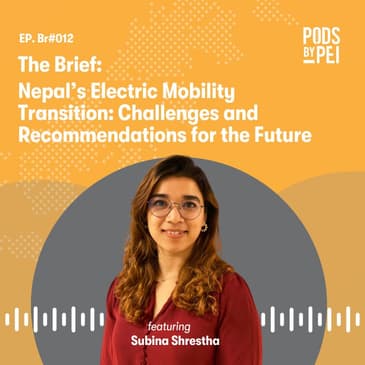
In today's episode, PEI colleague Shreeya talks with Subina Shrestha about Nepal’s transportation sector and connects it to the global discourse on climate change. They discuss the direct and indirect impacts of Nepal’s reliance on fossil fuels for transportation, its contribution to global emissions, and speaking from the angle of climate justice. They argue whether or not Nepal needs to make the transition to more sustainable options, and if and when it does - at what costs? They also talk about the existing policy options that are both working for and going against mobility transition and we also mull over future policy options for a more sustainable transition.
Subina Shrestha is a second-year Ph.D. Research Fellow at the Center for Climate and Energy Transformation at the University of Bergen, Norway. Shrestha’s Ph.D. explores the governance challenges associated with sustainable urban mobility (with an empirical focus on the movement of goods and freight logistics) in Norwegian cities. In her Ph.D., she assesses the current state of and potential for collaboration in urban logistics. By mapping stakeholder networks in the sector as well as engaging with stakeholders, Shrestha’s project explores how urban logistics challenges can be addressed through local solutions which integrate logistics into urban planning. In her research, she adopts broader governance perspectives to assess how they influence local policymaking as well as how different stakeholders shape mobility policy mixes at the urban scale.
She has work experience in Nepal, Thailand, and Norway, and her research interests include sustainable urban transitions, urban mobility, and low-carbon development. She is also interested in bridging perspectives across the Global North and Global South, particularly in climate change discourse. Shrestha enjoys working with different stakeholders to address issues of sustainability in a holistic manner. Prior to her current position, Shrestha worked as a researcher on energy transitions and policymaking, watershed management, stakeholder engagement, as well as climate finance.
Click here to support us on Patreon!!
[00:00:09] - [Shreeya Rana]
Namaste and welcome to Pods by PEI, a policy discussion series brought to you by Policy Entrepreneurs Inc. My name is Shreeya Rana. In today's episode, I sit with Subina Shrestha, a PhD research fellow at the Center for Climate and Energy Transformation in the University of Bergen, Norway. Subina and I explore the prospect of electric mobility transition in Nepal. We talk about the global discourse on climate change with a focus on the transportation sector, Nepal's reliance on fossil fuels for transportation, its contribution to global emissions and examine the policy options for sustainable mobility transition.
[00:00:47] - [Shreeya Rana]
Subina draws her insights from her PhD education where she explores the governance challenges associated with sustainable urban mobility, with an empirical focus on movement of goods and logistics in Norwegian cities. We hope you enjoy the conversation. Namaste, I'm Shreeya Rana.
[00:01:09] - [Subina Shrestha]
Namaste, I am Subina Shrestha.
[00:01:11] - [Shreeya Rana]
Welcome to the show Subina. It's so great to have you over. So Subina is joining us from her university in Norway. How is it out there in Norway, Subina?
[00:01:19] - [Subina Shrestha]
The day has just started and it's a snowy cold day. So we'll see if it's actually quite good. But thank you for having me.
[00:01:26] - [Shreeya Rana]
I hope the conversation we're going to have next will keep you warm. Let's see. So let's start with the main conversation today. So we're talking about the transportation sector in Nepal. While talking about the sector, one can clearly see that the current state of transportation is not sustainable.
[00:01:42] - [Shreeya Rana]
The country is overly dependent on fossil fuels for transportation, which is causing harm to the environment, and of course the health of the economy and its citizens alike. A transition to cleaner, more efficient form of transportation system is for sure needed. Subina, keeping these larger issues in mind, could you probably just frame what are your main ideas behind the need for mobility transition in Nepal?
[00:02:07] - [Subina Shrestha]
Sure, Shreeya. So if we look at a global perspective, combating climate change requires a fundamental transformation of the transport sector because globally transport has the highest reliance on fossil fuels amongst different sectors, and it is responsible for a quarter of global emissions. And even within transport, road vehicles alone account for 15% of emissions. So transport as a sector, at the same time is the only economic sector in which, emissions are actually rising, which is inherently against the need to curb emissions, which is super urgent. So in this regard, electrification is a very important and crucial step, getting rid of fossil fuels and replacing them with electricity because we can produce electricity that is both clean and green.
[00:02:56] - [Subina Shrestha]
And this is the global discourse that's happening in the transport sector with a focus on climate change mitigation. And this is what sort of frames the mobility transition in Nepal as well. The International Energy Agency, IEA in 2021 reported that the growth in transport sector emissions was the most notable in developing and emerging economies. And this is true for the case of Nepal as well, where transport related emissions make up the second largest energy related carbon emissions. So that's sort of the larger idea as to why a mobility transition is required in Nepal.
[00:03:32] - [Shreeya Rana]
Yes. If you talk in a broader sense, there is no arguing that this transition is vital for the economy for sure. But if you were to completely focus on climate change alone, for example, Nepal does not even contribute to 1% of the total global emissions. So why should we focus on decarbonizing this sector now?
[00:03:51] - [Subina Shrestha]
Well, what you say is absolutely true. The climate discourse in Nepal has focused largely on climate change adaptation because it is a climate vulnerable country. And now given the events leading up to the recent COP, it's been focusing on loss and damage. And this is also perfectly sensible because the number of annual climate related disasters that we face, it's been increasing year after year. But having said that, the focus on climate change mitigation has been relatively lesser.
[00:04:21] - [Subina Shrestha]
And I argue that it's not an either or situation that we either adapt or mitigate, we can and should do both. But the climate perspective aside, there are several reasons why it makes perfect sense for Nepal to decarbonize its transport sector. Firstly, an economic perspective, in the last fiscal year, Nepal imported petroleum products worth rupees $320,000,000,000 from India. And this is more than the country's total export value and a contributor of a massive trade deficit in Nepal. But at the same time, Nepal is also expected to have an electricity surplus once the hydropower facilities under development are complete.
[00:05:04] - [Subina Shrestha]
So going electric in transport sector offers an avenue to utilize the surplus while contributing to the domestic economy and closing the trade deficit simultaneously. Secondly, from a public health perspective, vehicular pollution has long been identified as one of the major sources of air pollution in urban areas, especially in Kathmandu Valley. And the morbidity that is associated with air pollution is on the rise. So sticking with fossil fuel based vehicles in Nepal is quite literally costing us years of our lives. So in this regard, electric mobility makes a lot of sense from both socioeconomic and public health perspective.
[00:05:46] - [Subina Shrestha]
And finally, from a market perspective, it's quite sensible. The EV market boom that we know about is not only happening at a global scale, but also here in Asia. In China and India, the EV market has grown over the last years tremendously as these countries have visions of increasing the share of EVs in their respective fleets. So the future of transport is electric and it is here to stay. And the private sector in Nepal is already showing interest to leverage this market growth of EVs and tap into it.
[00:06:18] - [Subina Shrestha]
So even from a market perspective, decarbonizing Nepal's transport is quite sensible. So climate perspective aside, we do have these other perspectives that makes decarbonizing quite sensible for the case of Nepal for transport.
[00:06:31] - [Shreeya Rana]
Indeed, those are some really compelling arguments, Subina. And what it also does is that it informs me that a more comprehensive integrated transportation system is needed so that this transition is successful. This also means that we need to make the right kind of investments into infrastructure, such as right kind of bike lanes, charging stations. At the same time, we also need policies that encourage the use of sustainable transportation options. So do you think Nepal has taken enough action to address this?
[00:07:02] - [Subina Shrestha]
Well, Nepal has taken action. Whether it's enough or not, that's up for debate, I guess. So the policy environment, let me begin with that. That is certainly in favor of this transition. For example, the environment friendly transport policy that was out in 2015, It encouraged a wider shift to sustainable transport services, which include targets of increasing environmentally friendly vehicles, which not only include EVs, but also bicycles shifting to public transport and so on.
[00:07:37] - [Subina Shrestha]
If we move more recently than in its nationally determined contributions, NDCs, Nepal committed to increasing the sales of all electric, private, as well as public passenger vehicles. And it has very specific targets such as by 2030 sales of all private passenger vehicles will be increased by 90% and that of all four wheeler public passenger vehicles by 60%. And finally, Nepal is also working on its long term strategy for net zero emissions by 2045. And this policy also favors the transition in transport sector. And in terms of operationalization also, we've seen quite a bit of progress.
[00:08:19] - [[Subina Shrestha]
For example, there are electric vehicle charging stations across the country and the Nepal Electricity Authority, NEA, has been building fast charging stations at over 50 locations along the main highways and also at bus parks and major cities across the country. Also vehicle manufacturers, they also have their own charging stations. And in terms of bicycle infrastructure, we can observe dedicated bicycle lanes across cities. So yes, the government has been investing the necessary infrastructure, but like I said, whether or not this is enough action, that is quite debatable.
[00:08:54] - [Shreeya Rana]
So based on your understanding, what kind of incentives or tax policies do you think are needed to make the transition to sustainable transportation successful in Nepal?
[00:09:03] - [Subina Shrestha]
So Nepal's targets for EV adoption that I discussed in its NDC, it's quite ambitious if we look at it. And despite having these targets, the EVs taxation history in Nepal has fluctuated and how. I can't believe that only a couple of years ago EVs were massively taxed because they were considered luxury goods. But having said that, the current scene is in fact in favor of EVs. So presently the excise duty customs and other charges on petroleum private vehicles, it sums up to more than 240%, which comprises of about 80% customs duty, up to 80% in excise duty, 15% VAT, 7% road construction fees and other charges.
[00:09:53] - [Subina Shrestha]
In sharp contrast to this, for electric vehicles, particularly private ones, the customs duty ranges from 10 to 40% and excise duty from 30 to 60%. Is this ideal? Perhaps not. The duties could have been lower. It has been in the past, but well, it's still favorable for the EVs.
[00:10:14] - [Subina Shrestha]
Secondly, there's also provisions that upon the conversion of petroleum powered vehicles to electric ones, the government will be providing a discount on registration fees and road tax for five years for electric vehicles. And finally, there is the provision that customs duty of only 1% will be applied on parts and raw materials used in manufacturing electric three wheelers and two wheelers. And all of this is to promote electric vehicles within Nepal. So the policy environment and the taxation, they are all quite favorable for the transition towards sustainable transport in Nepal.
[00:10:55] - [Shreeya Rana]
Hi there. This is Shreeya Rana from Policy Entrepreneurs Inc. We hope you're enjoying Pods by PEI. As you know, creating this show takes a lot of time and resources. We rely on the support of our community to keep things going.
[00:11:08] - [Shreeya Rana]
If you've been enjoying the show and would like to help us out, we'd really appreciate it if you could become a patron on Patreon. Patreon is the platform that allows listeners like you to support creators like us with a small monthly donation. Your support will go a long way in helping us to continue creating high quality content for you. So if you are interested in supporting our show and becoming a part of our community, head on over to Patreon and become a patron today. You can find us at patreon.com/podsbypei.
[00:11:42] - [Shreeya Rana]
Every little bit helps and we can't thank you enough for your support. Now, let's get back to the episode. Given these incentives which you just talked about, do you also see results? I mean, what are some of the sustainable transportation options which are actually available to Nepal at this point?
[00:12:04] - [Subina Shrestha]
Up until this point, I've been talking a lot about electric mobility, so it's a no brainer. EVs, they are currently available in Nepal. The EV market in Nepal has already arrived, be it in terms of electric motorbikes and scooters, electric cars, electric micro buses that operate from Kathmandu to Sindhuli, and also electric buses, for example, Sajha Yatayat, which plans to procure 40 electric buses. And one of my favorites, a special mention to Safa Tempo, which has existed for over thirty years and is still operating along some routes. And there are also electric rickshaws in Lumbini, for example.
[00:12:44] - [Subina Shrestha]
And this is a lot about just the electric mobility, but also we have bicycles and active mobility and those are being promoted by the government and we do have bike lanes. So results are quite visible, but a key problem I think is that our roads are designed to prioritize motorized personal transport over public transport, pedestrians and cyclists. So that kind of is an inherent urban planning problem that a lot of other urban planners have also talked about. But coming back to EVs, the current data shows that the market for EVs in the sphere of private four wheelers has already taken off, but to ensure that the future of transport in Nepal is in fact electric, the focus now needs to shift towards the public transport where similar market growth is yet to be observed.
[00:13:41] - [Shreeya Rana]
So diving deeper into the distinction between private and public electric transportation, Subina, Can you tell me what these key differences are that you've noticed between the two sectors?
[00:13:53] - [Subina Shrestha]
Statistics show that electric vehicles right now constitute about 5% of the total market share in Nepal's automobile industry. And most of this EV growth is very heavily skewed towards private vehicles. Last year alone, the import of lightweight EVs saw a sevenfold increase. And this is because on top of the lower excise and customs duties that's offered to EVs that we previously discussed, there are also auto loans available of up to 80% of the price of electric cars, which are provided by different banks and financial institutions. So this has really helped accelerate the deployment of electric vehicles, at least in private car ownership.
[00:14:41] - [Subina Shrestha]
And so in this sense, the electric vehicle market in Nepal has already arrived. We could also see that the NADA Auto Show, which is one of the biggest auto shows held by the Nepal Automobile Dealers Association in Nepal in the year 2022, it was fully EV. But having said that, we are yet to observe similar strides in the public transport. And this is rather unfortunate because public transport is perhaps where the biggest gains can be made in terms of reducing air pollution as well as cutting fossil fuel consumption. And this is because EVs like electric buses, for example, are not yet price competitive with their petroleum counterparts.
[00:15:23] - [Subina Shrestha]
The investment costs of purchasing an electric bus is very, very high, and it is not yet financially attractive for, operators to make this transition in public transport. And this perhaps is the biggest barrier that has prevented the accelerated deployment of electric buses in Nepal.
[00:15:43] - [Shreeya Rana]
So this is a very interesting observation, Subina. Could you please elaborate more on what you mean by these tensions for the public sector?
[00:15:51] - [Subina Shrestha]
So I'll try and focus on three tensions. So the first one is that of policy coherency. EVs are expensive, be it private or be it public. They have really high upfront costs. But what the government has done for public electric vehicles is that it has fixed only 1% customs on public electric vehicles, but there's still 13% VAT and 5% road tax.
[00:16:21] - [Subina Shrestha]
And this brings up the cost quite significantly. And so the prices of electric buses are still very high and we still lack a suitable financing mechanism that favors this transition. And this is because financial institutions are quite cautious about providing loans to these public vehicle operators because they are ownership transfers from one operator to another. And then there's an increase of default risks. So simply put, there is a lack of policy coherency for electrifying the public transport right now in Nepal.
[00:16:57] - [Subina Shrestha]
And this is unfortunate because the government cannot reach zero emissions by 2045 without electrifying the public transport. And given the status quo, it appears that there are several barriers rather than incentives for transport entrepreneurs to actually invest in electric buses. Secondly, power and politics. I think this is relevant to almost all sectors in Nepal, but especially in transport sector because the public transport in Nepal is operated by a lot of private operators and the routes are controlled by the Federation of Nepali National Transport Entrepreneurs. So what this means is that there is a lot of lobbying from the transport operators to maintain the status quo, which right now is the petroleum based public transport.
[00:17:47] - [Subina Shrestha]
And this has happened in the past. As we know, Nepal was a pioneer in electric three wheelers look and this was, you know, there was a lot of tension for the deployment and acceleration of Safa Tempos because of the power and politics involved in Nepal's transport sector. And thirdly, I think we have ambitious targets, but we don't have a concrete action plan as to how to reach these targets. And in this, the role of government is very, very important because public transport after all is a public service, whether it's operated by public operators or private operators. And this is perhaps where we could learn a lot from India, which has taken more concrete steps to electrify its public transport system.
[00:18:39] - [Subina Shrestha]
For example, India has its FAME initiatives which includes investments of over 100 billion Indian rupees to create demand for electric public vehicles and invest in charging infrastructure. Also, the government could perhaps make public procurement of electric buses a priority. The Bagmati province already wanted to do that, but it's kind of up in the air right now. And there's a lot of ongoing debate about well, rather than debate, discussion about perhaps the possibility of using the revenues generated from poll from pollution tax to subsidize electric public buses in Nepal. So in a nutshell, are many possible measures that could be taken, but we need a concrete action plan that sort of maps out what measures are possible so that the targets that we have set can in fact be met.
[00:19:35] - [Shreeya Rana]
So in the absence of rights incentives to make this transition, moving forward, where should policymakers position their arguments to encourage mobility transition in Nepal so that we are incorporating sustainable transportation solutions?
[00:19:51] - [Subina Shrestha]
Shreeya, I think the discussion about sustainable transport solutions in Nepal is already occurring. It's not a matter of when this transition will occur, but at what rate it's going to be at. And moving forward, that's where our focus should be to try and weaken and accelerate the pace of this transition. And what it entails is we start thinking long term. If we really want to have a sustainable transport system in Nepal, the policy environment has to be more favorable, especially for public transport.
[00:20:29] - [Subina Shrestha]
And this means not only creating tax incentives, but also looking at suitable financing mechanisms that actually make electric buses and vans quite competitive with petroleum ones. And also there is the possibility to try and leverage low hanging fruits, especially at institutional levels. For example, school buses can be electric, organizational transport could be electric. You know, Toraz is actually already doing it where it's procured a number of electric scooters. So other organizations could also pick that up.
[00:21:02] - [Subina Shrestha]
And the government's also already piloted this where it procured a number of electric cars, but so could other organizations. Secondly, infrastructure. We need infrastructure. Infrastructure must be in place and we are already seeing some aspects of this, But moving forward, we have to start thinking about what are the changes that we can expect in electricity demand and supply in patterns of electricity use, how many charging stations will be required and what are the optimal locations for these charging stations. And also in the same line of thought, the human resources would be imperative in terms of technical and technological skills needed to make this transition happen because, well, if the technology is going to change, so is the technological skill set required to address problems associated with these technologies.
[00:22:01] - [Subina Shrestha]
But moving forward, battery, and I cannot emphasize this enough. If we are thinking long term, we need to look at battery. And I probably don't have a lot of solutions for this, but a lot of open ended questions. Like when we do end up having a lot of batteries as a result of this transition towards electric mobility, what are we going to do with that? What's essentially going to be battery waste?
[00:22:31] - [Subina Shrestha]
Are we going to have recycling stations? Can we handle it? Will we be well equipped to handle this? And so we really need to start thinking about battery recycling, its feasibility, its possible impacts and so on. And going back to the global perspective that we started with, we have to be really careful and consider if and how battery waste could make Nepal a dumping site for batteries.
[00:22:59] - [Subina Shrestha]
And this is a thing that has happened elsewhere. And it's quite pertinent in discussions about climate injustices in the long run. So we have to start thinking about that as well. So yeah, moving forward, I think those three things are some of the most crucial things that we need to think about.
[00:23:17] - [Shreeya Rana]
Indeed, those are some pressing points that we will have to address to ensure that this transition is sustainable. And also, that's quite a food for thought to leave behind for our listeners, especially those thinking about buying electric vehicles. Now with that, we're coming to an end of our show. Thank you so much, Subina, for your time on our show. Any last words before we end the episode?
[00:23:38] - [Subina Shrestha]
Thank you, PEI and Trieste so much for having me. I had a really great time here and I hope we can continue having these conversations in the future. Like I said, Nepal's transport is looking electric and we need to have more discussions about how to make the transition happen quicker. So yeah, thanks.
[00:24:00] - [Shreeya Rana]
Hopefully we can have more frequent conversations. It was such a great pleasure to have you on our show today. And with that, it's a wrap. Thanks for listening to Pods by PEI. I hope you enjoyed my conversation with Subina on Nepal's transportation sector with a focus on exploring electric mobility as a sustainable solution, targeting both socio economic and climate change solutions.
[00:24:23] - [Shreeya Rana]
We further explored the prospect of electric mobility transition in Nepal and talked about the global discourse on climate change with a focus on the transportation sector, Nepal's reliance on fossil fuels for transportation, its contribution to global emissions and also examined the policy options for sustainable mobility transition. Today's episode was produced by Saurabh Lama with support from Nirjan Rai, Khushi Hang and Chhedon Kansakar. The episode was recorded at PEI Studio and edited by Saurav Lama. Our theme music is courtesy of Rohit Shakya from Jindabad. If you liked today's episode, please subscribe to our podcast.
[00:25:01] - [Shreeya Rana]
Also, please do us a favor by sharing us on social media and leaving a review on Spotify, Apple Podcasts, Google Podcasts, or wherever you listen to the show. For PEI's video related content, please search for Policy Entrepreneurs on YouTube. To catch the latest from us on Nepal's policy and politics, please follow us on Twitter tweet2pei and on Facebook policy entrepreneurs inc. You can also visit pei.center to learn more about us. Thanks once again from me, Shreeya Rana.
[00:25:38] - [Shreeya Rana]
We'll see you soon in our next episode.