
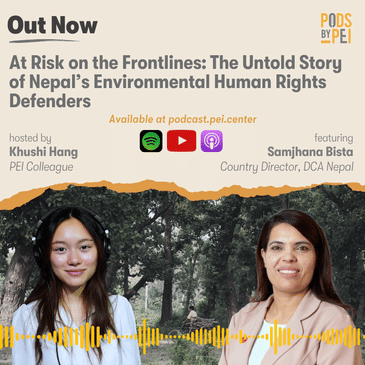
In this episode, Khushi and Samjhana spotlight the often-unseen struggles and strengths of Environmental Human Rights Defenders (EHRDs): community activists at the forefront of resisting environmental harm and advocating for human rights. They unpack the multifaceted challenges EHRDs face, from threats by powerful actors to the weight of social barriers. They explore gaps in national policy, the crucial role of support systems, and the potential for change through global intervention.
Samjhana Bista is a researcher and practitioner of sustainable consumption, nature-based adaptation to climate, and local policy solutions to climate change impacts. With 20+ years of experience in natural resource management, policy development, and programme leadership, she has supported government institutions across countries like Germany, Ghana, and Tanzania, and held senior roles in national and international NGOs, including the Country Director at DCA Nepal.
If you liked the episode, hear more from us through our free newsletter services, PEI Substack: Of Policies and Politics ( https://policyentre.substack.com/welcome ), and click here ( https://patreon.com/podsbypei ) to support us on Patreon!!
[00:00:08] - [Speaker 0]
Namaste and welcome to Pods by PEI, a policy discussion series brought to you by Policy Entrepreneurs Inc. I am Shriya Rana. In today's episode, Kushi is in conversation with researcher and activist, Sanjana Bishta on At Risk on the Frontlines, The Untold Story of Nepal's Environmental Human Rights Defenders. Samjana is a researcher and leading practitioner of sustainable consumption, nature based adaptation to climate and local policy solutions to the impacts of climate change. With over twenty years in natural resource management, policy development, and program leadership, she has supported government institutions across countries like Germany, Tanzania, and The Philippines, and held senior roles in national and international NGOs including the country director at DCA Nepal.
[00:01:02] - [Speaker 0]
Krishi and Samjana spotlight the often unseen struggles and trends of environmental human rights defenders in the face of extractive industries, state neglect, and social discrimination. Drawing from DCA's research and fieldwork, they unpack the multifaceted challenges EHRE face from threats of powerful actors to the weight of social barriers. They explore gaps in national policy, the crucial role of support systems, and the potential for change through global intervention. Like listening to thoughts? Would love to hear your thoughts.
[00:01:40] - [Speaker 0]
So please follow us on Spotify, Apple Podcasts, YouTube or wherever you listen to the show. You can also follow us on Twitter tweet2pei and on Facebook and Instagram policyentrepreneursinc for updates on the latest episodes. We hope you enjoy the conversation.
[00:02:05] - [Speaker 1]
Namaste. This is Kushi Hang.
[00:02:08] - [Speaker 2]
Namaste. I am Samjana Bista.
[00:02:11] - [Speaker 1]
Welcome to the show, Samjana. How are you doing today?
[00:02:14] - [Speaker 2]
I'm good. Thank you so much for having me.
[00:02:16] - [Speaker 1]
And thank you for joining us. I think what we're discussing here today is very critical but also interestingly overlooked, which is the conversation around the rights of environmental and human rights defenders or EHRDs. From what I understand, they include proactive citizens and civil society organizations engaged in various grassroots activisms and in this role they often confront powerful extractive forces which threatens them and their impacts. Your research works extensively around this topic so why don't we begin with first familiarize our listeners with what an EHRD is and what role they play in the larger scheme of mediating environmental and human rights issues.
[00:03:05] - [Speaker 2]
Yeah, thank you very much.
[00:03:07] - [Speaker 1]
It
[00:03:07] - [Speaker 2]
is indeed critical thing and with the climate issue and the impact of climate change in Nepal this is being even more important. So to understand it on a very simple term we consider environment human right defenders as those who are engaged themselves in the environment protection and who are also engaged in protecting the human rights of others who are engaged in environment protection. So basically the right defenders existed before also. For example in rural areas people were present, indigenous people and local people they were protecting the environment for their livelihood but they didn't call themselves environment human right defenders. And they were doing that for their living but now also a conscious group of people who know the impact of environment and about the importance of defending the environment they are also called environment defenders so I think we can understand it simply at that level
[00:04:09] - [Speaker 1]
I think there have been so many instances that even the general public know of where community members have been crucial in successfully navigating an environmental issue. Right? So can you share any such cases so that our listeners can catch up to speed?
[00:04:29] - [Speaker 2]
Yeah, sure. I could get an example from Saru communities who are indigenous group and they have been protecting the forest for many many years and they also have very good examples, simple examples and economic way of protecting the environment. For example, they pray to some of the trees and they also pray to rivers and by that means they are protecting the environment and they are also securing their own livelihood, right? They are so closely connected with their land and they consider themselves part of the nature and not something a superior being from the nature. That could be one of the examples.
[00:05:08] - [Speaker 2]
And they have been protecting the environment forever, but we do not actually consider them until now as the environment defenders right so yeah
[00:05:16] - [Speaker 1]
yeah as I listen to you I think what the EHRDs do is an important form of civil engagement not just in terms of environmental issues, but something that's very necessary for a democracy or a healthy democracy. But like your research shows, there are very real dangers associated with this work. And I think it's good for us to unpack them layer by layer and I want to begin with just asking you what are some of the external threats that one has to face or confront when working as an EHRD maybe as you go through this you can also share some allegories that you found in the field.
[00:05:57] - [Speaker 2]
Yeah, so first of all the concept of environment defender itself is a quite crucial and critical in itself because you are talking about the human right of other peoples and you are being the voice of those who do not have voice or maybe who do not have network and connections. So you are talking on behalf of them. And when we are talking about human rights defenders, we are working with those people who are actually protecting the environment, conserving the forest, saving water, maybe also fighting against some of the environment on friendly activities. So while doing that you are also irritating other groups, right, who do not want that to happen. Who are not so much conscious about the environment protection or maybe they are only conscious about their benefit.
[00:06:49] - [Speaker 2]
They are not thinking about the win win situation rather it is a situation where one party benefits a lot and others do not. So in that context of course you are putting that person or the perpetrators in an irritated situation. And especially for women when you are protecting conserving the environment, you are inviting intimidation, you are inviting assault, harassment in various forms. When I went to the field, are several examples where we find that these environmental defenders, especially women, their rights were violated. They go to the forest and they try to stop the illegal poaching and illegal logging.
[00:07:35] - [Speaker 2]
So they are sometimes even by the security forces, sometimes by the illegal poachers. They also get calls threatening life and harm to their kids and family members. We also reported one situation where one woman in Kailali District, she committed suicide because she was blamed for not taking care of her property and land when there was flood because flood happened as such but blame was on her because she was also the community forest user group member and she was also managing her own resources. But she got the blame from her family members and she committed suicide as a result of that which is such an extreme situation that we have been receiving from the field. Yeah.
[00:08:25] - [Speaker 1]
I'm glad that you brought up the idea of gender and women EHRDs being at special risk because the reality of this situation is that even though there are proactive and courageous EHRDs on the field they are still working within those social landscapes where norms and hierarchies of class, gender, ethnicity and caste are very real. So can you elaborate more on that? What does that look like?
[00:08:53] - [Speaker 2]
Yeah, that's the irony, right? Because these are the people who are most vulnerable to the impact of climate change and they are the one who suffer a lot when there are any kind of natural disaster or political instability or anything. Anything goes wrong in the nation, they are the one who are going to be impacted. As I said before, being a human rights defender itself, it is a very crucial task. There are a lot of security issues associated with that.
[00:09:23] - [Speaker 2]
And on top of that, you are representing a community which in itself is considered a lower caste. And you are given biasness at multiple level. You do not have equal right at the resources. And if many times you also do not have the same level of right at the decision making and if you are there at the decision making level, most often the time it's also just a token. Right?
[00:09:51] - [Speaker 2]
So that gives you less confidence as a human being to talk for yourself and also to fight for and stand for who you are. That is an example of a Dalit community. And also when we talk about somebody from an indigenous group, let say it's a community itself. They are so connected with the nature and they are very simple people where most of the time they don't even worry or are so much concerned about their power and their presence at the decision making level. And then that is taken for granted most of the time.
[00:10:28] - [Speaker 2]
You are there in the executive committee but then you are not given the right to raise your voice. Right? And then you have to be a woman on top of that or you are elderly citizen or you are representing a young generation, then the level of confidence and the level of support you deserve, you would not get, right? And there are a lot of norms and values in the community where sometimes our women and our girls are not able to fight back in the first instance. So it is a long process actually.
[00:11:03] - [Speaker 1]
We often miss out on the aspect that identities often hinder how effective they are able to be and this also comes from the fact that community forestry and other user group schemes have been commended for their inclusion of women and individuals from disadvantaged groups. And we often hear about how through engagement in these leadership positions, marginalized individuals have been able to gain this new identity and agency. But as you talk about this we're realizing that there is an underbelly and there is an inside power dynamics that's coming along as well and so the next question that I want to ask is where is the state in this reading your reports and listening to you talk about your project I realized that the frameworks that we have for managing human wildlife conflicts are weirdly quiet about EHRDs so can you tell us more about the oversights in our current policies?
[00:12:08] - [Speaker 2]
Yeah, and you have rightly mentioned that there are a lot of discussion going on about gender equality, I mean meaningful participation of women and Dalit and other marginalized groups and that is there actually. All of our legislative frameworks, the guidelines, policies for example Environment Act, Environment Policy, a Local Governance Act, Forest Act even. All of them have very strongly spoken about participation of marginalized and indigenous group. And actually a lot of things have happened also as a result of that. Ever since the community forestry happened we have been discussing about equitable share of resources and women in the executive committee and things like that.
[00:12:53] - [Speaker 2]
And it has happened actually. We should be very grateful to the amazing community forestry program in Nepal. It has happened and women have been capacitated on forest management, right? But the thing is the issue that we discussed yesterday is not the issue anymore today and maybe it will not remain the same issue tomorrow, right? Today, for example, DCA is a project ever since we started talking about environment human rights defenders.
[00:13:24] - [Speaker 2]
We wanted to understand a little more on what is not there behind the scene. I mean, there are a lot of issues, a lot of reports and a lot of incidences on gender based violence that are happening but there are no studies that have taken place for example within the community forestry. What kind of gender based violence happening and how the norms, the local values are exacerbating the gender based violence in that. So in one hand we are actually promoting the equal power and equal rights and responsibilities but have they actually enjoyed that?
[00:13:59] - [Speaker 1]
I think something that was really interesting for me was that there is no definition of who an EHRD is right and so things like that make for an institutional void because of which many of the people who are on field do not get the support. So what are some of the neglect?
[00:14:19] - [Speaker 2]
Right. Our legislative frameworks or guidelines everything that we have in place, they do not talk about the concept of environment human rights defenders. And when they don't talk about that concept, also don't talk about the protection of environment human rights defenders. What so much highlighted in all these policies and framework is that we need to conserve the environment, the natural resources and all the environmental services that are associated with it. But how about the human side of it?
[00:14:54] - [Speaker 2]
So human side of it is neglected. So when you are protecting the environment you should also respect human culture values, the social dynamics, everything that has not been considered until now and that is unfortunate. And because that is not considered we are only monitoring and our indicators are also designed in such a way that how many hectares of forest have we conserved? Successful are we in protecting the biodiversity, the mega spaces for example? And what are our results in that?
[00:15:28] - [Speaker 2]
But we have not been able to identify like are people able to change the way they live, the way they think when they are talking about the environment conservation and natural resource management? That aspect is missing, right? Even now we have national adaptation plan which is for quite long. It doesn't talk about environment human right defenders. But the international frameworks, right?
[00:15:56] - [Speaker 2]
Aarus Convention itself in 1998 had already acknowledged concept of environment human right defenders. And in the recent years UN has also quite progressed and they have acknowledged the role of environment human right defenders and the need to protect the environment human rights defenders. So the awareness is slowly coming there. I am seeing that it is coming slowly but I would also see that it is a journey which will take longer than we need.
[00:16:26] - [Speaker 1]
It's very interesting that you bring up international trends towards this issue and I definitely want to come back especially relating to Nepal and what Nepal can do about it. But something else that comes to mind when we're talking about the kind of support and recognition from the state is how do the local level communities or people surrounding these EHRDs recognize or acknowledge this kind of work how how do their families or their communities respond to that?
[00:16:56] - [Speaker 2]
I think there are two sides of it as we also discussed at the start. One side is people are conserving natural resources and protecting it because their livelihood is so much dependent on that. Right? They are not so much aware about the importance of conserving natural resources for the global citizens. They are so much concerned about their own livelihood and they do it for their life, for their children and for their family.
[00:17:25] - [Speaker 2]
In that aspect the family members also support because their whole livelihood and their system, family system is supported by the natural resources. But there is other side of it. Like we discussed about the forest users group Community forest is a forest that's a community property and everyone has the responsibility to conserve that. At the same time you also have the right to use resources from the community us. And it demands some voluntary activities from the members.
[00:17:57] - [Speaker 2]
If you are in the executive committee it would demand further responsibility from you. And in that case we have examples where the family members especially the male members and elderly members are not supportive enough to their female counterparts. For example, women where they are in the executive committee they definitely need to put in extra effort and energy to conserve the forest and not only utilizing the resources from the forest but also they need to strategize what it takes to conserve the forest bring it to the next level, right? So that side is something we are talking about gender based violence is happening in there because although you are the executive committee member, somebody else, for example father-in-law or husband represents you and they speak on behalf of you. Although they might speak completely different thing than you want to speak about, right?
[00:18:56] - [Speaker 2]
So I think that part, the volunteering, the concept of volunteering is not yet there. Especially when it comes to the environment protection in the rural area. But if we compare it in urban areas because we have a lot of young people who are now volunteering to protect the environment. There are several campaigns, boot camps happening to protect the environment and a lot of social media posts are also happening especially led by young people. I think there the cases of violence are to a different level.
[00:19:34] - [Speaker 2]
I mean you might be threatened online and a lot of other stuff. So there is a bit of a difference between urban area and rural area and also the level of understanding urban people have and rural people have.
[00:19:50] - [Speaker 1]
The more we talk about the challenges it seems so convoluted, it seems dense. So I am eager to hear from you how you and your project have been able to introduce interventions. Where does one even start to approach such a dense problem?
[00:20:14] - [Speaker 2]
DCA as an organization has climate action at the centre of its programming. Everything we do we are mindful of what contribution we can make to the environmental conservation. So there are several efforts that happen and we work with the community based organisations such as community forest user groups, women groups and also with local government think tanks who are knowledgeable in their field, right? So we are working with different group of people and while working with them, the same doesn't work with all of them. Especially at the community level we are starting with a simple climate literacy.
[00:20:55] - [Speaker 2]
It would include very simple classroom sessions on what is climate change, how does it impact you and your family and what do we need to do to protect the climate and what are the benefits that happens to you, right? That you can harvest by protecting the environment. So it's at a very basic level. And then we also need to engage other stakeholders. For private sector entities.
[00:21:20] - [Speaker 2]
Many times the private sector entities are focused on their business not in all the cases, but in most of the cases the environmental side of it is neglected and it's not taken care of. So we also engage the private sector and the local government security forces for example in a multi stakeholder platform where people come and talk about the climate issue debate in a certain place or forums so that people are on the same level. So going higher and when we are working with the experts or professionals or those individuals who are a bit more aware or who are educated, with them our discussion are at a different level. How do we contribute to the global problem? What kind of local solutions can be started at the local level so that we are able to contribute to the global problem, right?
[00:22:19] - [Speaker 2]
But of course our activities should be so much focused at the ground. As I mentioned climate literacy is one. We are promoting different kinds of green enterprises to support people so that they are able to raise income from that which includes leaf plates, also includes compressed, stabilized earth bricks which are more climate friendly. We are promoting agro ecological practices when we are working with smallholder farmers We are promoting a lot of nature based solutions to reduce the disaster
[00:22:53] - [Speaker 1]
With intention of helping them find streams of income livelihoods so that they can also support the they can continue their activism Yeah,
[00:23:04] - [Speaker 2]
that is exactly the reason because many times especially women they are not capacitated or confident enough to come forward because they do not have economic independence, right? And because when the family suffers from economic stability, there are a lot of other kind of violence happening. And our studies have also shown that the intimate partner's violation happens in those houses where they have economic instability. So also to contribute to reduce gender based violence and also to give that confidence especially to women and underprivileged group we promote these green enterprises which would mean that it is either utilizing the natural resources or it is utilizing less energy from the environment and as much as possible it is consumed in the local market. I
[00:23:59] - [Speaker 1]
think something that's worth pulling up right now is the idea of positive masculinities and how you're trying to create engagements that promote positive masculinities. Can we go over that?
[00:24:11] - [Speaker 2]
Yeah. So, you know there was a time where there were a lot of activism going on which was men versus women and we are now not in that era. We are now in the era of coexistence and co working and collaboration with different groups. So in that context we have identified that the main members of the community and society when they understand women's role and their importance in all the work that they are doing, it would be much more helpful and women get more confidence and more support. They can free up their time because men will then support them in their household activities.
[00:24:55] - [Speaker 2]
So it is not gendered rules. Right? So people would start doing anything that is of convenience and that is needed to do right now. So with that concept we started creating male champion in some of our projects who would actually fight for gender based violence and who supports women's non traditional effort. So traditional effort would be women are the only one who are responsible for their kids, household course and things like that.
[00:25:26] - [Speaker 2]
So non traditional activities of women would be that they go out of their house, they are engaged in economic activities, they are engaged in the social activities and things like that. So we have started that and very interestingly the members who we are working, main members, they are liking it. They are very enthusiastic in participating. We have just piloted it at this point but we are very interested to take it further to other areas also because our environmental defenders have different safes and firms. We are also working with community disaster management groups where we have some environmental defenders who are actually fighting for and supporting the reduction of disasters at the community level.
[00:26:19] - [Speaker 2]
And they also need some free time to come up from their home. There are some other women's groups who are participating in agro ecological practices which means they are using less external fertilizers and they are producing their own organic fertilizers. So to do all these things they need support from the influential actors and for now in many areas where we work main members of the house they are quite influential in supporting them and also shaping their career. So we are quite excited and happy about this
[00:26:54] - [Speaker 1]
I mean it's wonderful to hear that the approach that you're now taking is one that includes men as well and they have this positive attitude towards this change I was thinking about how in our policy frameworks there are a few gaps that we did identify and so moving forward what are some of the policy level changes and support that EHRDs need right now as you see them in the field?
[00:27:20] - [Speaker 2]
I mean the policies and frameworks in Nepal are changing on a regular basis, right? I mean whenever there is a need and when the context is changing they are also changing. And I think with the context that Nepal will likely graduate from the LDC status in November 2026, it's even more relevant now that we start recognizing the concept of environment human rights defenders. Why so is because the climate change is not going anywhere the impact is real and we have seen different examples of the extreme events that has happened as a result of climate induced disasters So when we are developing new policies or maybe when there is an opportunity to amend the existing one post LDC graduation status, we should definitely look into some of the factors. One is to recognize the existence of environment human right defenders.
[00:28:21] - [Speaker 2]
Not only now, but they have been forever in various safes and firms. We need to accept that and recognize them. There should be some provision for raising awareness on the existence and the very important role environment human rights defenders are doing at multiple levels, right? So not only at the ground level that we just discussed earlier but also at a very professional level One very important aspect that I also feel is these environmental defenders need to have access to different networks and platforms where they can tell their stories of success and also the stories of challenge what they are facing because the drive and this moment is not only for the future of Nepal, but it is the future of the globe, the future of Earth. What we are doing here is going to impact the entire globe, especially when we are talking about the environment conservation we share the same earth and there is no another earth that we all know so that platform which can be at the national level or the regional level but it can also be at the international level I think that existence should be there and that opportunity should be provided to environment human rights defenders The next thing is about motivation Sometimes it is so much demand late but other times it is to create new demand as well.
[00:29:48] - [Speaker 2]
So there should be several motivation factors for environment human rights defenders to work. It can be at the local government level also. It can be scholarships. It can be subsidies when you are starting a green enterprise. It can be a recognition of different kinds.
[00:30:07] - [Speaker 2]
Right? So motivation factors can also be included by the government. This has to be deliberate and it has to be a conscious effort. And finally with the post LDC status, private sector is coming out quite strongly and they should actually come out quite strongly. Innovating different start ups and enterprises but it has to be very environment friendly and they also need to respect the human rights when hiring people.
[00:30:35] - [Speaker 2]
They also need to be very conscious about what kind of environment impact their enterprises having or the industry is posing. And we should also invest and actually these policies and legislative frameworks should open an opportunity for academic institution to collect several evidences. We also need some very grounded resource on what has happened and what can be done more by mobilizing the environment human right defenders and also that will actually give advocacy points and talking points for the environmental defenders to move forward. Yeah.
[00:31:12] - [Speaker 1]
I think even help them in feeling like they are a part of a larger initiative than just themselves which is a different kind of support previously you said that we've been finding increasing evidence to show the various threats that EHRDs face but at the same time increasingly international organizations are starting to recognize these threats also. So how can Nepal sort of optimize these trends as it tries to safeguard its own EHRDs?
[00:31:42] - [Speaker 2]
Yeah, I talked earlier about giving access to networks and association and these platforms, we need to give more and more exposure to that group who is actually advocating right now. And there are different kind of platforms where environment human right defenders actually meet and not only the environment experts but actual environment human right defenders who are fighting for the rights of people to live in a healthy environment. So they meet up and for them it is not their job like the experts are professional. It is their passion and it is their life and they are really conscious about and sad about how earth is moving and how it is being polluted and how natural resources are being exploited. And they do discuss this kind of thing in the platforms and it is actually very different scenario than many of the conferences and works that I have attended.
[00:32:44] - [Speaker 2]
The one of Environment Human Rights Defenders is a separate of its kind. So I think our people need to have access to that so that they are able to listen to how other people are working and what are the solutions and how the other government or other stakeholders are supporting their activities or maybe not supporting also at some point. We need to get lessons from those kind of platforms. I think we also need to give many examples from other countries like in some of the Latin American countries. You can fight on behalf of natural resource.
[00:33:23] - [Speaker 2]
For example, you can fight in court on behalf of Mount Everest how much it is polluted. Right? So there are some countries where there is a right of nature, the concept on right of nature and this concept is actually existing for everyone but we have not gone to that level in Nepal. I'm just trying to give example about what are other concepts that are existing across the globe and what are the solutions that are being practiced So we need to give exposure more and more on that That would be one part but where it is not possible maybe we also need to find an alternative strategy about how do we bring those kind of stories to our people and how can we improve their access to this kind of stories and we also learn our government also learns from this kind of stories and as we discussed earlier about amending our policies, we can build those kind of strategies in our policies and also in practices. Moreover, the international organizations such as us, DCA, can also bring in the best practices from other countries where we are present to Nepal and vice versa.
[00:34:35] - [Speaker 2]
That way we can have global sharing and connection as well.
[00:34:42] - [Speaker 1]
I think that was such a well rounded response. We're thinking about different ways of targeting the same thing. And as I try to wind down this conversation, I think something that stood out to me was the idea of RD's being driven by passion. Oftentimes there is no social recognition, there is no monetary remuneration as such, and they're doing it for their families, yes, but also out of a reverence for environment and the well-being of everyone. And I'm bringing this up because in our previous conversation and also shortly today you talked about how you yourself are an activist and you've gone through some similar dangers but also are very much driven by that passion To end this conversation for our listeners who want to support environmental defenders or become one how can they navigate it?
[00:35:34] - [Speaker 1]
What are some advice that you would want to give today for people who are willing to join this cause?
[00:35:40] - [Speaker 2]
Yeah, that is such a relevant question actually and as you rightly mentioned I started my career by establishing Echoclaves at school when I joined my Bachelor's I started making Echocloves at school. The concept being the school students are the ones who should be more aware about environment conservation and mindful consumption and things like that. So the journey started since then and I have seen lots of ups and downs and when I recall now the concept of environment human rights defenders existed twenty-thirty years back as well and it exists now but maybe now in a different form and we are trying to take it to a different level. I have seen a lot of young people now being very enthusiastic and caring for nature. My six years old daughter she loves to see the sun sunset and she is conscious about we should not pollute the environment and she feels sad when she sees a lot of trashes in the public spaces open spaces.
[00:36:45] - [Speaker 2]
I see that as a very positive indication among the younger generation and that is why it is important to support the younger generation to that drive. Because there are a lot of campaigns happening, a lot of drives happening to protect the environment and the government has to support that. And we as the aware citizens should also support those kind of interviewer, right? So you yourself to become an environmental activist and environmental defender. You don't need to be out there to do something by yourself because you may not be of that capacity at times.
[00:37:22] - [Speaker 2]
But if you're supporting somebody who is in their drive, that's already an activism, That's already something that you are doing. So I would that it can come in different forms, different shapes, but it has to be very mindful and considerate and think twice about my own lifestyle, how it is and how I can change and how I can promote the love for nature which we are forgetting slowly and we are being very materialistic and I think we need to go back to few decades back where we used to enjoy a lot. So I think very conscious support at various level would be necessary at this stage
[00:38:03] - [Speaker 1]
Yeah I think what you just said opens up so many pathways for many people because like you said not everyone can be on the field but there are ways of contributing and supporting the HRDs that are around and that is equally important as well Thank you so much for this conversation I had an amazing time thank you for sharing your time and effort and knowledge is there anything you want to say before we go?
[00:38:29] - [Speaker 2]
Thank you for having me. It was equally a pleasure for me to talk about it. I would just say that the concept of environment human right defenders. I'm also quite passionate about learning about the concept, right? Because a few years back when we were trying to design a project focused on environment human right defenders, we had a lot of confusion.
[00:38:50] - [Speaker 2]
Who should we consider environment human right defenders? And who are our target groups? And things like that. But the days passed by and we also invested time and energy about understanding the concept itself. And now the stage we are in, we understand the concept as very simple terminology and it has a very broad sense and broad meanings and the solution can be very simple from individual level as long as we are not harming and we are not adding up to the pollution and destruction of the environment you are already contributing towards the support of environmental human rights defenders.
[00:39:29] - [Speaker 2]
And I would also like to invite and encourage everyone to be at least a supporter of clean nature and environment. Yeah. Thank you very much.
[00:39:39] - [Speaker 1]
Thank you so much. Thank you.
[00:39:42] - [Speaker 0]
Thanks for listening to PODS by PEI. I hope you enjoyed Kushi's conversation with Sam Jana on At Risk on the Frontline, the untold story of Nepal's environmental human rights defenders. Today's episode was produced by Kushi Hang with support from Nirjhun Rai. The episode was recorded at BI Studio and was edited by Khushi Our theme music is courtesy of Rui Chakya from Zindabad. If you liked today's episode, please subscribe to our podcast.
[00:40:14] - [Speaker 0]
Also, please do us a favor by sharing us on social media and leaving a review on Spotify, Apple Podcasts, YouTube, or wherever you listen to the show. For PEI's video related content, please search for policy entrepreneurs on YouTube. To catch the latest from us on Nepal's policy and politics, please follow us on Twitter tweet2pei and
[00:40:39] - [Speaker 2]
on
[00:40:39] - [Speaker 0]
Facebook policyentrepreneursinc. You can also visit pei.center to learn more about us. Thanks once again from me Shriya. We'll see you soon in our next episode.