
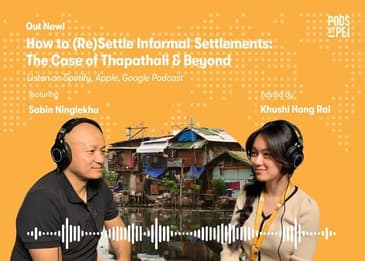
The November of last year saw a heated contention between the Kathmandu Metropolitan City and the slum-dwellers of Thapathali, as the yellow dozers of the first were confronted with the homemade weapons of the latter. This wasn’t the first time the squatter (or Basti) had garnered public concern, but it continues to struggle to reach a resolution as the State finds itself torn between its duties. On the one hand, it’s called by the ideals of urban planning for a world-class city; on the other, it’s obliged to uphold human rights within its territories.
In this episode, PEI’s Khushi and Sabin Ninglekhu look into the informal settlement of Thapathali to understand the rationale, actions, and desired ends of its two key stakeholders: the State and the settlers. They unfold, in detail, the tumultuous past and present of the Basti, covering all grounds, including the recent public discourse over the “fake settler”. They then branch out to other resettlement initiatives in Nepal, rethinking the role of aesthetics in humane urban planning and exploring how to best manage and resettle informal settlements.
Sabin holds a Ph.D. in Human Geography from the University of Toronto, Canada, focusing on informal politics and urban poverty. Sabin co-leads a long-term research project titled ‘Heritage as placemaking: The politics of erasure and solidarity in South Asia’, where he looks at the tacit and implicit roles of religion and heritage in urban planning agendas. Sabin also voices his findings and thoughts in op-eds for The Record, The Kathmandu Post, Naya Patrika, and Chetlung and occasionally translates popular pieces from Nepali to English.
Click here to support us on Patreon!!
[00:00:12] - [Speaker 0]
Namaste and welcome to Pods by PI, a policy discussion series brought to you by Policy Entrepreneurs Inc. My name is Sohrablama. In today's episode, have PI colleague Kushi's conversation with Sabin Ningleku on how to resettle informal settlements, the case of Bhagmaty, and beyond. Sabin holds a PhD in Human Geography from the University of Toronto, Canada, focusing on informal politics and urban poverty. Sabin collies a long term research project titled Heritage as The Politics of Erasure and Solidarity in South Asia, where he looks at the tacit and implicit roles of religion and heritage in urban planning agendas.
[00:00:50] - [Speaker 0]
Sabin also voices his findings and thoughts in op eds For the Record, the Kathmandu Post, Nayapatrika, and Chitlung and occasionally translates popular pieces from Nepali to English. In this episode, PI's Kushi and Sabin look at the informal settlement of Tapathali to understand the rationale, actions, and desired ends of its two key stakeholders, the state and the settlers. They unfold the tumultuous past and present of the Basti, covering all grounds including the recent public discourse over the fake settler. They then branch out to other resettlement initiatives in Nepal, rethinking the role of aesthetics in humane urban planning and exploring how to best manage and resettle informal settlements. We hope you enjoyed the conversation.
[00:01:34] - [Speaker 1]
Welcome to Pods Subbin. How are you doing today?
[00:01:36] - [Speaker 2]
I'm good. You?
[00:01:38] - [Speaker 1]
I'm doing fine as well. It's lovely to have you here. So today we're discussing the issue of resettling informal settlements residing on Bhagmaty's banks in Thapatali. Recently, this particular Sukumbasi Bosti has received quite the attention due to the efforts of Mayor Balen Shahar to remove them from the location. However, I do not want to limit our discussion to just one particular Bosti.
[00:02:00] - [Speaker 1]
Clearly, the issue of informal settlements will grow to be more significant in the coming days. There are some estimates that current informal settlements around the world will increase to 3,000,000,000 by 2050 and Nepal certainly will not be untouched by this phenomenon. But to begin with, let's focus on what's happening in Thapathalli. We know that this isn't the first time this particular busty has caught the general public's attention. So, Sabin, could you please draw out very briefly the series of significant events in Thapathali and the politics surrounding it that have taken place up to now so that we are all on the same page as we start?
[00:02:38] - [Speaker 2]
Thapathali Basti in particular has a very peculiar history when compared to other informal settlements or slums in the city. And the history goes back to what is called the people's war. After the war ended, the Maoist party came to the city and along with them, they brought hundreds of what was then their cadres and whole timers and whatnot and they had them the party had them settled in the Thapatali Basti or what is now known as the Thapatali Basti. The Basti was meant to be the urban base of the Maoist party. So that is the history of the formation of the settlement itself.
[00:03:21] - [Speaker 2]
Unfortunately, what happened for the Basti was the party went in its own direction that we all are aware of, and there's no need to get into the details of what direction it went into. A few years after they were settled in that particular location, the government also formally adopted a plan called the Bhagmatyaksan plan. So which was a plan very broadly put, the plan to, restore the environmental health of the Bhagmaty River through the construction of wastewater treatment plants and other forms of riverbank redevelopments. And that Basti happened to be literally on the way of that particular project that the state introduced to clean up the Bhagmaj. So that is the history in which the Bhasti locates itself and as such it always encounters one form of intervention or the other.
[00:04:19] - [Speaker 2]
Unfortunately some interventions are more violent and perhaps even unnecessary. So that is the brief history of it.
[00:04:26] - [Speaker 1]
So looking into how the public perspective of this issue has been, on one hand people see this as the state's responsibility of urban planning which in this case the revitalization of the dead or dying river of Bhagmaty and the need to remove people who have, in their definition, illegally occupied the public space. On the other hand, this is about the rights of the poor and the responsibility of the state towards them to provide them with safe housing opportunities. Could you please expand on these two framings? Also, there are any other additional approaches to view this issue that maybe I'm not aware of, you can share them as well.
[00:05:07] - [Speaker 2]
Well, from the perspective of urban planning, I think the framing or the framework of the state is that because it's responsible for ensuring that all kinds of public goods, assets and spaces are in place and they are maintained, are preserved. So the state is well within its right to ensure that through the project, what was then known as the Bhagavad Ekman plan in 02/2009, that the river has to be environmentally restored. The river banks have to be managed in terms of public space. So that is the framing of the state. As far as the framing of the other side, which mostly is located in the realm of rights both citizenship rights and human rights.
[00:05:56] - [Speaker 2]
The this the spirit or the sentiment if you wanna call it is that individuals have right to shelter just like their right to clean air and, you know, right to food security and so on. So it's, the state's responsibility also to bring it under the ambit of urban planning that is dedicated not just to restoring the river's health but also ensuring that in the process, the state is also responsible in the spirit of accountability towards ensuring that the poor have the right to live a life of dignity in the city. So those are the two framings. Unfortunately, they collide and they confront when they meet in real places, and that's what's happening in Tabithili.
[00:06:49] - [Speaker 1]
Are there any other views that have been coming up?
[00:06:51] - [Speaker 2]
Yes. There are. For example, one is more localized view that is, I guess, one could say that's linked to this idea of civilization and heritage. And the other view is one of it's more radical one would say, that comes from mostly informed through a certain field of academia, which also don't meet, which is in Kathmandu's case. I mean we all know that Kathmandu Valley's history is a significant part of the history is one of neo heritage and civilization.
[00:07:31] - [Speaker 2]
So if not tapathali, then other bastis are, you know, they sit alongside some of the tangible structures of heritage. So temples and monuments and so on and so forth. So in order to preserve that particular heritage, the Bhastis have to be relocated. So that is one idea. So on top of environment, there is the idea of heritage as well.
[00:07:57] - [Speaker 1]
But
[00:07:58] - [Speaker 2]
if one then brings some of the thoughts from the spaces of academia, which is informed through a long term rigorous research, is that one has to look at it also from the perspective of citizens' right. That there is an element of legitimacy that has to be considered and not not everything has to be, you know, has to be approached through the framework of what's legal and what's illegal. Because these things have, what's legal always has, spatial and temporal boundaries and they have to be reworked. So the idea of legitimacy is important. In other words, in the context of a quote unquote slum, have the dwellers of the slum after having lived in the slum and in the city for a number of years and decades, have they cultivated enough legitimate grounds as a way to rightfully demand for a certain kind of rights that they don't have access to.
[00:09:05] - [Speaker 2]
So it's a question of legitimacy too.
[00:09:07] - [Speaker 1]
That's very interesting that you talk about these alternate perspectives that are coming up. But for now let's focus on the two dominant sides, especially since we're trying to focus on Tapathali today. Let's examine the two claims, beginning with the position of those who are trying to evict the settlers. If you are in their shoes, what do you see as their rationale, their motives, desired ends or even perhaps the pressures that demand that the state carry out the evictions.
[00:09:36] - [Speaker 2]
So from the perspective of the state?
[00:09:38] - [Speaker 1]
Or people who agree with the removal of settlers?
[00:09:44] - [Speaker 2]
I some of the I guess some of my responses or rather themes of my responses I have already mentioned before. But to shed further light on it, like I said, somebody has to be responsible for things that are outside their private residence. Roads, river, public parks and so on and so forth. And that somebody happens to be the state. So like I said, it's well within the state's right to kind of rightfully come up with projects and planning interventions as a way to ensure that these things are preserved.
[00:10:19] - [Speaker 2]
These things serve the purpose that they are meant to serve. So the state is again well within rights to say that you know, this piece of land is not yours. So it's quite illegal for you to not only occupy it but also claim it as your own. That particular demand has no legal grounds. The state is well within its rights.
[00:10:43] - [Speaker 2]
And this particular position of the state is very understandable. But without locating oneself away from the space of the state, Locating oneself within this particular space. It's also important to make references to very important national documents that is a form of social contract between the state and the society. So whether it's the constitution, it's the land acts or whether it's the local government operations act. If one carefully combs through the different provisions of this act, these acts collectively clearly say that it is also the state's responsibility to take care of citizens who have been historically marginalized for owing to different structural factors.
[00:11:41] - [Speaker 2]
And it's fair to, I think, assume that a large majority of the settlers of the informal settlements happen to have come from the kind of communities that we call historically marginalized. And their experience, material experience of marginality degrades or worsens once they migrate to the city because the city is what it is.
[00:12:09] - [Speaker 1]
So as we talk about all these acts and even the constitution, could you sort of illustrate for us what are the responsibility of the state to those in the Basti and whether or not or how has the Nepali state upheld its duties so far, especially in the case of Tapatali?
[00:12:31] - [Speaker 2]
So nobody expects the state to be some sort of humanitarian agency. Right? That's not the expectation here. The expectation here is for the state to behave like a state. Which is like for the state to respect the kind of spirit that is enshrined through different provisions in the constitution, in the land act and in the local government operations act.
[00:12:56] - [Speaker 2]
Right? All of them very clearly say that so long as a household belongs to landless Sukumbasi category or belongs to landless Dalit category. It is the state's responsibility to ensure that they have a rightful access to shelter and land ownership. It is enshrined in this documents and that that process of ensuring this right is a collaborative process, is a participatory process that you consult, that you deliberate with agencies and organizations that represent the settlements to arrive at some kind of agreement. So that is also what needs to be highlighted that I think is missing in a lot of media coverages and that is missing in lot of these public debates and the discourse of urban planning and how it needs to incorporate the slum?
[00:14:04] - [Speaker 1]
I think when the topic is the responsibility of the state towards the Bosti, a crucial theme that comes about is the idea of relocation. Is the Nepali state under any obligations to relocate these people?
[00:14:19] - [Speaker 2]
Yes. And I say yes by firmly locating myself in the land act of 2021 Bikram Sambhat. Which was revised in 02/1978. The March 28, two years ago. And it has very clear provisions.
[00:14:41] - [Speaker 2]
Very clear provisions that the state is responsible, like I said earlier, it is the same thing. There are two or three provisions that very clearly state that it is responsible for relocation of households that belong to these two or three categories. But the question of whether or not the question of how do we ensure that these categories are where they belong is also to come through an exercise that is, you know, loyal, to this idea of democratic governance for example. Right? So let me also add a crucial piece of information here.
[00:15:21] - [Speaker 2]
That is from, four months ago. So the mayor of Kathmandu and the national land commission, representatives of national land commission who work closely with the Sogumbasi together have signed, what we one may want to call a memorandum of understanding. It's an agreement. It's a two page document. And the content of that particular agreement stands on the land act, the provisions that I mentioned about.
[00:15:53] - [Speaker 2]
Right? And the agreement very clearly says that Kaharani municipality will collaboratively work with the land commission and local state entities alongside members of the sukumbasi to identify, to collect data of each and every household in Thapatthili Basti and other Bastis as a way to find who are the ones that need relocation and who are the ones that don't need relocation. Mhmm. And not only that, after having completed this particular exercise, the municipality led by the mayor will work closely with the land commission, will work closely with the institutional representatives of the Sukumbashi themselves in identifying in identifying a location where the evicted will be settled. So these are just two of the points of understanding.
[00:16:48] - [Speaker 2]
Now what mayor does a month after having signed on that document is to everybody's knowledge. And hence there is something fundamentally flawed about the way the municipal state which is the Metropolitan City office operates.
[00:17:05] - [Speaker 1]
Moving on to the perspectives of the settlers themselves. What requests have they put forward to the state in terms of relocation and do you evaluate these requests to be reasonable on their end and feasible on the state's part?
[00:17:21] - [Speaker 2]
We can get to the specifics of what the request or demands have been. But the theme of demand or the request is this, which is that can we enter a dialogue in the spirit of the kind of time that we live in, which is a time of democratic governance. Can we enter a dialogue? You know? So that is that is both a request and a demand that is made to the mayor.
[00:17:46] - [Speaker 1]
What does the dialogue entail?
[00:17:48] - [Speaker 2]
So the dialogue entails, can we again go back to the agreement from three four months ago? Mhmm. And and can we sit on these points? And can we speak across difference to eventually, if not settle difference, come to some kind of negotiated or renegotiated agreement about what might. Let's forget this notion of social justice for now.
[00:18:11] - [Speaker 2]
Mhmm. Because the office or the city office does not care about this. Let's forget this notion of social justice. In the spirit of governance or good governance, can we revisit these agreements and see where it takes us rather than showing up with a bulldozer? Like, there is no democracy in this country.
[00:18:33] - [Speaker 2]
Like, there is no democratic institutions in this country. Like, there is no constitution in this country. So you can't just show up and, like, you know, ride over the very agreement that you signed on. May I also add one more information?
[00:18:48] - [Speaker 1]
Sure. Sure.
[00:18:49] - [Speaker 2]
Again, a month before the agreement was signed a month before the agreement was signed, the municipality, the city office worked with the local ward office responsible for governing Thaput Alibasti, worked with the representative representatives of the Sukumbasi organization to issue dedicated house number house number, a number plate containing the household head or whatever it is of this particular family alongside a number that identifies these houses. What that means is that the municipality has accorded certain legitimacy to these households. It's essentially saying that, look, we think it's illegal. Your occupation is illegal. But we recognize your inhabitants.
[00:19:40] - [Speaker 2]
And we recognize it and based on this recognition of ours, we consider you legitimate. So you do this and you do that. That's quite historic cause no mayor has ever done that before. Of these two things: issuing house numbers and the agreement. It has happened after more than two decades.
[00:20:02] - [Speaker 2]
And the next thing you do is you decide that you have this terrible memory loss syndrome that you're living with.
[00:20:12] - [Speaker 1]
Going deeper into understanding the terms of relocation, A very interesting thing happened in Thapatali where the relocation plans that were provided to them were not satisfactory and they wanted to negotiate for alternatives. What happened there?
[00:20:35] - [Speaker 2]
This was during the time when Babaram Bhattra was the prime minister. And we didn't have a mayor, and there was the Kathmand Valley Development Authority Led by Kesav Stapit. It's fair to say that the relocation plan went through a certain process. In the spirit of good governance and democracy and even a level of empathy. And what was built was.
[00:21:06] - [Speaker 2]
There are three complexes with over 200 rooms. About 12 crore I think Nepali rupees was allocated for this particular project. And this was a relocation project. Built with really good intentions. So what happened initially was many members or many households of the particular settlement refused, as far as I can tell, to be relocated.
[00:21:35] - [Speaker 2]
The reasons were it dislocates us from far away from our work.
[00:21:42] - [Speaker 1]
Livelihoods.
[00:21:42] - [Speaker 2]
Livelihoods. So it's gonna be a bit of a task to commute every day, day in, day out. Is it possible to be relocated to places somewhere closer? Where it can make, some kind of life? But over the course of time, majority of the households eventually agreed to relocate.
[00:22:06] - [Speaker 2]
But there are two problems. One was the high powered committee for integrated development of bhagmaty civilization. Which is under the Ministry of Urban Development. They offered. So the relocation had a condition, which is that the.
[00:22:27] - [Speaker 2]
Each and every single household that relocates would have to front a certain amount of cash, the size of which I forget, that they simply couldn't afford. Right? So that was one condition.
[00:22:40] - [Speaker 1]
Mhmm.
[00:22:42] - [Speaker 2]
The other more generally known condition or generally known challenge was this. Both the head of the ward in that particular place, Itzhagunaren, and the residents were against inviting Sukumbashi into their area. And this has happened many times before. Simply because the kind of stigma that the slum carries. Right?
[00:23:12] - [Speaker 2]
So they rejected. To the extent that one of the members of the ward even said that, you know in our own war, there are lots of sukumbassi. Let me take care of my sukumbassi people first and then we will think about having them over. So these were some of the tones or undertones that really led to one might call it a failure of that particular project. That was built with good intentions.
[00:23:41] - [Speaker 2]
And the state has to be created for that. But if we speak of ideal things, I think what did not certainly happen was, not a single member, not a single member of, forget the settlement, but not a single member of what is called Nepal Basobas. This organization that leads. It was five decades old. That lead the sukhambassy, land of sukhambassy movement in Nepal.
[00:24:04] - [Speaker 2]
Were consulted in the process. So there is that.
[00:24:14] - [Speaker 0]
Hello there. This is Saurabhlama from Policy Entrepreneurs Inc. We hope you're enjoying Pods by PI. As you know, creating this show takes a lot of time and resources, and we rely on the support of our community to keep things going. If you've been enjoying the show and would like to help us out, we'd really appreciate it if you could become a patron on Patreon.
[00:24:35] - [Speaker 0]
Patreon is a platform that allows listeners like you to support creators like us with a small monthly donation. Your support will go a long way in helping us to continue creating high quality content for you. So if you're interested in supporting our show and becoming a part of our community, head on over to Patreon and become a patron today. You can find us at patreon.com/podsbypei. Every little bit helps, and we can't thank you enough for your support.
[00:25:03] - [Speaker 0]
Now let's get back to the episode.
[00:25:07] - [Speaker 1]
Okay. Then we will come back again later on what elements make resettlement initiation successful and not. But for now, I'd like to take this conversation to a very interesting topic, I think further complicates the issue at hand, which are the allegations of fake settlers. This is particularly very prevalent in social media, and you yourself have written about it. Can you take us through your observations and response on this issue?
[00:25:40] - [Speaker 1]
And maybe we can start by explaining who a fake settler is for our audience who might have missed the lingo so far.
[00:25:49] - [Speaker 2]
A fake Sukumbasi or inauthentic Sukumbasi in Nepali, this category also goes by the name of Hukumbasi. In the sense that they are not Sukumbasi, but they are ones with Hukumb. There is a certain kind of right and capital and privileges and power. Or also Nokkali Sukumbasi. I think what the category entails is this.
[00:26:14] - [Speaker 2]
That you can't be a real Sukumbasi. You could be all of or any of this. Which is, you own a motorcycle, you wear good clothes, you send your kids to good school, some of them even abroad. You have decent income. Two, you own a piece of land in Kathmandan.
[00:26:40] - [Speaker 2]
We know it. Two, you actually own a house. A private house that's under your name. So once a family or an individual is deemed to own all of these things or any one of these things. Then they are deemed to be fake or inauthentic.
[00:26:59] - [Speaker 2]
So you are not real. So that's the kind of definition or understanding, commonsensical understanding that that particular phrase carries as far as I can tell. The kind of descriptors that this particular phrase carries in terms of real life, real everyday life is not wrong. So there are many many Sukumbasi people. Many of them my friends, I know, own a very good motorcycle.
[00:27:33] - [Speaker 2]
Own a vehicle. Own a piece of land. Or own a house. So there are handful of them. But the reason why because you you you asked about my observation or my interpretation of this.
[00:27:49] - [Speaker 2]
But the reason why I don't wouldn't or rather shy away from using that particular terminology is because of this. Which is that they all started as real sukupazi. They all came to the city, Couldn't rent a place in the city that was expensive or couldn't even if they had a little bit of money couldn't find a way to rent it. So decided to find a place where they could just build a shack and live there and make some kind of living there. And like all of us do, all the migrants to the city do, over time we learn some skills or we work some, we make some money.
[00:28:26] - [Speaker 2]
We buy a bike. We purchase good clothes, send our kids to school. And sometimes if we get lucky, we even build a house. So there is nothing fake or real about it. It's just like people making it in the city.
[00:28:41] - [Speaker 2]
That is very harsh. What needs to be added to this bit of information is this. Who have been called fake or inauthentic or nokali Sukumbasi or ukumbasi There are those categories of individuals and families. And this particular discourse of phrase of fake Sukumbasi, people raise it with regard to their rights. Right?
[00:29:08] - [Speaker 2]
You don't have the right to demand for land because you are fake. But these so called fake Sukumbasis are not demanding for a piece of land for their own ownership. That's not the demand. They are demanding for somebody else. Somebody else who lived life that they lived for the most part in the city.
[00:29:25] - [Speaker 2]
So that particular nuance somehow gets lost.
[00:29:30] - [Speaker 1]
So as we talk about fake settlers, I think the conception of fake settlers and the antagonistic response that it garnered from the general public really signals how we as the general public has come up with this very homogenous identity that we associate with squatter settlers. We have these certain stereotypes, especially linking to poverty and impoverishment that we associate with slum dwellers. Is this a correct understanding? Is does this limit us? What has your expertise and experience of working so closely on these issues and with these groups taught you about the true manifestation of slums and squatters in Kathmandu?
[00:30:18] - [Speaker 2]
That's a really good question. Where do I start? So I think I mean, you're right that, this very homogeneous way of understanding, again, quote, unquote, the slum or sukumbasi in the Nepali context is that, not only are they poor, but also they're dirty, they're illegal, they stink, they are matter out of place. This is not where they belong. They belong somewhere else, but not in the city.
[00:31:05] - [Speaker 2]
This is a very common way of understanding and talking about the slum anywhere in the world. But based on my own very initially as a researcher and as many other things, I can say with confidence that this idea of perceiving people as poor comes from seeing this particular place as poor. The place looks poor. Of course, the place looks poor because it has shacks, because it is built of, you know, made out of temporary, building materials, plastics and mud and tin roof and so on so forth. So there is an element of poverty that is manifested in the built form.
[00:31:53] - [Speaker 2]
But to kind of extend that into the human body and also call the human body poor is wrong. Because there is a lot of entrepreneurial spirit with which people make do in the city. And I don't say it as a matter of romanticizing these things. People actually, when the game has been rigged, the system is not in your favor. The market doesn't operate according to your own logic.
[00:32:25] - [Speaker 2]
Yet, you're somehow able to set up a shop. You're somehow able to create something out of nothing. They call it jugaad urbanism in the Indian context. You're somehow able to do something. You're somehow able to make family.
[00:32:42] - [Speaker 2]
You're some somehow able to make friends and build a community. To me, that looks like a lot of wealth produced. In the process, some of them are able to also, you know, like I said earlier, purchase this that and the other, the material things. So all of this to me signals that there is a lot of wealth in the place, in the form of people who are quite resilient in the face of uncertainty, in the face of unkind state. You know?
[00:33:16] - [Speaker 2]
They are somehow able to make do and make it in the city. Mhmm. In few cases, but still make it in the city. One other example. The Sukumbashi operates with this logic of house with three pillars.
[00:33:28] - [Speaker 2]
We don't have to go into all these single pillars, but one of the pillar is one led by the Zion and youth network. Now it is not as active now as it was about five years or even, like, close to a decade ago. But back then just check this out. Back then, these people were working on a syllabus to introduce to the public school system in Kathmandu as a way to say that, look, the kind of syllabus, the kind of courses that we have to read, the kind of subjects that we have to learn through the school system, through the syllabus, does not really tell us anything about our life and the city. Mhmm.
[00:34:12] - [Speaker 2]
So this is our these are our recommendations. Look at the kind of, you know, creative and and and radical intentions it carries. You know? To me that's a lot of wealth. There's no poverty there.
[00:34:24] - [Speaker 2]
But if you equate poverty with financial capital and private asset in material form, yes, These people are poor. But if one looks at wealth in a much more expanded and expansive sense. One that comes from you know a space of empathy and an understanding that is rooted in the ground. You realize that people carry wealth with them all the time. And they are looking for opportunities all the time.
[00:34:56] - [Speaker 1]
That's very well put. And I'm sure this drive and this will to life is gradually reflected in the demography as well of the slums. So moving forward with our conversation, I think I'd like to broaden horizon a bit and move forward from our focus on Thapathali. There have been many other resettlement initiatives in the past including cases where you personally have been involved. In our previous discussions, you described some of these as being successful and others not so successful or in plain words, they failed.
[00:35:36] - [Speaker 1]
Can you briefly describe some of these other initiatives? I know some of them have come up already, but if you could give us a list, a very general list of what other initiatives have taken place and how they fared.
[00:35:50] - [Speaker 2]
The Bismuthi link project hit the ground literally in the late 90s. And what was also found was, in the process it would encounter a lot of informal settlements. What happened then? There's a lesson to be learned for the state, the municipal state, mostly the municipal state. What happened then was Lumanti, an NGO, the municipality and different government entities including ADB who were funding the link road project came to an agreement that many households in the settlements need to be relocated and they need to be permanently settled.
[00:36:40] - [Speaker 2]
Check this out. Permanently settled elsewhere. And they entered a dialogue. They also invite Nepal Basobas into the dialogue. Which is the sister organization of Nepal Basobas into the dialogue.
[00:36:57] - [Speaker 2]
They found a spot, a location in Kirtipur. They found money to build a basti. And they built and they relocated a handful of households into the basti that continue to exist. It may have some problems here and there, but the process was democratic. The process was filled with dignity, and the outcome, while not ideal, was still solid because people still live there.
[00:37:29] - [Speaker 2]
I mean, if we go there and talk to people like we all do, there are people who continue to, you know, find some flaws or the other as it goes because it's further away from schools and work and so on and so forth. But something a a precedent, has been set in the Nepali context, in the Karpandale. The problem is that the municipality now, led by the mayor, simply refuses to acknowledge any of this. That was early two thousand. The next bit after that, unfortunately, took a long time, which happened in the wake of the 2015 earthquakes.
[00:38:08] - [Speaker 2]
Mhmm. Buddha Rin Konta municipality, members of the ward, Nepal Bossabas, and some members of, let's call them civil society and Aion, association of youth networks of Nepal. This really, really large federated network of many youth clubs and association in Nepal combined forces to rebuild this Dalit settlement four decades old Mhmm. In Brunei Al Konta. Right?
[00:38:40] - [Speaker 2]
Very recently, two years ago, less than a kilometer away from this settlement that I spoke about in Brunei Gonta, another settlement was built, rebuilt sorry, relocated and built. Again, affected by a road corridor project in Kathmandu Valley in Zabel. And it was carried with the same spirit, with same collaborative spirit, with same collaborative mode of engagement. State and entities include the Sukumbasi themselves identified this location, came up with the loan system, raised funds, and built houses. And they are there legally.
[00:39:21] - [Speaker 2]
So these things have happened. It's possible. It's very feasible.
[00:39:26] - [Speaker 1]
The other question that I have is perhaps a bit out of the box from whatever we've been talking about so far. But it does talk about it does look at the process of urban planning from a very macro view. I read a paper you wrote back in 2017 published in the Himalaya, the Journal of Association of Nepal and Himalayan Studies, titled Inauthentic Sukumbasi, The Politics of Aesthetics and Urgency in Kathmandu. Is there space for aesthetics in urban planning, or is it just an elite construct?
[00:40:01] - [Speaker 2]
I think there are different ways of respond to this question. One way to do so is this. There is a space for aesthetics in urban planning. I would even go on to claim that aesthetics has been the single most powerful logic with which urban planning operates increasingly by the day. In and of itself is not a problem because we all want to live in a city that is beautiful.
[00:40:36] - [Speaker 2]
Aesthetics as a tool, as a weapon, as a tool for manufacturing consent from the public and at large becomes problematic when it intentionally or unintentionally is mobilized against everything that the poor have built in the city to somehow be able to live in the city after spending decades in the city. So a very dangerous political function of the logic of aesthetics has been that it caters to the middle class and the upper middle class and their sense and sensibilities about what the good city is, and it is insensitive to the aspiration and the necessities of the poor. Now that is the faulty trope on which this idea of aesthetics walks on and walks with so much confidence and swagger, backed by financial capital.
[00:41:36] - [Speaker 1]
Mhmm.
[00:41:38] - [Speaker 2]
So, what I call this idea of aesthetics is a politics of aesthetics. That people who are responsible for running the city mobilize. The scholar Amitabh Bhabhiskar based in Delhi, calls it Burza Environmentalism. By that she means.
[00:41:59] - [Speaker 1]
Liberal environmentalism.
[00:42:00] - [Speaker 2]
Or liberal environmental By that she means that, again, the logic of aesthetics is in service of middle class and upper middle class. Mhmm. Now there's very important something very important that is to be said about, let's call it, neva environmentalism. The environmentalism, the traditional environmentalism that has been designed, deployed, championed, lived by the neos in the valley. Right?
[00:42:28] - [Speaker 2]
And I'll give you a very concrete example about concrete things that have gone in the city. This politics of aesthetics that stands on this ideological ground of Bursa Environmentalism, which informs the making of a lot of master plans and planning guides and guidelines that are responsible for erecting shopping malls and big buildings and complexes in the city that we see in Kathmandu by the day. And the concrete parks that go up by the day. This form of bourgeois environmentalism, I'll claim, is directly, directly hampering and destroying neo environmentalism. One only has to look at the heater system to be able to get a good grasp of it.
[00:43:21] - [Speaker 1]
The pipelines?
[00:43:23] - [Speaker 2]
The heater system is the traditional water underground water resizing system. Right? So all the. So we have if we do a historical biography of all the major shopping complexes in the city, majority of them stand on top of a heaty or the other. So what you have essentially done is you have destroyed the underground water charging system permanently.
[00:43:51] - [Speaker 2]
You've destroyed a form of neo environmentalisms and civilization permanently that used to feed households with drinking water back in the day. And the kind of preservation that is in place to recharge or rebuild the heater system is also fundamentally flawed because it is also in service of aesthetics.
[00:44:15] - [Speaker 1]
Mhmm.
[00:44:16] - [Speaker 2]
So you you build all this, and somebody else has done a research on this, who goes by the name of Mona Lisa Marjan. And Padma Sundar Jossi has written about this. This is not my original research. But all this new all this rebuilt heater system, the dungadhara, if you look at it very closely, you'll see that they look shiny as hell. They look aesthetically pleasant in service of the politics of aesthetics.
[00:44:42] - [Speaker 2]
Mhmm. Unfortunately, sadly, no water flows in there. Right? So in monumentalizing something Mhmm. As an act of preservation, we have also permanently declared this thing dead because a heater system is alive only if water flows out of the mouth of the snake or elephant or whatever it is in the shape of the tap.
[00:45:07] - [Speaker 2]
Right? Mhmm. So this is one claim that I make, the kind of bursa environmentalism, the kind of aesthetics politics that all the planners and the mayors in Nepal and out beyond Nepal are playing this game is directly, you know, dismantling and erasing, in the case of Kathmandu, Neva environmentalism. In other cases, we could call it traditional environmentalism. You could call it indigenous environments.
[00:45:33] - [Speaker 2]
Whatever you wanna call it.
[00:45:34] - [Speaker 1]
Wow. I think that was a very insightful tangent. But let's come back to our conversation on urban planning in reference to informal settlements and especially taking this to a more global scene. When we talk about informal settlements and urban poverty, they are often framed as symptoms of a lack civilization or development. And they are sort of understood as this thing of the past or a thing of a society that's lagging behind.
[00:46:05] - [Speaker 1]
However, like the projection that I mentioned right at the beginning of this show, we can see that this issue will not only stay around into the future, but will also grow in size and significance. What are the possible reasons behind these projections?
[00:46:21] - [Speaker 2]
So what if the number of slums in the city will increase by twenty fifty? So what? It's it's not a problem in and of itself. If we decide to see slums differently. Right?
[00:46:33] - [Speaker 2]
This whole idea of slum free cities as a matter of future to be arrived at, will never come. The future will simply never come. Because I don't think you'll never you'll ever have a slum free city in in the sense that I don't think that there will ever be a city without poverty. Mhmm. But what can definitely happen, the kind of future that we can definitely arrive at is how we understand this thing called poverty.
[00:47:01] - [Speaker 2]
What kind of other things that we might begin to see wealth in and and and and begin to invest on it institutionally by the state and donor agencies? Now that's the question that's more that's more important for the humanity to us to engage is that do we begin to see slum differently? And once we arrive at some kind of answer, I can guarantee that the idea of slum free city is a flawed idea. It's to we we have to begin to see that our slum merits design interventions to look more beautiful. Our slum merits social justice intervention to be more dignified.
[00:47:44] - [Speaker 2]
Slum merits employment programs to be more livable. Merits fairness so that the market is more affordable to it. So these are some of the through which our common sense need to be, need to explode in different directions so we can take stock of it and begin to see poverty in general differently and slum in particular differently. Because it's the people in the slum, one does has not taken a quantitative account in the context of Kathmandu, this whole thing called informal economy. Right?
[00:48:22] - [Speaker 2]
But if we look at this really big slums in Kenya and India and South Africa, the amount of circulation of labor and capital that sustains the city Mhmm. Is what makes the city tick, is what makes the city reproduce itself as a living entity. In other words, is what makes the city livable for not just the slum dwellers themselves, but people like you and I too. So the optic has to change.
[00:48:48] - [Speaker 1]
Mhmm. So, clearly, this is a much graver issue than we previously thought of it to be. However, often when we talk about the duty bearing bodies responsible for managing informal settlements, we limit ourselves to the municipality. And this is especially true in the case of Nepal. What further institutional care is needed on this issue?
[00:49:10] - [Speaker 1]
To what other institutions should this issue be of concern?
[00:49:13] - [Speaker 2]
Let me respond to this question in a very concise manner, again in the interest of time. I'll list out the institutions, and I'll tell you I'll try to tell you why this would take stock of it. Yeah. The home ministry should be involved in it. So that whenever there is an attempted eviction drive, it doesn't become violent and inhuman.
[00:49:34] - [Speaker 2]
So that is the home ministry's department. Right? The ministry of land cooperatives and poverty alleviation has to be directly involved in it. And work very closely to the national land commission and its district subordinaries. So that whatever is enshrined in the constitution and in the land act is implemented.
[00:49:54] - [Speaker 2]
Right? Because of the provisions that we have discussed early on. The Kathmandu Valley development authority has to be involved because land zoning, land pooling is within its ambit. And this particular thing concerns land, whether it's shelter or land title. It concerns land in the city.
[00:50:13] - [Speaker 2]
The high power committee for integrated development of the Kathmandu Valley or something like that has to be involved. And they are involved, but they are involved in a very confusing manner. They have to clearly, you know, clearly and publicly state what kind of projects they want to deliver and how. You can't get rid of the slum and not do not install waste water treatment plants two three years after the demolition. That's what happened in Dhaapatthali.
[00:50:40] - [Speaker 2]
They demolished everything and they didn't build anything in response. Donor agencies who have invested money on restoring the environmental health of the river and beautifying the river corridors. Both of them very important. Have to have have to stand on some kind of ground with an ethics of accountability towards the citizen. Not just that inanimate, material things but citizens people who live in the city.
[00:51:08] - [Speaker 2]
Some kind of accountability has to be there. Right? Multilateral institutions such as UN Habitat very responsible for housing for the poor have to clearly state where they stand.
[00:51:22] - [Speaker 1]
So do we as people who are not ourselves the settlers have any responsibility in how we should respond to this issue?
[00:51:32] - [Speaker 2]
I think we have a very direct. We ought to have a very direct say and involvement in this issue. Not just as fellow citizens and residents of the city. But also our you know the direct and indirect ways in which we are responsible for both creating the system that treats the poor and reproducing conditions of poverty itself. Right?
[00:52:04] - [Speaker 2]
Because we want to go to the shopping malls. Because we are not invested in cleaning the river. And there are many other reasons why we want to be involved in. But my earnest plea to fellow residents of the city is this. We've got to take a walk outside the social media.
[00:52:20] - [Speaker 2]
We've got to go to this unknown, uncomfortable looking locations, strange looking locations, and and quote unquote dirty looking people and try to, you know, have a conversation with them.
[00:52:32] - [Speaker 1]
Mhmm. So it's about empathy?
[00:52:34] - [Speaker 2]
It's about empathy.
[00:52:36] - [Speaker 1]
So before we end this conversation, I think it's important to tie this up properly by returning to the case of Bhagmaty and to that of Thapattholi. We agree that the state has a right to evict or move these people away, but it also has a responsibility to a humane process and to resettle these informal settlements. What do you see are the key challenges in how this issue will move forward? And besides the one you've already, shared, what are your other advices to the executives and planners at Kathmandu Municipality?
[00:53:11] - [Speaker 2]
In an ideal world, it would be amazing if all the entities that you have spelled out just now congregated with the land act provisions in front of them and with the agreement that, the land commission signed with the municipality in front of them and let those two documents and the provisions they contain be the basis for looking ahead and planning. But that may not simply happen. So in the event in a very realistic event that that is not happening, as cynical and pessimistic as it may sound, the least that the state or the states within the state could do is perhaps employ some semblance of empathy when they go out with the bulldozer to dismantle Tapathali. And I hope, I really hope that they have a plan in place with regard to this very pertinent question. What after demolition?
[00:54:21] - [Speaker 2]
I hope there is a plan. So that's it.
[00:54:26] - [Speaker 1]
Thank you so much for being here with us today Sabine. I've kept you for quite a while. Is there anything you want to add to our listeners?
[00:54:36] - [Speaker 2]
Well, nothing. Thanks Kusi for this wonderful conversation. That's it.
[00:54:43] - [Speaker 0]
Thanks for listening to Pods by PI. I hope you enjoyed Kushi's conversation with Sabine on how to resettle informal settlements, the case of Bhagmaty and beyond. Today's episode was produced by Nirajan Rai with support from Kushihang, Chedron Kanskar, Rideshapkota, and me, Saurabhlama. Episode was recorded at BI Studio and was edited by Nirajan Rai. Sound mixing was done by Rideshapkota.
[00:55:06] - [Speaker 0]
Our theme music is courtesy of Rohit Shakya from Zindabad. If you liked today's episode, please subscribe to our podcast. Also, please do us a favor by sharing us on social media and leaving a review on Spotify, Apple Podcast, Google Podcast, or wherever you listen to the show. For PEI's video related content, please search for Policy Entrepreneurs on YouTube. To catch the latest from us on Nepal's policy and politics, please follow us on Twitter tweet2pei.
[00:55:34] - [Speaker 0]
That's tweet followed by the number two and PEI and on Facebook policy entrepreneurs inc. You can also visit pei.center to learn more about us. Thanks once again from me, Saurabh. We'll see you soon in our next episode.