
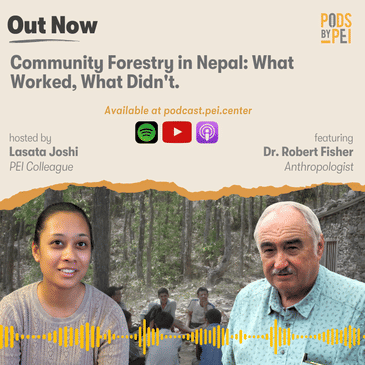
In this episode, Lasata and Robert discuss Nepal's globally praised community forestry model. Unpacking its evolution from early experiments with user groups to the 1991 political revolution and 1993 legislation, they discuss how local communities learn to govern forests and explore transferability as global interests in the model rise. They also investigate tensions around inclusion, power, and decision-making, and consider what makes community forestry both promising and problematic—then and now.
Dr. Robert Fisher is an anthropologist and human geographer with decades of experience in the social dimensions of natural resource management. His long association with community forestry began in Nepal, where he worked with the Nepal–Australia Forestry Project in the late 1980s. Since then, he has worked in various capacities across Asia, Africa, and the Pacific, with a focus on issues such as land tenure, conservation, and local livelihoods. He is currently a Senior Lecturer at the University of Sydney and a Senior Research Fellow at the University of the Sunshine Coast.
If you liked the episode, hear more from us through our free newsletter services, PEI Substack: Of Policies and Politics ( https://policyentre.substack.com/welcome ), and click here ( https://patreon.com/podsbypei ) to support us on Patreon!!
[00:00:07] - [Speaker 0]
Namaste, and welcome to parts by PEI, a policy discussion podcast series brought to you by Policy Entrepreneurs Inc. I am Kushi Hung. And in today's episode, PI colleague, Lassita Joshi, is in conversation with anthropologist doctor Robert Fisher on community forestry in Nepal. What worked? What didn't?
[00:00:28] - [Speaker 0]
Robert Fisher is an anthropologist with decades of experience in the social dimensions of natural resource management. He worked with the Nepal Australia Forestry Project in the late 1980s. Since then, he has worked in various capacities across Asia, Africa, and The Pacific with a focus on issues such as land tenure, conservation, and local livelihoods. He's currently a senior lecturer at the University of Sydney and a senior research fellow at the University of Sunshine Coast. Lasathay and Robert discuss Nepal's globally praised community forestry model, unpacking its evolution from early experiments with user groups to the nineteen ninety one political revolution and 1993 legislation.
[00:01:11] - [Speaker 0]
They discuss how local communities learn to govern forests and explore transferability as global attention to the model rises. They also investigate tensions around inclusion, power, and decision making and consider what makes community forestry both promising and problematic then and now. Like listening to pods? We'd love to hear your thoughts. So please comment on Spotify, Apple Podcasts, YouTube, or wherever you listen to the show.
[00:01:38] - [Speaker 0]
You can also follow us on Twitter at tweet to PEI and on facebook and instagram policyentrepreneursinc for updates on the latest episodes we hope you enjoy the conversation
[00:01:49] - [Speaker 1]
it's really nice to have you with us here Doctor. Frischer we often hear about Nepal's community forestry in terms of policy and programs But I would love to start with the people and the relationships behind the story So let's start with what brought you to Nepal and how did lead you to get involved with community forestry on the ground?
[00:02:14] - [Speaker 2]
Well, in 1983 I was doing my PhD research in anthropology in India, and I came to Nepal for a few months. I think it was almost exactly three months. During the time that I was here, I met people from what was called the Nepal Australia Forestry Project and I visited the field site. And I'd already heard a little bit about community forestry but I started to get a pretty reasonable idea of what was happening in those days. I met the Divisional Forest Officer at the time.
[00:02:52] - [Speaker 2]
I gradually got a lot of ideas and I did consider at one stage converting my research to Nepal, I went back to India. Then subsequently I applied for a job in the project and started working in 1987 with the project. I was there for two and a half years in Nepal. Subsequently, I'd probably been to Nepal sort of mainly on short term visits up to three months at a time on one occasion, but normally shorter than that. Maybe I've been 30 or 40 times, I'd say.
[00:03:31] - [Speaker 2]
So I've kept up the connections for a long time and most of those visits were kind of work related, one or two private holidays. So I've had a long connection. But I've always been interested in understanding the linkages between environment, natural resources, and people. I stress too that I'm not a forester. I'm an anthropologist.
[00:03:55] - [Speaker 2]
I'm an anthropologist with an interest in the environment. I'm not a forester who just happens to be interested in people. I started from the people side. I was pretty lucky that the people I worked with who were foresters were also really open and really interested in understanding the society and all that sort of stuff.
[00:04:14] - [Speaker 1]
It's really interesting that your path started with the people side and not the forestry, and that you found foresters who were equally curious about society and community. Now looking back at the late 80s when you joined Nepal Australia forestry project, could you share what the community forestry landscape looked like then?
[00:04:37] - [Speaker 2]
Well, was a really important point of transition switching because when it first started, community forestry was basically about getting local communities to protect forests, maybe plant new forests, protect them. There wasn't much sense of people being allowed to actually use the trees that they were planting or use what was in what were technically all government forests. That was what it had been like. Then just around about the time that I was here, 1987, and a few years before that, it started to change. There were some things happening with the influence of some local leaders and particularly some Nepali forestry officials like TBS Mahat, who was a district or divisional forest officer who later went to do a PhD in Australia.
[00:05:40] - [Speaker 2]
He was working with local community leaders like a guy called Laxman Dong. He realized these people were already, regardless of the government program, already doing a lot of pretty constructive, productive use of forests protecting them and developing ideas about how they could be used. Now he's not the only one. He's quite important in the history of the Nepal Australia Forestry Project. There were also other district forest officers or divisional forest officers.
[00:06:12] - [Speaker 2]
I think they were originally called divisional forest officers. They were doing experiments even within the fairly strict rules. They were often doing some little pilot activities. One of those was a DFO called Jagadish Baral. At the same time, there were a lot of international projects around.
[00:06:33] - [Speaker 2]
There was an Australia one, which is quite old a British one which is more research oriented, a very good Swiss project and quite a lot of others. There was a lot of international donor interest and some people think there was too much pressure from the donors. It's a matter of opinion but my feeling was that there was a lot of initiative on the forestry department and the ministry side. In 1987, when I arrived, fairly soon after I arrived, was a major conference funded by the donors but managed by the ministry and the department of forests in Kathmandu. That was really quite radical, talking about we have to start using forests to provide resources, livelihoods to people.
[00:07:26] - [Speaker 2]
It was new thinking expressed in a very public way, but there had already been people working towards that, including some pretty good people at the government level in the ministry. There was also, the 'eighty seven, 'eighty eight, a Finnish project which was preparing a big master plan for forestry in Nepal, which was submitted in 1988. In that they actually said community forestry should be people anywhere in the hills of Nepal who have the ability and interest to take on a community forest should be given the right to do so. It also said they should be allowed to use and benefit from all the resources that were profits that were made. That part didn't happen, but it happened to some extent.
[00:08:21] - [Speaker 2]
But the idea that just said, Okay, you can have community forestry anywhere where people are interested and capable. That was really important. It was approved as a policy quite quickly but then the mechanics about how it would work became a problem until 1993 when there was new legislation passed. The 1993 Forestry Amendment Act. I can't remember the exact terminology.
[00:08:48] - [Speaker 2]
That was all happening at the time. I was just lucky I came at the time when it was all changing. Also because we were interested in understanding more about what communities were doing, then being an anthropologist was quite convenient. We were able to identify quite a lot of traditional forest management systems by communities. I didn't like the term traditional because in many cases they were quite recent.
[00:09:16] - [Speaker 2]
They'd been set up because the government system wasn't working very well. These things happened with the community efforts. A lot of what I was doing with a couple of very good research assistants and so on, I was doing was going out and having a look and seeing how they worked. That was really valuable. All of these bits and pieces came together and I think that's where we were at.
[00:09:42] - [Speaker 2]
We're at that point when community forestry had been quite successful in planting areas of trees with communities lot of those forests grew quite well. We started to move towards making it about people using communities and people having some level of control. I don't want to romanticize that, but that's what happened. I had good leadership in the project that I worked for. It was actually managed by the forestry department at Australia National University under the leadership of David Griffin, who was in Nepal part of the time, he was a really good leader and really innovative and so on.
[00:10:29] - [Speaker 2]
The local boss, the team leader, was Don Gilmore, who was there on two separate occasions for several years each time. He's always been a major figure. There were others in that project and there were lots of others in projects like the Swiss and the British project and so on. Yeah, it was an exciting time with a lot of working with the forestry department officials.
[00:10:53] - [Speaker 1]
That sounds like it was a very energetic and important time with lots of shifts happening both in policy and on the ground. But as you said, moving from policy to real change, it's really straightforward. So after 1993 law came into effect, did communities actually gain control over the forest or were there still big challenges or hurdles they had to work through?
[00:11:19] - [Speaker 2]
That's very tricky because the law changed in 1993. Before that there were pretty strict restrictions on what people could take out of forest. Even to collect timber they had to get permission from the forest department. They were allowed to collect dry stuff that was lying on the ground branches and stuff. They weren't supposed to cut branches off trees.
[00:11:46] - [Speaker 2]
I suppose they could have got permission but it was pretty slow until the new legislation came in. Anything like that was kind of tolerated but not really approved or only on some occasions. After that it was still a slow process because people might have had an agreement by the Forest Department to have a management plan that said what they would do and what they would be allowed to do, but that still had to be approved by the Forest Department. Sometimes the restrictions were still pretty strong and it was a long time before anyone was allowed to harvest timber for sale, which is probably the main way to make income. The livelihoods probably did improve fairly quickly, but it wasn't an overwhelming change.
[00:12:36] - [Speaker 2]
It was a gradual change. And a long time after the laws changed, getting permission to actually sell timber commercially was pretty hard to get permission to do that. It's all a process, a slow process that needs to be really understood quite well. There have been changes since then. Sometimes they're more generous use.
[00:13:01] - [Speaker 2]
On other hands, Forest Department was sometimes trying to take control back a little bit. So use of resources is always contested. I think the advantage is that there were some really very dedicated officials in the forest department that were really trying very hard to make it work. I think to a large extent they made it work.
[00:13:27] - [Speaker 1]
Yes, I do agree. Change often comes slowly and unevenly. From what you've described, that was certainly the case in the community forestry in Nepal. But at some points it really did gain momentum and became a nationally recognized program right? So from your vantage point what helped dip this balance?
[00:13:49] - [Speaker 1]
Was it policy shifts or a change in public or institutional attitudes or something else entirely that allowed community forestry to really take off?
[00:14:01] - [Speaker 2]
Well I think that a lot of people kept pushing it. I don't mean just foreigners, but lots of people in the Forest Department were really pushing it very hard. I think there were a couple of particular developments that were really important. One was a political change that in a way almost happened regardless of forestry. That was the revolution in 1990 because prior to that all community forestry was run through punch hats.
[00:14:36] - [Speaker 2]
There were two types of community forestry. Panchayat forest, which was where communities took responsibility to plant new trees, reforestation, and that was done very effectively in many cases. Then there was another type called Panchette Protected Forest, which is where the forest already existed and were in good condition. Their jobs would look after it and keep anyone from using it or keep only the minimum amount of use. In 1990, when the punch out system ended, just changed its name initially.
[00:15:13] - [Speaker 2]
What happened is that the assumption that all community forestry had to be at the level of a punch out disappeared and the ideological thing changed. The problem with that old system is punch outs were often quite big. The forestry had to be run through the predant punch and the Punch Out Council often were in one village in a very remote part or only one part of the Punch Out. The people who were using the forest and actually interested in the forest were living completely separately, sometimes crossing punch out boundaries. So it was an actual major problem because you were actually, in some cases, working with the wrong people.
[00:15:58] - [Speaker 2]
Then when there were attempts to, even in the late 1980s, to allow communities to harvest firewood and stuff like that, one of the problems is that sometimes it was given to the wrong people. The people who had some traditional practices of using that land weren't necessarily the ones that were actually allowed to collect. So it was making decisions on the wrong basis. I think one of the big things that happened is that allowed the shift to this user group idea of forestry rather than the punch yard based forestry. Now that still took a couple of years to be part of the legislation but it suddenly made it a lot easier to start working with the right group and so on.
[00:16:41] - [Speaker 2]
There had been experiments with that but they were a bit awkward. A second thing that happened, I think, is that the emphasis changed from trying to teach communities about how important it is to look after forests to actually trying to train forest department staff to work with communities. I remember you used to see these pictures of women carrying huge loads of firewood and stuff and they'd walk for hours and hours every day or several days a week. And everyone was saying, We have to teach these people the importance of trees. That's ridiculous.
[00:17:21] - [Speaker 2]
I mean, someone who walks six or seven hours, five times a week to carry 30 or 40 kilograms of firewood doesn't need to be taught that trees are important. They might need to be given rights and there might be ways of helping to do it better, but that's not the point. So the emphasis came in a lot in the idea of actually working with the forest staff, the local people, particularly the rangers and so on, and providing them with training about ways to work better with communities. There were a couple of people very prominent in that and certainly one of them is Narayan Kaji Srestha, who's quite famous working with Watch, the organisation, Women Acting Together for Change and a British volunteer called Jane Gronau who did a lot of that with Kaji. So that sort of work was really important and it did change things.
[00:18:14] - [Speaker 2]
Given the right support, some of these rangers preferred. They preferred not to be police charging people with breaking the law. They preferred to work with the communities. And I'm not saying everyone changed, but there was a lot of that and I think that was a really major change. You had to have good leaders in the forest department to do that.
[00:18:37] - [Speaker 2]
Some of them took a while to change and some of them changed very quickly. All of that was, I think, really important. I would put those two things: change in the policy towards user groups, change in the emphasis of who you're going to target to change from being the communities to the forest officials, and I think the recognition that communities had pretty good ideas about what they were doing anyhow. They were often very effective even if what they were doing wasn't recognised.
[00:19:09] - [Speaker 1]
So clearly, some important changes happened over time. Now I would like to understand how did the community forestry initiatives and the people involved learn and adapt as things progressed? Were there particular challenges or experiences that shaped how the projects and communities evolved over time?
[00:19:29] - [Speaker 2]
I think I'll probably focus a little bit on the forestry projects and how they learned. A lot of the learning was by mistake, learning from mistakes. It was clear that some things were not working very well. Lots of things were working well but it was pretty obvious that certain needs weren't being met like the really serious needs of people for forest products and so on. They weren't being addressed and I think a lot of people started to realize that and to think of ways of doing it.
[00:20:01] - [Speaker 2]
In the Nepal Australia Forestry Project, we actually specifically talked about action research. It doesn't mean others weren't doing it, but we actually use that as a term. What that was really about is we'd do things and then if they didn't work, we'd do it differently. One of the things that we found out, for example, is that when I say we, I wasn't involved in this or it was happening pretty well before I was there, when there's an arrangement in one particular panchayat to share forest products with people from the panchayat, It didn't work because they gave it to people who weren't normally using that forest. What happened is that there was a lot of discussion.
[00:20:42] - [Speaker 2]
We sent someone to find out what had happened and it was learned that we had misunderstood how the forest was being used by people traditionally and we changed the practice. So that's action research. You learn by doing, but maybe more importantly, you learn by making mistakes and learning from the mistakes. So I think that's important and I think everyone was doing that. I guess we wrote more about it, but it doesn't mean other people weren't doing it.
[00:21:13] - [Speaker 2]
Other thing, it necessarily goes to the community level. Yeah, I mean, you don't want to romanticize that every community knew what they were doing and that every community had good leaders and stuff. That's not true, but a lot of people did. And again, people changed things. They started doing it one way and then they realized that didn't work so they changed it.
[00:21:34] - [Speaker 2]
Sometimes they're using traditional knowledge and sometimes they've been doing stuff for years. But on the other hand, lot of what they were doing twenty years ago or fifty years ago wasn't legal anymore. They modified what they were doing and changed the way they did things. That was often not about so much their knowledge about how you use forests. It was about how you organize yourselves.
[00:21:57] - [Speaker 2]
There was a case of one study up in Sindopalchok where the community started off with, We better do something. Village leaders started it, but they got everyone else involved and recognizing it. At one stage they had a committee to run it and the other next stage they didn't bother anymore because they didn't think it was necessary to have a community. Sometimes they had forest watchers who were paid to go out and paid a bit of grain or maize or something like that to go and look after the forest and check that no one was cheating. After that, they just thought maybe it's better for our community members just to police it themselves.
[00:22:38] - [Speaker 2]
So there was this modification and adaptation. I think that happened at both in the various government projects, in government staff, and also with communities. I think that sort of bit of a learning emphasis is really important to what happened. Things adapted. I mean adapting to what was happening was, I think, important, but slow.
[00:23:01] - [Speaker 2]
It doesn't happen instantly. A lot of people, like some local leaders and some government officials, don't want change or didn't want change, but others did. You have to be very conscious of just the difficulty of making that. A lot of places, have not made those changes very well in a lot of countries. Some may have, but yeah.
[00:23:24] - [Speaker 1]
That was a really insightful look at how learning and adaptation shaped community forestry over time. You also touched on the shift from Panchayat system to use the group forestry after political changes, which seems like a major shift. So how would you describe the current state of power and decision making in Nepal's community forestry? Who really holds influence these days and how have things like women's participation marginalized group and social and economic changes have affected that balance?
[00:23:59] - [Speaker 2]
Okay. There's probably a couple of different aspects of that. Firstly, if you just look at the devolution of power, under the law, ownership of the forest didn't change. It's still state forest or government forest. What happened is that people were given rights to it and specifically groups of people were given rights, specific user groups were given rights, they had to sign an agreement about forest management with the forest department.
[00:24:31] - [Speaker 2]
Now in that, the extent of just how many rights and how much they could decide themselves varied. Sometimes they had a fairly strong right to make the decisions and the Forest Department went along with. In other cases, it was a bit more restricted. They weren't allowed to collect as much. They weren't allowed to sell things like timber or they weren't allowed to sell them outside the community or something like that.
[00:25:00] - [Speaker 2]
There were all these sort of things. It was never a complete open show. The other thing is that the inclusion of women and poorer people, usually lower caste people, was variable again. There were some committees where women were quite reasonably dominant. There were others that were largely excluded.
[00:25:25] - [Speaker 2]
There were some areas where the committee might be dominated by a couple of local people who were generous. At other times it might be dominated by people who weren't, who were selfish. So there's all sorts of things happening there. Devolving power is not just, Okay, here it is. It's all up to you.
[00:25:43] - [Speaker 2]
A number of things that were a bit of a problem is that at one stage community there were guidelines being pushed about the number of women that had to be on the committee. But there's one thing getting somebody on the committee and the other thing is giving them any power. That sort of comes out. I remember once we actually making a video, but we were talking to women about their role. We asked one woman, one of the Nepali guys working with our project asked this woman, Are you on the committee?
[00:26:17] - [Speaker 2]
And she said, I was, but I think I might have been kicked off. She didn't even know. Is there any other woman on the committee now? I think there's a woman down there that's on the committee. So what I'm getting at is that yes, there were efforts to encourage women to be on the committee but it didn't always lead to any major change.
[00:26:36] - [Speaker 2]
On the other hand, we could see examples of very strong women being on the committees and so on. It's never a simple story. It's that getting people to give up power is pretty hard. I think that was a major issue. It's changed now because in many areas there's been such a change in the economy and many men working overseas in The Middle East and Malaysia and so on.
[00:27:08] - [Speaker 2]
So there's actually, in many cases, a shortage of young men or men of a working age who used to work in the farms not working in the farms anymore, leaving their wives and others to manage the farms, manage the agriculture. Now that's a huge change. On one hand, that's probably given a lot more. There's been some very good research done that by several Nepali women and they found, yes, women have actually got more power, but they've also got more responsibility. So there are changes like that.
[00:27:42] - [Speaker 2]
The other thing is with all that money coming in, and it's quite a lot of money that comes in remittances, as you know, I think what's happened there is that a lot of people are not really looking for forest products anymore. But the danger is that people are saying that but they forget that there are poorer people in the community who do need those products who are not getting as much access, I believe. I don't know. So there's all these complexities and there is so much change occurring in Nepal that what worked beautifully twenty years ago has to be continually modified. I think that's really an important part of what is happening in Nepal.
[00:28:28] - [Speaker 2]
There's lots of those discussions going on.
[00:28:30] - [Speaker 1]
That really shows how complex and evolving community forestry is in Nepal. Given that Nepal's approach is often cited globally as a model, from your perspective, which parts of Nepal's experience could offer useful lessons or inspiration to other community forestry efforts around the world?
[00:28:52] - [Speaker 2]
I think Nepal's experiences were widely influential in many countries. I should say, I'll say mainly in Asia, in the sense that the situation in the African countries, some things have been adopted and used, but there's a bit of a transfer and it's quite different. There's probably also similarities with Latin America or Central And South America. I think that's under completely different circumstances and I'm not as confident about knowing exactly what's happening though. There are some similarities.
[00:29:26] - [Speaker 2]
They often tend to be much more focused on indigenous groups because they're more organised and bigger indigenous groups, which is not really the case in Nepal. It's more a mixed community in Nepal. Ram and Chetri plus indigenous. I think that's generally the case. But I think in Asia, Nepal's been held up as a model in many ways.
[00:29:52] - [Speaker 2]
I think the political situation has always been a little bit different in Nepal, not just in terms of the monarchy and then the monarchy going and stuff like that, but everything's changing. One of the biggest factors in Nepal is that during this heyday of community forestry, many of these communities were quite and we're talking about the hills, not in the Tarai many of these communities were fairly isolated. On the one hand, that's a disadvantage because they're hard to visit. On the other hand, it's a bit of an advantage because people don't bother them so much, if you know what I mean. I think there was a bit more willingness to devolve power, partly because the forests weren't commercially valuable.
[00:30:41] - [Speaker 2]
I mean, the forests in the hills were very hard to actually harvest and sell commercially because there were very few roads and so on. So to some extent that actually, I think, gave an opportunity in Nepal. Whereas what you have in many other countries I don't want to be too specific about other countries because there are internal variations as well. But in many other places, India started various systems of forestry independent of community type forestry that were very different from Nepal quite early. But I don't think there was much influence from Nepal in India.
[00:31:20] - [Speaker 2]
If you look at Bhutan, there's very much emphasis on a lot of the ideas of community forestry in Nepal, but they've been interpreted a little bit differently because the situation is different, the geography is different and so forth. Thailand, there's been a lot of enthusiasm that came from the experiences in Nepal. Almost all of what we call community forestry occurs in protected areas rather than just in the forest That's put a lot of pressure in Thailand and it's become a very big political issue where you had advocates of indigenous people, particularly advocating for community forestry and rights and so on, and other people saying strong environmental movements are actually saying we should look after the forest and forget the people. I didn't quite say that, but you know what I mean. So it's difficult to see too many exact copies.
[00:32:21] - [Speaker 2]
The politics in each of the countries is different. The public administration is different and that affects things. You've got different structures. In some cases, have provinces that are very powerful. In other cases, it's down to a district level, which was the way it basically was in Nepal.
[00:32:40] - [Speaker 2]
The specifics of the model being copied, but what's being copied is a lot of the objectives of the project and the idea of devolving some sort of power to communities. And the idea in many countries is the idea of allowing people to have access to forest products and so on. But the mechanisms have been different because the authorities are different. In many cases, there's a lot of talk about that, but there's not much willingness to actually change things. So I think it's easy to generalise and to see the impacts of the ideas and experiences.
[00:33:14] - [Speaker 2]
It's a bit harder to see them being copied in a very precise way. But the idea of some devolution of power and some devolution of rights seems to have been recognised but not always implemented. I think Nepal's done very well compared to almost anywhere in Asia and I'm just not able to really comment too much about the South American thing because it's quite different. But it's part of it. Nepal was very early in developing a fairly progressive concept of community forestry.
[00:33:51] - [Speaker 2]
I think that's a big advance and it's something that's not being missed. It works that way. But a lot of other places, the emphasis is not on community forests, it's emphasis on privatization of forests. Nepal was a bit lucky because of the remoteness of many of the forests in the hills. It didn't make any sense on privatization.
[00:34:13] - [Speaker 2]
So I think that was a disadvantage for some reasons, but an advantage in other ways. Yeah.
[00:34:19] - [Speaker 1]
We have discussed community forestry's development over time, the policies, practices, and the people behind it. Looking back more broadly, if you could go back to the beginning, your younger self with a fresh notebook working in rural Nepal, what would you do differently? Also, how do you think our understanding of community and its relationship with the forest has evolved since those days?
[00:34:47] - [Speaker 2]
It's hard to separate the bits and pieces of that question. I started as being an anthropologist but I didn't have clear ideas what I would be focusing on while I was there. For example, and that's true with the project, they sort of knew that they needed social science knowledge but they didn't know what for. For a long time most of the social science research that had gone on in Nepal regarding community forestry was about surveys to find out how much firewood people collected and needed. So you do surveys and you calculate that for each family in the household, maybe dependent a bit about the local situation.
[00:35:34] - [Speaker 2]
They need so many head loads a year and the results were incredibly different from each other. But that really wasn't the issue. A lot of the issue was not understanding how communities made decisions and what communities' practices were. It was only really because personally I got the opportunity because the project had been doing some experiments about getting communities to harvest products and share them and they realized they were getting it wrong. They didn't understand the social structure, which is an anthropological question or sociological question.
[00:36:10] - [Speaker 2]
Secondly, ISIMOD, International Center for Integrated Mountain Development, had a project which was exploring local management, local institutions. They had a number of people doing components to that project and they made an agreement with us. So we actually had the opportunity to go out and look at those questions about how communities organise themselves. That was just sheer luck. The timing was perfect for me and the project was also playing around at some of those cases which didn't work very well, which they couldn't understand very well.
[00:36:50] - [Speaker 2]
They were really starting to do the research and so we just sort of expanded it and did that. I didn't come into the project with that in mind. I came into the project to where there were a lot of really interesting issues but without having any detailed experience of Nepal. I had experience elsewhere. I was in the desert in Rajasthan so it wasn't particularly useful.
[00:37:16] - [Speaker 2]
So I think that sort of thing was hard to predict. I mean, would I come in? I guess now I would. Anywhere I go, I start looking at those issues about how people organize their things, how they make decisions, tenure, what rights people have, and how they can be changed. Now I would always go into anywhere new with those ideas in mind and those questions in mind.
[00:37:43] - [Speaker 2]
I didn't particularly go into them when I first went to Nepal and I think people didn't. It was only after they were emerging as being big questions.
[00:37:54] - [Speaker 1]
So much has shifted over the years, particularly in Nepal's social and economic landscape. Looking at the present day, what would you say are the biggest challenges facing community forestry now? And despite those hurdles, what gives you hope that community forestry and related development efforts are still heading in a positive direction?
[00:38:19] - [Speaker 2]
Yeah. I What we have to always understand is that these things are never permanent. Nepal was in a certain state of development with a very large rural population that was not so much concerned with subsistence only. They did have some market influences, but they were largely concerned with consuming things themselves and making sure they had enough to live by. They weren't engaged in markets and the education system in rural areas was pretty limited and so forth.
[00:38:58] - [Speaker 2]
All of that's changed a lot, So the same solutions don't work now. Everything has to be quite adaptive. You have to look for new ways. People are struggling. Governments are struggling.
[00:39:14] - [Speaker 2]
Forest Department officials are struggling about how to make their programs more relevant, how to acknowledge the fact that things have changed, but how to also recognize some things haven't changed. So I think that's a real challenge. When you bring that across the outside, then the overall context in every country can be quite different. The challenge is really to see what's there and adapt in a way that assists rural people to do better. I don't think there's any magic solution, but the big issue there is to actually get involved in talking to communities and not designing the solution from the outside.
[00:40:03] - [Speaker 2]
That's easy to say, but it's hard to do. I also think it's very difficult to do that without good leadership at the political level. It doesn't mean every member of the government has to be interested in community forestry, but you've got to have some champions and you've got to have champions in the forest departments and environmental agencies. Now I think that's the pattern and I utterly believe that you need some social science in that to learn how to have those sorts of meetings and discussions with local people. I'm a fairly big advocate of something like action research or action learning and being very participatory about how you do that.
[00:40:48] - [Speaker 2]
So I think trying to pick up a model and move it to some other case is not very practical. It's one thing to have some principles that come out of that model, like the need to identify all the different stakeholders within a community and who gets likely to get affected and so on. So it's not trying to transfer the picture of what that looks like, but to transfer the idea that you need to understand that and that you need to understand markets. I'm not an economist and I'm not even interested in economics in a detailed sense, but clearly you need to understand what markets are there and how they can be used and how they can be disadvantageous as well. So it's more a matter of not trying to say this is what works, but identifying methods and concepts that help you to understand different contexts.
[00:41:49] - [Speaker 1]
So much has changed over the years. Now looking at where things stand today, what would you identify as the most pressing questions currently facing community forestry here in Nepal? And despite these challenges, what gives you hope that community forestry and related development efforts are still moving in a positive direction?
[00:42:13] - [Speaker 2]
I suppose there's different big questions everywhere. Let me put that as a challenge. What's the biggest challenge? Because one of the things that's changed a lot in a relatively short time is the number of people talking about community forestry as a way of getting communities to earn livelihoods and better protect forests and so on. There's much less discussion of that now, I think.
[00:42:44] - [Speaker 2]
Much more of the discussion now is about carbon credits, climate change. But Communities more and more fit into that in terms of where all the funding is coming from donors and governments and businesses. Communities fit much more into that. How do they get involved in forest restoration, plantation, and that's done in many cases on the basis of carbon credits and so on. How can communities be involved in that?
[00:43:19] - [Speaker 2]
How can they actually get a fair share, a serious share? And how much that may be stopping some of the other old uses of community forests, which were subsistence or livelihoods or some market use and so on. Because if you're locking up the carbon, you've got to work there are different ways of doing that. Internationally, in rural areas, as far as communities are concerned, the emphasis is moving away from a more community forestry notion in that sense we talked about today. But it's moved much more towards a concern about how do you involve communities in that so that they contribute to the restoration but also get some benefits.
[00:44:07] - [Speaker 2]
Nepal has a REDD plus project, which is not a carbon credit simply, but it's also that you ideally reward communities for protecting the forest so that they lock up carbon. Well, that's a good idea, but there's a long way to go before the methodologies for doing that are as designed as they could be. That to me is the biggest challenge. This is not to say that there won't be concerns more simply with livelihoods for a long time. That to me, in terms of where the money is going in international aid and business and so on, is where the emphasis is.
[00:44:52] - [Speaker 2]
And if you look at the publications in journals and so on, that's where it's going a lot. Don't know whether that answers your question. I suppose it does in a way. I don't think there's anything I would add to the general discussion. I would like to sort of add though that just how fascinated I have been working because I also work in universities some of the time I've been fascinated how many people from Nepal, coming often from forestry, as forest officers who are trained as foresters and so on, have become really active in the study of how community forestry works and so on, often from very social science points of view.
[00:45:45] - [Speaker 2]
The number of people who have gone from Institute of Forestry and several years of experience as a forester, a working forester, who have gone on to do PhDs and become leaders actually, not just in Nepal but internationally in these sorts of issues. I think that that's a really important thing and I guess it must mean that something about it inspired people to change the way they look at things and to become really interested in how to make it work better in different countries. So that's a pretty inspiring thing to notice.
[00:46:26] - [Speaker 1]
Thank you so much for sharing your deep insights from complexities of power and livelihood to the evolving challenges of climate change and carbon markets. It's inspiring to hear how community forestry continues to spark new question and passionate leaders both here in Nepal and beyond. Clearly, it's a living story that will keep evolving and your reflection remind us how important it is to stay curious, adaptive, and grounded in communities. I really appreciate your wisdom and time today. It's been a rich conversation and that I'm sure will resonate with many.
[00:47:07] - [Speaker 0]
Thanks for listening to Pause by PEI. I hope you enjoyed Lassita's conversation with Robert on community forestry in Nepal, what worked, what didn't. Today's episode was recorded at PEI studio, and our theme music is courtesy of Rohit Shakya from Zindabad. If you like today's episode, please subscribe to our podcast. Also, please do us a favor by sharing us on social media and leaving a review on Spotify, Apple Podcast, YouTube, or wherever you listen to the show.
[00:47:36] - [Speaker 0]
For PEI's video related content, please search for policy entrepreneurs on YouTube. And to catch the latest from us on Nepal's policy and politics, please follow us on Twitter at tweet to PEI. That's T W E E T followed by the number two and PEI. And on Facebook at Policy Entrepreneurs Inc. You can also visit pei.center to learn more about us.
[00:47:59] - [Speaker 0]
Thanks once again from me, Kushi. We will see you soon in our next episode.