
ABOUT THE EPISODE
#Ep.046
Nepal's current state of infrastructure financing plays a critical role in shaping the country's development and prosperity. Adequate infrastructure is crucial for Nepal's economic growth, job creation, and overall socio-economic advancement. However, Nepal faces various challenges in securing sustainable infrastructure financing for long-term development. Limited fiscal resources, difficulty accessing affordable financing, bureaucratic hurdles, and governance issues hinder the financing process. Furthermore, political instability, weak institutional frameworks, and corruption pose additional obstacles to attracting essential foreign investment. Addressing these challenges requires comprehensive efforts to streamline bureaucratic processes, enhance governance practices, establish specialized financing mechanisms, and create a favorable investment climate.
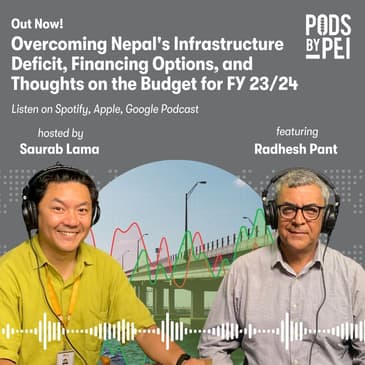
In today’s episode of PODS by PEI, we have PEI colleague Saurab Lama’s conversation with Radhesh Pant. Building on Radhesh’s past experiences at the helm of the Investment Board of Nepal, Saurab and Radhesh explore the intricacies of project planning, financing, and implementation of various Nepali projects, and discuss the core challenges Nepal faces to ensure sustainable and effective infrastructural development. They further discuss the way forward for Nepal to improve its institutional organization, resource mobilization, and governance in the midst of the climate debate and the ongoing geopolitical contestations within the South Asia region.
Radhesh is the Senior Managing Partner at VRock and Company and also serves as chairman in various boards for Asia Network for Sustainable Agriculture and Bio resources (ANSAB), Smile Nepal, and is a founding director for South Asia Institute of Management (SAIM). He also served as the Chief Executive of the Investment Board Nepal (IBN). He holds an MBA from University of California Los Angeles (UCLA) and a Bachelor of Technology in Aeronautical Engineering from Indian Institute of Technology (IIT), India.
[00:00:09] - [Speaker 0]
Namaste and welcome to Pods by PEI, a policy discussion series brought to you by Policy Entrepreneurs Inc. My name is Kushi Hang. In today's episode, we have PI colleague Saurabh Lama's conversation with Radesh Pant to discuss Nepal's infrastructure deficit, financing options, and his in-depth take on the upcoming budget for twenty twenty three-twenty twenty four fiscal year. Building on Radesh's past experiences at the helm of the Investment Board of Nepal, Saurabh and Radesh explore the intricacies of project planning, financing and implementation of various Nepali projects and discuss the core challenges Nepal faces to ensure sustainable and effective infrastructural development. They further discuss the way forward for Nepal to improve its institutional organization, resource mobilization and governance in the midst of the climate change debate and the ongoing geopolitical contestations within the South Asia region.
[00:01:02] - [Speaker 0]
Radesh is the senior managing partner at V Rock and Company and also served as the chief executive at Investment Board Nepal, where he was responsible for delivering infrastructure through private investments. He also holds an MBA from the University of California, Los Angeles. We hope you enjoy the conversation.
[00:01:24] - [Speaker 1]
A warm welcome back to all our listeners to another brand new episode of Pause by PI. Namaste. This is Saurabhlama, and I welcome my guest today, Mr. Rajesh Pant, onto today's show. Namaste.
[00:01:37] - [Speaker 1]
Welcome to Paws by PI, Ramesh. How are you doing today? Doing great.
[00:01:40] - [Speaker 2]
Thank you for inviting me and having me here.
[00:01:43] - [Speaker 1]
And it is indeed our pleasure to have you here on the show. So shall we get on with our conversation then? Sure. So let's start off our discussion today by taking a bird's eye view of the issues around infrastructure development in Nepal There have been some well documented issues when it comes to infrastructure development, haven't there? So based on your experience in the sector, including as the CEO of the Investment Board of Nepal, how would you describe, perhaps to someone who is not familiar with the issue, the status of our country's infrastructure?
[00:02:16] - [Speaker 1]
What do you see as some of the key reasons for where we are, and what are your thoughts on how this has impacted our development?
[00:02:24] - [Speaker 2]
Thank you, Saurabh. First of all, I think infrastructure development has not really taken off in Nepal. To be honest with you, we've been talking about 46,000 megawatts of, you know, energy. We've been talking about how we are linked with India and China, how we could be geopolitically very important, commercially also. But for some reason, we have not been able to get there.
[00:02:49] - [Speaker 2]
And I think the primary reason is, first of all, the political, you know, landscape that we're in. The country has not been ruled after the democracy by a very consistent and stable government. So what that means is, you know, the politicians themselves and also the bureaucrats, the private sector are not looking at long term. It's a very short term game. So infrastructure requires a lot of work.
[00:03:16] - [Speaker 2]
It requires a lot of preparation, it requires expertise, and most of all, it requires a lot of money also. So money has to come from outside the FDI, that's what I think. Nepal does not have enough money to build its own infrastructure. So because of all these issues, infrastructure development hasn't taken place. Even though we have pretty decent policies, I don't think we have been able to convince people that infrastructure is important because without infrastructure, if you look at all the countries like Japan, Korea, Singapore, Malaysia and even The US and everywhere.
[00:03:50] - [Speaker 2]
Infrastructure is the key to actually improve export, improve tourism, improve everything. So we have a problem and we can talk a little bit more.
[00:04:02] - [Speaker 1]
Absolutely. We'll come to some of the nuances of some of the issues that you highlighted in your previous answer. But while we are still on the topic of infrastructure development, just a quick follow-up to what you said. So if you were given the responsibility to pick three projects that Nepal should move forward with, which ones would you prioritize and why? Okay.
[00:04:24] - [Speaker 1]
First off,
[00:04:25] - [Speaker 2]
I think, you know, since we can develop a lot of of electricity, I think transmission line, cross border transmission line, it could be the line that MCC is working on. That would be very, very crucial for Nepal because not only that we can export it, we would, you know, once we develop, will require power, right? So we can import power also. Currently we only have Dhal Qibar Bujafar Fur, which is not enough, I would say, to export or import for that matter. Second, would really focus on an airport because we talk a lot about Sagarmatha, we talk a lot about Buddha was born in Nepal, we talk about all these beautiful sceneries and lakes and what have you not.
[00:05:07] - [Speaker 2]
But how do we get people here? How do we get the tourists? How do we increase our access to international tourist market? And by that, I think airport is extremely important. That's the first impression.
[00:05:20] - [Speaker 2]
And third, I think, you know, we've got to have good road, cross border roads, you know, like the fast track that's going on right now. Because Nepal can produce a lot of good agricultural herb products. However, we're not able to really get it to the market. You know, the whole value chain is really not there, so everything gets wasted. Rather, we are net importer importer in agriculture and foods.
[00:05:45] - [Speaker 2]
So I think these three will be the areas that I can think of right now.
[00:05:49] - [Speaker 1]
So you touched on quite a number of things in your answer there, and I'd like to gradually get into each of these topics. Let's first begin with the role of the government, especially with regard to planning for infrastructure. Now let's explore Nepal's infrastructure paradigm a little. Nepal's development has been riddled with a lack of integrated master planning and similarly a lack of inter agency coordination. I liked how you brought the topic of airport because my question was going to be about this.
[00:06:19] - [Speaker 1]
Now, the lack of planning and coordination has been further highlighted by how our two recently completed airports in Bhairava and Pokhara are struggling. And despite all the contentions and debates at the national level from politicians and civilians alike, the Nijgad Airport is a project that the government seems quite intent on pushing through as was mentioned in the prime minister's speech last month. So what is your take on how projects are planned in Nepal?
[00:06:47] - [Speaker 2]
The projects are not planned. Let me tell you very honestly. My experience is that, you know, every government has been short lived, couple of years, you know, since democracy, I would say. More so, I think understanding, as you mentioned, you know, there is no plan in the sense that there are no sectoral development. For example, if you have an airport, it's not just tourists.
[00:07:10] - [Speaker 2]
It's not just tourism, you know. Airports help you in many aspects. Good airports, you know, you're talking about foods, you're talking talking about, you know, other entertainment, you're talking about hotels, you're talking about, you know, even, I would say, consumption of electricity and and it really impacts a lot. So in that way, intersectoral planning and master plans have not been done in Nepal, number one, you know. That's why you see these other two airports, and unfortunately, we're not being able to use it.
[00:07:40] - [Speaker 2]
So now let's move
[00:07:41] - [Speaker 1]
on from the planning of projects. Let's move on to execution. So time and again, we have had different cost overruns, time overruns in our infrastructure development processes. One very well documented project is the Melanchi water project, which has taken around three decades and billions of rupees. And yet, this project is yet to be fully completed.
[00:08:06] - [Speaker 1]
So the Bhairola Airport itself went over the scheduled cost and completion date and the Toray fast track is already behind schedule and is expected to cost 200 to 300 percent more than what was first planned. The list unfortunately goes on and on for quite some time. So can you give your thoughts on why this is such a regular feature in our projects?
[00:08:28] - [Speaker 2]
No. I think the the the first and foremost thought is that there's no ownership, accountability of these projects. The governments are not accountable, it seems. Political leadership, political parties are not accountable. And even as long as there's money coming in, even if it's delayed, no one cares.
[00:08:47] - [Speaker 2]
Infrastructure projects, usually there is cost overrun and time overrun. Usually cost overrun would be about, I think, 60% or so, usually. Okay? But here, like you said, we're talking about hundreds of percent, maybe thousand percent, you know. So the first and foremost is the ownership and accountability.
[00:09:06] - [Speaker 2]
Second, you know, honestly, I don't think we really have good experience in making large scale projects. We still need to build our capacity inside Nepal, in the government, in the private sector, because we really haven't built large scale infrastructure. So essentially to monitor and evaluate and then prepare to regulate, I mean, how the regulation, even legal matters and all, we need outside help, and we should get that. And that's where I think the donors can play a huge role, because I don't see that happening. By saying the donors are supporting mostly on the soft side, and I think what needs to happen is really get them to helping Nepal in building infrastructure, in building capacities for the engineers, the builders, the private sector, and the government, so that we're ready for the future.
[00:10:05] - [Speaker 1]
We'll most certainly be back on the topic of FDI and foreign investment. But while staying on the topic of the Nepali government, looking inward, how do you evaluate the institutional setup to foster a more conducive environment for infrastructural development in the country? I mean, I ask this because I know that the investment board has been institutionalized for this very purpose, and you yourself had led the institution for a number of years. However, there do not seem to be desired outcomes other than maybe the progress with the Arun three hydropower project. So what were, or in particular, are the limitations that hinder our progress?
[00:10:45] - [Speaker 2]
Saurabh, know, for me, the thing is that, you know, we really have not in Nepal, we have not been able to communicate, you know, communicate at all levels. We We have not been able to communicate to the local level where the projects happen. They have no idea what the projects are bringing. We're not able to communicate to the civil society, that is also if we have one. I don't see a strong civil society in Nepal who actually are non party, who are focused for the interest of the people's societies and so forth.
[00:11:20] - [Speaker 2]
I do not see even bureaucracy between the ministries, between the institutions talking, understanding, and working together, and definitely the politicians also, the political leaders. I don't think there is much communication. So what I think is, you know, for a project to happen, a large scale project to happen, This is saying from someone, you know, who was at IFC and helped us at the beginning of when I was there at the investment board. It's basically, unless and until you can win the hearts and minds of people, trust, confidence of the people, none of these projects are going to happen. And that's where I think we have to work.
[00:12:03] - [Speaker 2]
The government has to have a really clear mechanism of communicating about these projects. Why, like you said, maybe have a master plan and why these projects are aligned, you know, in the top priority. What is it going to bring to the country? We we should understand more about these projects, what exactly it's bringing, not only rupees, you know, because a lot of these projects are so inter sectoral that, you know, it helps agriculture, it helps tourism, it helps, you know, sectors as well. So we need to be able to evaluate all that.
[00:12:38] - [Speaker 2]
We need to be, you know, able to do that. And finally, again, that accountability ownership unfortunately is really missing, you know, in Nepal.
[00:12:47] - [Speaker 1]
Similarly, how do you evaluate the role of the Nepali private sector in infrastructure development? What do you think needs to be done in order to have the private sector contribute more to this discussion?
[00:13:00] - [Speaker 2]
Yeah. First of all, I think we're we're gonna have a stable government. Unless and until there's stable government, private sector is not gonna invest in infrastructure because, you know, it's a long term. Infrastructure is a long term capital. If there was a private sector and if he could make a buck trading, there's no risk.
[00:13:17] - [Speaker 2]
You just bring in product, sell it at a higher price, and then you make your spread, right? But if it's infrastructure, you have to borrow for a long term, and then whether if there's a political strike, this and that, there are a lot of risks, okay? So I think private sector has a lot of work to be done. I know we have private sector and they are becoming professional, but I think there is much more that the private sector needs to do. Private sector, I think, does in most of the development in the world, private sector plays a key role.
[00:13:54] - [Speaker 2]
Of course, they play a key role in small and medium enterprises, but even at the, you know, infrastructure level. I think the capacity of private sector has to go up. There is capacity. It's being built, especially in the hydro side, but in the roads or other construction, I think there's got to be some more capacity built. And I think we need to start introducing the environment, the climate change impacts, the studies, because there is a lot of fun.
[00:14:24] - [Speaker 2]
And then usually, you know, these funds are not gonna come to Nepal unless and until we actually enclose these things, you know, in the projects. So especially, you know, I think private sector, they invest, and they have the appetite to take so much risk in any project. So government has to take some of those risks. Okay? For example, let's say, you know, a private sector or a foreign investor we invite in the country and has invested x amount of money.
[00:14:56] - [Speaker 2]
Now the thing is, in that project, if there's a strike because of political reasons, what can the private sector do? Mean, private sector can't do anything. It is government's responsibility to actually pay for, you know, to basically help the private sector to give the private sector confidence, security that this is not going to happen. Not only that, know, I think private sector can take a lot of risks, like the technical risks, the financial risks, project risks, and all that, and you know, the other risks such as the earthquake and all that can be taken by insurance companies and whatnot. But there are certain risks which private sector has no no control.
[00:15:40] - [Speaker 2]
For example, I would even like to say that, you know, the currency risk, for private sector to take the currency risk is extremely difficult. So it has to be somehow shared, because the peg is decided by the government, So that risk, government can take. Private sector cannot take it. But however, the Indian currency to dollar or the foreign currency, that can be taken by the private sector given certain cost associated.
[00:16:19] - [Speaker 3]
Hi there, this is Shia Rana from Policy Entrepreneurs Inc. We hope you're enjoying Pods by PEI. As you know, creating this show takes a lot of time and resources. We rely on the support of our community to keep things going. If you've been enjoying the show and would like to help us out, we'd really appreciate it if you could become a patron on Patreon.
[00:16:38] - [Speaker 3]
Patreon is a platform that allows listeners like you to support creators like us with a small monthly donation. Your support will go a long way in helping us to continue creating high quality content for you. If you are interested in supporting our show and becoming a part of our community, head on over to Patreon and become a patron today. You can find us at patreon.com/podsbypei. Every little bit helps.
[00:17:04] - [Speaker 3]
We can't thank you enough for your support. Now, let's get back to the episode.
[00:17:13] - [Speaker 1]
So now let's move on to the issue of financing. One of the key ways that Nepal has and is financing many of its infrastructure projects is through multilateral banks. Multilateral banks such as the World Bank and the Asian Development Bank play and will continue to play a prominent role in Nepal's infrastructure financing. How would you say their role has been in supporting the government in infrastructure development? Given that there are still many challenges even in infrastructure projects these institutions have funded, Do you have suggestions as to what they should be doing to make things better?
[00:17:51] - [Speaker 2]
I think they are currently, are focusing a lot on infrastructure development. I think, you know, both the banks that you mentioned are trying to take up projects rather than really getting to other fields. I think the first and foremost is that, you know, because while they're investing, they need to actually sit down with the government, with the politicians, and actually pave the way for others also. I think they're in a position where they can really negotiate well with the government. For example, the investment board.
[00:18:27] - [Speaker 2]
For the investment board to be one window, You know, they need to work with the government. They need to work with these projects and actually first institutionalize investment board, you know. Because private sector is not gonna come without an institution that is such as the investment board, because it's really too much trouble running around to different institutions. Not only that, for the government also, the investment board, the way I see it is the commercial phase for the government. They have the knowledge that they can deal with the private sector, and then at the same time, what they can do is also they know what kind of money they are making so the government can maximize, you know.
[00:19:10] - [Speaker 2]
It's a partnership, of course. So basically, you know, I think it is very necessary to have these institutions. Along working on projects, focusing on projects which the ADV and World Bank are doing, I would suggest that they also really strengthen the investment board because because, you know, only institutions like this, I think, in Nepal can deliver, you know, FDI increase and so forth.
[00:19:40] - [Speaker 1]
So apart from the fundings from multilaterals, the other source of financing for us is the concessional loans that we get from emerging superpowers, China and India. Now the discussion around this is that there's a growing infrastructure diplomacy between these two countries within Nepal and in South Asia. The competition expands beyond just our two neighbors and also includes countries like Japan and The United States. So what are your thoughts on how Nepal should engage in this infrastructure diplomacy, especially keeping into consideration the MCC debate a couple of years back? So we are best able to exploit any opportunities that arise while understanding and mitigating any possible economic and political risks.
[00:20:30] - [Speaker 1]
Yeah. I think, first of all, I think
[00:20:32] - [Speaker 2]
what we need to do is in Nepal, our political parties, the political leaders, they have to come together. There's got to be a plan. Know? I think you're absolutely right. You know, China can build great.
[00:20:44] - [Speaker 2]
India can do it. Japan, US, everything. That's great. You know? But we, as Nepalese, we need to be the one to look at the landscape of Nepal and say, okay.
[00:20:57] - [Speaker 2]
These are the five projects that we wanna do, 10 projects that we wanna do, and this is how we're gonna do it. Because, you know, we we will definitely we have to manage the geopolitics. Right? So so it should be our call, number one, I think. We should be able to we have to be able to, you know, set our priorities right.
[00:21:20] - [Speaker 2]
Number two, I think, funding. So essentially, you know, if we get a bilateral fund, this kind of funding, it's basically Nepal itself is actually, you know, building it. Basically, you go to within, you know, EPC contract or so forth, right? So it's not an investment, private sector is not involvement. There I think we've got to really have good project management.
[00:21:45] - [Speaker 2]
Mean, that's where I think we have to start building capacity within the government, within Nepal that can really look into these projects and really say that. Because the problem we see that is, you know, like you said, a of these projects are concession loans, but however, you know, somehow Nepal is always, you know, they don't complete on time. Even if they do, the quality is not there. We don't know what's going on. And number three, I think, is that, you know, we need to educate, these countries and the capabilities of Nepal and what we really need from them apart from money.
[00:22:23] - [Speaker 2]
And then that goes on with the ADB and World Bank also. They need to understand how Nepal works. It cannot be totally what is done in some other countries, we can't just bring it to Nepal and make that happen. So I think these are the few things, and ultimately I think, whatever we do, we have to within Nepal, there's got to be strong support from the people, and that is something that I told you previously, that we have to start communicating. Development, infrastructure we need it for development.
[00:22:56] - [Speaker 2]
Without development, people will not have confidence and trust in the government. So in order to do that and in order for the politics to continue and all that, we have to start engaging people, communicating to them, talking to them what is good for investment, what Nepal is doing, how the government is performing, and we have to be more proactive.
[00:23:18] - [Speaker 1]
Besides these financing opportunities from bilateral and multilateral sources, are there any other types of financing, especially market based ones that Nepal can have access to?
[00:23:29] - [Speaker 2]
No. Definitely. I I personally think, like, climate finance. There's a lot of money, you know, and I'm I always think, like, places like Kearnali, you know, Kearnali and Far West. I mean, there's so much that can be done, and there's an opportunity there, you know.
[00:23:43] - [Speaker 2]
Like you said, master plan, projects. I think there we could really do a true climate project because nothing has been really taken out, there have not been much investments, so we can start from ground zero and build up the infrastructure, which can actually be showcased all around the world, you know. So I think climate finance is one. Private sector, I think it's going be very difficult because once the bilaterals, multilaterals, you know, the private sector arm of them start investing, which they are doing now, with that, I hope that the private sector investors outside the country would get more confidence that is there. And the other thing is, you know, in order for the climate finance and all things to work, I mean, we've got to be serious at the government level, you know.
[00:24:33] - [Speaker 2]
There's a committee in finance ministry. I'm not too sure what they're doing. And third, I think, we've got to have a country rating. That's really required for, let's say, a private company or for investments from other markets.
[00:24:49] - [Speaker 1]
Would this be an evaluation of the potential risk and opportunities?
[00:24:53] - [Speaker 2]
Countries are always rated. So basically, you have to start somewhere, okay? But what the investors look at is, if your rating is, let's say, B-, what the investors look at is, if that rating becomes B plus after a year, two years, and it's a positive, so they would be more interested. Our rating is going to be low, we know that. But we have to, nonetheless, have the country.
[00:25:21] - [Speaker 1]
How about the alternative financing options such as public private partnerships? What might be potential benefits and risks associated with this in infrastructure financing for Nepal?
[00:25:32] - [Speaker 2]
No, I think this is one of the major areas where Nepal has to focus for infrastructure financing. However, having said that, again, it's a long term, right? So hydropower, it's kind of easy to do a PPP. For example, the Arun three is a PPP, so to speak. GMR project, Kurnali is a PPP, whereby the private sector brings in all the investments, and government basically gives that project for a tenure of, say, thirty years.
[00:26:04] - [Speaker 2]
Private sector builds it and leaves it behind, and that plant will be government's after that, right? So this is a good project, definitely. But in Nepal, think, especially on the roads, it really hasn't happened. As you know, you know, in Delhi Airport to the Delhi City, the freeway, Initially, when it was it was built, it was thought that, you know, the builders were gonna lose a lot of money. But right now, builder has they have made all the money and and some more.
[00:26:33] - [Speaker 2]
Even the government has made it, so it's free now, you don't have to pay. I don't think there's any toll. So putting toll, you know, viability gap funding, all these are things where government has to really look at, you know, because a lot of these projects require VGF, viability gap funding. But it's not a lot, you know? I mean, once once the project is made, usually these projects become successful, say, after five to ten years, and
[00:26:57] - [Speaker 1]
then it it goes on forever. So now let's switch gears a little. I wanted to get your thoughts on Nepal's budget for the coming year. We're recording this episode on the May 29. And by the time our listeners will be listening to this episode, the budget for Nepal will already have been announced.
[00:27:17] - [Speaker 1]
So I have two questions for you with regard to the budget. Let's begin with reflecting on past budgets with regard to how they came about and what was achieved. And what have been the limitations in the past, and what do you expect from this year's budget?
[00:27:34] - [Speaker 2]
Thank you. I'm not a I'm not a great economist, but what I can say that is my experience in the past budgets, to be honest with you, has not been The reason I say that is, you know, most of the things, most of the new things, innovation that are mentioned in the budget never happens. Most of the allocation of resources, especially, you know, training people, enhancing capacity, smaller SMEs, you know, giving money to SMEs. These things have not happened. I mean, and even if they've happened, you know, they've they've been misused.
[00:28:10] - [Speaker 2]
That's that's my 2¢, you know. So budgets are great. Budgets are great, but just coming out, you know, with a budget, I just don't see, you know, in a positive light. So what I would say, budgets, focus on two, three things that you're going to deliver. Okay?
[00:28:28] - [Speaker 2]
Infrastructure project, okay. Focus on, like, maybe two, three projects. On the tax side, on the revenue side, focus on actually enhancing the revenue net. On exports, focus on export industries, you know, give them rebate. Because let's not only look at one year budget.
[00:28:53] - [Speaker 2]
We're very myopic. We forget what the last year's budget is. Let's look at a five year budget, you know. How the government is performing. Let's analyze that.
[00:29:04] - [Speaker 2]
Let's question the government. We don't do that. It's an individual every year budget and it's most likely there's a new finance minister all the time. So for me, to be honest with you, you know, I think there's got to be more work done. I would strongly say that these budgets should be there for like say three to five years, you know, and then rolled over if things have not been spent or done according to budget.
[00:29:28] - [Speaker 2]
And third, I think, accountability. Maybe, you know, government has to be accountable. The bureaucrats, the politicians, whoever are involved, they have to be accountable in their jobs. That is something which is very lacking in Nepal, and that's one reason, you know, why we are where we are.
[00:29:46] - [Speaker 1]
Again, staying on the topic of the national budget. Expediting capital expenditure has been a chronic problem in the Nepali government mechanism. So how would we go about rectifying the situation? How might our government do better at this?
[00:30:02] - [Speaker 2]
That's a $100,000,000 question. But let me tell you, we cannot rectify just like that. I mean, we have to do a enormous we we have to actually think different than the way we're doing right now, you know, the way the bureaucracy works. So there's got to be a political leadership which is going to change the way we do things. I mean, it has to be a gigantic task.
[00:30:29] - [Speaker 2]
Unless we do that, you've seen, you know, for the last ten years, every government is saying, We're going to spend more this year. We're going to spend more this year. It's not happening. So our process is wrong, I think. The way we do things is wrong.
[00:30:42] - [Speaker 2]
The way we're looking at things is wrong. And again, it boils down to accountability and ownership because no one seems to own it. Governments don't own it. Politicians don't own it. And then, you know, we're stuck all the time.
[00:30:56] - [Speaker 1]
So let's try to predict the future a little bit here. So what direction would you hope the upcoming budget should take in order to strengthen our national infrastructure financing mechanism?
[00:31:07] - [Speaker 2]
No. I would hope that the upcoming budget would really focus on couple of projects, you know. It would focus on expanding the capital expenditure since the beginning. It would focus on it was focused on more coordination, you know, because finance ministry is the main. More coordination like how it can enhance and send out capital when it is required and all that.
[00:31:34] - [Speaker 2]
And it would focus on actually measuring performance, measuring performance in the sense that not only of the projects also, but measuring performance rather every month, rather than waiting for nine months, we're all excited about why budget is not spent, why do we have liquidity crisis. And the other thing is we have to start analyzing. I don't think we do a lot of research, you know, in Nepal. Why has this been the way it has been for the last ten years? I mean, I don't know, I don't have the answer, but it's something we could do, you know, we could do.
[00:32:10] - [Speaker 2]
Where exactly that we have to hit. So those are my, you know, few suggestions.
[00:32:18] - [Speaker 1]
And lastly, as we close out our discussion today, is there anything else you would like to convey to our listeners? I'd like
[00:32:26] - [Speaker 2]
to say that, you know, I think Nepal has huge potential. I think we can do a lot better in the future and hopefully we will. We have a young population and we have people all over the world who are experts and who love the country. So you know, we've got to get all together and actually build this country, and I don't think it's that difficult. I think one project is done well, I think the confidence and trust of people amongst themselves with with the government, with the politicians probably would go up.
[00:33:00] - [Speaker 2]
But people don't want any any policies or act and all, I think. What they really want is, you know, projects to happen.
[00:33:12] - [Speaker 1]
And with that, we have come to the conclusion of today's episode. Thank you very much, Radish, for this very insightful conversation and also for graciously accepting our invitation to be a part of PozzFab PI.
[00:33:24] - [Speaker 2]
Thank you. I really enjoyed also and thank you for inviting me again.
[00:33:29] - [Speaker 1]
Thank you folks for tuning in. Please join us again next week for another episode of Pods by PEI. Same time, same place. Goodbye.
[00:33:42] - [Speaker 0]
Thanks for listening to Pods by PEI. I hope you enjoyed Saurabh's conversation with Radhesh on Nepal's infrastructure deficit, financing options, and his in-depth take on the upcoming budget for twenty twenty three-twenty twenty four fiscal year. We should note that this is the last episode for Saurablama who is moving on from PEI. We thank him for all his contributions to Pods by PEI and wish him the very best for his future endeavors. This episode was produced by Nirjuna Rai with support from Saurabhlama, Hidesh Sapkota and me Kushihang and was recorded at the PEI studio.
[00:34:16] - [Speaker 0]
The episode was edited by Hidesh Sapkota and our theme music is courtesy of Rohit Shakya from Sindhabad. If you like today's episode please subscribe to our podcast. Also please do us a favor by sharing us on social media and leaving a review on Spotify, Apple Podcasts, Google Podcasts or wherever you listen to the show. For PEI's video related content, please search for Policy Entrepreneurs on YouTube. To catch the latest from us on Nepal's policy and politics, please follow us on Twitter tweet2pei.
[00:34:47] - [Speaker 0]
That's TWEET followed by the number two and PEI and on Facebook at Policy Entrepreneurs Inc. You can also visit pei.center to learn more about us. Thanks once again from me Kushi. We will see you soon in our next episode.