
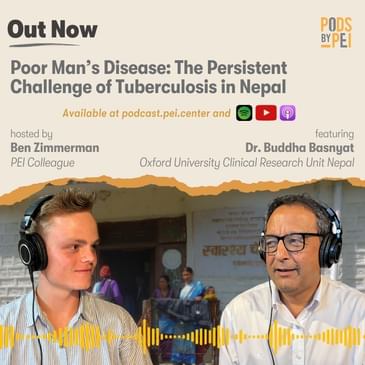
In this episode, Ben and Buddha discuss infectious diseases in Nepal, focusing on tuberculosis (TB). They highlight Nepal's epidemiological shift from to non-communicable diseases, while noting that TB continues to disproportionately affect poor and vulnerable populations, framing it as a “poor man’s disease” shaped by poverty. Despite effective, low-cost preventative therapies and lessons from past successes, TB persists due to limited funding, attention, and advocacy.
Dr Buddha Basnyat is a physician and clinical researcher. A leading expert in infectious diseases, high-altitude medicine, and antimicrobial resistance in Nepal, he has conducted landmark typhoid treatment trials and shaped national antibiotic guidelines. He co-founded Oxford University Clinical Research Unit Nepal and was recently honored with the (NHRC) Lifetime Achievement Award for Health Research in Nepal, recognizing his exceptional.
If you liked the episode, hear more from us through our free newsletter services, PEI Substack: Of Policies and Politics ( https://policyentre.substack.com/welcome ), and click here ( https://patreon.com/podsbypei ) to support us on Patreo
[00:00:06] - [Speaker 0]
Namaste and welcome to pause by BEI, a policy discussion podcast series brought to you by Policy Entrepreneurs Entrepreneurs Inc. Am Kushi Hung, and in today's episode, PI colleague Ben Zimmerman is in conversation with Doctor. Buddha Basnith on poor man's disease, the persistent challenge of tuberculosis in Nepal. Doctor. Buddha Basnith is physician and clinical researcher.
[00:00:29] - [Speaker 0]
A leading expert in infectious diseases, he has conducted landmark typhoid treatment trials and shaped national antibiotic guidelines. He co founded the Oxford University Clinical Research Unit Nepal and was recently honored with the NHRC Lifetime Achievement Award for Health Research. Ben and Buddha discuss infectious diseases focusing on tuberculosis. They highlight Nepal's shift from communicable to non communicable diseases while noting that TB continues to disproportionately affect the poor and vulnerable, framing it as a poor man's disease driven by poverty, overcrowding and nutrition. Despite effective low cost preventative therapies and lessons from past successes, TB persists due to limited funding, attention and advocacy.
[00:01:18] - [Speaker 0]
Like listening to pods? We'd love to hear your thoughts. So please subscribe on Spotify, Apple Podcasts, YouTube or wherever you listen to the show. You can also follow us on Twitter at tweet to PEI and on Facebook and Instagram at Policy Entrepreneurs Inc for updates on the latest episodes. We hope you enjoy the conversation.
[00:01:40] - [Speaker 1]
Doctor. Budha, welcome to Pods by PEI. We're talking about health care and disease today, which are quite broad topics, and it's sometimes hard to know where to start. In a minute, we'll get to the landscape of health care in Nepal, specifically focusing on infectious diseases and TB. But I wanna start by setting the scene.
[00:02:00] - [Speaker 1]
When we're thinking about health care and disease at a national level, what are some of the ways we measure mortality, disease, and health care?
[00:02:11] - [Speaker 2]
Well, in terms of mortality, which is very important, obviously, you can say, what's the disease burden, like, per hundred hundred thousand? That so that's one way of measuring mortality. That's how we measure burden of the disease. And besides mortality, what's the vaccination uptake in terms of prevention of diseases, health care? So that would be another measure.
[00:02:40] - [Speaker 2]
And in terms of curative care, a hospital, does it adopt like a minimum service standard? Do they do the things that are required, at least a passing grade? So those would be like for prevention, would be like vaccination, like uptake for treatment. Do they have what it takes?
[00:03:03] - [Speaker 1]
You mentioned mortality, and that's that's what I wanna stick on here for a moment. Specifically, at a national level, leading cause of death, essentially what's killing the the largest number of people. In the last thirty years, Nepal has seen a pretty significant shift in this indicator in what kills the greatest number of people. In 1990, two thirds of deaths were caused by CMNN diseases. That's communicable, maternal, neonatal, and nutritional diseases, and one third were caused by noncommunicable diseases, NCDs.
[00:03:36] - [Speaker 1]
When we get to 2015, that ratio is flipped. NCDs now make up two thirds of deaths, and CMNN diseases are only one third. That gap has grown since 2015 with the exception of the COVID years. Can you just give us a basic understanding of what caused this dramatic shift in the leading cause of death from communicable, essentially, to noncommunicable diseases over this period?
[00:04:01] - [Speaker 2]
What you have to understand is we have a double whammy situation. You know? So there's the noncommunicable diseases like coronary artery disease, stroke, diabetes have taken over. But it's not like the infectious diseases, the communicable diseases are sort of gone away. There's still a big, as you said, one third affecting millions of people in our part of the world.
[00:04:25] - [Speaker 2]
So it really is a double whammy situation. And to answer your question, well, the answer is obvious. There's dietary changes, lifestyle changes, you know, people are walking less, there's people are not eating the usual, you know, you know, their staple diet like wheat, and everyone's eating noodles. And the whole thing's flipped because of all of this. And as I mentioned, pollution, those are clear to see.
[00:04:51] - [Speaker 2]
But I think what needs to be appreciated is a double whammy in big numbers.
[00:04:57] - [Speaker 1]
It's interesting that you say that we'll get more into this a bit later. But the increase in non communicable diseases does not in any way mean that communicable diseases have gone away. Absolutely. But I understand that with this shift, policy, funding, and and health infrastructure have somewhat shifted their priorities to target what is now killing the greatest number of people, diabetes, heart disease.
[00:05:27] - [Speaker 2]
So these are, you know, in a sense, harder to tackle. You know, they're multipronged. So I gravitated towards this infectious disease like typhoid tuberculosis. It's something that you can treat, something that can be more easily tackled, if you will. Maybe I'm understating this, but but, you know, the whole thing about pollution, lifestyle changes, and this requires a lot of multipronged attack.
[00:05:53] - [Speaker 2]
Not that the infectious disease don't, but it's just, like, gone off the screen as it were.
[00:05:59] - [Speaker 1]
Yeah. Up until this point, we've talked about disease at a national level. And when we think about both health care and disease at a national level, I think it's sometimes easy to miss out the fact that the diseases that we're talking about do not affect all Nepalis the same way. There's significant disparity between rural and urban health care, the health care that high income versus low income people receive. When we think about these disparities, my inclination is first to focus on health care access.
[00:06:31] - [Speaker 1]
I think about, okay, are rural people getting access to health care? Is there a health post or hospital near them? Are poor people able to afford health care? But you brought up with me this concept of a quote unquote poor man's disease. And that challenged me to think about health care and disease one step before access.
[00:06:54] - [Speaker 1]
It's not just about accessing health care once you contract a disease, it's it's about whether you contract the disease to begin with, who's vulnerable to the disease. Ultimately, we're talking about mortality, and whether a disease kills you depends on two things. The first is whether you are exposed to the disease and contract it, and then only secondarily whether you can be treated for it. In its fullest sense, what does this concept of poor man's disease mean?
[00:07:21] - [Speaker 2]
So the concept of poor man's disease, and I'm going to hone in on these infectious diseases that are so common here, like typhoid fever. Okay? This is passed on or transmitted by what's called the fecal oral route. Basically, you're you're eating contaminated stuff, drinking contaminated with feces. So obviously, if you have good clean water, you're going to not suffer from this.
[00:07:47] - [Speaker 2]
So the vulnerable population is going to be the poor people. And similarly, with tuberculosis, I mean, it's overcrowding, you know, like where you're all living in one room and coughing. And obviously, if you're more affluent, you're going to have a room to yourself. And so this plays to this vulnerability. And this is also why these diseases don't get the attention that they require for us to try to get rid of these because it is a poor man's disease.
[00:08:22] - [Speaker 2]
It's the vulnerable population and it doesn't affect the Western world. And for the rich in the impoverished world, the rich suffered less from tuberculosis and typhoid. Two good examples of rampant diseases.
[00:08:41] - [Speaker 1]
You brought up tuberculosis, and I'm glad you did because that's the the quote unquote poor man's disease, which we're focusing on today. And it's the most deadly infectious disease in Nepal. You sort of began to get into both the national and global context of TB. Before we get into that, I want to quickly just touch on on what the disease is, what it's like to be infected with TB. Walk us through that journey.
[00:09:09] - [Speaker 1]
Me and you were sitting here having a conversation. I have TB. I've been infected with TB. Walk us through the journey. What happens to you?
[00:09:16] - [Speaker 2]
Because this is a respiratory illness, just like COVID nineteen, With this sustained coughing from you, I get the droplets and I will be infected. And maybe my immune system will fight against the infection, but maybe it will not. And this is a toss-up. It depends on nutrition. Like if I am well fed, I have a nutritious diet.
[00:09:43] - [Speaker 2]
So again, you see the vulnerable population will not have this nutritious diet. And so they're again going to be easy fodder for the bug. And that's it. Overcrowding, poor nutrition, the stage is set, and no attention. And the thing keeps going, perpetuating.
[00:10:05] - [Speaker 2]
I I wonder if you remember during COVID nineteen, something called contact tracing. You know? Just nothing like this. For a deadliest killer, for a while COVID nineteen took over, and now tuberculosis has taken over in terms of infectious disease in the world. You know, in countries like Nepal, India, Pakistan, Bangladesh, this hub for tuberculosis, there's hardly any contact tracing.
[00:10:33] - [Speaker 2]
The setup should be such that just like for COVID nineteen, we contact trace at least the household. Just like when if you have TB, then we should go around saying who has been already infected in that household and check things out. That doesn't happen. That doesn't happen.
[00:10:49] - [Speaker 1]
What I hear you touching on here, both in terms of an individual being contagious and also an individual's body fighting back against the disease and it not becoming deadly, is this distinction between latent and active TB. Can you can you explain the distinction between those two stages? Yes.
[00:11:09] - [Speaker 2]
Yes. Very good question. So the latent TB is when the TB bug remains dormant in me. It's alive, but my immune system is strong enough that it contains the infection. But over time, I may transform to an active disease.
[00:11:34] - [Speaker 2]
From that latent or dormant state, if you have a good protein diet, then you have antibodies in your system. Antibodies are like soldiers. They'll defend the body against against that latent TB burgeoning, like coming out. And if your antibodies are not there or very weak and you've got other illnesses like diabetes or you're taking cancer medicine. So this goes into other areas too.
[00:12:05] - [Speaker 2]
So nutrition is very important. It's clearly linked to the latent TB being active. And not even, I think if your nutrition is good, then you may not even have that latent infection. So the active disease is where the disease has taken over, like it's left the latency. And you need treatment.
[00:12:30] - [Speaker 2]
So the disease progressed, right? Just like you have HIV, you don't want the guy to get AIDS, you know, which is progression to a full disease. So HIV people take these preventive drugs so that HIV doesn't progress. So similarly, latent TB, there are effective drugs to prevent the progression to a full blown active TB. Then, you know, all bets are off.
[00:13:02] - [Speaker 2]
You've got to take medicines for six months, and, you know, chaos ensues.
[00:13:09] - [Speaker 1]
You touched on TB in the West, and and you've compared it HIV a couple of times. I'm specifically interested in the fact that to most people in the West, TB is a foreign disease. A lot of people don't know what it is. I'm interested why it's been eradicated in the West while in primarily lower income countries, they remain a hotbed for TB, and they remain the reason why the disease has not been globally eradicated yet.
[00:13:40] - [Speaker 2]
This is, again, clear cut, like, example of why this is economically related. Right? The Western world is richer, has dealt with this. In fact, when I when I talk about tuberculosis or TB, people think, oh, television, TB, TV, you know? Or sometimes in Britain, a lot of the very famous poets and writers died of tuberculosis.
[00:14:04] - [Speaker 2]
They wrote beautiful poems, and that's our operas, you know, people that that sing the beautiful operatic presentation and die coughing blood. You know, this is the sort of thing. It's all in the past. Right? And and that's their memory.
[00:14:20] - [Speaker 2]
And so, you know, if if you don't see something, you're obviously not going to remember it, and it's all in the back somewhere in your memory. But also, in 02/2018, I read in The New York Times about how TB can be conquered in poor countries. It was an invited editorial. I said, well, how do these guys know about, you know? And they mentioned a guy, a famous epidemiologist by the name of George Comstock.
[00:14:51] - [Speaker 2]
And George Comstock worked in Bethel, Alaska in the 1950s. He's a clinician epidemiologist from Johns Hopkins. The drugs for the disease had just come out, and he was able to bring down the mortality rate of tuberculosis in Bethel, Alaska. He brought it down with proper treatment. And because he was an epidemiologist, he said, Oh, why hasn't this hit?
[00:15:19] - [Speaker 2]
I'm treating everyone with TB rock bottom, you know, like there should be no deaths. And he said, Maybe there is an infection that has not progressed to the disease. Why don't we just treat them with one of these drugs and try to shut out the infection? And lo and behold, he actually treated latent TB and was one of the first guys to do this and got rid of TB to a large extent in this Inuit population. Why aren't we doing this, I thought to myself?
[00:15:51] - [Speaker 2]
Why isn't this being taken up? And the reason is clear. Even in the face of WHO, the all the world, the union, TB, everyone is saying do it. Treat latent TB, but it's not being done because there is no funding. There's no funding.
[00:16:11] - [Speaker 2]
So this is the deadliest infectious disease in the world. It's like an old ghost that's been around for such a long time that we tend to dismiss this. And it just doesn't get the play that it requires. And, also, because it's a poor man's disease, there are no activists. There's HIV.
[00:16:33] - [Speaker 2]
Why is it under greater control? It's because there were Hollywood actors that were activists. You can you know, here, you have a poor man who is trying to maybe be an activist. It's son, this is not gonna cut it.
[00:16:48] - [Speaker 1]
I'm glad that you brought up sort of the the extensive history of studying TB, of looking at TB, looking at what works. I wanna read off a couple global figures that were pretty striking to me. In 2023, TB caused one point two five million deaths. The WHO estimated that one quarter of the global population, that's two billion people, billion with a b, are currently infected with TB. We've studied TB for a while.
[00:17:21] - [Speaker 1]
The WHO and other global health experts have attempted to bring about extensive public health campaigns to hopefully in the long term eradicate the disease or at least bring it under sustained control for the time being. Why have they been unable to get the funding for these public health campaigns to really be as effective as they should be?
[00:17:44] - [Speaker 2]
So this is a lot of money. And so, although it's easy for me to say, it's a lot of funding, millions, easily. But the thing is that the process has not even started, and and these big organizations like the Gates Foundation or the Wellcome Trust have not invested in treatment of latent TB, which is a right now solution that was applied in Alaska in the nineteen fifties. They're working on a vaccine, which is very important. This needed to have been done.
[00:18:17] - [Speaker 2]
But the vaccine is going to cost over a billion dollars, with a b. And so they're working on it. We don't know when the results will come out. From what I can understand, the vaccine that they're studying is only fifty percent effective. If you look at the data, the latent TB treatment is ninety percent effective.
[00:18:37] - [Speaker 2]
And you know what? Just to add to all this I mentioned about it's a poor man's disease. It's no funding. It's also not a sexy disease. This is like it's not we're not looking at some inflammatory markers and some sophisticated something.
[00:18:52] - [Speaker 2]
I mean, this has been around so long. It's no longer appealing. It doesn't have the attraction that other diseases have. But it keeps killing.
[00:19:05] - [Speaker 1]
A sexy disease like like you might call COVID nineteen a sexy disease.
[00:19:08] - [Speaker 2]
Well, I mean, it affected the Western world too. You know? See, this is a great distinction. And vaccine, mRNA, that we lucked out with that, by the way. So it's all very good.
[00:19:20] - [Speaker 2]
But this is what I want to starkly portray, if you will. I hope we get some good, you know, results from the vaccine. But it is an unsexy disease, and I think it's gone beyond one more article in the New England Journal that will swing things. It's not gonna happen that way. I think we need a philanthropist.
[00:19:40] - [Speaker 2]
Some guy to step up to the plate and say, yeah, I think this makes a lot of sense looking at the literature. I told you about Comstock. There have been study after study after study that have proven this point. I mean, people can write all this stuff from Geneva. You know, they do a good job, but it needs to be translated in the ground.
[00:20:02] - [Speaker 1]
We'll talk about what it looks like on the ground here in Nepal. Let's talk about what they're writing in Geneva for now. In 2015, the WHO produced its end TB strategy. I'm interested in what its goals were in producing that strategy and how it envisioned the future, the coming twenty years from 2015 on, of dealing with TB.
[00:20:25] - [Speaker 2]
So one of the things that when we talk about WHO and TB is we have to talk about something called DOTS, d o t s. I think it's directly observed therapy. Right? So the guy is actually taking the medicine in front of you at the health post. When this came out, they put all their eggs in one basket.
[00:20:46] - [Speaker 2]
It did help, but it wasn't enough because they were doing nothing about contact tracing. So you treat the guy who's got the disease, but he's already infected a whole bunch of other people in his house, in his workplace. And that just got no attention until recently, like fifteen, twenty years ago. So so WHO now is again saying contact tracing is important, that DOTS alone will not do it, and they've also put a lot of store buy latent TB treatment. But you see, to figure out who in that household has latent TB, you've got to rule out active TB.
[00:21:25] - [Speaker 2]
So that means you're doing contact tracing. Before I give latent TB treatment, I have to make 100% sure that you don't have that active, full blown TB, because this would be counterproductive. I have to make sure that your chest X-ray is clear, that this simple Mantou test, and if you're positive on that test, and your chest X-ray is clear, but your Mantou test is over 10, that's where you qualify treatment. If your X-ray is riddled with opacities or marks, and you should not get treatments, you have to follow some rules, but this has been done. There are a lot of pilot studies, studies in Nepal, in India, that have shown that this is doable, except we need to scale it up.
[00:22:10] - [Speaker 2]
And with USAID cut, this has become a problem, I think, in places in India where this was going on.
[00:22:17] - [Speaker 1]
Let's focus in on Nepal as you just mentioned there. One of the points you made early on is that many people, even doctors here, aren't aware of the fact that TB is still an issue. In the lead up to this episode, I asked a few friends, how many people do you think die of of TB every day or or every week in Nepal? A number of them said, you know, maybe one or two a day, something like that. These were friends who went to school in the nineties.
[00:22:44] - [Speaker 1]
So they said, know, in the nineties, we heard a lot about it in the news. Health officials would come to our schools and tell us about it. We don't hear much about it anymore. They were pretty surprised when I told them, it's not one a day. It's one person every half hour.
[00:22:58] - [Speaker 1]
So that's 16,000 people a year. That's a pretty staggering figure. Before we get into why that number is still so high, can you tell us a little bit about the improvements that Nepal has made?
[00:23:15] - [Speaker 2]
A lot of people are eating better diet. You know? I I know in the beginning, I said they're eating a lot of noodles, but they're also eating more meat, eggs. So that's definitely helping. The medicines, once you get TB, the Nepali government gives free treatment, so that obviously helps.
[00:23:34] - [Speaker 2]
So I think economically, like all over the world, in Nepal too, there's been economical progress, which tracks, you know, if you make economic progress, then TB goes down. And so I think that's clearly one of the reasons. But still, it's still killing a lot. Know, it's, again, it's this vulnerable population. And we're not doing anything about active case finding.
[00:24:02] - [Speaker 2]
So although we're treating the people with full blown TB, why don't we turn the tap off, turn the latent TB off?
[00:24:11] - [Speaker 1]
You've brought up preventative therapy a couple times, and that's really the focus of this discussion, the focus of of eradicating TB, this poor man's disease. You have an article in the British Medical Journal entitled Prevent TB to End TB. The title makes it sound pretty straightforward, and I think that's that's the point you're trying to make both in this conversation and in that article. You've touched on it a little bit. Can you walk us through how preventative therapy works and why it's the most effective way of dealing with TB to date?
[00:24:48] - [Speaker 2]
Yeah. Very good question. So we don't have a vaccine. So they're working on a vaccine, but we're not sure what the results will be. This is, again, a poor man's disease.
[00:24:59] - [Speaker 2]
These pharmaceutical companies are not going to be very interested, even though it may be very effective. So someone has to step in. I think that this preventive therapy, which is latent TB treatment, has been transformed. This is no longer what what George Comstock did in Bethel, Alaska, one drug for six months every day. They've refined it.
[00:25:24] - [Speaker 2]
See? And so we're not taking advantage of this refinement that someone like Richard Chason from Johns Hopkins again, around twenty fourteen, fifteen, I forget exactly when, did this beautiful study where he showed that if you take two drugs called rifapentine and isoniazid only once a week for three months, So a total of 12 dosages. Okay? Study after study using this particular regimen, as it is called, three h b, taking two of these drugs for three months, only once a week, brought down the progression. So this is not being taken advantage of or, you know, to the fullest extent.
[00:26:07] - [Speaker 2]
And this is, like, 90% effective. You know? And the most important thing, the whole regimen for one guy costs less than $10 and local drug companies, local meaning in India, Lupin and MacLeod, they supply these drugs. India does a lot of this, like, generic drugs and and useful for lots of people who cannot afford the full price. And a lot of people don't know, so it's lack of awareness.
[00:26:38] - [Speaker 2]
Just like you said, not just your friends, even these doctors. You know, forget the doctors in the West. I mean, they do not know about TB being the biggest infection because it doesn't enter their practice. Even doctors here who see TB every day are dumbfounded many times when they hear that it is, like, the biggest killer because you just get used to it.
[00:27:03] - [Speaker 1]
So this regimen this latest regimen of preventative therapy that you're mentioning, so that's two drugs once a week for three months, $10 for each dose. So that's
[00:27:17] - [Speaker 2]
$10 for the the whole thing.
[00:27:21] - [Speaker 1]
For the whole for the whole three months. So maybe we're thinking a thousand, 1,300 rupees for people in Nepal. That's there you've mentioned the cost of it. What about access to the drugs? What on a practical level, how accessible are these drugs to people in Nepal?
[00:27:37] - [Speaker 1]
Specifically, I'm thinking about people in in rural Nepal who might not be too close to a hospital or a health post or a pharmacy.
[00:27:45] - [Speaker 2]
So this cannot be something like I'm a poor guy living in a village. I can't go and access this. I don't think it's gonna work that way. I think this should be like a vaccination plan. It needs to be like a drive, and it needs to be concerted effort by the government.
[00:28:02] - [Speaker 2]
The government is willing to do this, but the government, including WHO that says do this, they don't have the money. We need access to funds, and I don't think it's more research that is required. We need to get the job done. Someone needs to step in or some people need to step in who have the box and have the heart and the willingness and awareness has to be built. Study after study has shown this.
[00:28:30] - [Speaker 2]
You know? Like, look. Do this. So I I think doing one more study will be just one guy's PhD. You know?
[00:28:36] - [Speaker 2]
But how many more do we need?
[00:28:40] - [Speaker 1]
So I understand that that when you talk about funding and and funding being sort of an obstacle to extensive rollout, that's not just funding for the drugs itself. That's not just $10 for that regimen. Part of the preventative therapy is the contact tracing, as you mentioned, detection as well.
[00:28:58] - [Speaker 2]
So we've done this. You know, like, there are there is Britain, Nepal, sometimes called Birat, Nepal Medical Trust. We had some funding. It's called BNMT. And we did a pilot study.
[00:29:12] - [Speaker 2]
And amazingly so these are people that we we did contact tracing, okay, in in in Chitwan and Putan. And we did this, what I just told you, this three HP. What I was surprised about, Ben, what we were surprised about, all the people at BMT doing this, excellent workers, you know, was that the willingness of the people who are just contacts, right, and tested positive, they don't have the disease. So there was all this human cry about, oh, no one will take this drug, you know, if you're well. But they had such fresh memory of their father dying or their wife or their son coughing up blood that it's it's just raw, you know?
[00:29:58] - [Speaker 2]
They said, yes. They subscribed to this. We didn't have to, like, try to convince them. Even though the administrators of the drugs, the guys we employed, they wanted to take the drug. So it went wild.
[00:30:10] - [Speaker 2]
I mean and here, we thought that there would be a lot of resistance, but this is the way out. So we were pleasantly surprised. This is like I said 95% uptake. So this is why we said we need to scale this up. This gave us confidence.
[00:30:25] - [Speaker 2]
So the whole thing is that the drug is one part of the whole infrastructure. Right? So you've got to have people go to people's homes, then get a chest X-ray done. Right? So that chest X-ray part, so if you if you suspect TB, the government will pay for this.
[00:30:41] - [Speaker 2]
But then there are those that will have no problems on the x-ray, which is the group that we want have a positive skin test. Right? So we give them the drugs, and then they need follow-up for three for three months. We need to make sure they're taking the drugs. So it's just not the drugs.
[00:30:59] - [Speaker 2]
This is a whole system set up, which there is a template for, which we have done and feel confident enough that this can be scaled up in many more districts of Nepal, where all you know, where TB is rampant.
[00:31:15] - [Speaker 1]
I'm interested in in what you mentioned, sort of how willing people were to take these preventative drugs. And when you mention the importance of attention, of people knowing about this disease, one component of that, as you've mentioned, is sort of the the philanthropic side of finding somebody to really promote this and really get the funding that's needed, both in Nepal and globally, to roll out preventative therapy, to find a vaccine. The other component of it is of sort of attention of people knowing about the disease is vulnerable communities themselves being aware of the disease and the danger it is. You you mentioned the the people you're conducting the study with. They sort of had these images of of their their mother coughing up blood and dying.
[00:32:02] - [Speaker 1]
So talk about that side of attention and exposure about the disease, not just people who might fund preventative therapy, but vulnerable communities themselves knowing about the disease and knowing about the danger it is to them.
[00:32:18] - [Speaker 2]
Yeah. So the vulnerable community knows about this disease. In fact, it has a stigma. Right? Like, they're on they'd say, oh, the guy has TB, or the guy has leprosy.
[00:32:27] - [Speaker 2]
The stigma of the disease is there. So people don't wanna talk about this. But it's rampant. But they are aware, and they are aware to the extent that if you offer them like we offered them latent TB treatment, there was no backing off. There was really no resistance.
[00:32:45] - [Speaker 2]
I mean, we're in the hub of TB. Right? So people understand this. It's like, you know, in The United States, are a lot of anti vaxxers in the West because people have forgotten what diphtheria is and what measles is. Here, we're seeing this every day.
[00:33:00] - [Speaker 2]
We know what it is. Everyone has someone that was afflicted by TB or died. So there is that awareness to a great extent. But this has not been because, again, I'm sorry, I'm going back. You know, it's just poor person's disease.
[00:33:15] - [Speaker 2]
This has not been able to garner the funds, you know, where and so they're trying to make a vaccine. It's great. But there is this this readily available solution that's sort of being left aside.
[00:33:29] - [Speaker 1]
You brought this back to to poor man's diseases where we started. And that's how I wanna conclude. TB is the most deadly infectious agent in Nepal, but it's just one of a number of of infectious diseases, you mentioned typhoid, disproportionately affecting poor Nepalis, both in death toll and mortality, and the burden it has on their livelihood, the time it takes away from making money to support a family. What does preventative therapy in both the opportunity it presents and the challenges holding it up, specifically funding, have to teach us about providing underprivileged communities equal access to health care and ultimately an equal chance at life?
[00:34:15] - [Speaker 2]
Yeah. I mean, you know, I think your question is the answer too. It's just a reflection of how we, you know, deal with problems. I mean, if it gets attention, you know, like COVID nineteen did, it affects a lot of people all over the world. It will find a solution.
[00:34:33] - [Speaker 2]
But even something as as rampant as TB, because it is focused on the vulnerable population, it's hard to find a solution. The guys that have it just don't are not the people that will attract attention, and there isn't anyone speaking on their behalf. Although I have to I want to end this by saying I've read a book recently called Everything is Tuberculosis by John Green. So this is the first time I saw an American guy who who's, like, bringing this up and really talking about it. His experience in Sierra Leone, I think is great.
[00:35:08] - [Speaker 2]
I really think that will help focus attention on this poor man's disease.
[00:35:16] - [Speaker 1]
Well, the work you're doing and and the time you've taken to to come speak to me on this podcast is part of that movement to allow more people to know about TB and and the persisting threat it is specifically to vulnerable communities in Nepal. So thank you for the work you're doing. Thank you for the time you've taken to speak with me today.
[00:35:34] - [Speaker 0]
Thanks for listening to Pods by PEI. I hope you enjoyed Ben's conversation with Doctor. Butta on poor man's disease, the persistent challenge of tuberculosis in Nepal. Today's episode was produced by me, Kushi Hang, with support from Nirjuna Dai. This episode was recorded at PEI studio and our theme music is courtesy of Rohit from Zindabad.
[00:35:56] - [Speaker 0]
If you liked today's episode, please subscribe to our podcast. Also, please do us a favor by sharing us on social media and leaving a review on Spotify, Apple Podcasts, YouTube, or wherever you listen to show. For PEI's video related content, please search for policy entrepreneurs on YouTube. To catch the latest from us on Nepal's policy and politics, please follow us on Twitter tweet2pei, that's T W E E T followed by the number two and PEI, and on Facebook at Policy Entrepreneurs Inc. You can also visit pei.center to learn more about us.
[00:36:30] - [Speaker 0]
Thanks once again from me, Kushi. We will see you soon in our next episode.